

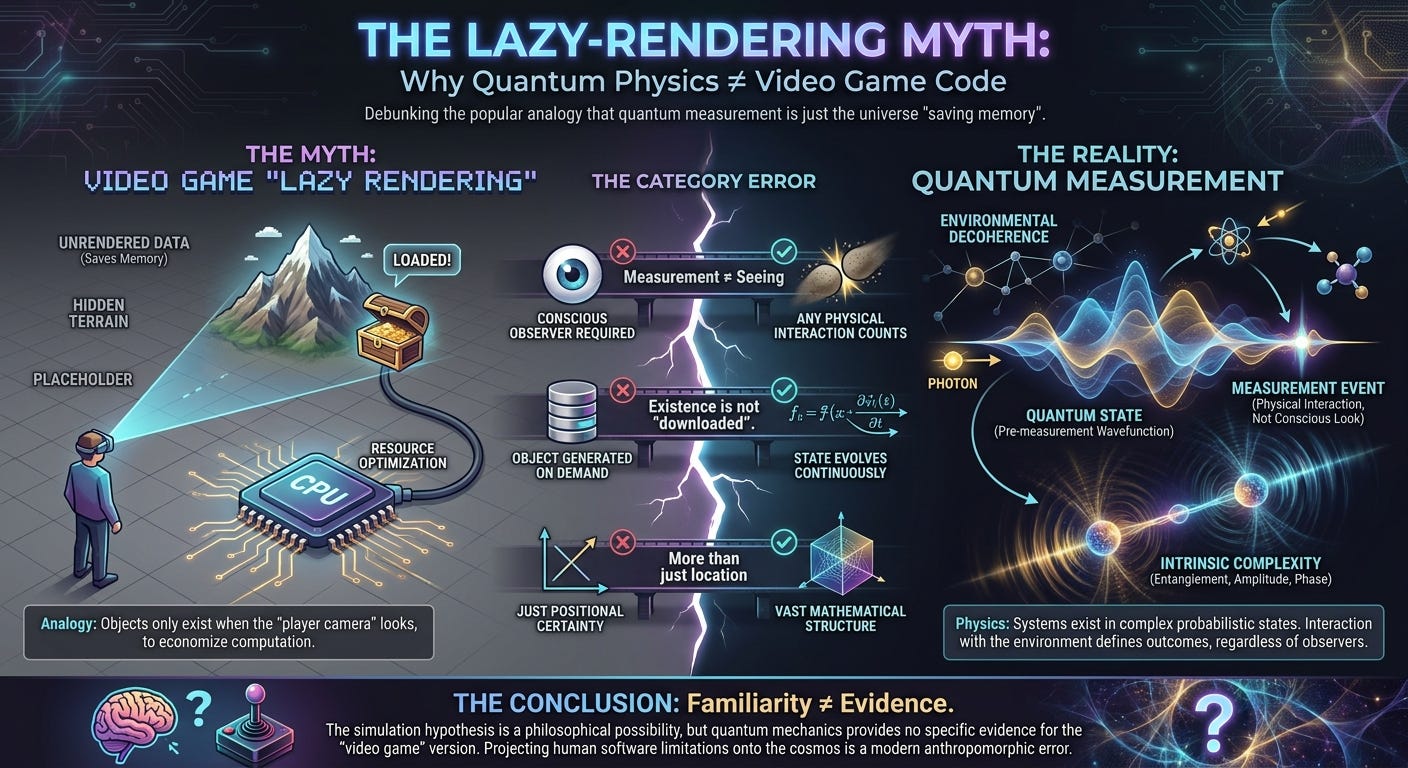
Elon Musk recently described quantum mechanics as “consistent with the simulation hypothesis,” comparing quantum measurement to a video game that generates objects only when they are observed.
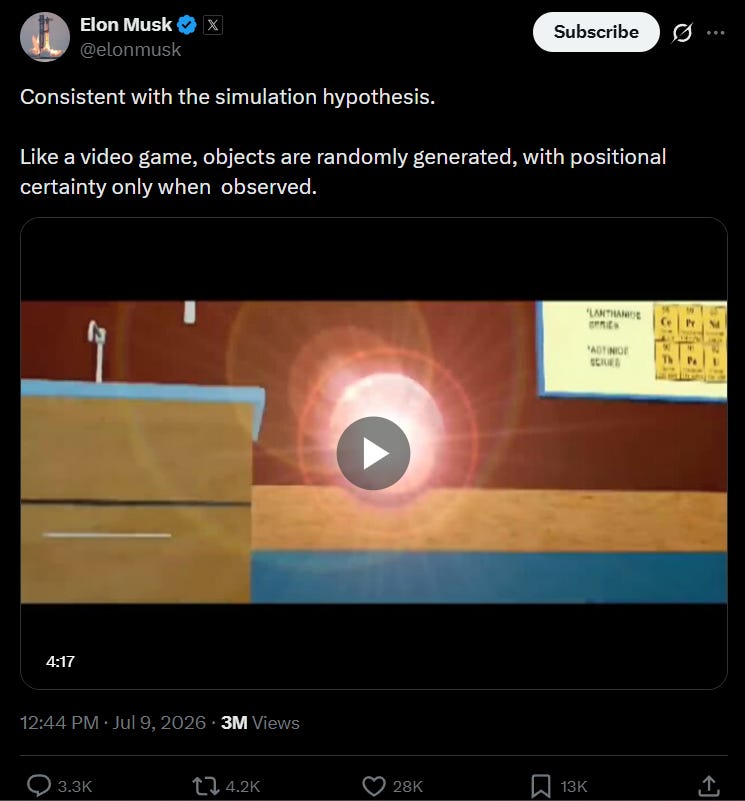
The analogy has immediate intuitive appeal. Games often avoid computing distant terrain, hidden rooms, or unseen objects until a player approaches. Quantum systems likewise appear to lack definite values for some properties until a measurement occurs. Perhaps the universe economizes on computation by rendering reality only when someone looks.
Almost every part of that comparison misrepresents the physics.
Quantum measurement does not mean conscious inspection. Quantum states do not sit idle until reality needs to manufacture an answer. Position has no special status resembling an object’s location in a game engine. The simulation hypothesis also predicts no particular quantum behavior unless someone supplies a detailed model of the supposed simulation.
The analogy feels explanatory because it replaces unfamiliar physics with familiar software engineering. Familiarity carries no evidential weight.
The Universe Has No Player Camera
The lazy-rendering comparison begins with the word “observed.” In ordinary language, an observation involves a person looking at something. In quantum theory, a measurement is a physical interaction that correlates a system with an apparatus or environment in a way that can support a stable record.
A photon scatters from an atom. A detector absorbs an electron. A molecule collides with another molecule. A dust grain becomes entangled with the light passing around it. These processes occur whether or not a human notices them.
Macroscopic objects constantly interact with their environments. Air molecules strike them. Thermal photons leave them. Ambient light scatters from them. These interactions rapidly distribute information about position, momentum, orientation, and other properties across the surrounding environment. The process known as decoherence suppresses observable interference between macroscopically distinct alternatives.
Nothing waits for a conscious observer. A game engine has a camera because it serves a player. The engine calculates what must be displayed on a screen and ignores details that cannot affect the player’s current experience. Quantum mechanics contains no analogous screen, camera, or privileged observer. It describes interactions among physical systems.
The analogy imports the most important element from video games—the player—and quietly leaves it undefined. Who counts as the player? A person? A bacterium? A photodetector? A rock struck by sunlight? Any interaction capable of leaving a record?
Once observation is understood physically, the metaphor loses its intended shape. Reality looks less like a scene rendered for a viewer and more like a network of systems continuously becoming correlated with one another.
Measurement Does Not Generate the Object
Procedural generation in a video game creates data that was previously absent from the game state. A distant planet may have no detailed terrain until a player travels there. The engine then constructs mountains, rivers, settlements, and textures according to an algorithm.
Quantum theory describes a different process. A quantum system has a state before measurement, and that state evolves according to precise mathematical rules. It may encode a range of possible measurement outcomes, along with amplitudes that determine their statistical structure. Measurement changes the relation between the measured system, the apparatus, and the surrounding environment.
Interpretations disagree about the ontology of this process. Collapse theories say that one outcome becomes actual through a physical stochastic event. Everettian quantum mechanics describes measurement as branching correlations within a continuously evolving universal wavefunction. Bohmian mechanics supplements the wavefunction with definite particle configurations. Relational and epistemic interpretations give still other accounts.
Across these interpretations, the system exists before anyone requests its coordinates.
The measured value also cannot be treated as a missing database field populated on demand. Quantum measurement is contextual. The outcome depends on the observable being measured and the experimental arrangement used to measure it. Different observables can be incompatible, represented mathematically by noncommuting operators. Asking for a position is a different physical intervention from asking for momentum or spin along another axis.
A game object normally has a complete internal state whether or not every property has been rendered to the display. Quantum theory does not describe measurement as revealing arbitrary components of such a hidden classical record. Bell experiments and contextuality results place severe constraints on any attempt to explain quantum predictions through pre-existing local values.
The database analogy fails alongside the rendering analogy.
Position Is a Distraction
The tweet singles out “positional certainty,” which makes the phenomenon sound like graphical optimization. Games decide where objects are placed. Quantum mechanics supposedly decides where particles are placed. The resemblance is mostly verbal.
Quantum theory concerns far more than uncertain position. It includes interference, entanglement, contextuality, nonlocal correlations, quantized energy levels, spin, phase, amplitude, and the algebra of observables. Any proposed computational analogy must account for that mathematical structure.
Lazy rendering does not explain why alternatives interfere, why entangled measurements violate Bell inequalities while preserving no-signalling, or why probabilities follow the squared magnitude of complex amplitudes. These are central structural features of quantum theory, not incidental signs that some details remain uncomputed.
“Because the simulator saves processing power” derives no part of the formalism, predicts no new result, and identifies no implementation constraint. It merely attaches a familiar engineering motive to an unfamiliar physical theory.
The analogy also misstates what certainty means. Quantum mechanics rarely grants unlimited positional certainty. Greater localization in position entails a broader distribution in momentum. An exact position eigenstate is an idealization with pathological physical consequences, including unbounded momentum uncertainty. Real measurements have finite resolution.
Reality does not alternate between an absent object and a perfectly rendered object. Quantum states support structured distributions whose evolution and measurement obey exact quantitative laws.
Simulation Does Not Imply Optimization
Suppose the universe is simulated. What follows about its physics?
Almost nothing.
A simulator could evolve every degree of freedom continuously. It could use a cellular automaton, a tensor network, a path integral, a global constraint solver, an analogue substrate, or a computational architecture beyond anything humans have conceived. It could simulate only coarse-grained histories. It could compute all branches. It could generate entire spacetime blocks at once. It could possess resources so vast that optimization would be unnecessary.
The video-game comparison selects one narrow implementation strategy from present-day human software and projects it onto hypothetical universe-builders.
This projection carries several hidden assumptions. The simulators face scarce computational resources. Their resource constraints resemble ours. Rendering is their dominant cost. Observers deserve preferential allocation. Quantum measurement reflects that allocation strategy. The resulting optimization happens to generate the complete formal structure of quantum mechanics.
No evidence supports any link in this chain.
Even human games do not generally create objects when they are observed. They use many techniques: level-of-detail scaling, culling, streaming, deterministic procedural generation, cached state, server authority, collision meshes, probabilistic spawning, and precomputed assets. “Rendered when observed” compresses several distinct engineering processes into a cartoon.
Using that cartoon to infer the architecture of the universe compounds the simplification.
Information Is Not Simulation
Quantum theory has deep connections to information. Quantum states constrain what can be known, copied, transmitted, and reconstructed. Black-hole thermodynamics and holographic dualities relate geometry to information in surprising ways. Some physicists have even proposed that physical evolution should be understood as computation.
These ideas do not imply an external simulator.
Information-theoretic quantities describe constraints on physical states, transformations, and correlations. Computation can be understood as a physical process performed by those systems. A simulation adds a further claim: the system we observe is implemented by some external substrate whose states represent ours.
That additional layer does no explanatory work unless it produces additional predictions.
Wheeler’s “it from bit” does not mean “it from someone else’s computer.” The holographic principle does not turn three-dimensional reality into a projected image. A computational universe need not have a programmer, a display, or a rendering budget.
Conflating informational physics, physical computation, and external simulation gives the simulation hypothesis borrowed scientific prestige while discarding the distinctions that make the underlying physics meaningful.
A universe may be fundamentally informational without being artificial. It may implement computation without having been programmed. It may admit a lower-dimensional description without being projected from a screen.
The connection between physics and information is substantive. The connection between that research and video-game rendering is rhetorical.
Compatibility Carries Little Evidential Weight
Quantum mechanics is compatible with the simulation hypothesis in the same weak sense that Newtonian mechanics, general relativity, cellular automata, and a universe made of clockwork could all be simulated.
A sufficiently capable computer could implement almost any internally coherent set of physical laws. Once simulation is defined that broadly, every possible observation becomes compatible with it.
Compatibility alone provides little evidence.
To support a hypothesis, an observation must be more expected under that hypothesis than under relevant alternatives. A specific simulation model might satisfy that requirement. It could predict discretization artifacts, finite precision, anisotropies tied to an underlying lattice, computational resource ceilings, reproducible update errors, information-loss boundaries, or deviations from known symmetries.
Those predictions would expose the model to failure. Experiments could distinguish it from ordinary physical theories.
The vague simulation hypothesis makes no such commitment. Whatever physics discovers can be described afterward as the simulator’s chosen rule set. Continuous spacetime? The simulator used continuous variables. Discrete spacetime? The simulator used a lattice. Deterministic laws? The simulator evolved them deterministically. Quantum randomness? The simulator sampled outcomes or branched. Hidden variables? The simulator tracked hidden state.
A hypothesis flexible enough to absorb every result gains no special support from any result.
Saying that quantum mechanics is “consistent with” simulation therefore establishes almost nothing. Quantum mechanics is also consistent with physical reality simply having quantum structure. Adding an invisible simulator leaves the empirical predictions unchanged.
The Analogy Relocates the Mystery
The simulation story can feel satisfying because it gives quantum strangeness a purpose. The universe behaves this way to conserve computation.
That explanation immediately creates new questions. Why does the simulator face those resource constraints? Why does it use quantum amplitudes? Why does it preserve unitarity? Why do interactions produce decoherence? Why does the Born rule govern observed frequencies? Why is no-signalling maintained? Why does the optimization remain mathematically uniform across the observable universe?
The original physics still requires explanation. The simulation story adds an external machine whose rules and constraints also require explanation.
This does not show that simulation is impossible. Metaphysical possibilities often remain open when empirical evidence is absent. Our universe could be simulated, created, mathematically instantiated, or embedded in some larger structure. Quantum measurement supplies no distinctive support for the video-game version of that possibility.
Everett Makes the Comparison Especially Awkward
Under Everettian quantum mechanics, the universal wavefunction evolves continuously and deterministically. Measurement entangles an observer with different outcome branches. Each resulting observer state records a definite outcome relative to its branch.
No central renderer selects an outcome. No physical system waits to be generated when a mind looks. The universal state already contains the structure from which branch-relative experiences emerge.
Decoherence explains why those branches cease to interfere at macroscopic scales. The observer becomes part of the physical process rather than occupying a privileged position outside it.
The game analogy therefore resembles a crude popular caricature of Copenhagen more than it resembles quantum mechanics in general. It treats measurement as a request from a user, collapse as object generation, and the measured world as a display surface.
Those additions come from the metaphor. The equations do not contain them.
Postscript
Human beings routinely interpret unfamiliar natural processes through the technologies of their era. The brain has been compared to hydraulic machinery, a telegraph network, a telephone exchange, a digital computer, and a prediction engine. The universe has been compared to clockwork, steam machinery, a computer, a hologram, and now a video game.
These comparisons can aid intuition. They become dangerous when borrowed structure is mistaken for discovered structure.
Quantum mechanics challenges classical intuitions developed through interaction with medium-sized objects at low speeds. Its strangeness tells us that those intuitions have a limited domain. It does not tell us that reality is artificial.
The simulation hypothesis remains a philosophical possibility. Turning it into a scientific hypothesis would require a model with identifiable mechanisms, quantitative predictions, and conceivable falsifiers. Until then, “the universe renders objects when observed” is software folklore attached to a misunderstanding of measurement, and quantum mechanics is strange enough without pretending it runs on Unreal Engine.