


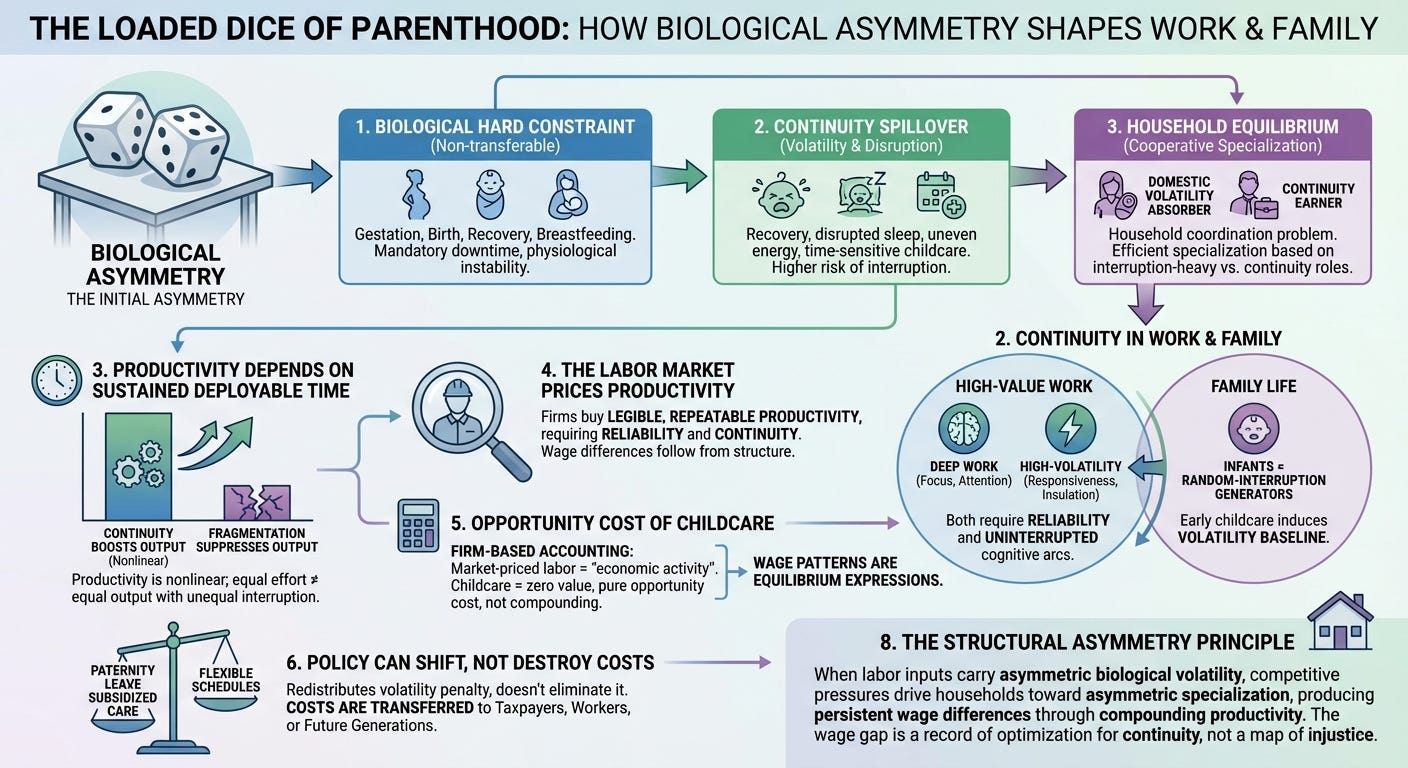
Human labor markets do not begin from a neutral baseline. They rest on an asymmetric biological foundation: one sex absorbs the non‑delegable physiological costs of gestation, childbirth, postpartum recovery, and early breastfeeding. These events do not predetermine years of childcare, but they do impose an early volatility penalty—a structural disturbance that affects continuity, availability, and productivity at precisely the stage when careers typically begin compounding.
What follows is not biological determinism but economic path dependence: biology creates the initial asymmetry; markets magnify it; households stabilize it.
1. From Hard Constraints to Soft Equilibria
A clean analysis distinguishes three interacting layers.
Layer 1 — The Biological Hard Constraint
Gestation, childbirth, recovery, and early breastfeeding are not transferable. They impose mandatory downtime and physiological instability.
Layer 2 — The Continuity Spillover
This downtime generates a secondary pattern of volatility. Recovery, follow‑ups, disrupted sleep, uneven energy, and a higher baseline risk of interruption create a disruptive rhythm. Early childcare—time‑sensitive, unpredictable, and physically coupled to the mother’s initial role—extends this volatility beyond the biological window.
Layer 3 — The Household Equilibrium
Once early childcare begins, households face a coordination problem: who protects their wage continuity, and who absorbs domestic volatility? The partner already in the interruption-heavy role continues in it; the other becomes the continuity earner. The result is not imposed by nature but encouraged by it—a dice‑loaded equilibrium shaped by efficiency rather than ideology.
2. Continuity of Focus and Continuity of Availability
High‑value work takes two primary forms. Deep‑work roles—coding, law, research, design—depend on uninterrupted cognitive arcs and stable attention. High‑volatility roles—medicine, crisis response, executive leadership, sales—depend on rapid responsiveness and insulation from domestic entropy.
These domains appear distinct, yet both place a premium on reliability. Infants, however cherished, function as random‑interrupt generators. Because mothers begin parenthood with a biologically induced volatility baseline, continuity asymmetry arises from performance structure rather than prejudice.
3. Productivity Depends on Sustained Deployable Time
Complex work relies on deployable state: cognitive readiness, stable time, focused attention, predictable energy, and low interruption variance. Pregnancy and early childcare degrade these conditions. Because productivity is nonlinear—continuity boosts output while fragmentation suppresses it—equal total effort cannot compensate for unequal interruption patterns.
4. The Labor Market Prices Productivity, Not Intention
Firms do not buy sincerity; they buy legible, repeatable productivity. Productivity requires reliability, reliability requires continuity, and continuity requires uninterrupted deployable time. Biological asymmetry alters deployable time, and competitive markets price that asymmetry. Wage differences follow from structure, not animus.
5. The Opportunity Cost of Childcare Under Wage Accounting
Under firm‑based accounting conventions, only market‑priced labor counts as “economic activity,” which assigns domestic labor a value of zero. Childcare therefore appears as a pure opportunity cost: every hour spent on infant care is an hour not compounding market-valued human capital. Because early childcare disproportionately falls on women due to Layer 1 and Layer 2, continuity differences emerge and compound. The resulting wage patterns are equilibrium expressions of asymmetric volatility.
6. Policy Can Shift the Equilibrium, But Not the Cost
Societies can apply non‑coercive equilibrium nudges—paternity leave, subsidized childcare, flexible scheduling, norm shifts toward shared responsibility, technologies that reduce interruption cost. These interventions adjust the social equilibrium without altering the biological foundation. They redistribute the volatility penalty rather than eliminating it.
Economic costs cannot be destroyed; they can only be transferred.
Who Pays for Subsidized Childcare?
All subsidy regimes shift costs from non‑users to users.
Taxpayer-funded models transfer the burden to the general population.
Employer-funded models transfer it to workers through lower wages or reduced hiring capacity.
Debt-funded models transfer it to future taxpayers.
Real programs blend these channels; none escape the arithmetic. Such nudges can redistribute volatility, but the premium labor markets place on reliability remains. Unless society decouples uninterrupted effort from economic value—a move that would flatten the high‑performance economy—these asymmetries can be softened but not erased.
7. Voluntary Asymmetry Is Not Injustice
Perfect rationality is unnecessary. Simple incentives suffice. Early childcare, rooted in biological starting conditions, exposes mothers to higher volatility. This nudges them toward continued childcare while the less‑interrupted partner specializes in wage labor. This is cooperative specialization under asymmetric constraints, not oppression. Enforced symmetry misidentifies difference as harm and voluntary specialization as subjugation.
8. The Structural Asymmetry Principle
The dynamics reduce to a single principle:
When labor inputs carry asymmetric biological volatility, competitive pressures drive households toward asymmetric specialization. This specialization produces persistent wage differences through compounding productivity.
The wage gap is not primarily a measure of discrimination but a record of how households optimize for continuity in a biologically asymmetric world—a trace of starting conditions expressed through free choices, not a map of injustice.