

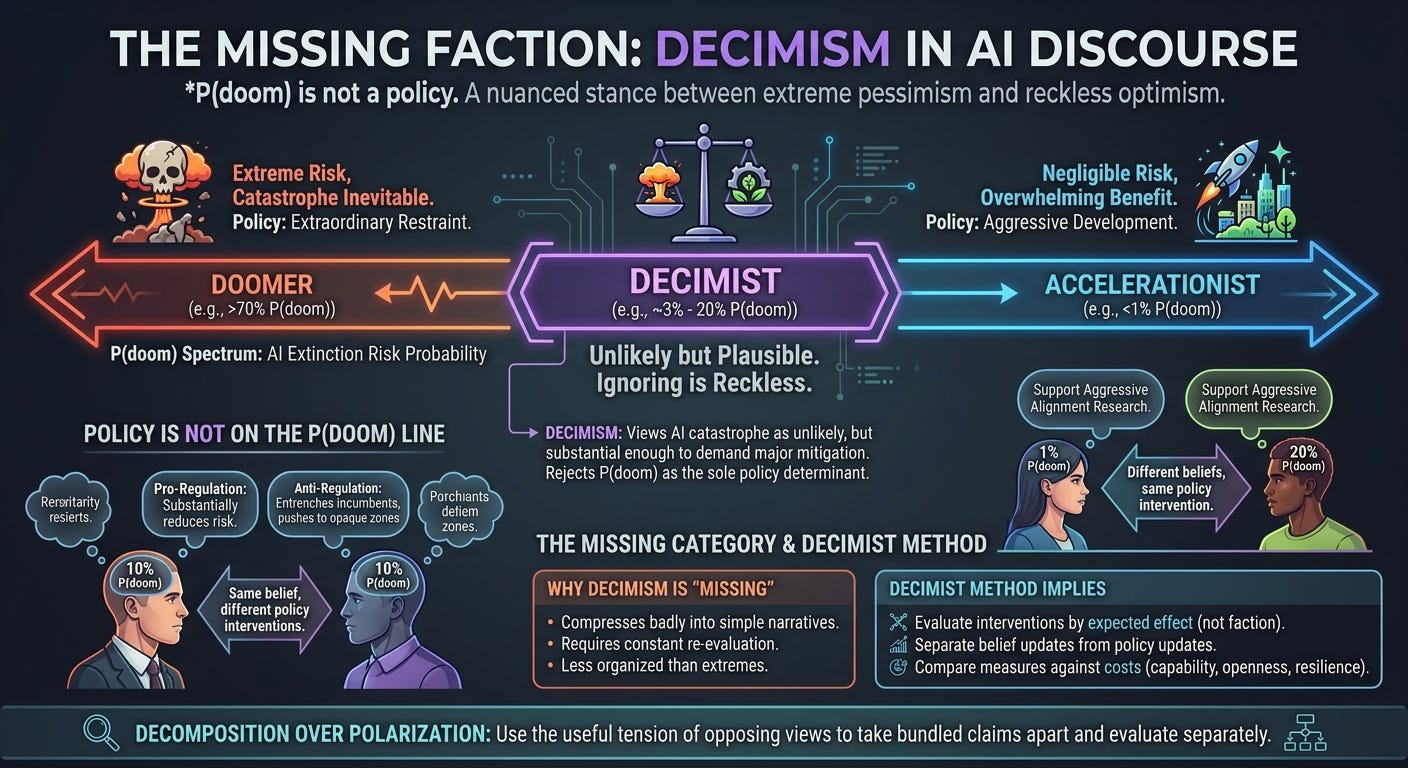
AI discourse has developed recognizable factions. At one end are people who think advanced AI poses an extreme or overwhelming existential risk. At the other are those who think rapid development is overwhelmingly beneficial and that attempts to slow it are themselves dangerous. The labels vary, but “doomer” and “accelerationist” have become the standard shorthand.

Matthew Pirkowski recently described these camps as opposing forces in a productive civilizational tension: anxious pessimists restraining reckless optimists, while reckless optimists prevent anxious pessimists from freezing progress. The psychology is caricatured, but the structure is recognizable. If one person assigns a 70 percent probability to AI-caused extinction and another assigns 0.1 percent, the first is plainly more pessimistic about AI risk, and there is nothing confused about representing that difference on a line.
The mistake begins when that line is treated as a complete map of the debate. Knowing someone’s P(doom) tells us something important about their empirical beliefs. It does not tell us what policies they support, how valuable they expect advanced AI to be, how tractable they think alignment is, or what they expect delay to cost.
There are plenty of people whose estimates fall between the poles. What is missing is a comparably legible category for them.
Call them decimists.
One axis is not enough
Policy does not lie on the P(doom) line.
Two people can assign the same probability to catastrophe and still favor very different actions. One may believe regulation can substantially reduce the risk at tolerable cost. The other may believe the same regulation will entrench incumbents, push development into less transparent jurisdictions, reduce defensive capability, or simply fail. They agree about the risk and disagree about what intervention will do to it.
The converse also holds. Someone at 1 percent and someone at 20 percent might both support extensive alignment research, reaching the same recommendation through entirely different models of the world.
“Doomer” and “accelerationist” therefore do two jobs at once. They loosely describe positions on a genuine risk axis, and they also carry a bundle of policy preferences, institutional attitudes, and expectations about technological progress. The bundling is where the taxonomy loses information.
A decimist world
My own estimate of AI-caused existential catastrophe by 2040 is roughly 10 percent. The number is deliberately approximate; the uncertainties are large enough that additional decimal places would add theater rather than information.
A 10 percent probability means catastrophe is not the expected outcome. Talking as though doom were inevitable would misrepresent the model. But a one-in-ten chance of existential catastrophe is also enormous. In almost any other engineering context, a project carrying that downside would receive intense scrutiny. Talking as though concern were irrational would misrepresent the same model just as badly.
Decimism is the view that AI catastrophe is unlikely, but plausible enough that ignoring it would be reckless. Nothing special happens at exactly 10 percent. Someone at 3 percent and someone at 20 percent can reasonably act quite differently, but they share the region where catastrophic risk is substantial and remains a minority outcome. The name marks that region rather than a point estimate.
Nor is the estimate reached by averaging a doomer and an accelerationist. It comes from judgments about timelines, capability growth, alignment difficulty, institutional preparedness, and the conditional probability of catastrophic failure. The number sits between the poles; the reasoning never consults them.
Why the factions dominate
The endpoints compress well. “AI will kill us” is easy to understand. “AI will transform the world for the better” is easy to understand. Each supplies a coherent story, a recognizable tribe, and a direct prescription.
Decimism compresses badly. A decimist may expect advanced AI to be enormously beneficial while treating catastrophic failure as plausible enough to deserve major attention. That person may support aggressive alignment research while opposing a broad moratorium, and worry about uncontrolled acceleration and the costs of delay at once. Those combinations are harder to package into an identity.
There is also a policy asymmetry. Extreme estimates generate comparatively direct prescriptions. If doom is nearly certain, extraordinary restraint becomes easier to justify. If the risk is negligible and the upside enormous, aggressive development becomes easier to justify. A 10 percent estimate does not tell us what to do by itself.
It forces further questions. How much can safety research reduce the risk? Who develops the systems if one jurisdiction slows down? Does restricting open development concentrate dangerous capabilities? Does faster development build defensive capacity against the risks that restraint leaves in place? The probability constrains the problem without solving it.
That creates a selection effect in public argument. The extremes are easier to organize around because they collapse uncertainty into a story. Decimists have to keep reopening the model.
What decimism implies
Decimism implies a method, though not a platform.
Treat existential risk as large enough to justify serious mitigation, but not so dominant that it erases competing risks and benefits. Evaluate interventions by expected effect rather than by which faction proposes them. Compare measures by how much catastrophic risk they reduce against what they cost in capability, openness, resilience, and option value.
Keep belief and intervention separate. New evidence about capabilities may change P(doom) without changing which policies work. New evidence about regulation, coordination, or safety techniques may change the best policy without moving P(doom) much. The two updates should be allowed to move independently.
Stated abstractly, this sounds obvious. Factional politics makes it difficult in practice. Once a position becomes part of an identity, changing one component can feel like defecting from the whole package.
The category was missing, not the people
Decimists may not be numerically rare. Frontier laboratories, researchers, policymakers, and ordinary observers may already hold combinations of beliefs that look broadly decimist. What they lack is a name. We have familiar labels for people near the poles and almost none for someone who expects enormous benefits, assigns a serious minority probability to catastrophe, favors aggressive safety work while distrusting some proposed restrictions, and expects each of those judgments to stay revisable.
“Decimist” is deliberately loose. It should not become a purity test or a new ideological package. Its function is to mark a region the binary handles badly.
What the conflict gets right
Pirkowski is probably right that opposition between pessimists and optimists can be useful. Safety researchers search for failure modes, adversarial dynamics, coordination problems, and catastrophic tails. Accelerationists search for the costs of delay, regulatory failure, stagnation, and ways progress can itself reduce danger.
Both searches are valuable. The error is treating their conclusions as packages to accept or reject whole. A safety argument should survive because the failure mode is plausible and important; an accelerationist argument should survive because the opportunity cost or governance failure it identifies is real. The useful product of adversarial disagreement is decomposition: taking bundled claims apart and evaluating them separately.
Conflict does not guarantee that product. Rival camps can instead select for caricature, purity tests, motivated reasoning, and escalating rhetoric. Opposition becomes epistemically useful only when mechanisms force updating: explicit predictions, empirical tests, adversarial review, postmortems, and consequences for repeatedly being wrong. Without them, “generative tension” is a flattering description of polarization.