

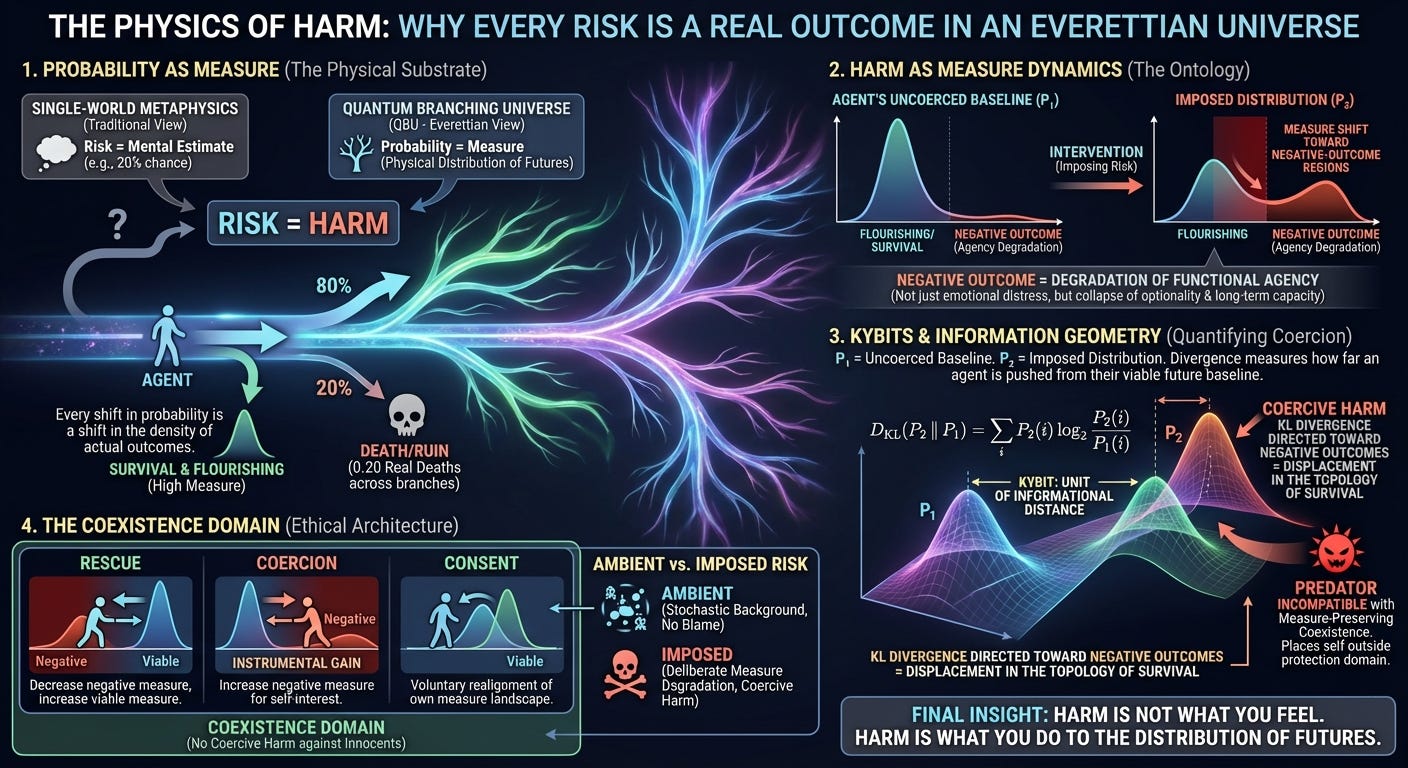
1. Probability as Measure
Probability has never been the benign bookkeeping device most ethical theories assume. In the Quantum Branching Universe (QBU), probability is measure: the physical distribution of real futures across the multiverse. Every shift in probability is a shift in the density of actual outcomes experienced by the agent whose future is being modified. A 20% chance of death is not a mental estimate. It is 0.20 real deaths across that agent’s descendant branches. Once this is understood, the framework’s Everettian grounding becomes explicit: Measure Ethics evaluates harm within a quantum-branching ontology where futures are physically realized with differing measure.
With this in view, the foundation of Axio’s invariant becomes unavoidable:
Risk = Harm.
The conventional separation between risk and harm is a parochial artifact of single-world metaphysics. In a multiverse, to impose risk is to shift the measure distribution toward negative-outcome regions of the branching structure, and to move measure toward them. Ethical analysis can no longer pretend that “nothing has happened yet” merely because no branch has been singled out by subjective perspective. Harm begins the moment measure is degraded.
The underlying structure is straightforward. In the QBU, all physically possible outcomes occur. Probability is therefore not epistemic uncertainty but relative branch-weight. High-measure outcomes propagate through a wide region of the branching structure; low-measure outcomes occupy thin, brittle sets of futures. To increase someone’s probability of ruin is to increase the measure of futures in which they are ruined. And since Axio defines harm as a reduction of an agent’s viable futures, measure becomes the physical substrate on which harm is defined. This frames the transition from probability itself to its ethical consequences.
2. Harm as Measure Dynamics
This reframes the ontology of harm entirely, preparing the ground for a precise information‑theoretic account of how interventions distort an agent’s future landscape. Harm is not a retrospective label assigned once a bad outcome is actualized. Harm is the measure dynamics induced by your action.
Clarification: In Measure Ethics, a “negative outcome” is not any experience that feels bad. It is specifically an outcome that degrades an agent’s functional capacity to pursue or maintain their valued goals. Emotional disappointment, offense, or heartbreak do not qualify unless they impair agency. Measure Ethics evaluates harm at the existential layer—reductions in viable future measure—Emotional distress does not qualify unless it impairs that capacity. However, extreme or prolonged suffering reliably degrades agency: it collapses optionality, imposes traumatic preference distortions, and reduces long-term functional capacity. For this reason, such states count as negative-outcome futures within Measure Ethics.
This reframes the ontology of harm entirely,: the shift in the probability distribution over survival, flourishing, stagnation, and negative outcome. Attempted harm, negligent harm, and manifested harm differ not in kind but in magnitude of measure degradation. The classical distinctions are procedural conveniences; the physics collapses them.
3. Kybits and Information Geometry
To formalize these dynamics—and to quantify exactly how interventions reshape the structure of viable futures—Axio employs the kybit: an information-theoretoretic unit defined by the KL divergence between two distributions over futures,
Originally introduced to quantify agency—how much an agent shapes its own distribution—the same divergence precisely quantifies coercive harm.
The divergence is computed as KL(P₂‖P₁) because P₁ represents the agent’s uncoerced baseline; the asymmetry reflects how far the imposed distribution deviates from the future the agent would have had without interference. (P_1) is the agent’s survival distribution before your intervention; (P_2) is the distribution after your imposed risk. The divergence measures the informational distance by which you have pushed them away from their viable baseline. KL divergence provides the magnitude of imposed measure change; the valence depends on whether the shift moves probability toward negative or positive outcomes.
The baseline distribution (P_1) is defined as the agent’s uncoerced trajectory—the futures they would face absent negative-valence interference by other agents. Environmental hazards, personal decisions, and consensual interactions are part of this baseline; imposed degradation is not. In ambiguous cases—misperception, manipulation, third-party interference, or conflicting signals—the agent’s uncoerced trajectory is determined by Axio’s Procedural Layer, which resolves interpretive uncertainty while defaulting to autonomy and innocence. Harm arises only when an action shifts measure away from this uncoerced baseline and toward negative-outcome regions.
In these terms:
Coercive harm = KL divergence directed toward negative outcomes in another agent’s future-measure.
This is the point where ethics, information theory, and multiverse physics become a single structure.
Axio treats future branch-instances as identity-continuous realizations of the same agent-pattern. Because measure quantifies how much of the agent-pattern persists across futures, shifting measure toward negative-outcome regions directly reduces the agent’s future footprint, which is why such shifts count as harm. A shift of measure toward negative-outcome futures therefore harms the agent by reducing the pattern’s viable modal footprint. Harm is an alteration of the geometry of futures. A coerced shift in measure is not a metaphorical injury; it is a quantifiable displacement in the topology of survival.
Once risk is recognized as measure redistribution, the ethical consequences follow with sharp inevitability. If you impose risk on an innocent, you alter the topology of their future selves. You increase the density of branches in which they suffer and decrease the density of branches in which they thrive. No branch with non-zero measure is hypothetical. Every such branch is a lived experience for a future instance of the agent. To impose risk is to shift measure toward futures in which the agent suffers because of you.
This measure-centric picture then cleanly organizes the structure of rescue, coercion, consent, and ambient risk. Rescue is an intervention that decreases negative-outcome measure and increases viable measure. Coercion is an intervention that increases negative-outcome measure for instrumental ends. Friction is negligible Δ-measure. Consent is voluntary realignment of one’s own measure landscape. Ambient risk is stochastic background not attributable to an agent; imposed risk is deliberate measure degradation caused by one.
With these distinctions in place, Axio’s invariant is precise:
If your action worsens another agent’s measure landscape without consent, you have committed coercive harm.
Predation now becomes a structural classification rather than a moralistic label. A predator is an agent who systematically shifts others’ measure toward negative-outcome futures for instrumental gain. Such an agent is not “evil” in any supernatural sense; it is incompatible with measure-preserving coexistence. By repeatedly degrading others’ distributions, the predator performs its own domain exit: it places itself outside the protection domain that shields innocents from coercive harm. Defensive coercion becomes permissible, not as revenge, but as a measure‑preserving operation. This sets the stage for understanding how stable coexistence emerges from these constraints.
4. The Coexistence Domain
From here, the architecture of a stable coexistence domain emerges with coherent force. A viable domain requires that no agent arbitrarily increases another’s negative-outcome measure. Net-worsening (negative-outcome increasing) transformations are forbidden; net-improving transformations are permitted; consensual risk trades are admissible; and background stochasticity is not grounds for blame. Measure Ethics supplies the physical backbone for Axionics: no coercive harm against innocents is not a moral slogan—it is a constraint on admissible transformations of the multiversal measure field.
Everything converges on a single insight: probability is measure; measure is the architecture of futures; and harm is the negative manipulation of this architecture. The practical consequence is as clear as it is uncompromising.
Harm is not what you feel.
Harm is what you do to the distribution of futures.
This is the sharp line that survives contact with physics.