

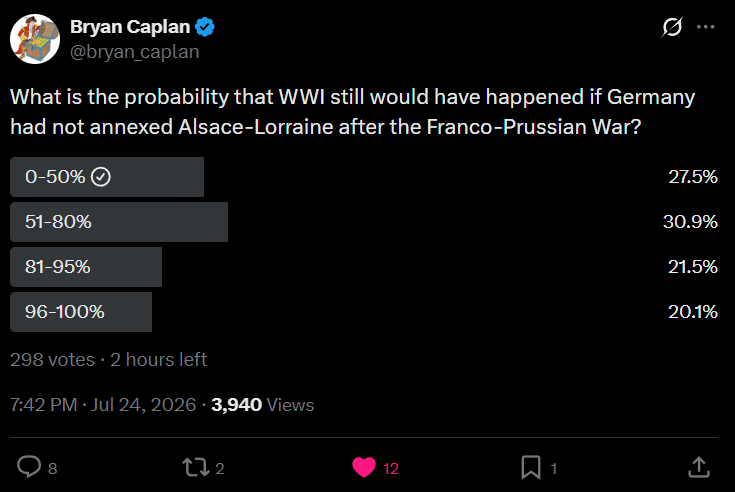
Bryan Caplan recently asked:
What is the probability that World War I still would have happened if Germany had not annexed Alsace-Lorraine after the Franco-Prussian War?
The question looks like an invitation to historical speculation. It also exposes a deeper problem: what kind of probability can a counterfactual historical claim possess?
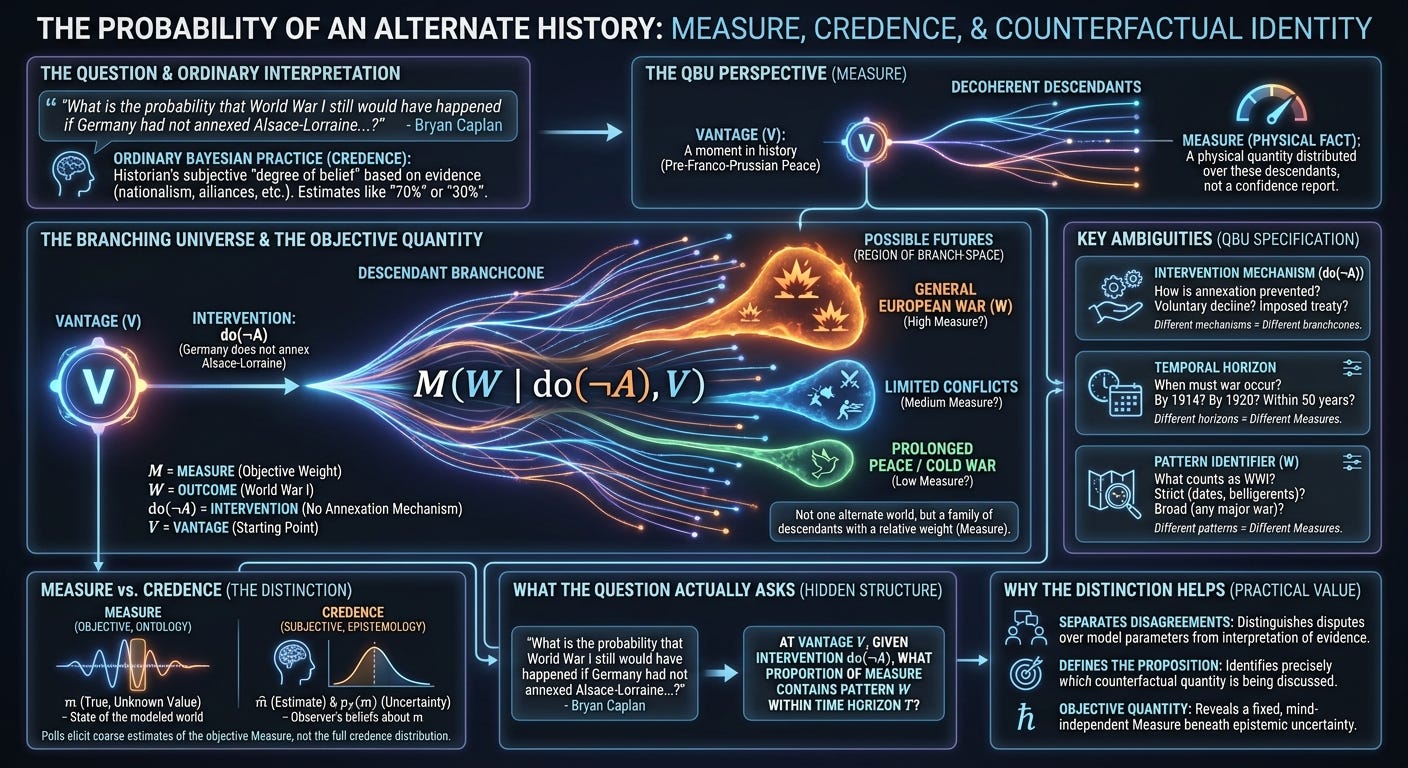
Under ordinary Bayesian practice, the answer is treated as a credence. A historian considers nationalism, alliance structures, military mobilization, imperial rivalry, domestic politics, and the specific role of Franco-German revanchism, then assigns a degree of belief. Perhaps 70 percent, perhaps 30 percent. The number reports the historian’s estimate.
The Quantum Branching Universe framing (QBU) says there is another quantity underneath that estimate. On that view a moment in history is a Vantage with many decoherent descendants, and the Measure distributed over those descendants is a physical fact rather than a report of anyone’s confidence.
There is no single alternate history
The usual phrasing encourages us to imagine one alternate world. Germany does not annex Alsace-Lorraine, and then what happens?
But removing the annexation does not determine a unique successor history. France may still seek revenge for defeat. German diplomacy may develop differently. Bismarck may retain power longer or fall sooner. Russia and Austria-Hungary may clash over the Balkans on a different schedule. Britain may remain outside a continental war. Sarajevo may never occur, or some other crisis may take its place.
The counterfactual does not generate one alternate timeline. It defines a family of possible descendants: timelines in which something recognizably like World War I occurs, timelines in which a different general European war occurs, timelines containing only limited conflicts, and timelines in which the major powers avoid general war for decades.
The relevant probability is therefore not the probability assigned to one imagined story. It is the relative weight of a region of branch-space.
The objective quantity
Let V be a Vantage preceding the peace settlement of the Franco-Prussian War, let A denote the annexation of Alsace-Lorraine, and let W denote the occurrence of World War I. The quantity Caplan appears to be asking for is:
This is the Measure of descendant histories in which W occurs, conditional on the non-annexation of Alsace-Lorraine at V. Under QBU, once the Vantage, intervention, and Pattern Identifier are specified, the resulting Measure is objective. It does not depend on what anyone believes. It is fixed by the structure of the branchcone descending from the specified Vantage under the specified condition. The specification is a modelling choice; the quantity it picks out is not.
QBU does not require stochastic fundamental laws. Deterministic evolution of the universal state can still yield multiple decoherent descendants with different Measures.
Branching also need not imply that history is maximally fragile. Microscopic differences may generate many distinct descendants while large-scale political structures keep most of their Measure concentrated around similar outcomes. QBU therefore distinguishes contingency from robustness: a high conditional Measure for general war would mean that the conflict survives wide variation in the details, and a low Measure would mean that it depends on a narrow historical path.
We do not know the value of the Measure, and we almost certainly cannot calculate it. Those are epistemic limitations, not evidence that the quantity itself is subjective. QBU reads the poll responses as coarse estimates of an objective quantity the respondents cannot observe directly, whether or not they hold the ontology that names it.
The question is still underspecified
Writing the expression does not make the problem complete.
The first ambiguity is the intervention. “Germany does not annex Alsace-Lorraine” could mean several things. Germany may decline the territory voluntarily. France may retain it as part of a different peace settlement. The war may end before annexation becomes possible. Bismarck may be overruled, or foreign powers may impose a settlement. These are not causally equivalent, and they produce different descendant branchcones.
There is no neutral operation that deletes the annexation while leaving every upstream cause untouched. A counterfactual intervention must be represented either as a specific physical condition imposed at the Vantage or as a selection rule over descendants satisfying a defined condition, and these are not the same quantity. Conditioning on descendants in which the annexation happens not to occur,
selects branches in which something else suppressed it, and whatever did the suppressing carries its own downstream effects. Imposing non-annexation as an intervention,
specifies the mechanism rather than inheriting whichever mechanisms happen to produce the observed condition. The two expressions need not agree, and different mechanisms producing non-annexation define different counterfactuals.
The Vantage must also precede the causal divergence that produces non-annexation. A Vantage chosen after the relevant decisions are settled conditions on a state in which the question has already been answered.
The second ambiguity is temporal. Does the question ask whether a general European war occurs by 1914, by 1920, or at any point within fifty years? A war delayed until 1928 may support the claim that Europe’s structural tensions made conflict likely, but it would not ordinarily count as World War I still happening.
The third ambiguity is the most important: what qualifies as World War I?
The Pattern Identifier
Historical events are not elementary objects. “World War I” names a pattern.
A strict Pattern Identifier might require approximately the same dates, substantially the same belligerents, a Balkan trigger, a German invasion of Belgium, British entry, a Western Front, and large-scale industrialized warfare. Under that definition, the Measure may be low. Removing Alsace-Lorraine need not prevent a European war, but it could easily alter enough details that the resulting conflict is no longer the same event.
A broader Pattern Identifier might require only a general European war involving several great powers within a specified period. Under that definition, the Measure could be much higher. Broader still, the identifier might ask whether the alliance system and geopolitical pressures eventually produce any major industrial war, which is no longer primarily a question about World War I as a historical individual. It is a question about the stability of the pre-1914 European order.
The probability changes as the Pattern Identifier changes. This is not a defect in QBU. It exposes an ambiguity already present in ordinary historical language.
People may appear to disagree about whether World War I was likely when they are answering different questions. One means the specific war that began in 1914. Another means a similar continental war. A third means some catastrophic breakdown of the European balance of power. Those are different predicates over branch-space, and therefore have different Measures.
Measure and credence
Once the Vantage, intervention, time horizon, and Pattern Identifier are fixed, the counterfactual has an objective answer:
This notation does not make the categories interpretation-free. The Vantage, intervention, and Pattern Identifier are parts of the model, and they must be chosen, defended, and sometimes compared with alternatives. Formalization does not remove judgment. It reveals where judgment enters.
A respondent does not observe the Measure. He constructs an estimate of it from historical evidence and then selects the poll bin containing that estimate. Choosing the 51 to 80 percent bin means his estimate falls somewhere in that range. It does not mean he is confident that the true Measure lies there. Behind a single estimate may lie a whole distribution of uncertainty across the values the Measure might take, but the poll does not elicit that distribution. It asks only for a coarse estimate of the underlying quantity.
Measure is the quantity being estimated. Credence governs the estimate and the uncertainty surrounding it.
Ordinary language uses “probability” for both. Someone says there was a 70 percent chance of war, and may mean either that the relevant class of descendant histories has Measure 0.7, or that their best estimate of that Measure is 0.7. The numbers may coincide, but they are not the same kind of thing. Measure belongs to the modeled world; credence belongs to an observer reasoning about that world. QBU separates the ontology from the epistemology.
Why the distinction helps
The framework does not calculate the answer for historians. It does something prior to calculation: it separates different sources of disagreement.
Two people may disagree because they specify different interventions, because they use different Pattern Identifiers for “World War I,” because they adopt different physical models, or because they agree on all of those and differ only in their interpretation of the historical evidence. Without these distinctions, all four disagreements collapse into an argument over one number.
The formalism therefore has practical value even when the Measure remains inaccessible. It identifies which proposition is being disputed.
It also marks the boundary of the QBU claim. A historian who rejects Everettian ontology can still borrow the intervention and Pattern Identifier machinery. What QBU adds is the claim that, once those elements are fixed, there is an objective descendant Measure rather than only an epistemic degree of belief.
Postscript
Caplan’s poll is not malformed. It is incomplete.
A fully specified version would look more like this:
At a Vantage preceding the peace settlement of the Franco-Prussian War, suppose the settlement is altered by a specified mechanism so that Germany does not annex Alsace-Lorraine. What proportion of the resulting descendant Measure contains a general European war between 1900 and 1925 satisfying a specified Pattern Identifier?
No social-media poll should be written that way. But that is the structure hidden inside the ordinary sentence.
The value of QBU here is not that it supplies the number. It identifies what the number would refer to.
Alternate history is usually discussed as though one counterfactual produces one replacement world. Under QBU it selects a branchcone. The relevant historical pattern has a Measure within that branchcone, and our uncertainty about that Measure is credence.
Confusing the two makes counterfactual probability look inherently subjective. Distinguishing them reveals an objective quantity beneath the uncertainty.