

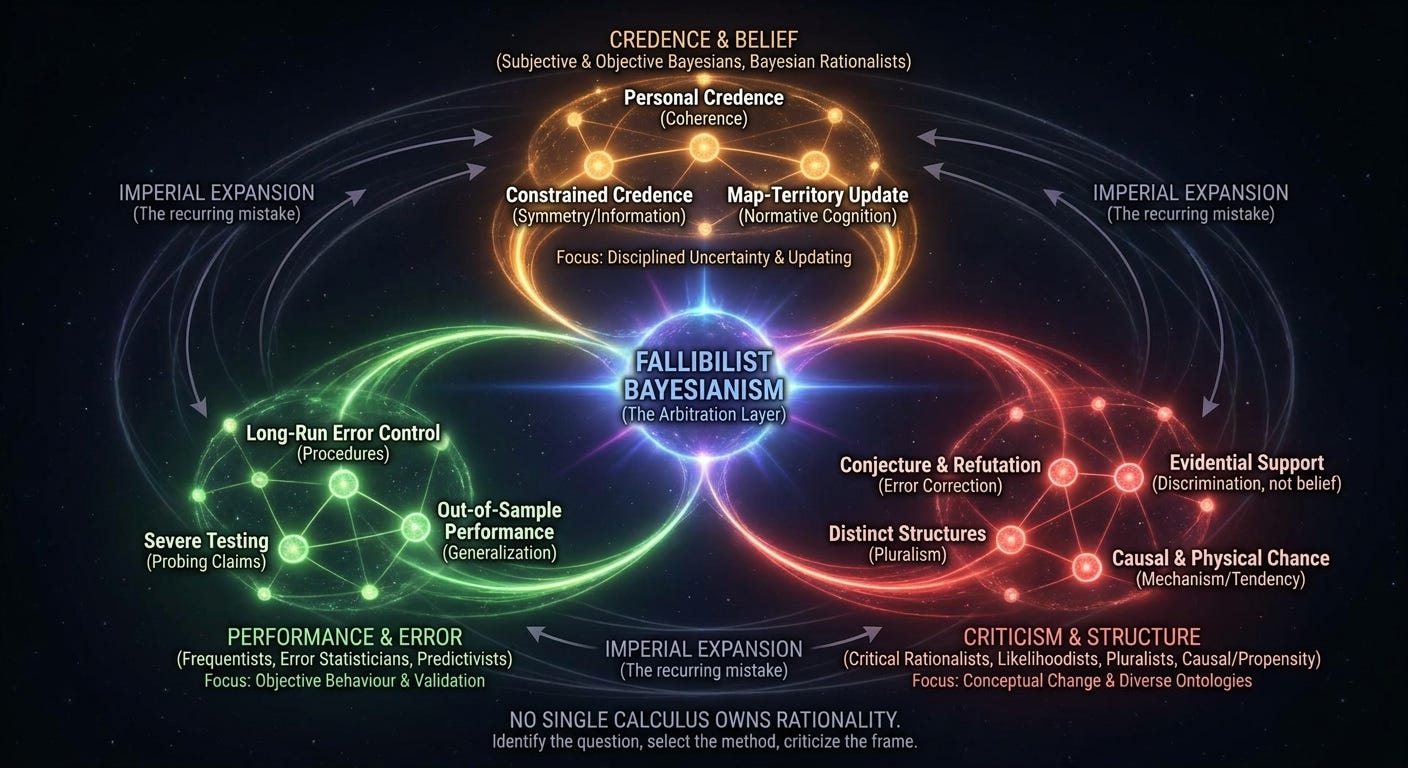
People often argue about probability as though everyone were discussing the same thing. If only that were true.
One person treats probability as a degree of belief. Another treats it as a long-run frequency. A third treats it as a physical tendency in the world. A fourth uses probability as a formal measure over possibilities while refusing to interpret it as belief at all. A fifth denies that scientific theories should receive probabilities in the first place.
These disputes are usually compressed into familiar labels: Bayesian, frequentist, likelihoodist, falsificationist. The labels help, but they also conceal the structure of the disagreement.
The argument concerns more than calculation. It concerns what probability is, what kinds of things receive probabilities, how evidence bears on hypotheses, and what rational inquiry is trying to accomplish.
The familiar Bayesian-versus-frequentist dispute covers only part of this territory. Critical rationalists reject the premise that science advances by assigning rising probabilities to theories. Objective Bayesians think rational agents should converge on the same probabilities given the same information. Subjective Bayesians allow different coherent agents to begin with different priors. LessWrong-style Bayesian Rationalists extend Bayesianism into a general theory of rational cognition. Likelihoodists separate evidential support from belief. Error statisticians ask whether a claim has survived a severe test. Predictivists judge models by generalization. Probability pluralists deny that one interpretation can cover every legitimate use of probability.
Each school captures part of the landscape. Problems begin when one local insight is promoted into a complete theory of rationality.
Four Questions That Should Be Kept Separate
Most disputes about probability become clearer once four questions are separated.
The first is ontological: what is probability? It might be a degree of belief, a long-run frequency, a physical propensity, a measure over possible states, or several different things connected by common mathematics.
The second concerns scope: what receives a probability? A future event may receive one. So may a parameter value, a theory, a branch of the wavefunction, or an agent’s own uncertainty. Different schools disagree about which of these assignments are meaningful.
The third is evidential: what does evidence do? It may update credence, alter a likelihood ratio, increase the severity of a test, improve predictive calibration, or reveal that the original hypothesis space was malformed.
The fourth is methodological: how does inquiry progress? Answers include conditionalization, model comparison, conjecture and refutation, error correction, and conceptual reconstruction.
These questions interact, but they do not collapse into one another. A person can use Bayesian computation while rejecting subjective probability. A Popperian can accept objective physical chances while denying that theories themselves are probably true. A machine-learning researcher can optimize probabilistic predictions while remaining indifferent to whether those probabilities represent credence, chance, or mechanism.
Subjective Bayesians
Subjective Bayesianism interprets probability as credence: an agent’s degree of belief.
Frank Ramsey, Bruno de Finetti, and Leonard Savage supplied much of the intellectual foundation. Their work connected probability to rational preference, betting behaviour, and decision under uncertainty. Coherence constraints prevent an agent from holding combinations of beliefs that expose it to guaranteed loss. Conditionalization supplies the standard rule for changing credences in response to evidence.
This framework has great elegance. It unifies belief and action. It allows an agent to reason about unique events that have no meaningful long-run frequency, such as whether a particular government will fall next year or whether a specific scientific hypothesis is true.
The trouble starts at the boundary between coherence and truth. Two agents can assign very different priors while remaining internally coherent. Dutch-book consistency tells us that their beliefs fit together. It does not tell us which agent has modeled the world more successfully.
De Finetti pushed the view to its sharpest form with the slogan that probability does not exist. He meant that objective probability does not exist as a property of the world. What exists is an agent’s uncertainty, represented through coherent betting commitments.
De Finetti’s version clarifies one use of probability by denying the others. Less radical subjective Bayesians may accept objective chances while reserving Bayesian probability for credence. Either way, the subjective interpretation remains central to Bayesian epistemology.
Objective Bayesians
Objective Bayesians also interpret probability epistemically, but they reject broad freedom in the choice of priors.
Harold Jeffreys and E. T. Jaynes are major representatives. Rudolf Carnap belongs to a related logical tradition. Their projects differ substantially, but all seek constraints on rational probability stronger than personal coherence alone.
On this view, two agents with the same evidence should not be free to choose radically different priors merely because their betting dispositions differ. Rationality should constrain the assignment more tightly.
This answers a real problem in subjective Bayesianism. It also creates another.
A supposedly uninformative prior depends on how the problem is represented. A distribution uniform in one parameter may become non-uniform after transformation. Symmetry is powerful only after the relevant symmetry group has been identified. Maximum-entropy reasoning depends on which constraints have been selected and which variables define the state space.
Objective Bayesian methods can reduce arbitrariness inside a model. They cannot choose the model’s ontology, variables, or boundaries without relying on judgments from outside the formalism.
Jaynes described probability theory as extended logic. That captures the inferential discipline available once the possibilities and information have been represented. Logic does not decide which representation deserves authority.
Bayesian Rationalists
Bayesian Rationalism developed around LessWrong, the Bay Area rationalist community, Eliezer Yudkowsky’s Sequences, and the wider effective-altruist and AI-safety milieu that grew around them.
Its epistemology combines Jaynesian probability, decision theory, cognitive-bias research, and the map–territory distinction. Probability primarily represents quantitative credence. Uncertainty resides in the agent’s map, while reality itself has whatever structure it has. Rational belief consists, ideally, in maintaining coherent degrees of belief and updating them in proportion to how strongly the evidence was predicted by competing hypotheses.
Bayesian Rationalists differ from personalist Bayesians because they do not regard arbitrary coherent priors as equally rational. Shared evidence, simplicity, symmetry, and calibration should constrain belief. Their view is closer to objective or logical Bayesianism, though often expressed in psychologically practical rather than formally axiomatic terms.
They also extend Bayesianism much further than most statisticians do. Bayesian probability is treated as the normative core of epistemic rationality. Expected utility supplies the corresponding account of instrumental rationality. Cognitive biases are interpreted as systematic departures from these norms.
This produced real intellectual gains. The community trained people to think in graded rather than binary beliefs, attend to base rates, distinguish likelihood from posterior probability, and notice motivated reasoning. Ordinary public argument would improve considerably if these habits were more common.
Solomonoff induction often supplies the idealized background picture. An agent distributes prior weight across computable hypotheses according to simplicity, then updates as observations arrive. This appears to answer the objection that ordinary Bayesianism begins with an arbitrary finite list of hypotheses. The universal prior assigns weight to every computable predictor expressible in the chosen coding framework.
The solution is formal rather than operational.
A Solomonoff prior assumes an observation sequence, a coding language, and an environment representable as computation. It assigns weight to programs expressible in that framework. It does not explain how an embodied agent decides what counts as an observation, identifies semantic variables, or notices that its ontology is malformed.
Saying that an unconceived theory had nonzero weight in an ideal universal mixture does not explain how an actual reasoner could formulate, understand, test, or use it.
This marks the characteristic excess of Bayesian Rationalism: Bayesian imperialism. A local calculus for uncertainty becomes an account of rational cognition as a whole. Hypothesis invention, explanatory criticism, and model replacement are redescribed as implicit Bayesian operations because a sufficiently rich ideal prior could supposedly contain every possibility.
That preserves formal universality by pushing the difficult work into the prior.
The community has never been fully homogeneous. Later work on embedded agency, logical uncertainty, model misspecification, and ontology identification exposed weaknesses in the original picture of a cleanly separated agent updating on neatly delivered evidence. Many present-day rationalists also use “Bayesian” loosely to mean calibrated uncertainty, explicit alternatives, and willingness to revise.
The originating orientation remains recognizable:
Probability is credence, Bayesian updating is the normative core of belief revision, and ideal Bayesian machinery can in principle subsume rational inquiry.
Fallibilist Bayesianism agrees with the discipline of graded belief and rejects the claim of completeness.
Pragmatic Statisticians
Pragmatic statisticians form less a philosophical school than a professional stance toward the schools. They combine estimation, graphical diagnostics, model checking, predictive validation, and domain knowledge. A Bayesian may use frequentist calibration to evaluate a procedure. A frequentist may use likelihood methods, regularization, or prior-like penalties. Both may revise a model after inspecting residuals or discovering a measurement defect.
Andrew Gelman is a prominent Bayesian example, but the stance is broader than Bayesian practice. Its defining commitment is methodological responsiveness: use the formalism suited to the problem, then test whether the resulting model works.
This school lives comfortably with philosophical ambiguity. A prior may be partly regularization, partly substantive knowledge, and partly computational convenience. A confidence interval may serve as a procedural guarantee while also being read informally as an uncertainty summary.
What this buys is practical effectiveness. What it costs is conceptual precision. A posterior, confidence interval, p-value, and predictive score can all be used productively while their distinct meanings blur. Pragmatism prevents doctrinal paralysis, but it can also conceal category errors.
Frequentists
Frequentist statistics validates methods through their long-run behaviour under repeated sampling. Some frequentists go further and interpret probability itself as long-run frequency; many make the weaker methodological claim while staying agnostic about ontology.
Jerzy Neyman and Egon Pearson developed a framework centred on error rates, power, and repeated sampling performance. Ronald Fisher is commonly grouped with them, though his philosophy differed significantly. Modern statistical practice often combines Fisherian significance testing with Neyman–Pearson decision rules despite their incompatible foundations.
Frequentist methods ask how a procedure behaves across repeated applications. A confidence interval procedure may be designed so that, over many repetitions, 95 percent of the resulting intervals contain the true parameter. A hypothesis test may control the probability of rejecting a null hypothesis when it is true.
This buys objective performance: a method can be evaluated by calibration, coverage, false-positive rates, and power, with no prior distribution over fixed parameters required.
The bill arrives with the individual case. Once a particular 95 percent confidence interval has been calculated, frequentism does not say there is a 95 percent probability that the parameter lies within it. The parameter is fixed, and the interval either contains it or does not. The 95 percent refers to the procedure’s long-run performance.
This often frustrates users because their practical question concerns the case in front of them. Frequentism evaluates the method that produced the answer more naturally than the uncertainty attached to the answer itself.
Working frequentists are not confined to rigid textbook procedures; the philosophical account concerns what validates an inference, not everything a competent statistician does before and after the formal calculation.
Likelihoodists
Likelihoodism focuses on how strongly observed evidence discriminates among hypotheses.
The likelihood function measures how well each hypothesis predicts the observed data. A likelihood ratio compares two hypotheses directly. If the data are much more probable under one hypothesis than another, the evidence favours the first.
A. W. F. Edwards and Richard Royall developed this view in explicit philosophical form. Likelihoodism separates evidence from belief. Prior credences are not needed to say that one hypothesis predicts the observation better than another. Long-run error rates are not needed either.
This gives likelihoodism considerable conceptual clarity. Evidence can favour one hypothesis while still leaving it improbable overall if the prior odds were strongly against it. Evidential support and posterior belief are distinct relations.
Scope is where it runs out. Likelihoods alone do not produce decisions, posterior probabilities, or complete uncertainty distributions. They compare represented hypotheses but do not generate them. Likelihoodism captures one important relation between evidence and hypothesis and leaves the rest of epistemology to others.
Predictivists
Predictivists judge models primarily by out-of-sample performance.
This is the operative philosophy of much of modern machine learning. Models are trained to minimize predictive loss and evaluated on held-out or future data. Cross-validation, calibration, robustness, and generalization matter more than whether the model expresses a transparent causal theory.
For the predictivist, a probability is often whatever predictive quantity minimizes loss, calibrates well, and generalizes. Its metaphysical interpretation can remain deliberately unsettled: regularization can resemble a Bayesian prior without being interpreted as belief, and probabilistic outputs may be treated as calibrated scores rather than claims about chance or credence.
The empirical discipline is real: a model must succeed on data it was not trained to fit, and this orientation has produced systems whose performance exceeded what hand-designed approaches could achieve.
The frame cracks when the environment changes or action alters the system being predicted. A model can exploit stable correlations while lacking any account of the mechanism behind them. It may perform well under ordinary sampling and fail under intervention, strategic response, or distribution shift.
Benchmarks create another vulnerability. Once a benchmark becomes a target, systems can overfit to its peculiarities. Data contamination, selection effects, and narrow task definitions can produce impressive scores with weak real-world authority.
Predictive success is a genuine epistemic achievement. It does not automatically yield causal understanding, explanatory depth, or safe extrapolation.
Objective Chance
Some probabilities appear to belong to the world rather than to an agent’s ignorance.
A radioactive atom has a characteristic probability of decaying within a given interval. A coin-tossing device may have a stable physical bias. Quantum theory assigns measures that predict outcome statistics. Statistical mechanics uses distributions over microstates to derive macroscopic behaviour.
Propensity theories interpret such probabilities as dispositions or tendencies of physical systems. Karl Popper defended a version of this view. This fact is often missed because Popper is remembered mainly as an opponent of probabilistic confirmation.
His position separates two questions. A physical setup may possess an objective probability distribution over outcomes. A scientific theory need not possess a probability of being true.
That distinction matters. Anti-Bayesianism about scientific inference does not entail hostility to probability itself.
Physical-chance interpretations face difficult metaphysical questions. What kind of property is a propensity? How does it relate to actual frequencies? Can a single-case chance be empirically identified? These questions remain open, but they cannot be dissolved by renaming physical probabilities as credences. An agent’s uncertainty about radioactive decay and the physical structure governing decay rates are related without being identical.
Critical Rationalists
Critical rationalism rejects induction as the engine of scientific knowledge.
Karl Popper argued that theories are conjectured, exposed to criticism, tested, and replaced. Evidence can reveal error. It cannot establish a universal theory as probably true through accumulated confirmation.
William Bartley, David Miller, and David Deutsch developed different versions of this tradition. Deutsch places particular emphasis on explanation, problem-solving, and the open-ended creation of knowledge.
Critical rationalists object to Bayesian epistemology at a structural level. A posterior distribution over theories assumes that the relevant theories have already been articulated. It does not explain how explanatory alternatives are invented, how conceptual frameworks change, or how criticism reveals that the original problem was badly formed.
They also reject the idea that scientific merit should be identified with high probability. Highly informative theories rule out more possibilities and therefore expose themselves to more ways of failing. A theory that says little may be logically safer while explaining almost nothing.
Error correction is the school’s strongest ground: knowledge grows because conjectures are placed under pressure, and explanations earn standing by solving problems, surviving criticism, and generating new tests.
Graded uncertainty is where the framework is least developed. Evidence often changes comparative confidence without conclusively refuting any live theory. Auxiliary assumptions complicate failed predictions. Decisions must be made before criticism has produced a clear winner.
Critical rationalists sometimes treat degrees of belief as a distraction from objective problem-solving. Agents still need to choose experiments, estimate risks, and act under uncertainty. Refusing Bayesian imperialism does not remove those tasks.
Error Statistics and Severe Testing
Deborah Mayo’s error-statistical approach occupies territory between frequentist procedure and critical rationalist testing.
The central question is whether a claim has passed a severe test. A test is severe when it would probably have exposed a relevant error if that error were present. Evidence supports a claim to the extent that the claim survives a procedure capable of finding its flaws.
This differs from asking for a posterior probability. It also differs from merely rejecting a null hypothesis at a conventional threshold. The quality of the evidence depends on the test’s capacity to discriminate the specific claim from plausible errors.
Severe testing captures an important feature of science. A prediction that could easily have succeeded under many alternatives tells us little. A risky prediction that would probably have failed if the theory were wrong provides stronger evidence.
The method remains dependent on test design, model assumptions, and the specification of relevant errors. Severity is not supplied automatically by the data. Still, error statistics offers a formal account of criticism that neither subjective Bayes nor crude frequentism provides.
Imprecise Probability
Precise probability assigns one number to every event under consideration. That demand often exceeds the available information.
Imprecise-probability theories allow uncertainty to be represented by intervals, lower and upper probabilities, or sets of probability distributions. Isaac Levi and Peter Walley are major figures in this tradition. Robust Bayesian methods and credal-set approaches belong to the same broad family.
This framework distinguishes genuine indecision from a precise but poorly grounded compromise. An agent may know that several probability distributions are compatible with the evidence while lacking grounds to choose among them. False precision is avoided without abandoning formal reasoning.
Yet a set of probability distributions still presupposes an event space, candidate variables, and a model family. Imprecision represents uncertainty within a frame without solving the problem of constructing the frame. There are also cases where even an interval is premature because the event itself remains unstable or ambiguous. The problem may require conceptual clarification before probabilistic representation becomes meaningful.
Probability Pluralists
Probability pluralism denies that all legitimate uses of probability reduce to one thing.
Credence represents an agent’s uncertainty. Frequency describes repeated outcomes. Physical chance describes stochastic structure or propensity. Statistical mechanics uses measures over microstates. Quantum theory supplies a measure with a physical role that remains interpretation-dependent. Symmetry can justify equal weighting without invoking personal belief.
These structures share mathematical relations. That does not prove they share one ontology.
A pluralist can accept that objective chance constrains rational credence. The Principal Principle is one attempt to state that relationship: absent defeating information, credence should align with known chance. The relationship itself presupposes that chance and credence are distinct.
Pluralism gains accuracy at the cost of unification. It refuses to force every probabilistic concept into one metaphysical category. Critics may regard this as theoretically untidy. The alternative often achieves tidiness by conflating structures that play different roles.
The practical discipline is simple: whenever probability is invoked, ask which kind.
Fallibilist Bayesianism
Fallibilist Bayesianism combines several elements from these traditions without accepting any one of them as complete.
It treats Bayesian conditionalization as a valid method for redistributing uncertainty within an adequately specified model. It accepts that rational agents often need degrees of belief and that evidence should change those beliefs systematically.
It also treats probability as plural. Credence, frequency, physical chance, and quantum measure need not be reduced to one underlying substance.
The framework remains fallibilist because every probabilistic model depends on prior acts of construction. Events must be distinguished. Variables must be selected. Evidence must be represented. Candidate hypotheses must be invented.
Those choices can fail.
Bayesian updating operates while the frame remains fixed. Criticism evaluates the frame itself. Model checking, causal analysis, failed interventions, and explanatory criticism may reveal that the original representation deserves revision.
Bayesianism remains in the name because agents must ultimately integrate heterogeneous evidence into action under uncertainty. Frequentist guarantees, likelihood ratios, predictive scores, and severity assessments answer different questions, but a decision-making agent still needs an integrated representation of uncertainty and consequence. Bayesian credence is the most developed general framework for that role, though the representation may remain imprecise when the evidence does not support a unique distribution. Fallibilism denies that the layer can validate its own inputs or complete the epistemology around it.
This gives a compact description of the stance:
Bayesian about updating, pluralist about probability, critical-rationalist about knowledge.
The position accepts the Bayesian demand for disciplined uncertainty. It accepts the frequentist demand that procedures answer to objective performance. It accepts the likelihoodist distinction between evidential support and belief. It accepts the predictivist demand for out-of-sample success. It accepts the critical-rationalist emphasis on error correction and model replacement.
It rejects the promotion of any one of these insights into a total epistemology.
When Methods Disagree
Methodological pluralism does not mean averaging incompatible answers.
Different methods establish different properties. A Bayesian posterior characterizes uncertainty relative to a prior and likelihood model. A frequentist procedure controls long-run error under a sampling design. A likelihood ratio measures comparative support among specified hypotheses. A predictive score measures expected performance on future data. A severity assessment asks whether a test would probably have exposed a relevant error. A causal model supports claims about intervention under structural assumptions.
These quantities can point in different directions because they answer different questions.
Consider a clinical trial. A Bayesian analysis may assign high posterior probability to a treatment effect. A frequentist design may not yet have crossed a prespecified stopping boundary. A predictive model may show strong out-of-sample discrimination while remaining poorly calibrated for a vulnerable subgroup. A causal analysis may show that the treatment effect on the measured endpoint does not transport to the patient outcome of interest.
No single number resolves the decision.
The governing question is which epistemic property the task requires and which errors carry the greatest cost. If the objective is regulatory control of false positives across many trials, frequentist guarantees matter. If the objective is the current decision for a particular patient population, posterior uncertainty and expected consequence matter. If the environment will change after deployment, causal robustness matters more than static benchmark performance.
A decision can require several constraints at once. A method may be rejected because it fails any one of them.
Purpose does not make the choice arbitrary. The objective, loss structure, affected population, and reversibility of error constrain which method deserves authority. Those choices remain open to criticism.
Identify the question, identify the error that must be controlled, select the method whose guarantees match the relevant property, and test whether the framing assumptions survive contact with the world.
Fallibilist Bayesianism supplies an arbitration rule at the level where conflict actually occurs.
Where the Schools Actually Disagree
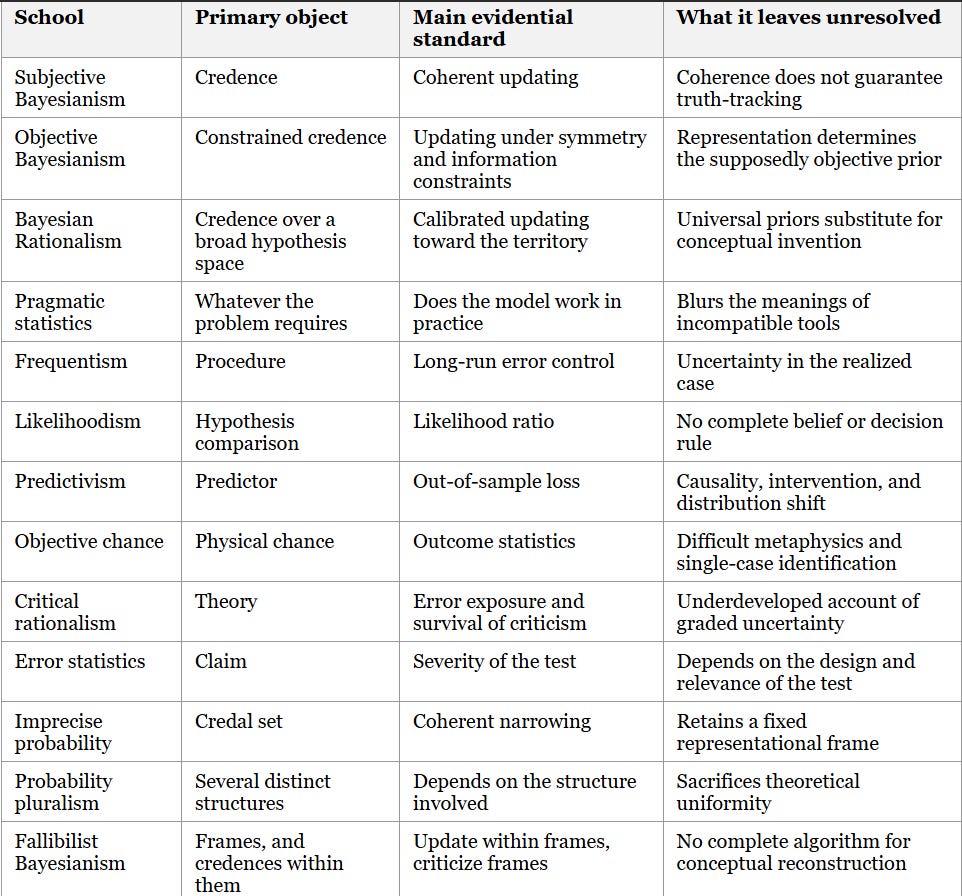
Fallibilist Bayesianism does not provide a mechanical procedure for inventing the next ontology or explanatory model. No existing school does.
Open-ended conceptual invention may resist full reduction to an update rule. A system can automate parts of hypothesis generation, causal discovery, and model revision. The search space still has to be represented somehow, and its failures may require another level of reconstruction.
Recognizing this gap is more rational than pretending it has already been solved.
Postscript
The probability schools are often presented as competing religions. In practice, each has identified something real.
Bayesians are right that uncertainty should respond coherently to evidence. Bayesian Rationalists are right that base rates, likelihood ratios, and graded belief belong in ordinary reasoning rather than remaining specialist statistical tools. Frequentists are right that procedures must be evaluated by their behaviour. Likelihoodists are right that evidential support can be distinguished from prior belief. Predictivists are right that models should succeed on data they were not trained to fit. Error statisticians are right that good evidence must come from tests capable of revealing error. Critical rationalists are right that knowledge grows through conjecture, criticism, and replacement. Probability pluralists are right that credence, chance, frequency, and measure should not be collapsed into one thing.
The recurring mistake is imperial expansion.
Credence becomes all probability. Conditionalization becomes all rational learning. Universal priors become substitutes for conceptual invention. Long-run performance becomes all evidential warrant. Falsification becomes all scientific judgment. Explanatory criticism becomes a reason to ignore degrees of uncertainty.
Rational inquiry includes several irreducible operations: representing uncertainty, comparing hypotheses, controlling error, testing generalization, identifying causes, exposing failed assumptions, and constructing new frames. Each operation has its own standards, and none can absorb the rest without losing information.
No single calculus owns rationality.