

The fertility collapse is usually argued at the wrong altitude. Conservatives blame feminism, liberals blame unaffordable housing, technologists blame phones, and economists blame incentives. Each explanation catches part of the phenomenon. None of them, by itself, explains why the decline tracks so reliably with prosperity itself.
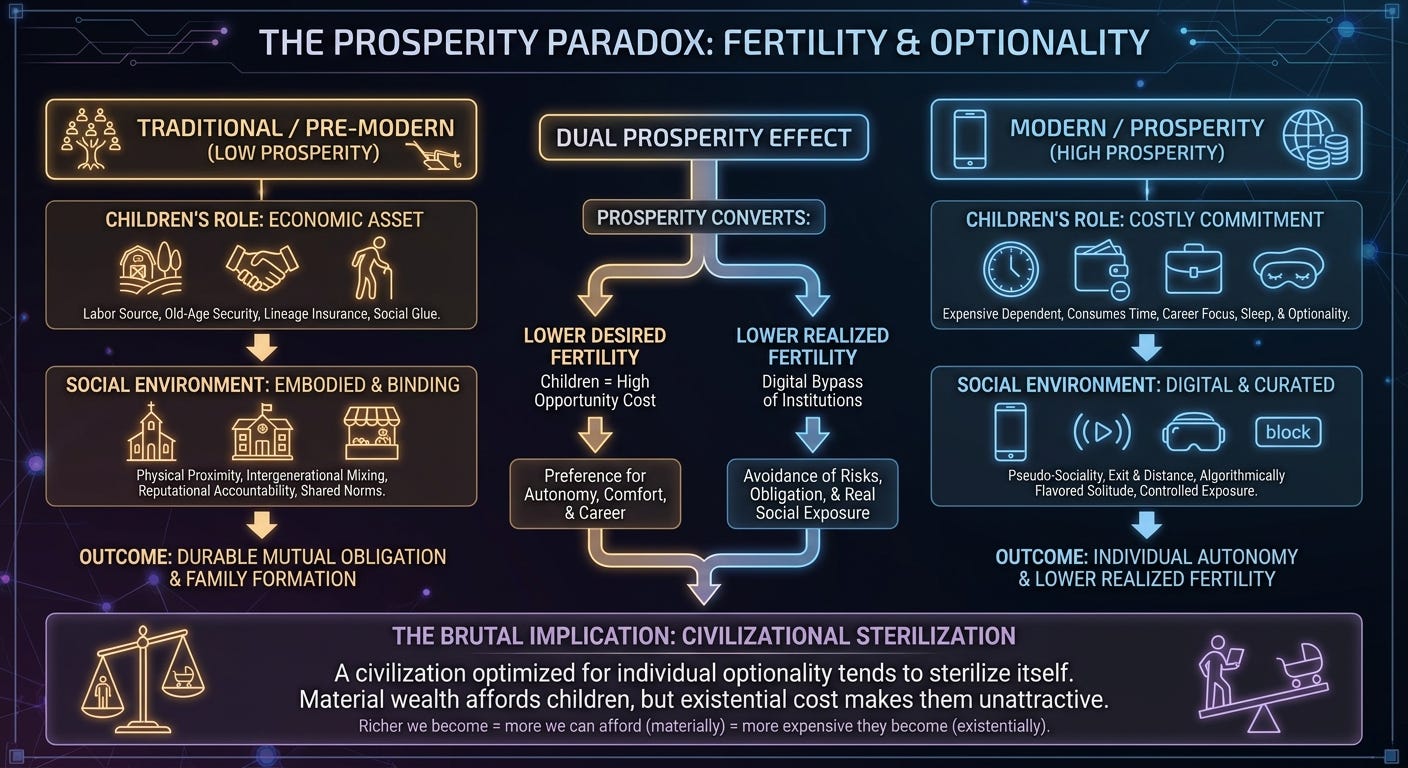
The deeper problem is that prosperity changes the role of children. In premodern life, children were economic contributors, lineage insurance, old-age support, household resilience, and social continuity. In modern affluent societies, children become expensive dependents requiring years of intensive parental investment. They consume money, time, sleep, mobility, career focus, romantic flexibility, and psychological bandwidth. The more optionality a society gives its members, the more costly children become, because children are the supreme anti-optionality commitment.
Richard Hanania adds a useful second layer. Modern prosperity does more than raise the opportunity cost of having children. It also lowers the cost of avoiding the social environments that produce children. Phones, streaming, remote work, porn, algorithmic entertainment, online communities, dating apps, and private living arrangements allow people to satisfy many social and hedonic appetites without entering the embodied, obligation-bearing spaces where courtship and family formation used to occur.
The key primitive is optionality. Prosperity lets people preserve optionality, and modern technology lets them consume pseudo-sociality while avoiding the risks of real social exposure. Real social life carries rejection, embarrassment, dependence, ambiguity, obligation, and constraint. Digital sociality offers curation, exit, distance, blocking, lurking, scrolling, ghosting, and control. It is socially flavored solitude with an escape hatch.
This explains why mere affordability arguments fail. A society can be richer than any society in human history and still produce fewer children, because aggregate wealth does not erase opportunity cost. A professional couple can afford a child in the narrow budgetary sense while still rationally seeing parenthood as a massive reduction in autonomy. Subsidies help at the margin, but a baby bonus does not compensate for twenty years of constraint.
It also explains why churches and similar institutions mattered. Their theology was only part of their function. They created repeated physical proximity, intergenerational mixing, visible courtship markets, reputational accountability, shared norms, and durable mutual obligation. The secular world has produced many recreational substitutes and very few binding substitutes. Gyms, hobby groups, conferences, Discord servers, coworking spaces, and dating apps rarely generate the same thick social ecology.
The fertility crisis is therefore best understood as a dual prosperity effect. Prosperity converts children from assets into costly commitments. Digital modernity then allows people to satisfy social drives while bypassing the institutions that historically produced families. One mechanism lowers desired fertility. The other lowers realized fertility.
The brutal implication is that a civilization optimized for individual optionality tends to sterilize itself. People do not need to hate children for fertility to collapse. They only need to prefer autonomy, comfort, career continuity, frictionless entertainment, controlled sociality, and reversible commitments. Modern life offers all of those in abundance. Children require the opposite: durable constraint, embodied dependence, long-term coordination, and irreversible attachment.
That is the actual prosperity paradox. The richer we become, the more we can afford children in material terms, and the more expensive they become in existential terms.