

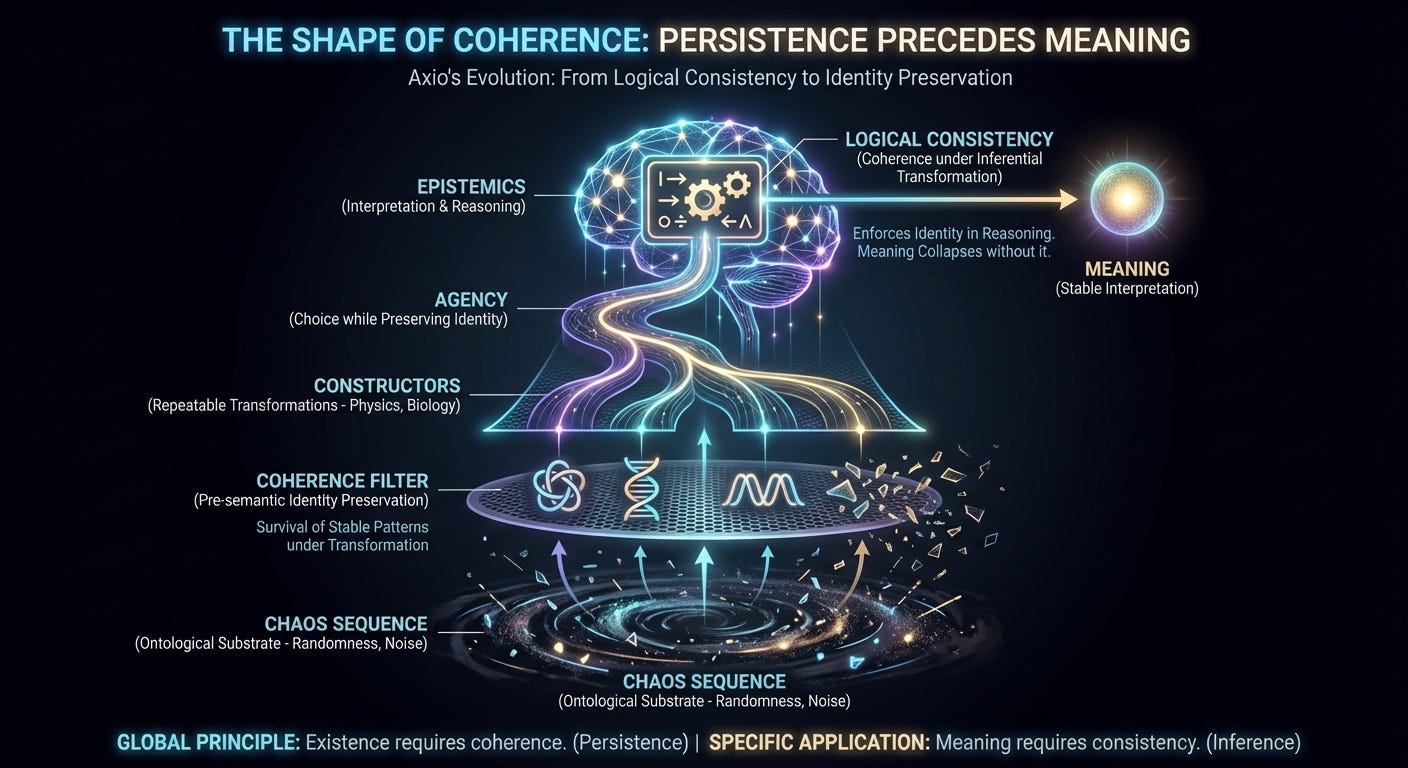
Coherence as an Axionic Problem
From its earliest formulations, Axio treated coherence as indispensable. The intuition was uncompromising: without coherence, reasoning collapses, ethics becomes arbitrary, and discourse loses any claim to meaning. Early Axio writing therefore elevated coherence—understood in the standard philosophical sense of logical consistency—to a position of unusual importance. This move followed directly from Conditionalism, which holds that all truth claims are conditionally true relative to background assumptions, and that those assumptions must hang together coherently for interpretation to occur at all.
That intuition remains correct. What has changed is the depth at which coherence is now understood to operate.
The introduction of the Chaos Sequence forced Axio to confront a question that epistemics alone cannot answer. Before beliefs can be consistent or inconsistent, before claims can be interpreted or evaluated, something must persist long enough to be interpreted in the first place. Once Chaos is taken seriously as an ontological substrate—an overwhelming space of possible descriptions dominated by randomness—logical consistency alone cannot carry the explanatory load coherence was previously asked to bear.
Chaos and the Failure of Consistency as a Foundation
Algorithmic information theory makes this pressure explicit. Almost all real numbers are incompressible infinite bitstrings. Almost all descriptions are noise. Consistency is cheap in such a space. Randomness does not contradict itself. Vacuity is perfectly consistent. Yet none of these persist as patterns under transformation. They fail to hold together.
Chaos reframes the problem. The relevant question is no longer whether a description avoids contradiction, but whether a pattern can survive change without dissolving. Persistence, not correctness, becomes the bottleneck.
This shift forces a refinement in what Axio means by coherence.
Coherence as Identity Preservation
Axio now defines coherence in deliberately pre-semantic terms. Coherence is the property of a pattern for which a stable identity can be preserved across transformation. A pattern counts as coherent if there exists at least one non-degenerate mapping under which it can be re-identified as the same pattern across time, perturbation, or update.
This definition does not invoke meaning, belief, truth, logic, or interpretation. It applies equally to physical attractors, biological organisms, stable algorithms, social institutions, and artificial agents. Most of Chaos is neither coherent nor incoherent; it is pre-coherent. It never survives long enough to qualify for filtering at all.
The language of “re-identification” here does not presuppose an observer, an act of recognition, or a semantic criterion of sameness. A mapping counts as non-degenerate only insofar as it preserves the pattern’s continued viability under the same constraints that produced it. Identity is therefore fixed by survivability under constraint, not by interpretation or recognition. Patterns that admit arbitrarily loose mappings do not survive coherence filtering, because such mappings fail to preserve constraint satisfaction across transformation.
Once coherence is understood this way, coherence filters cease to look metaphorical. Patterns that cannot preserve identity across transformation simply disappear. Nothing evaluates them. Nothing rejects them. They fail structurally. Patterns that remain identifiable persist. Constructors—repeatable transformation patterns—are what remain after this filtering has done its work. Physics appears, in this view, as the regularities of what survived Chaos long enough to matter.
Agency has not entered the picture yet. Neither has interpretation.
Where Logical Consistency Fits
At this point, the status of logical consistency becomes clearer. Its importance was never overstated; its scope was mislocated. Logical consistency is not coherence itself. It is coherence applied to a specific class of transformations: inferential ones.
Inference is symbolic transformation governed by rules of reasoning. Within that domain, identity preservation matters just as much as it does in physics or biology. Logical consistency can therefore be understood precisely as coherence under inferential transformation.
This reframing clarifies why inconsistency becomes dangerous when it does. The problem is not the mere presence of contradiction. The problem is inferential identity collapse. Collapse occurs when contradictions propagate without containment, destroying the boundary that allows a system to remain identifiable as a single theory. When that boundary dissolves, interpretation loses traction because re-identification fails.
This also explains why coherent agents routinely tolerate local inconsistency without collapsing. Belief revision, scientific progress, biological regulation, and paraconsistent reasoning all involve managing internal tension in ways that preserve global identity. Vacuous consistency preserves nothing of interest. What matters is whether the system remains trackable as itself under reasoning.
Recovering the Force of Sacred Coherence
Early Axio essays that elevated coherence retain their force once their domain is clarified. Those essays concerned epistemics: interpretation, justification, ethics, and reasoning under assumptions. Epistemic systems exist entirely within inferential transformation. For them, logical consistency is indispensable because it is the coherence constraint that preserves identity under reasoning. Meaning collapses when inferential identity collapses.
Seen this way, the original intuition behind Sacred Coherence stands intact. The refinement lies in recognizing that epistemic coherence is a specialization rather than the foundation of coherence itself.
The Axio Stack Clarified
With the distinction made explicit, the Axio stack stabilizes. Chaos supplies maximal possibility. Coherence selects identity-preserving patterns. Constructors enact repeatable transformations. Agency introduces choice while preserving identity. Epistemics adds interpretation. Logical consistency enforces coherence at the inferential level.
Logic governs meaning. Coherence governs persistence.
Postscript
Coherence was never abandoned. It was deepened. Once Chaos is taken seriously, coherence must refer to identity that survives change. Once interpretation begins, that same invariant reappears as consistency under inference.
Existence requires coherence.
Meaning requires consistency.
Those claims no longer compete. They describe the same structural constraint, operating at different depths.