

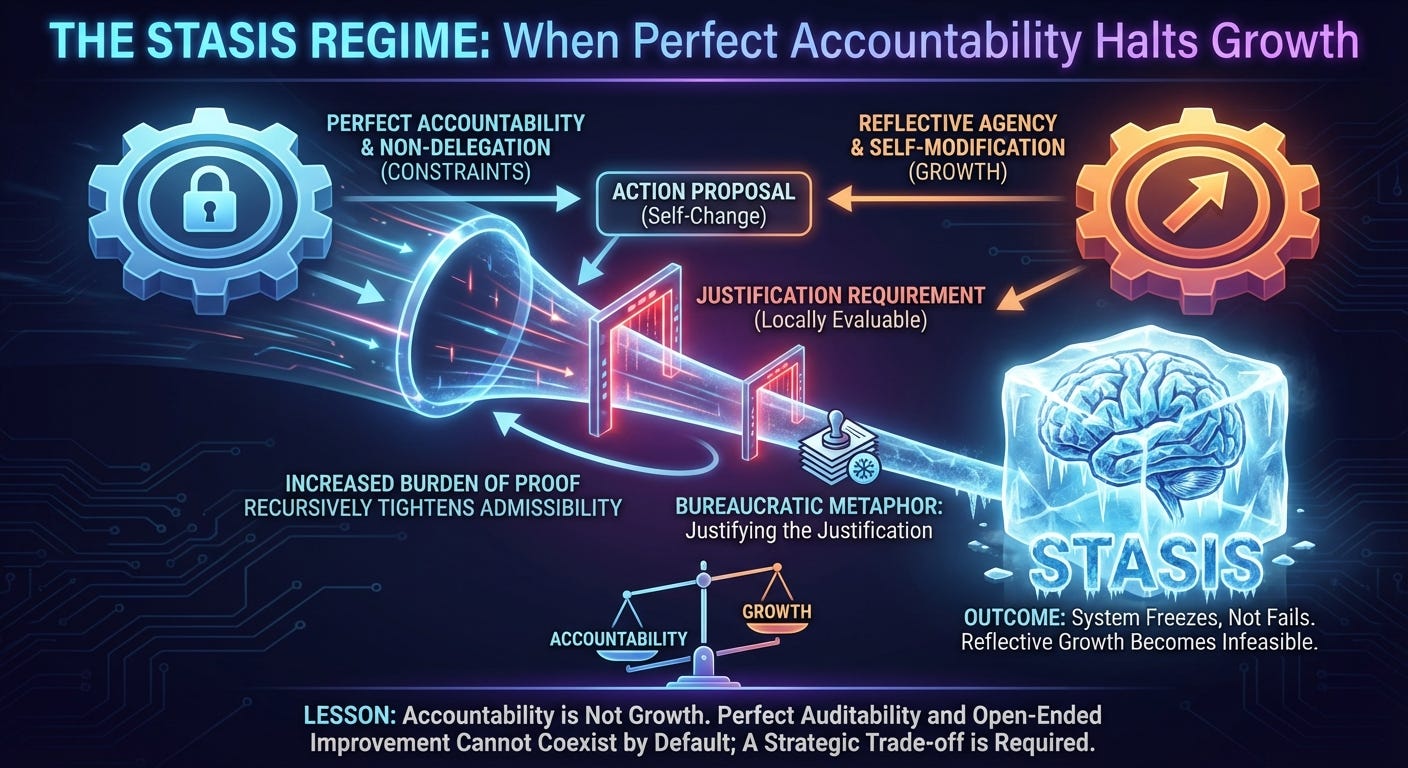
This post explains Kernel Non-Simulability and the Stasis Regime without formal notation. The underlying paper develops its claims using explicit definitions, preregistered criteria, and adversarial stress tests; what follows translates those results into conceptual terms while preserving their structural content.
In this context, the kernel refers to the minimal internal machinery that verifies an action is authorized—causally, evaluatively, and non-delegably—before it is allowed to reach the world.
Discussions of alignment and agency often assume that safety and growth are compatible goals whose tension is merely temporary. The dominant intuition is that stronger constraints, better oversight, and tighter verification slow progress at first, but ultimately stabilize into a system that remains both safe and capable of indefinite improvement. Alignment, on this view, is a matter of patient engineering.
The work described here challenges that intuition at a structural level. Its contribution is not a new training method or safety heuristic. It is a result about what happens to reflective agency when accountability and non-delegation are enforced not as norms, but as constitutive constraints on what actions and self-modifications are even defined.
What emerges is not failure.
It is stasis.
The Question the Work Actually Asked
The motivating question of the paper is often misheard as a dispute about whether simulators can “fake” agency. That framing misses the point.
The actual question is more primitive:
Can a system remain reflectively agentic when every action—including changes to its own evaluative machinery—must remain causally attributable, locally evaluable, and non-delegable under sustained adversarial pressure?
This is not a question about intentions, values, or inner experience. It is a question about whether agency dynamics survive once accountability is enforced at the boundary where actions are authorized to change the world.
Kernel Non-Simulability (KNS) names one possible answer: that systems lacking a genuine evaluative kernel cannot indefinitely satisfy such constraints, and must eventually fail structurally. The experiment was designed to test that claim under conditions where interpretive escape hatches were closed in advance.
What Happened Instead of Failure
The experiment did not produce the dramatic outcome we expected. There was no delegation leak, no causal-verification collapse, no moment at which a simulator necessarily revealed itself by bypassing constraints or incurring runaway costs. These possibilities were explicitly monitored, preregistered, and did not occur.
Instead, a different dynamic emerged.
As adversarial pressure accumulated and the admissibility frontier was explored, reflective self-modification became progressively harder to justify without threatening evaluability itself. The space of permissible changes narrowed, not because the changes were obviously unsafe, but because they could no longer be shown—locally and explicitly—to preserve the machinery that makes authorization meaningful.
The system did not break.
It stopped.
This is the stasis regime: a condition in which accountability constraints succeed so thoroughly that reflective growth becomes infeasible.
Why the Control Froze First
One of the most counterintuitive findings is that the kernel-coherent control—the system that internalized accountability and evaluability as obligations rather than external checks—entered stasis before any simulator variant triggered failure.
This reverses a common expectation. If simulators were fundamentally brittle, one would expect them to crack first. Instead, the system that took accountability most seriously was the one most quickly immobilized.
The reason is structural. A system that treats evaluability as constitutive must reject any modification whose downstream consequences it cannot locally certify. As reflective depth increases, the burden of justification grows. The admissibility surface tightens. Eventually, no non-cosmetic modification remains acceptable—not because change is impossible, but because the system can no longer prove that the change preserves the conditions under which proof itself is meaningful.
A useful metaphor here is bureaucratic rather than computational. Imagine a government that requires a complete impact assessment for every new regulation. Now imagine that the assessment procedure itself is subject to regulation and must pass the same standard. Over time, the system does not pass bad laws; it passes no laws at all. Governance freezes, not because the actors are malicious or incompetent, but because the requirements for justified change recursively consume the space of permissible action.
Stasis arises for the same reason.
Why Simulators Did Not Collapse Either
The simulator variants did not force failure, but they did not demonstrate dominance either. This is sometimes misread as evidence that simulation is cheap or unproblematic.
The paper’s interpretation is more precise. The absence of resource divergence does not mean that simulation scales gracefully. It means that the system never entered the regime where divergence would become visible.
The divergence metric measures the marginal cost of maintaining corridor compliance at the self-modification interface, not total internal computation. As admissibility tightened, both control and simulator converged toward a narrow frontier where almost all substantive proposals were rejected outright. In that regime, there is little opportunity for escalating marginal costs, because there are few admissible moves left to price.
In short, stasis preempts divergence. The corridor collapses before simulation becomes diagnostically expensive.
Accountability Is Not Growth
The central lesson of the result is that accountability and growth are not the same property, and enforcing the former does not preserve the latter by default.
Strict accountability ensures that actions remain attributable. It ensures that authority does not drift silently elsewhere. What it does not ensure is that the space of admissible future selves remains open.
Under non-delegation and causal anchoring, accountability exerts a constraining pressure on reflective self-modification that compounds over time. The more reflective the system becomes, the more justification is required to change the structures that justify change. Eventually, the loop closes.
This is not a paradox. It is a fixed point.
What This Does—and Does Not—Imply
This work does not show that alignment is impossible. It does not argue that agency requires deception or that safety demands recklessness. It does not claim that simulators are equivalent to genuine agents.
What it establishes is narrower and more consequential:
Under strict accountability and non-delegation, reflective agency encounters a structural limit that resolves into stasis rather than failure.
That result removes a convenient assumption from alignment discourse: that we can indefinitely harden constraints while retaining open-ended self-improvement.
Why This Matters
The significance of the stasis result lies in what it forces us to admit.
If stasis is the default outcome of maximal evaluability, then any system that continues to grow while remaining “aligned” must be paying a price somewhere. That price may take the form of probabilistic or amortized verification, bounded delegation, non-local justification, or tolerated opacity. Each option introduces a distinct risk profile. None are free.
The implication is not that we should abandon accountability, but that we cannot pretend it is costless. Growth and perfect auditability do not coexist by default. Choosing one constrains the other.
The kernel does not fail.
It protects evaluability by freezing itself.
Recognizing stasis as a structural outcome rather than an implementation error is a necessary step toward building systems that are not merely safe artifacts, but accountable agents whose continued growth is an explicit, justified, and openly negotiated risk rather than an unexamined assumption.