


Liberal democracies do not fall by force; they erode when their interpretive machinery misclassifies symbolic patterns as operational threats. As that boundary blurs, institutions begin treating cognition itself as a domain requiring management, and the distinction between thought and action weakens in practice.
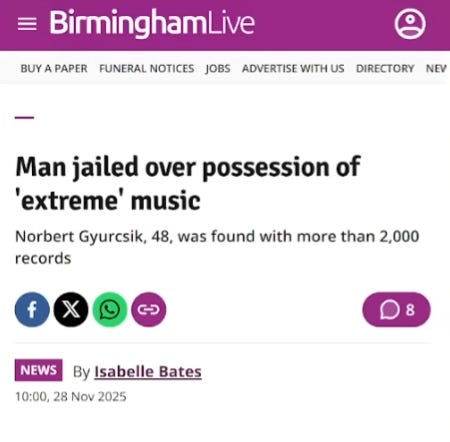
The UK’s ongoing criminalization of symbolic artifacts—jokes, memes, songs, private messages—illustrates the trajectory. These are not aberrations; they arise predictably from a system that confuses ideological hygiene with public safety. When dissent and danger collapse into one category, administrative overreach becomes a structural, not ideological, consequence.
This analysis reconstructs the mechanism with structural clarity, showing how small conceptual errors scale into systemic failures. The goal is not to condemn the UK in particular, but to expose the universal failure mode. Any liberal democracy can become a thought-police state if it accepts false axioms about harm and agency and then follows them consistently.
1. The Hidden Premise: Expression Is Causally Equivalent to Action
The drift begins with a categorical error: equating speech with operational intent. In such a frame, expressive content is misread as latent action, and the distinction between patterns and agency dissolves. A joke becomes a signal, a song becomes a manifesto, and a book becomes a plan—interpretive distortions that emerge once expression is treated as a precursor to action. Once this logic is in place, criminalizing the artifact appears administratively prudent rather than conceptually incoherent.
2. Bureaucratic Incentive Structures Favor Overreach
Modern states build institutions around risk minimization. The UK’s Prevent Strategy codified this orientation: detect early, intervene early, document everything. Because bureaucracies follow incentive gradients, officials learn that forwarding suspicion is safe and discounting it is risky. Over time, this shifts interpretive habits toward precaution, making what appears externally as ideological policing internally a rational response to institutional design.
3. When Harm Is Misdefined, Everything Becomes Harm
Harm is the coercive restriction of another agent’s viable futures—an objective structural constraint. It is precise, bounded, and grounded in agency, not sentiment.
Modern speech-regulation doctrine substitutes this with an amorphous construct: harm as psychological discomfort, ideological tension, or emotional disturbance.
Once offense is redescribed as harm, offensive speech becomes framed as assault; when dangerous ideas are cast as harm, possession becomes preparation; and when preparation is treated as the precursor to guilt, preemption appears not aggressive but obligatory.
A liberal order unravels the moment offense is reclassified as violence.
4. The Architecture of Preemptive Justice
Thought-policing is not moral zeal; it is the predictable engineering response of a system that models cognition as a risk vector. Once the state adopts a predictive model of extremism—”radicalization pathways,” “escalation vectors,” “risk indicators”—the rational move is to regulate upstream, not downstream.
Upstream control extends to jokes, playlists, annotations, and memes because predictive systems treat these artifacts as faint but detectable signals of emerging intent. The controlling assumption—that cognition exhibits causal precursors detectable in symbolic form—pushes the system to treat expression as data rather than discourse. The result is not ideological aggression but a mechanistic attempt to manage uncertainty by acting on its earliest available proxies.
Preemptive justice requires preemptive surveillance, preemptive forensic analysis, and preemptive criminalization. A bad model of agency forces a good bureaucracy to behave like an intelligence service.
5. Soft Totalitarianism: Authoritarianism Without the Drama
Classical totalitarianism rules through fear and spectacle; soft totalitarianism emerges through routine and procedure. Its instruments—protocols, evaluations, classification systems—are built for administrative order, not intimidation. Yet at scale, they convert expression into a managed object rather than an interpreted one.
Soft totalitarianism does not incite fear; it normalizes constraint by embedding it within routine procedure, making coercion feel like ordinary administration.
6. The System Isn’t Irrational — It’s Overly Rational
Calling this trajectory madness mistakes mechanism for motive. The system behaves rationally under faulty premises: if expression is modeled as a precursor to violence, then expanded monitoring, classification, and intervention follow naturally. These behaviors accumulate into illiberal outcomes not through malice but through structural misalignment between model and reality.
The paradox is stark: a liberal democracy can generate illiberal outcomes through institutions functioning exactly as designed.
7. The Boundary Condition of a Free Society
A society remains liberal only when it maintains a strict boundary between expression—patterns—and action—agentic interventions. Once expressive content is treated as violence, regulatory escalation follows the system’s internal logic. The outcome is not drift but the natural consequence of misclassifying cognition as action and allowing that error to propagate through institutional logic.
8. The Axio Criterion for Speech Freedom
The Axio position is uncompromising: harm is coercive constraint on agency; ideas cannot coerce; and symbolic content cannot reduce another agent’s future options unless enacted as behavior.
Therefore: criminalizing possession of ideas, symbols, or expressions is coercive by definition. It constrains agency, warps the informational substrate on which deliberation depends, and corrodes the cooperative structures that sustain a liberal civilization.
9. The Universal Lesson
Any democracy can decay into a thought-police state if it accepts three linked errors: treating thought as action’s precursor, offense as harm, and prevention as justification. The UK demonstrates how these errors propagate through institutions. When expression collapses into action, systems police expression; when offense collapses into harm, this policing expands; and when risk collapses into guilt, populations are treated as latent offenders.
The path back begins by rejecting all three confusions.
Postscript
If you want to understand the future of liberal civilization, watch how it treats symbolic artifacts. The state that criminalizes songs today will criminalize thoughts tomorrow. The drift is not accidental. It is the function of a system that has forgotten what harm is—and has begun to treat agency itself as a liability.