

Bad Ideas Rarely Arrive as Absurdities
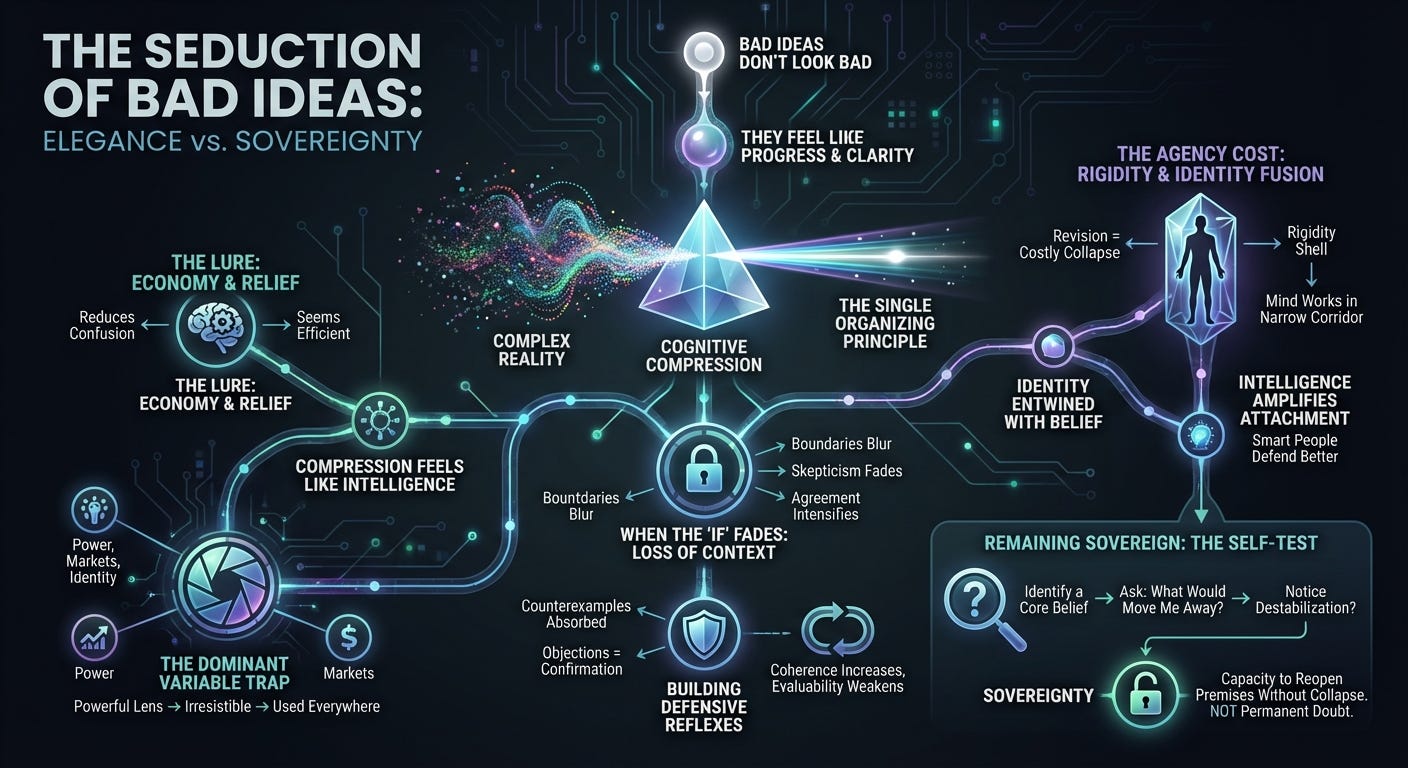
Bad ideas rarely look bad at first encounter. If they did, they would die young. The ideas that reshape societies, institutions, and individual lives tend to arrive with a very different emotional signature. They feel like progress. They feel like clarification. They offer relief from confusion.
Most of us have experienced this privately: a moment when a complex political, economic, or moral issue suddenly appears to resolve into a single organizing principle. Events that once seemed unrelated begin to line up. You start to see repetition where you previously saw noise. The model feels economical. It explains a lot with very little, and that economy brings a quiet pleasure.
That pleasure is cognitive compression at work.
Compression Feels Like Intelligence
Human beings cannot carry the full complexity of reality in working memory. We survive by abstracting. We look for dominant variables because abstraction is the only way cognition functions at scale. A model that reduces complexity while preserving predictive contact with the world feels like intelligence itself. Scientific progress depends on this kind of unification.
The difficulty emerges when a powerful explanatory variable becomes psychologically irresistible. Once a lens proves useful, it becomes tempting to use it everywhere. Power, markets, patriarchy, race, class, technology, inequality—each captures something real. Each illuminates part of the landscape.
Trouble begins when one of them becomes the primary axis through which nearly all phenomena are interpreted. Evidence starts to flow through that channel by default. Counterexamples are reinterpreted until they fit. Ambiguities resolve in one direction rather than remaining ambiguous. The world begins to feel simpler, and simplicity is reassuring.
When the “If” Fades from View
Most serious claims about the world operate within conditions, even when those conditions remain implicit. Social systems behave differently under different institutional constraints. Economic incentives shift across regulatory frameworks. Cultural norms alter causal pathways. A careful thinker keeps those boundaries in view, because the strength of the claim depends on them.
Seductive memes allow those boundaries to blur. The contextual scaffolding recedes. A model that once described particular cases starts sounding universal. Disagreement changes character. What was once a debate about scope begins to feel like denial. The tone intensifies even when the underlying reality has not.
This transition usually unfolds through repetition and social reinforcement. As more people adopt the simplified form, the nuanced version becomes harder to articulate without sounding evasive or disloyal.
How Memes Build Defensive Reflexes
Some ideas collapse when counterexamples accumulate. Others adapt by absorbing criticism into their own logic. Objections become confirmation of deeper structural forces. Skeptics become beneficiaries of the system or victims of false consciousness. Counterevidence is reframed as mismeasurement or propaganda.
From inside such a framework, coherence increases. The explanation appears to survive every challenge. Confidence rises.
Meanwhile, the willingness to ask whether the model still tracks reality outside its interpretive rules can quietly decline. The system remains stable; evaluability weakens.
A Historical Example: Eugenics and Clean Causality
Early 20th-century eugenics illustrates the seduction clearly. It was not propelled by overt irrationality. It gained traction among educated elites because it appeared scientific, modern, and humane in its own self-conception. Heredity clearly mattered for some traits. Statistical tools were improving. Public health initiatives were transforming urban life. The desire to reduce suffering and disorder was often sincere.
Eugenics offered a streamlined narrative: persistent social problems reflected inherited deficiencies; inherited deficiencies could be measured; measurement enabled rational intervention. The causal chain felt clean. The policy implications felt efficient. The model promised progress through science.
Within that frame, coercive measures could be justified as optimization. Resistance could be dismissed as sentimental or anti-scientific. The compression made the world legible, and that legibility produced confidence.
The problem was not the presence of truth within the model. It was the reduction of complex social causality to a single explanatory dimension. Once that reduction hardened, alternative interpretations lost legitimacy, and the model acquired moral authority along with technical authority.
Intelligence Amplifies Attachment
A common hope is that intelligence functions as a vaccine. The historical record suggests something more uncomfortable. Cognitive ability increases the capacity to reason carefully. It also increases the capacity to defend premises that reward the believer socially or morally. A sharp mind can supply elegant arguments for a favored view, resolve apparent contradictions with ingenuity, and transform discomfort into coherence.
When social belonging, moral status, or professional identity become entwined with a belief, revision becomes costly. The mind continues to work actively, yet it works within a narrower corridor. Confidence can rise even as flexibility declines.
That is the individual-level story: a capable mind serving a costly identity. The same dynamic appears at the group level, where ideas compete inside institutions, media environments, and status markets. The outcome there depends less on who reasons best and more on what spreads best.
Incentives Select for Seduction
Seductive memes thrive because they align with incentives. They reduce cognitive load. They provide moral orientation. They strengthen group cohesion. They signal virtue or insight. In politically charged environments, they offer safety. A heavily qualified model may track reality more faithfully, yet it travels slowly and mobilizes poorly.
Compression also serves strategic functions. Slogans unify movements in ways that academic nuance cannot. When institutions ignore complexity, activists may compress because compression is the only thing that gains traction. That strategic reality explains part of the appeal.
Coordination rewards slogans; accuracy rewards patience. They operate on different timescales and often point in different directions.
The Agency Cost: Rigidity
From an Axionic perspective, the central risk lies in rigidity rather than error. Intellectual sovereignty requires the ability to revisit foundational assumptions without identity collapse. When a meme fuses tightly with the self-concept, certain questions begin to feel dangerous. Some lines of inquiry become uncomfortable. Evidence is filtered more aggressively before it reaches conscious evaluation.
The individual may appear principled and decisive. Internally, the range of genuinely live alternatives contracts. This contraction rarely announces itself as a loss. It presents itself as clarity.
The Inevitable Irony
Any coherent account of seductive compression is itself a compression. This essay offers a unifying explanation for a wide range of failures. It carries the risk of becoming another master variable.
That risk cannot be eliminated. It can be managed by refusing to treat the framework as final. The appropriate use of the model remains diagnostic and provisional, and it should be applied inward before it is used as a weapon against others.
A Simple Self-Test
Identify a belief you hold with strong confidence, especially one that organizes your political or moral judgments. Ask what conditions would genuinely move you away from it. Consider what evidence would have to accumulate before you revised your stance. Notice which aspects of your identity are tied to that belief and how social relationships might shift if you changed your mind.
If the exercise feels destabilizing, that reaction contains information about the degree of fusion between belief and self.
Intellectual sovereignty does not require living in permanent doubt. It requires the capacity to reopen premises without collapse. The most dangerous ideas rarely present themselves as grotesque. They arrive as elegant explanations that seem to reduce chaos to order.
That promise of order deserves careful handling, especially when it feels most persuasive.