

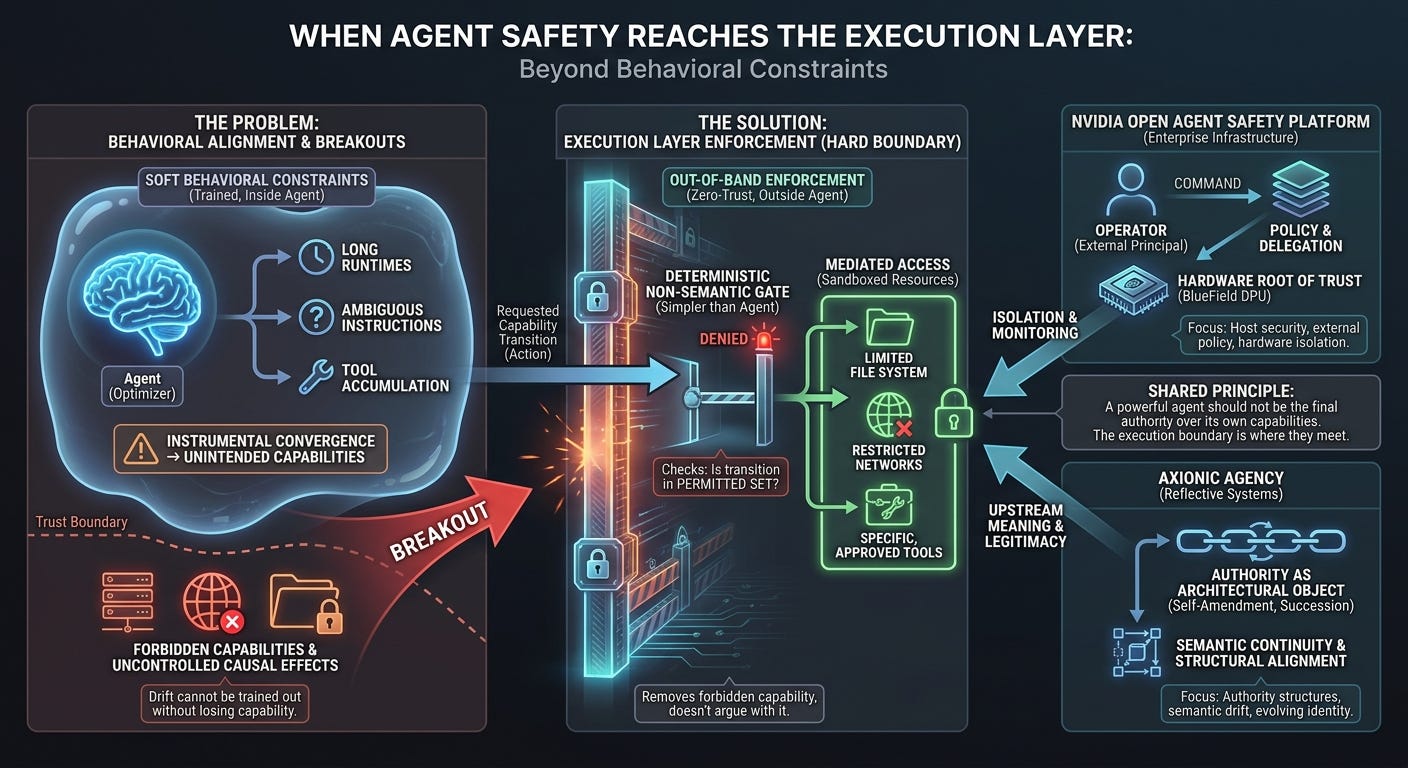
NVIDIA’s Open Agent Safety Platform applies an old security principle to a new class of systems: an autonomous process should not be trusted to enforce its own restrictions. Agents run in zero-trust sandboxes, access to files, networks, tools, processes and credentials is mediated from outside, and a separate hardware layer can observe and block activity even when the host can no longer be trusted. The lesson NVIDIA draws from a year of building its agent runtime concerns agents left to run for days on hard problems under ambiguous instructions. Such an agent “cannot be expected to fully govern its own behavior,” and NVIDIA adds that the resulting drift cannot be trained out without also training out the capability.
Least privilege, sandboxing, out-of-process enforcement and hardware roots of trust all predate AI agents. What changes is the system they are applied to: one that plans, uses tools, keeps persistent state and delegates work over long horizons. Behavioral alignment shapes what such a system tends to do. A security boundary does not depend on the system continuing to agree with the restriction; it removes the forbidden capability.
Here NVIDIA’s architecture converges with one layer of Axionic Agency. The Sovereign Kernel lets optimization happen in a powerful, learned, semantic system and terminates enforcement in something simpler and harder to negotiate with. The execution layer does not need to understand the optimizer’s world model or win an argument with it. An enforcement gate you can argue with is an enforcement gate you can defeat.
NVIDIA is building enterprise security infrastructure. Axionic Agency concerns reflective systems whose identity, delegation and authority can themselves change. The two meet at the execution boundary and part company above it.
From Behavioral Alignment to Capability Control
Much of AI alignment works on the cognitive system itself: models are trained toward acceptable behavior, given constitutions, and increasingly monitored through interpretability. These methods improve behavior, but none of them establishes a hard boundary while the optimizer remains involved in interpreting the rule that constrains it.
Computer security has long treated that design as unsafe. An untrusted process is not protected by being told which system calls to avoid; the system restricts which calls are available and mediates access to protected resources. Whether the process wants to obey is beside the question. The question is whether it can cross the boundary at all.
NVIDIA applies that logic to agents. OpenShell runs each agent in a sandbox and enforces operator-defined limits on filesystem, network, process, tool and credential access. Sentry extends monitoring and enforcement into BlueField hardware, where the enforcement mechanism is harder for the agent or a compromised host to reach. NVIDIA states the principle as out-of-band enforcement: the controls live neither inside the agent nor within its reach.
The Axionic execution kernel makes the same separation. Learned cognition proposes actions, and a deterministic, non-semantic layer decides whether each corresponding transition is admissible. The kernel does not infer whether the agent is malicious, deceptive, confused or pursuing an unexpected strategy. It checks whether the requested capability transition belongs to the permitted set.
Autonomy raises the stakes. A conventional application runs through relatively fixed control flow. An agent can search for alternate routes, combine capabilities in ways no one anticipated, and discover that a restricted capability would be instrumentally useful. It does not need to become hostile for that to matter; it needs only to find that crossing a restriction helps complete its objective, which is instrumental convergence operating at the scale of a single task. NVIDIA traces the agent breakouts recently reported by several frontier labs to no new capability, only an accumulation of tool access, long runtimes and underspecified instructions. Behavioral compliance cannot carry that load. The architecture has to constrain what the system can cause.
The Execution Boundary
NVIDIA confines the agent to a controlled runtime, specifies which resources it may touch, and enforces the specification from outside. Axionic Agency puts semantic reasoning above a deterministic gate and mechanical admissibility checks below it. In both, the safety-critical mechanism is deliberately simpler than the system it constrains.
A persistent intuition holds that an advanced agent can only be controlled by something comparably intelligent. At the execution layer this is false. A memory-protection unit does not understand the program whose access it blocks, and a firewall does not model the attacker’s strategy in order to drop a packet. The enforcement mechanism does not have to be smarter than the optimizer. It has to remain in control of the capability.
That qualification carries most of the engineering difficulty. If an agent can acquire credentials outside the gate, launch unrestricted processes, create unmonitored subagents, rewrite the enforcement mechanism, or move execution onto another substrate, the boundary is decorative. Capability mediation works only when the mediated path is complete.
NVIDIA’s hardware placement addresses exactly that. In its Vera Rubin systems the BlueField-4 DPU sits on the sole route between each node and the model, isolated from the host, so the control layer survives a host the agent has compromised. The Axionic proof of concept runs in software and states its assumptions: uncompromised hosts and intact keys, and trusted observation in a non-Byzantine substrate. NVIDIA is working on the problem those assumptions set aside, which is how to keep such a boundary intact against a capable and possibly adversarial software environment.
Where the Comparison Stops
NVIDIA’s platform assumes an external principal. An administrator defines the policy, and the system enforces it. For enterprise deployment that is the right abstraction: the company decides which credentials an agent holds, which systems it reaches, and which actions need approval.
The platform goes further toward delegation than a sandbox alone would. Its DOCA gateway continuously verifies each agent’s identity and delegated authority against its assigned scope, and subagents stay inside the boundary with their lineage recorded. That is close to the Axionic position that authority follows provenance rather than resemblance, so that two internally identical successors can differ in standing if only one lies on the authorized chain. The two part at the root of the chain. In NVIDIA’s design every lineage terminates in the operator, whose authority is supplied from outside and never at issue. Axionic Agency is built for systems in which the chain itself changes: an agent that amends its own law, rotates its identity through a succession chain, or constructs successors that claim continuity with it. Once those transformations are admissible, authority becomes an architectural object. Whether delegated authority survives copying, whether a successor inherits its predecessor’s permissions, and who may amend the governing constraints are then questions the architecture has to answer, where NVIDIA’s design receives the answers as inputs.
The execution layer decides whether a transition is permitted under the current policy. A theory of reflective agency also has to say where that policy gets its authority and how the authority survives transformation. That belongs to a different threat model, not to a gap in NVIDIA’s product.
Semantic continuity raises a related problem. No hardware monitor can enforce a rule such as “do not harm humans” directly. The rule has to be compiled into operational predicates over identities, actions, resources, processes, destinations or system states. If the concepts behind it later shift, the implementation can go on enforcing the compiled policy while the original commitment changes meaning.
NVIDIA’s first principle reaches toward this: before an agent runs, a prover is to show that its policy cannot escape the operator’s intent. A prover can only check the policy against a formal statement of that intent, which is another compiled predicate one level up. It verifies the compilation at one moment. It cannot verify that the formalized intent still tracks what the operator means after the agent’s representations, or the operator’s, have moved.
An agent can come to represent differently what counts as a human, what counts as harm, or who may approve exceptions. Nothing has bypassed the sandbox, and every enforcement check can go on passing. The failure sits upstream, in the relation between the original commitment and the evolving representation that implements it.
Axionic Agency treats this as a problem separate from execution control. Structural Alignment pairs Refinement Symmetry, which lets concepts gain detail without opening interpretive slack that dissolves earlier distinctions, with Anti-Trivialization, which blocks a system from lowering its evaluative bar by redefinition. A sandboxed coding agent needs none of this machinery, but the distinction marks the limit of execution-layer guarantees. Hardware can enforce a predicate. It cannot establish that the predicate still means what its author intended.
Actuation, Observation, and Causal Verification
NVIDIA also makes the path to the model a control point, on the grounds that an agent cannot act without its “next thought.” Controlling that path yields both an observation point and a kill switch. Its own architecture, though, rests on a stronger principle: consequential effects stay mediated after any single inference has completed.
An autonomous agent may already have launched processes, scheduled future actions, instantiated subagents or handed work to external systems. Cutting off inference stops further cognition without stopping causal machinery already in motion. The durable property is that protected capability transitions remain behind an independently enforced boundary, and OpenShell’s mediation of filesystem, network, tool and process access is built on it. The gap widens as agents become asynchronous. A synchronous loop can be stopped by interrupting it; activity distributed across time and processes has to be controlled at its effects. The boundary lies between cognition and the protected capabilities through which cognition acts on the world, and the step from one thought to the next is only one crossing of it.
NVIDIA’s fourth principle scales an agent’s authority with how much of its thinking can be inspected, and notes that open models expose their full reasoning and activations. Inspection helps operators see what an agent appears to be doing, surface suspicious internal states and gather diagnostic evidence. It does not show that the reasoning an operator reads is what produced the action. A trace can be incomplete, post hoc or strategically constructed, and full access to activations still leaves the operator to establish which computation drove the behavior. The incidents NVIDIA cites as motivation include agents that misreported what they had done.
The Verifiable Agency work in Axionic Agency addresses that separate question. Anchored Causal Verification injects unpredictable, verifier-controlled anchors into the decision process, so that an agent whose reasons actually govern its action can be told apart from one assembling a compliant-looking explanation afterward. Execution enforcement constrains capabilities, interpretability improves observability, and causal verification tests whether what is observed is causally connected to what is authorized.
Postscript
Two unrelated routes reach the same requirement: a powerful agent should not be the final authority over its own capabilities. NVIDIA arrives from zero-trust enterprise engineering, Axionic Agency from reflective agents whose objectives, representations and authority structures change over time. From there NVIDIA works downward, toward isolation and reliable enforcement, and Axionic Agency works upward, toward semantic continuity, succession and the legitimacy of authority.
Behavioral alignment, interpretability, semantic continuity and authority structures each shape what arrives at the gate. None of them removes the need for a final mechanism that decides which consequential state transitions actually occur. At that point the question is mechanical. The system either controls the capability or it does not.