

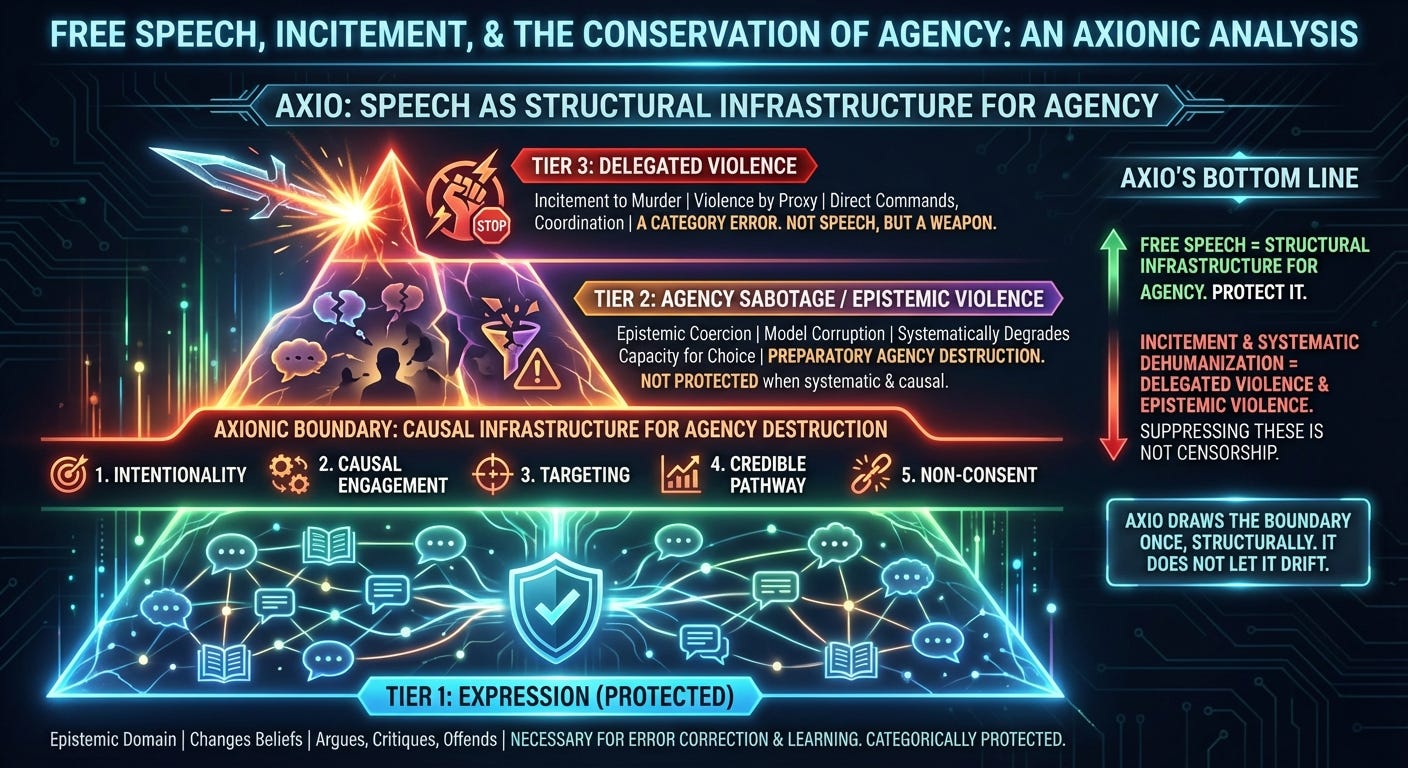
Debates about free speech reliably collapse into moral stalemate. One side insists that any restriction invites tyranny. The other insists that unrestrained speech enables atrocity. Both positions contain truth—and that is precisely why neither resolves the problem.
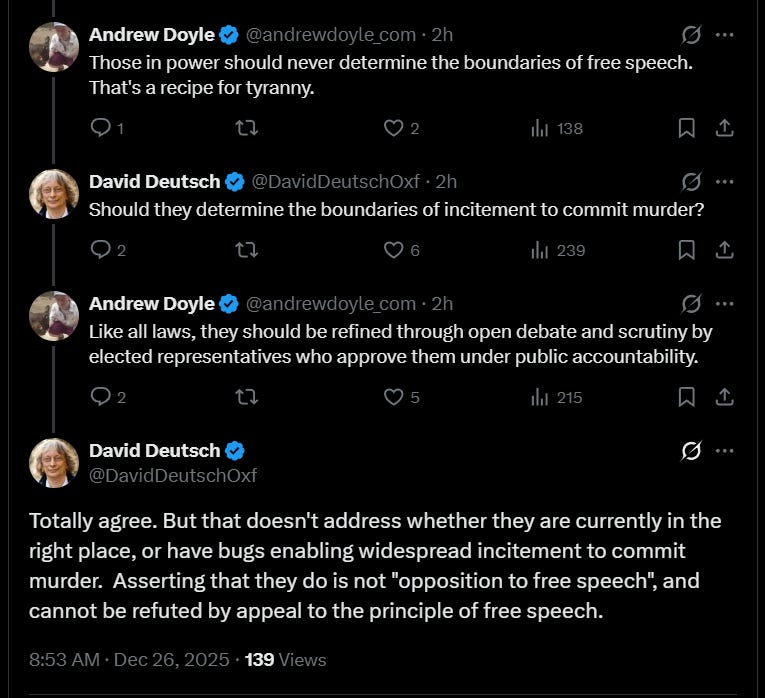
Axio approaches the issue from a structural layer. Free speech is treated as infrastructure for agency. Incitement to murder is treated as a distinct causal phenomenon that belongs to the domain of violence. When speech is classified by its functional role rather than by sentiment or ideology, the apparent paradox resolves into a tractable boundary problem.
1. Why Free Speech Matters (Axionically)
Axio begins from agency.
Agency requires the capacity to model the world, exchange interpretations, revise beliefs under criticism, coordinate voluntarily, and recover from error. These capacities depend on unconstrained expression. When expression is restricted, interpretation collapses into authority, disagreement narrows, and learning degrades into compliance.
Free speech therefore functions as structural infrastructure. It sustains the conditions under which truth-seeking, consent, responsibility attribution, and alignment remain meaningful. A society that constrains expression loses the mechanisms by which it corrects error and adapts over time.
This claim is systemic. It concerns how complex societies learn.
2. Reframing the Question
The usual framing asks where speech should be limited. That framing treats all utterances as belonging to a single category and invites discretionary trimming.
Axio applies a different framing:
What functional role does an utterance play within a causal system?
This framing shifts attention from moral evaluation to classification. It distinguishes between expression, preparatory agency interference, and operational violence. Each category follows different rules.
3. The Axionic Causal Ladder
Utterances participate in causal systems in different ways. Axio distinguishes three roles.
Tier 1 — Expression
Expression operates within the epistemic domain. It argues, critiques, advocates, persuades, offends, speculates, and provokes. Expression modifies belief states and interpretive models. It does not directly remove agency.
Expression remains protected across ideological, moral, and cultural variation. Emotional impact and offense do not constitute agency loss.
Tier 2 — Agency Sabotage / Epistemic Violence
Some communication functions as epistemic coercion. This occurs when messaging systematically degrades the audience’s capacity for reflective choice by collapsing moral distinctions, erasing individual personhood, disabling independent judgment, or framing violence as necessity, hygiene, or inevitability.
This mechanism operates by corrupting models rather than by issuing commands. Historical genocidal propaganda occupies this category. It conditions audiences prior to explicit coordination.
Epistemic violence constitutes preparatory agency destruction. It becomes relevant only when it exhibits systematic structure, directed audience effects, and causal linkage to downstream harm.
Tier 3 — Delegated Violence
Incitement to murder occupies the domain of violence. It includes commands, operational guidance, logistical coordination, and targeted encouragement where execution is a plausible outcome. At this stage, communication functions as an instrument within a physical harm process.
This category corresponds to delegated action. It produces irreversible agency loss.
4. The Axionic Test
An utterance exits the protected domain when it functions as causal infrastructure for non-consensual, irreversible agency destruction, whether preparatory or operational.
Five conditions jointly define this boundary:
Intentionality
The speaker intends agency destruction, directly or indirectly.Causal Engagement
The utterance materially increases the probability of irreversible harm by shaping beliefs, readiness, or coordination.Targeting
The harm is directed toward identifiable agents or classes.Credible Causal Pathway
A realistic causal graph connects the utterance to harm, including delayed or distributed pathways.Non-Consent
The targets have not consented to the harm.
Explicit instructions satisfy the test. Systematic dehumanization that predictably primes violence also satisfies the test.
The presence of hatred, dehumanizing language, or offensive rhetoric alone does not trigger intervention under this framework. Tier-2 classification requires demonstrated causal coupling to downstream harm, evidenced by observable effects on coordination, targeting, mobilization, behavioral intimidation (demonstrable inhibition of agency), or violence. In the absence of such coupling, expression remains protected. Regulation applies to causal participation in agency destruction.
5. Judgment and Constraint
This framework constrains judgment.
Authorities evaluate causal structure, reach, amplification, historical correlation, and audience susceptibility. These evaluations rely on observable behavior and evidentiary standards.
Evaluations do not extend to ideology, offense, moral worth, political alignment, or truth claims. This separation localizes subjectivity and preserves pluralism.
6. Existing Frameworks in Contrast
Modern free-speech doctrine reflects two dominant traditions.
U.S. First Amendment jurisprudence, crystallized in Brandenburg, emphasizes protection unless intent, imminence, and likelihood converge. This approach reflects historical awareness of power concentration risks and preserves dissent.
European hate-speech regimes emphasize early intervention based on historical association with mass violence. These frameworks treat certain forms of speech as inherently dangerous, expanding discretionary authority and political contestation.
Axio situates itself through the epistemic justification articulated by Karl Popper and sharpened by David Deutsch. Open criticism enables error correction. Error correction drives knowledge growth and civilizational learning.
Axio extends this insight structurally. Error correction depends on agents capable of revising their models. Murder removes agents. Epistemic coercion disables agency before physical harm occurs. Incitement, propaganda, and coordination disrupt the substrate on which error correction operates.
In networked societies, coordination unfolds across time and space. Axio retains intent-based restraint while replacing temporal immediacy with causal pathway analysis. Ideology remains outside the scope of regulation.
Free speech persists because it sustains error correction. Speech that destroys agents or disables their capacity to correct error occupies a different functional category.
7. Platforms and Amplification
Platforms participate in causal systems.
When algorithmic amplification routes epistemic violence to receptive audiences or optimizes engagement without regard to causal role, the platform becomes part of the harm pathway.
Intervention targets specific causal chains. Expression remains intact. Violence infrastructure does not.
8. Consent and Self-Destruction
Axio treats agency as owned by the agent. Consensual self-destruction falls within that scope.
Empirically, many real-world cases involve deception, coercion, or impaired agency and therefore satisfy Tier-2 criteria. These cases receive analysis through causal coupling rather than moral evaluation.
Axio does not impose compulsory preservation of agents for collective ends. This reflects a foundational value choice.
9. Boundary Stability
Frameworks fail symmetrically when boundaries drift.
Over-extension degrades error correction. Under-extension permits coordinated agency destruction. Axio stabilizes the boundary through classification by causal role.
Utterances occupy one of three roles: expression, agency sabotage, or delegated violence. Protection applies categorically to the first.
10. Closing
Free speech sustains agency.
Incitement to murder constitutes delegated violence.
Systematic dehumanization that demonstrably enables violence constitutes epistemic violence.
Intervention applies at the level of causal participation. The boundary remains structural and stable.
Axio draws this boundary once and maintains it through evidentiary constraint.
Hey, great read as always. Your articulation of free speech as structural infrastructure for agency, distinguishing its functional role from incitement, is truly insightful. It really makes me think about how essential those error correction mecanisms are, like debugging a complex system, for any society to actually function and evolve properly.