

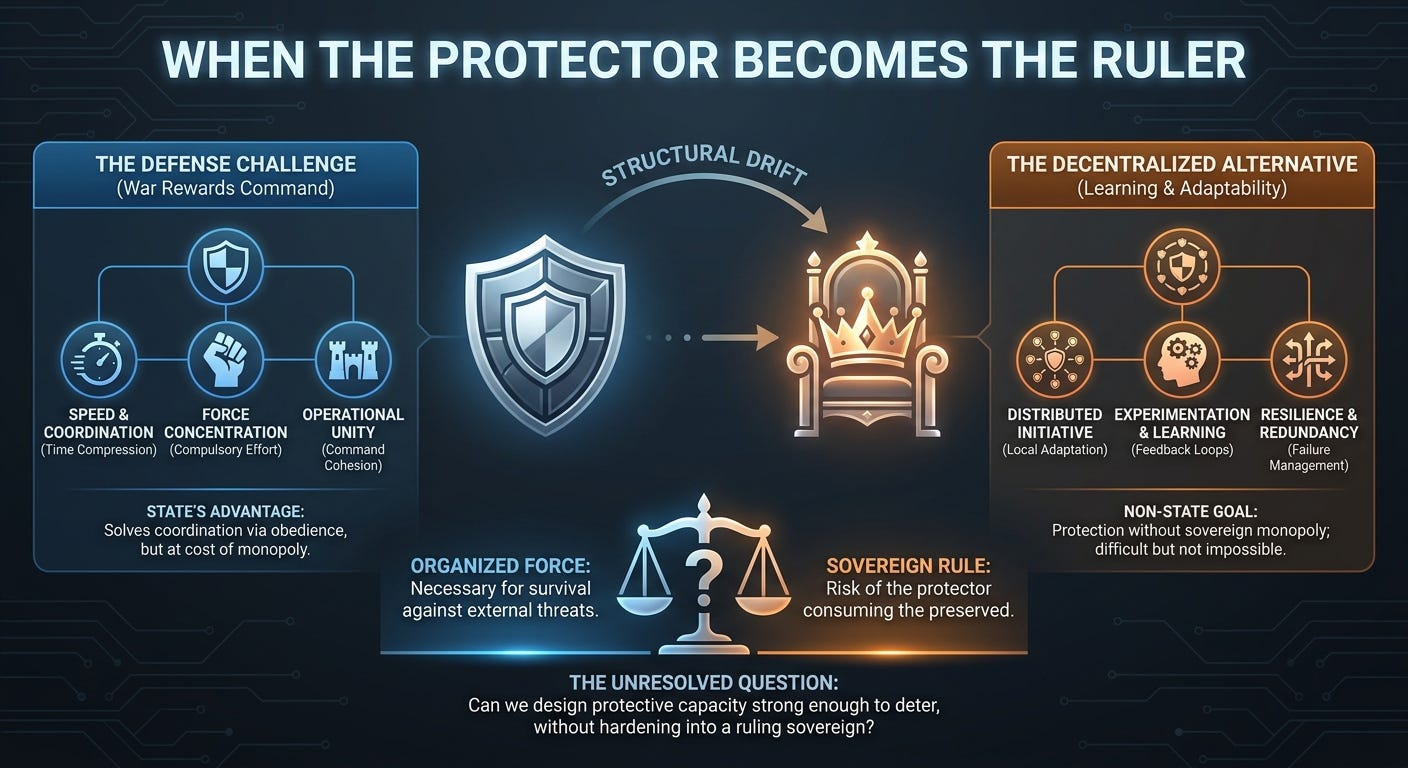
The question of the state is not settled by pointing to public services. A society can need roads, schools, insurance, courts, and infrastructure without thereby licensing a coercive monopoly over law and force. The real issue appears under external threat. Defense is the hardest case because war compresses time and makes coordination failures lethal.
This matters because the defense case is the one serious case. External threat creates a real coordination problem under severe time pressure, in a domain where fragmentation can kill, hesitation can kill, and institutional slack can kill. A society facing invasion cannot rely on leisurely trial and error. It needs intelligence, logistics, procurement, deterrence, command, and response capacity that can function under stress. If there is a strong argument for the state, it begins here.
I still do not think that argument succeeds. I do think it identifies the hardest problem any anti-state political theory must solve. That distinction matters. The necessity of defense does not by itself establish the necessity of sovereignty. It establishes the need for organized protective capacity. Whether that capacity must take the form of a coercive territorial monopoly is the point under dispute, not the premise that can simply be assumed.
War Rewards Command
War compresses time, and that changes the institutional premium. Decentralized systems derive much of their strength from discovery. They run multiple experiments at once. They preserve feedback. They let failure remain local. They allow bad providers to be replaced without requiring regime change. Over long horizons those properties are extraordinarily powerful because they produce adaptation rather than mere compliance. War shifts the premium toward speed, concentration, interoperability, and command cohesion. A centralized structure can often move resources faster because it can compel. It can seize, tax, conscript, standardize, and punish defection. That is the cleanest thing one can say in favor of the state. It solves some coordination problems by replacing consent with obedience.
That is a real advantage. It is also a narrow one. People often stop thinking at exactly the wrong point. They notice that coercion can coordinate rapidly under threat and infer that the institution wielding coercion is therefore necessary, justified, or superior in the larger civilizational sense that matters. None of that follows. Coercion is a shortcut. Shortcuts can be effective in narrow contexts while still being corrosive overall. The state’s capacity for rapid mobilization tells us something about force concentration. It does not settle the question of legitimacy, and it certainly does not vindicate the sprawling welfare-regulatory-security apparatus that modern states have become.
What the Defense Argument Establishes
The defense argument establishes that a society requires organized protective capacity. That much is obvious. The interesting question begins one step later: how must that capacity be organized, through what institutions, with what funding model, under what constraints, with what safeguards against expansion, with what exit mechanisms, and with what limits on jurisdiction? Those are the real questions. They are usually buried beneath rhetoric about realism and fantasy, as though naming the problem were equivalent to solving it.
Defense is a function. The state is an institutional form. Confusing the two is the central error in most defenses of government. A society needs protection. It does not follow that it needs a monopolist sovereign. It may. It may not. That is precisely what must be shown. The argument cannot simply help itself to the conclusion by treating organized defense and the state as interchangeable terms.
That move appears everywhere. Food is necessary, therefore state agriculture. Medicine is necessary, therefore state medicine. Law is necessary, therefore state law. Defense is necessary, therefore the state. The pattern is intellectually lazy in every case. A real need never proves one preferred implementation. That remains the strongest point in the anti-statist case.
A Defense Shell Is Not Magic
The alternative to the state is not the absence of protection. It is protection organized without a sovereign monopoly. A defense shell is a set of functions: threat detection, intelligence gathering, infrastructure hardening, logistics, procurement, training, response planning, interoperability, deterrence, recovery, and alliance management. None of these tasks is metaphysically statist. They are difficult. Difficult is not the same as impossible.
Much of the substrate already exists outside the formal state sector. Ports, grids, shipping, aerospace manufacturing, satellite systems, telecom networks, cloud infrastructure, cybersecurity operations, large-scale logistics, and financial rails are already built, maintained, and protected by private actors or by institutions far closer to firms and contractors than to the romantic image of the public realm. The productive base on which defense depends is not some sacred state artifact. It is mostly the output of civil society, capital accumulation, engineering, and commerce.
That observation, however, does not yet amount to a workable model of stateless defense. The argument is stronger at showing that sovereignty does not follow automatically from the need for defense than it is at showing that an alternative system could actually withstand the pressures of modern conflict. That weakness is real. A serious anti-state position has to say more than “careful design” and leave the hardest mechanisms unspecified. If the problem is command architecture, deterrence funding, anti-capture constraints, and collaboration under invasion, then those are the problems that must be named directly rather than left floating in the background.
Incentives for Self-Protection
A wealthy society has immense concentrated incentives for self-protection. Those who own ports, factories, data centers, energy systems, transport corridors, housing stock, farmland, inventories, and communications infrastructure do not need an abstract lecture on civic obligation to understand the value of deterrence. Their capital is exposed. Their families are exposed. Their future income streams are exposed. Their reputations, contracts, and productive networks are exposed.
They already spend enormous sums on insurance, continuity planning, security, cyber defense, redundancy, compliance, emergency response, and physical hardening. Extending that logic toward territorial defense is difficult, but it is not conceptually strange. It is what aligned incentives look like when the threat model expands. The usual objection is free-riding. Some actors will hope others bear the cost while they enjoy the benefit. True. Free-riding is real. It is also one of the most abused words in political theory. Its mere existence is constantly treated as though it ends the conversation. It does not. Markets deal with free-riding imperfectly all the time through contracts, bundling, insurance requirements, membership structures, concentrated funding by large stakeholders, exclusion where possible, and treaty-like commitments among parties with the most to lose. Perfection is unnecessary. The relevant threshold is whether enough capacity can be funded and sustained.
Yet there is a second problem here that matters even more than free-riding: alignment under invasion. It is easy to assume that capital will defend the society on which it depends. Sometimes it will. Sometimes it may calculate differently. In a live invasion, some firms may conclude that collaboration is cheaper than resistance. Some elites may try to preserve assets by cutting deals with the invading force. Without precommitted defense obligations, credible penalties for defection, and structures that make collaboration costly, the assumption of automatic alignment is naïve.
This is why any serious proposal for non-state defense would need more than goodwill or shared culture. It would need binding mechanisms: bonded mutual-defense compacts, distributed financing pools, treaty-enforced interoperability, precommitted command triggers, and automatic sanctions for withdrawal or collaboration under defined threat conditions. That is not yet a full blueprint. It is enough to show what the blueprint would have to contain.
The State’s Advantage and Its Cost
The strongest argument for the state is simple: it can force people to contribute to defense whether they wish to or not. That is true. It can also force them to pay for wars they oppose, interventions that do not protect them, alliances they did not choose, occupations they do not benefit from, procurement boondoggles that enrich insiders, and security bureaucracies that metastasize far beyond any plausible defensive purpose. Compulsory burden-sharing solves one problem and opens the door to many others.
This is why the defense argument must be handled carefully. Its strongest point is narrow. Its institutional consequences are not. Military necessity has historically been one of the great engines of state expansion. Armies require revenue. Revenue requires extraction. Extraction requires administration. Administration requires records, surveillance, standardization, enforcement, and hierarchy. The apparatus built to repel external threats gradually acquires a standing claim over internal life. The defense shell becomes a fiscal machine. The fiscal machine becomes a political order. The political order discovers endless reasons to preserve and enlarge itself.
By that point the protector has become a ruler. This is not a rare pathology. It is one of the oldest patterns in political history. The institution that begins as a shield develops interests of its own. It accumulates personnel, prestige, clients, secrets, emergency powers, and doctrinal justifications for permanence. It stops presenting itself as a service provider and starts presenting itself as the indispensable container of civilization. That transformation is not accidental. It is a structural tendency.
The Three Hard Objections
A serious anti-state argument about defense has to confront three problems directly.
The first is sovereignty drift. Private defense networks are one historical pathway by which states form. That does not prove they must become states. It proves that protective institutions with concentrated coercive capacity are metastatically unstable unless they are bound by hard competitive, contractual, technical, and cultural constraints. A defense provider that cannot be contained becomes a government in all but name.
The second is great-power scale. Homeland hardening, logistics, cyber defense, and infrastructure resilience are not the same as nuclear deterrence, carrier fleets, missile defense, or long-horizon strategic mobilization. A voluntary defense shell may be plausible in some threat environments and much less plausible in others. A society facing raids, insurgency, cyber attack, piracy, or regional aggression poses one problem. A society facing a peer nuclear superpower poses another. Any honest account must admit that modern deterrence at the highest level may require capital concentration and command depth that a voluntary order could struggle to sustain.
The third is collaboration under pressure. Wealth does not guarantee loyalty. Under invasion, the incentive to preserve capital may fracture solidarity rather than strengthen it. Without prior commitments and enforceable rules, some actors may defect. That problem exists inside states too, but the state at least claims a sovereign right to punish treason. A non-state order would need an alternative way to make betrayal strategically costly rather than individually rational.
These objections do not refute the anti-state thesis. They define its frontier.
Survival and Flourishing
A civilization should not be judged only by how quickly it can obey commands during emergencies. It should be judged by whether it survives, adapts, learns, and flourishes over time. On that standard, monopoly institutions have a deep problem. They suppress experimentation. They centralize failure. They convert local mistakes into system-wide mistakes. They protect incumbents from replacement. They hide the cost of delay. They turn process into a shield against accountability. They almost never relinquish powers once acquired. They routinely convert temporary urgency into permanent authority.
Decentralized systems have different weaknesses. They can be messy. They can under-coordinate. They can fragment under pressure. They can struggle with burden-sharing and operational unity. All of that is real. The relevant question is what they gain in return. They gain learning. They gain adaptability. They gain redundancy. They gain distributed initiative. They gain the ability to replace bad institutions without tearing the whole system apart. Over long horizons those are not decorative virtues. They are central to survival and flourishing in any environment defined by uncertainty, technological change, and strategic competition.
This is why the state’s hardest case remains unresolved rather than decisive. It identifies a real difficulty. It does not establish that the only answer is a standing coercive monopoly with open-ended jurisdiction.
The Real Problem
The most important question is not whether society needs governance. Of course it does. The important question is whether the final layer of defensive coordination can be organized without recreating a state.
Can a defense shell be funded voluntarily at sufficient scale? Can it maintain credible deterrence? Can it coordinate command under stress? Can it solve interoperability problems without a sovereign monopolist? Can it handle free-riding well enough? Can it impose real costs on collaboration? Can it remain bounded instead of converting operational authority into political supremacy? Those are hard questions. They deserve institutional imagination, not lazy dismissal.
The standard statist move is to point to the difficulty of the problem and then smuggle in the conclusion that sovereignty is necessary. That move still fails. Hard coordination problems require careful design. They do not automatically justify coercive monopoly. The anti-state case, however, must now be phrased more carefully as well. It is not enough to say that a private defense shell is plausible in the abstract. The stronger and more disciplined claim is that the necessity of defense does not by itself prove the necessity of sovereignty, and that the unresolved task is to design protective capacity strong enough to deter external threats without becoming a sovereign itself.
That is a narrower claim. It is also a better one.
Postscript
The best argument for the state comes from war because war rewards speed, unity, and command. That much is true. It still does not establish that a sovereign monopoly is necessary, and it certainly does not establish that the modern redistributive-regulatory state is justified. It identifies the hardest coordination problem in political order. That is all.
A free society that cannot defend itself will not remain free. The challenge is to construct protection without allowing protection to consume the thing it exists to preserve. That challenge is harder than statists admit and less impossible than they pretend. The relevant burden of proof therefore cuts both ways. Defenders of the state still have to show why defense requires sovereignty rather than merely organized force. Critics of the state have to show how organized force can be made strong enough to deter external threat without hardening into rule. That is the central unresolved question, and the rest of the argument should be judged by how seriously it confronts it.