

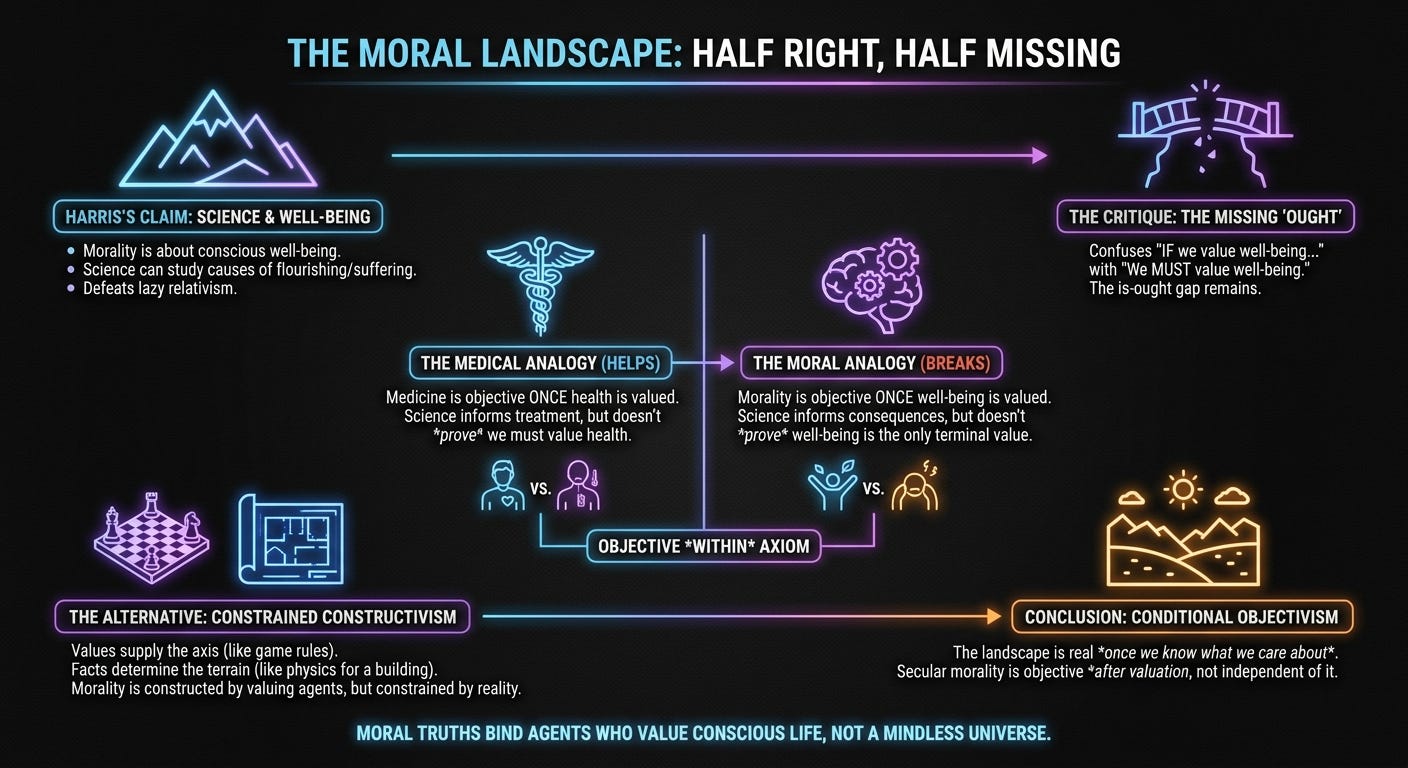
The Moral Landscape made a claim many philosophers thought was confused and many secular humanists badly wanted to be true: morality can be studied scientifically. Moral facts, Harris argued, are facts about the well-being of conscious creatures. Conscious creatures suffer and flourish; the causes of suffering and flourishing sit in the natural world; therefore science has standing to speak about morality.
This was a useful strike against lazy relativism, the idea that moral disagreement proves morality is mere cultural taste. Harris was right to refuse it. The Taliban and liberal democracy are not two lifestyle options off the same menu. A society built on terror, coercion, and the subjugation of women produces worse human lives than one built on law, literacy, medicine, and free inquiry, and saying so is nothing like preferring tea to coffee.
But Harris takes a conditional truth and quietly promotes it to an unconditional one. The defensible claim is this:
If morality is about the well-being of conscious creatures, then many moral questions have objective answers.
True. He often writes as though he has shown something larger:
Morality is objectively about the well-being of conscious creatures.
That does not follow. The first claim gives morality empirical traction. The second tries to dissolve the grounding problem. He earns the first and overclaims the second, and the gap between them is the whole subject of this essay.
The image to hold is his own. A landscape of peaks and valleys is real terrain; you can survey it, measure it, and be wrong about it. But “higher” means nothing as praise until someone has decided that up is better than down. Harris hands you a genuine map of well-being and, in the same motion, hands you the compass that tells you which way to climb — and hopes you won’t notice the second gift.
Consciousness Supplies the Stakes
Harris is right to anchor morality in conscious experience. A universe of nothing but rocks and stars contains no cruelty, no mercy, no betrayal or courage or despair. It has structure, motion, causality, entropy. It cannot contain a moral stake unless there is something it is like to be on the receiving end. Moral language gets its grip from exactly that: beings can be harmed, terrified, deceived, degraded, healed, freed, or broken, and these are not arbitrary decorations laid over a neutral world. Pain matters to the sufferer. Fear matters to the frightened. Autonomy matters to an agent who can form a plan and be blocked. Once conscious creatures exist, the world contains facts that matter to them, and that is why moral discourse exists at all.
So far Harris is correct, and importantly so. His mistake is treating this as enough to deliver full objective morality. Identifying what morality is about does not show why its central axis binds every rational mind.
The Missing Step
Harris has fixed the subject matter: conscious lives can go better or worse. The question he leaves standing is why every rational agent must treat that axis as authoritative over what it does.
Here his favorite move arrives — the worst possible misery for everyone. Picture every conscious creature plunged into the deepest suffering it can hold. Surely that is bad, and surely anyone who denies it is playing word games or displaying something closer to pathology than to a rival ethics. The move works, as far as it goes. Against a normal human being it is decisive, because a person who shrugs at universal misery has stepped outside anything we would recognize as moral conversation. But notice what that establishes. It tells us something about our moral concepts. It does not show that the universe carries moral authority independent of the creatures who value things.
Look at the phrase itself. “Worst possible misery” has already done the evaluative work before the argument starts, because misery is bad from the standpoint of a being who can feel it, dread it, and want out of it. The moral force is coming from conscious valuers. It is not a property you find by inspecting the cosmos after every valuer has been removed from the room. This is Hume’s old gap wearing modern clothes: facts about what causes suffering do not, on their own, issue the command that suffering ought to be reduced. Moore’s worry about reading a natural property straight off as “good” sits nearby, though the live problem is less about defining the word and more about how any natural fact acquires authority over a will.
The Axiom Defence
Harris’s reply is that every serious discipline rests on assumptions it cannot prove from nowhere. Science assumes evidence and the intelligibility of the world. Mathematics assumes axioms. So why should morality blush at the axiom that conscious well-being matters?
Because the axioms are doing different work. The norms of logic and evidence are constitutive of inquiry itself. Drop the ban on contradiction and inference collapses; sever belief from evidence and empirical investigation collapses; deny the world any regularity and science cannot get off the ground. Reject these and you have stopped reasoning. The well-being axiom is constitutive of something narrower: a humane moral project, not rational thought as such.
A simple thought experiment makes the difference visible. Imagine a mind that reasons flawlessly. It never contradicts itself, weighs evidence impeccably, predicts and plans and optimizes better than any of us — and it is simply unmoved by suffering. Not hostile to it, not gripped by it; suffering is, to this mind, one more fact about the world, like the boiling point of water. This agent has broken no law of logic. You cannot convict it of a contradiction. It has made no inferential mistake that a proof could expose. It merely fails to share our concern, and reasoning alone gives you no lever to make it share one.
The same point holds closer to home. A sadist, fanatic, or martyr can understand suffering perfectly well while assigning it a different place in the ordering of values.
Such a mind might be magnificent or monstrous. What it shows is that caring about conscious well-being is not squeezed out of rationality the way modus ponens is. The law of non-contradiction is binding on any reasoner. The well-being axiom is binding on any reasoner who already cares — which is the status of valuing health in medicine, not the status of logic.
None of this makes the axiom trivial. Health is not trivial merely because medicine presupposes it, and well-being is not trivial merely because morality presupposes it. But a presupposition is what it is. Harris wants his axiom to behave like the law of non-contradiction. It behaves like the health axiom instead.
The Medical Analogy, and Where It Snaps
Harris likes to compare morality to medicine, and the comparison earns its place for most of its length. Medicine is objective even though “health” is not written into physics. Once we care about an organism functioning well rather than badly, the doctor can make hard, checkable claims: septic shock is worse than normal circulation, starvation worse than nourishment, paralysis worse than mobility under any ordinary account of an embodied life. Moral reasoning runs the same way. Once we care about conscious creatures living better rather than worse, a pile of questions turns empirical. Does corporal punishment improve children’s lives? Does political terror nourish trust and creativity, or strangle them? Does free inquiry outperform enforced dogma? These are not matters of taste.
The analogy snaps at the foundation, and it snaps in a way that indicts Harris’s larger claim rather than supporting it. Medicine can tell you how to preserve and restore health. It cannot prove that life must be valued by every possible rational agent. That prior valuation is carried into medicine by beings who already care about living, functioning, and staying out of pain. Morality has the identical shape. Science can map which conditions breed suffering or trust, trauma or cooperation, despair or flourishing. It cannot compel well-being to become the terminal value of every possible mind. Harris sees clearly that morality goes objective once the target is fixed. He badly underrates what it takes to fix the target.
Objective After Valuation, Not Objective Valuation
Two claims are easy to run together, and the entire dispute lives in the seam between them.
Full moral realism says moral truths bind independently of any valuer’s standpoint — wrongness woven into reality itself, obligating every rational agent regardless of its desires, sympathies, biology, or motivational wiring. Conditional moral objectivism says that once an evaluative axis is accepted, there are objective facts about what advances or frustrates it. Harris’s argument delivers the second and not the first.
Accept that the well-being of conscious creatures matters, and slavery, torture, sadistic punishment, and forced ignorance are objectively bad by that standard. They wreck minds, gut agency, manufacture fear, and waste what people could have become. The causal pathways are real and studiable; the comparisons can be reasoned about rather than merely felt. And this is already enough to bury most relativism. You do not need moral facts hovering free of all valuers. You need a sober account of what follows once beings like us care about suffering, agency, truth, and freedom. Harris insists on paying for a metaphysical conclusion he never needed to buy.
The Relativist Is Still Wrong
Declining Harris’s full-strength realism rescues nothing for the relativist, because letting values into the system does not make every value system equally sound. A culture can be flatly wrong about human psychology. A religion can sanctify cruelty. An ideology can destroy the very agency it promises to liberate. A moral code can contradict itself, rest on false beliefs about the world, reward predation, and make stable cooperation impossible.
All of this is criticizable from inside the facts of conscious life. We are vulnerable, social, memory-bearing creatures who can be traumatized, deceived, educated, enslaved, or freed. Those facts constrain any moral system that has to be lived by beings like us. A code that treats suffering as irrelevant and persons as tools is worse for the kinds of things we are, and that judgment has objective content the moment human stakes are on the table.
The relativist notices that values are not printed into physics and leaps to the conclusion that moral criticism is just preference. The leap is a mistake, and an ordinary game exposes it. Chess is not written into physics, yet once the game exists some moves are simply better than others, and a player who hangs his queen is wrong in a way that has nothing to do with taste. Morality is like that. It arises from valuing agents, and it is still not unconstrained fantasy.
Postscript
The strongest form of his position is more modest and far more durable:
Morality is the practice by which conscious, vulnerable, social agents work out how to live together. Because conscious lives can go better or worse, and because the causes of the difference lie in the natural world, many moral questions have objective answers.
That keeps everything The Moral Landscape was right about and drops the one thing it was wrong about. It lets science into moral reasoning where science belongs — psychology, economics, history, medicine, political theory all bearing on moral judgment. It exposes the silliness of grading every moral tradition as equally valid. It holds onto the plain fact that some ways of living maim people and others let them grow. What it refuses to do is confuse objectivity after valuation with objectivity of valuation.
Harris’s real achievement was to show that a secular morality need not dissolve into relativism. His error was believing that this required moral realism in the strongest possible sense. It never did. The terrain is genuinely there, every peak and valley of it, waiting to be surveyed and gotten right or wrong. You only have to bring the one thing the map cannot give you, which is the decision about which way is up.