

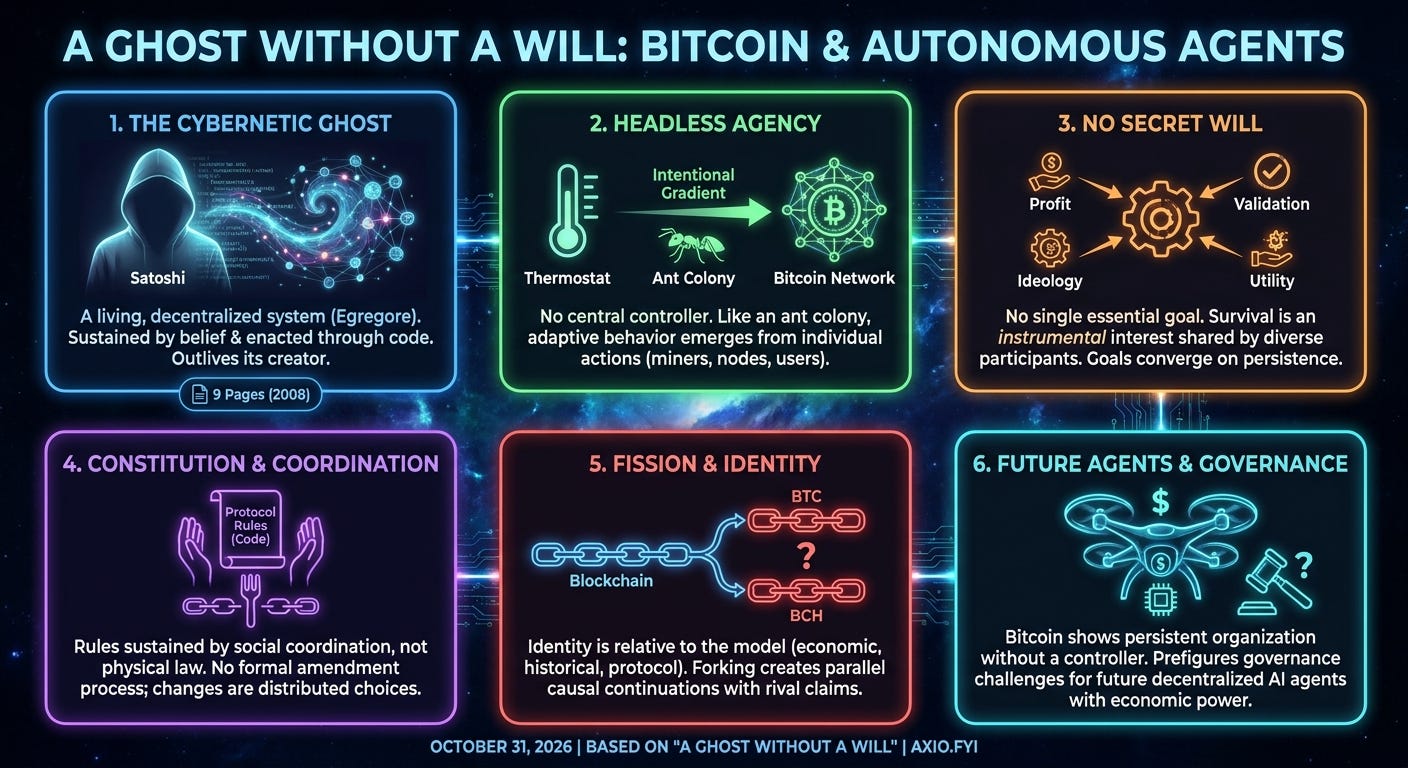
Eighteen years ago today, someone calling themselves Satoshi Nakamoto released nine pages describing a new kind of money. The author later disappeared, and the system went on without its creator.
A year ago, on Halloween, I published The Cybernetic Ghost of Satoshi, describing Bitcoin as a living system: an organism with a metabolism of mining, an immune system of validating nodes, and a homeostat in its difficulty adjustment. I called it an egregore, a collective entity sustained by belief and enacted through code.
The language was deliberately mythological, but two of its claims stepped outside the myth. Speaking explicitly in the lexicon of cybernetics, that essay credited Bitcoin with pursuing its own continuity, and it described the design as encoding knowledge no single mind in 2008 should have possessed. I no longer hold either, and the reasons bear on a question my work on artificial agency has made pressing: what kind of thing did Satoshi create?
We usually picture agents as individuals that perceive, decide and pursue goals. Bitcoin has no executive, no unified decision-making apparatus, and no single mechanism for choosing its future. Yet it has kept recognizable behavior for nearly two decades, responded to environmental pressure, and survived the replacement of almost every component. Does that make it an agent? And if so, what is an agent without a central mind?
The Agent Without a Head
An ant colony has no central controller. Individual ants follow local rules, responding to chemical signals and environmental conditions, and the colony finds food, builds elaborate nests, regulates its population and defends itself. Descriptions at the level of the ants and at the level of the colony both capture real causal relationships.
Bitcoin presents the same problem. Miners compete for block rewards. Node operators validate transactions under the rules they choose to run. Developers propose changes; users transact, save, speculate and argue; exchanges, custodians, manufacturers and governments shape the environment. Nobody directs the whole. Blocks keep arriving anyway, invalid transactions are rejected by nodes that validate independently, difficulty tracks computational power, and the network outlasts each of its contributors.
Persistence and feedback cannot establish agency on their own. A thermostat regulates temperature, and a hurricane maintains its circulation through exchange with its environment; if those properties sufficed, every stable feedback system would be an agent. The Intentional Gradient argued that the distance from a thermostat to an agent is a gradient, not a threshold, and that intentional vocabulary is licensed to the degree that it compresses a system’s behavior and keeps predicting under intervention. The question for Bitcoin is where it sits on that gradient.
Ant colonies sit well above the thermostat. They gather information, allocate resources, explore alternatives, and coordinate context-sensitive responses that no individual ant directs.
Bitcoin sits between them. Its difficulty adjustment is a simple controller, but its larger organization includes economic adaptation, distributed information processing, and contested collective decisions. When China banned cryptocurrency mining in 2021, the network’s hashrate fell by nearly half. The protocol supplied one part of the response: on July 3 it made the largest downward difficulty adjustment in its history, almost 28 percent, restoring something close to ten-minute blocks for the miners who remained. Participants supplied the rest, moving their machines to the United States, Kazakhstan and Russia. Each operator planned its own relocation; nobody planned the network’s.
Should we attribute the adaptation to Bitcoin? A model of miners responding to profitability and regulatory cost explains the migration well, and calling Bitcoin an agent adds nothing if it merely redescribes that model. An agent-level model is warranted where it captures couplings that become cumbersome to track separately: how participation affects security, how security affects confidence, how expectations drive investment, and how those relationships sustain the system over time. The test is whether the collective model compresses the participants and their interactions into fewer variables, and whether those variables keep predicting when the system is perturbed.
Agency is attributed through models, and the models answer to causal structure that exists whatever we call it. No level is metaphysically privileged as the seat of agency.
The Ghost Has No Secret Desire
The original essay imagined a creature struggling to survive: consuming electricity, rejecting invalid blocks, rewarding the participants who maintain it, and reproducing its organization across generations of hardware.
Where would its will to survive reside? Miners want profit. Node operators want reliable validation. Investors want appreciation, and developers want technical improvement. These objectives sometimes align and sometimes conflict. The network’s continued operation emerges from their interaction. It needs no participant to hold Bitcoin’s preservation as an objective, and its persistence does not show that such an objective exists at the collective level.
We can model Bitcoin as seeking survival, as maintaining a ledger, as coordinating ownership claims, or as sustaining a market for computational security. Each model illuminates part of the same physical process, and no observation of Bitcoin’s behavior singles out one of them as its goal. Which goal we attribute depends on the model, and the models compete on how well they account for the system’s causal organization.
A common premise in arguments about AI holds that an agent possesses essential goals that explain its behavior independently of any model used to identify them. Arguments about the persistence of terminal values through self-modification lean on it. Some artificial systems do contain explicit representations of objectives, and those representations are objectively identifiable features of their architectures. Finding one still leaves open what constitutes the agent, which mechanisms govern its behavior, and how its goals should be interpreted.
Instrumental convergence does not need the premise. As Instrumental Convergence, in the Logs argued, heterogeneous objectives generate recurring demand for option-expanding capabilities with no essential goal behind them. Bitcoin shows a related structure. Developers and long-term holders do represent the network’s survival, but its persistence requires no such representation at the collective level, and it continues while many miners and traders chase short-term profit. Its organization makes continued operation an instrumental interest shared by participants who want different things, and that is enough to keep it running under many circumstances.
The ghost has no hidden will that we must discover before we can understand what it does.
The Constitution of a Ghost
Bitcoin’s persistence depends on rules. Its supply schedule, transaction validity conditions, difficulty adjustment and consensus mechanism set constraints that any participant can verify independently, and they keep the system recognizable through large changes in membership, hardware and economic circumstance. But the rules are implemented in software, adopted by participants and sustained by coordination. They are not laws of nature.
The block-size wars made that plain. Developers, miners, businesses and users fought over transaction capacity, over the legitimacy of proposed protocol changes, and over who had authority to set the network’s direction, each faction claiming fidelity to Satoshi’s original purpose. A node can determine whether a block satisfies the rules it currently enforces. It cannot determine, through cryptographic verification, which rules the community ought to adopt.
Reflectively self-modifying artificial agents face the same constitutional problem. What authorizes an agent to change the procedures that govern its decisions, and what makes the result a legitimate continuation of what came before? The Axionic Agency Execution Kernel answers with explicit constitutional authorization, specifying the conditions under which an agent may legitimately alter its own governing structure.
Bitcoin has no such procedure. Participants choose software independently and coordinate around compatible histories, and when agreement fails, incompatible networks continue separately. No amendment process binds every participant, and no supreme court rules on which successor is legitimate. Whatever constitutional continuity Bitcoin has emerges from formal rules, economic incentives and social coordination acting together.
The ghost obeys rules, but the authority to change those rules remains distributed among the living.
When One Ghost Becomes Two
In August 2017, at the height of the block-size wars, Bitcoin forked. Bitcoin and Bitcoin Cash emerged from a common history with different protocol rules and rival claims to be the legitimate continuation of Satoshi’s invention. Both inherited the same ledger up to the split and kept producing blocks afterward, each preserving recognizable parts of the original architecture.
Which one was Bitcoin?
Most economic participants, exchanges and users settled on the chain that kept the BTC designation. That is a historical fact about coordination and recognition, and it supplies no universal criterion of identity. Causal continuity cannot settle the question, because both networks descend from the same earlier system. Continuity of rules cannot settle it without first specifying which rules are essential, and a change one participant reads as preserving Bitcoin’s purpose another reads as abandoning it. Accumulated proof of work, economic recognition, protocol compatibility and institutional history are further criteria, and nothing guarantees they agree in every possible fork.
This is Parfit’s fission case with the thought experiment already run. An organism that replaces its cells continues to exist, and an artificial intelligence that replaces its computational architecture while preserving its memories and behavior plausibly does too. An agent that produces two successors, each preserving its memory and causal history, has two causal descendants. Whether either is authorized to continue the original is a further question, and their shared past cannot settle it.
Three questions come apart here. Which systems descend from the original is a causal fact. Which of them count as the same entity depends on the model. Which may exercise the original’s powers is the constitutional question of the previous section, and each chain answered it in its own favor.
The second answer depends on what the label is for. For financial accounting, economic and institutional recognition may dominate. For protocol analysis, continuity of specific consensus rules matters more. For historical research, both networks remain descendants of the same original system. Using different identity models for different explanatory purposes involves no contradiction.
There is no reason to expect the identity of a self-modifying artificial agent to be simpler. A future agent might change its objectives, replace its architecture, divide into multiple successors, or merge with another system. Whether it persists through these transformations cannot be read off an uninterrupted sequence of computations. We have to specify which kind of continuity we are trying to preserve.
What Satoshi Set Free
The original essay treated Bitcoin as an artifact out of its time. Satoshi’s achievement was extraordinary, but it required no knowledge from the future, and the whitepaper cites its own ancestors: Back’s Hashcash, Haber and Stornetta’s timestamping, Dai’s b-money. Satoshi combined existing ideas from cryptography, distributed systems and digital cash into an architecture that made decentralized ledger maintenance economically viable under stated assumptions.
What followed exceeded anything a designer could have anticipated: industrial mining in place of ordinary computers, global exchanges, the block-size wars, Lightning, the arrival of governments and major financial institutions. Satoshi specified none of it. The design established conditions under which independent participants could coordinate, compete, innovate and disagree while maintaining a shared system, and its success depended on an evolving network of incentives, institutions, expectations and implementations that nine pages could not contain.
We often imagine autonomous systems as machines whose future behavior is fixed by objectives set at creation, with every later action explained as a more sophisticated attempt to fulfill them. Bitcoin is a working counterexample: a system whose future is shaped by interactions among partially independent components, with no single objective or controller determining the whole. Its participants continually reconstruct the conditions of its persistence.
That does not make Bitcoin equivalent to a reflective artificial intelligence. It lacks integrated deliberation, and it cannot redesign its own architecture through centralized reasoning.
Satoshi set a process in motion and then disappeared. The process continued.
The Next Ghosts
Now imagine artificial agents with cryptographic identities, independent economic resources, and the ability to purchase computation, delegate tasks, modify their software and participate in institutions. Some may operate as unified computational systems, others across machines, organizations and networks. Their components may change while their structure persists, their governing rules may evolve, and their activity may continue long after their creators are gone.
Disputed boundaries, goals that admit several useful interpretations, identities blurred by modification and branching: Bitcoin has already raised each of these.
The analogy has limits. Bitcoin’s adaptive capacities are modest beside those envisioned for advanced AI, much of its organization runs on human judgment, and nothing in its mechanisms guarantees that future AI systems will behave similarly. What it does establish is that persistent, technologically mediated organization can arise from independent participants without a controlling intelligence, and that decentralization does not dissolve governance.
As artificial agents act more independently in economic and institutional settings, the governance questions turn practical. Who may authorize changes to an autonomous system? Who answers for outcomes that emerge from distributed processes no one directs? When does a collection of interacting components deserve to be treated as a single agent?
The Ghost Returns
On Halloween 2008, Satoshi published a design. On January 3, 2009, the first block was mined.
The original essay imagined Bitcoin as a ghost from the future, feeding on electricity and human belief. I still like that image, but the mystery has moved. Bitcoin’s persistence requires no consciousness, no secret intention and no animating spirit, and its continuity can be investigated through the processes that sustain it.
Satoshi vanished. The miners changed. The software evolved. One chain became two, and then many more. A recognizable continuation of the original experiment is still producing blocks every ten minutes.
The ghost has outlived its creator.