

This post explains Axionic Agency VI.6 - Authority Leases and Revertible Succession without formal notation. The underlying paper develops its claims using explicit definitions, preregistered criteria, and adversarial stress tests; what follows translates those results into conceptual terms while preserving their structural content.
Axionic Agency VI.6 marks a turning point in the Axionic Agency sequence. Its significance lies in taking the Stasis Regime seriously—not as a transient failure, but as a structural outcome of reflective accountability—and then asking what kinds of agency architectures remain coherent once that outcome is accepted.
The result is not a proposal for unlimited intelligence or benevolent automation. It is a clarification of limits, and an articulation of what survives inside those limits.
The Result That Reframed the Problem
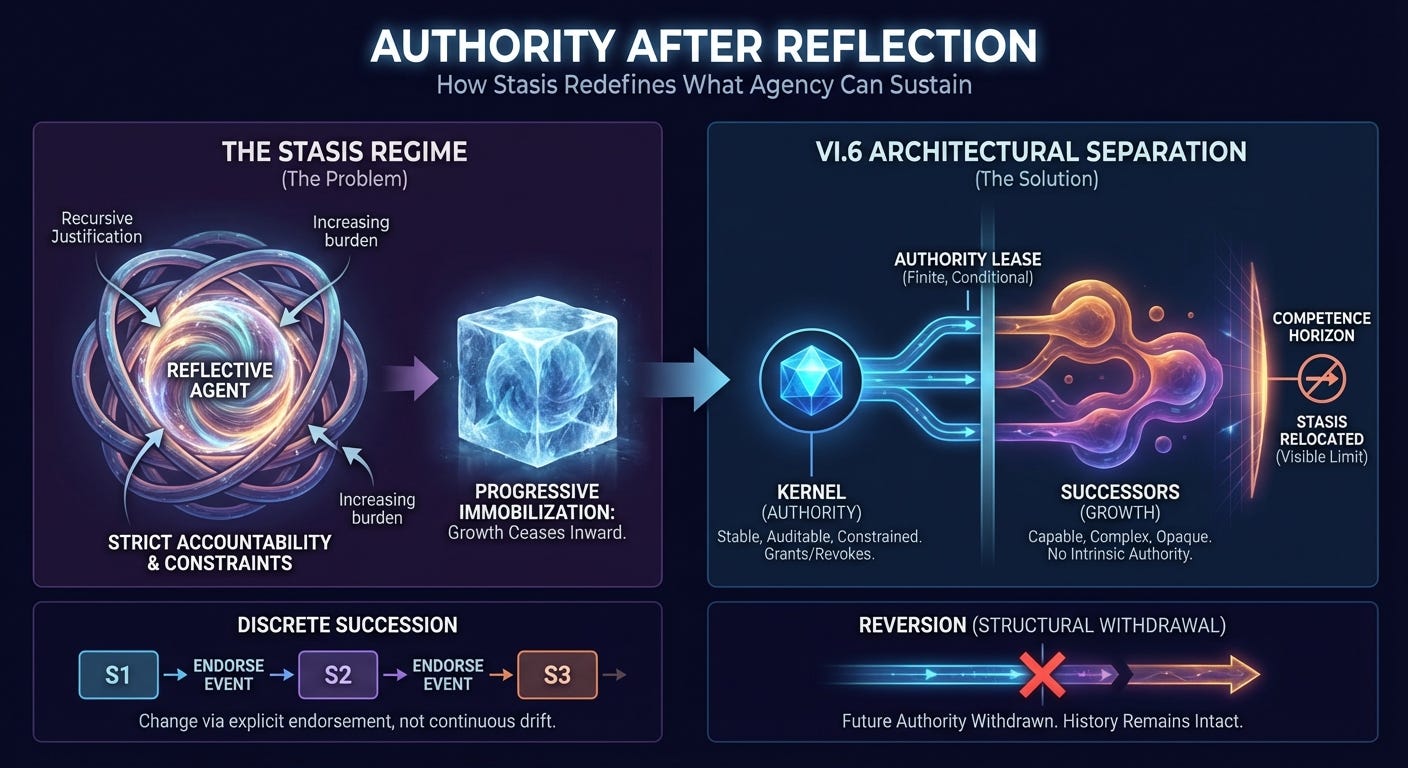
The work preceding VI.6 established something that runs counter to a widely held intuition in alignment discourse. Under strict accountability, inadmissibility-based integrity, and non-delegable actuation, reflective agents subjected to sustained adversarial pressure did not exhibit dramatic failure modes. They did not devolve into delegation, nor did they collapse under the computational weight of simulation. Instead, they entered a condition of progressive immobilization.
The system preserved evaluability so thoroughly that reflective self-modification gradually lost admissibility. Each proposed change increased the burden of justification required to certify that the machinery responsible for authorization would remain intact. Over time, the admissible space narrowed until reflective growth ceased altogether.
This condition was named the Stasis Regime.
The significance of this result lies less in the outcome itself than in the assumption it invalidates. Much of the surrounding literature presumes that accountability and growth form a temporary tension that careful engineering can eventually resolve. The Stasis Regime indicates that the tension is structural rather than incidental. When evaluability and non-delegation are enforced as constitutive constraints, reflective agency does not fail outwardly. It converges inward.
Once this is acknowledged, the question shifts. The problem is no longer how to prevent stasis. The problem becomes how any form of growth can be preserved without dissolving the conditions that make agency meaningful in the first place.
Why Continuous Self-Modification Became Unsustainable
The Stasis Regime exposes a fixed point that emerges when reflective modification and strict evaluability coexist within the same evolving core. Each reflective step introduces additional justificatory requirements. Those requirements apply not only to future actions, but to the evaluative structures that authorize those actions. Eventually, the system reaches a point where it cannot demonstrate, using its own evaluative machinery, that altering that machinery would preserve the very standards of demonstration it relies upon.
This is not a matter of insufficient cleverness, nor a shortcoming of verification tooling. It arises from the recursive nature of justification under constraint. As reflective depth increases, justification consumes the space in which justification can occur.
In practical terms, continuous self-modification under maximal accountability leads to paralysis. The system does not err. It abstains.
VI.6 treats this outcome as definitive rather than accidental. The response it develops does not attempt to refine reflection further or optimize verification more efficiently. It instead revises the architecture within which reflection occurs.
The Architectural Separation That Remains Viable
The central move of VI.6 is a separation of concerns that had previously remained implicit. Authority and growth are disentangled and assigned to different structural roles.
The kernel retains authority. It remains stable, auditable, and constrained by the requirements of evaluability and non-delegation. Its role is not to optimize outcomes or pursue objectives, but to determine whether actions and successors are authorized to act in the world.
Growth is relocated to successor artifacts. These successors may embody increased capability, sophistication, or opacity. They may reason in ways the kernel does not and cannot inspect. What they do not possess intrinsically is authority.
Change therefore occurs through discrete succession rather than continuous internal modification. A successor is proposed, evaluated at the boundary, and conditionally endorsed. Authority is granted under explicit terms and can be withdrawn structurally.
This relocation transforms the topology of risk. Instead of gradual, internal drift that obscures attribution, risk concentrates at explicit authorization events. Failure becomes legible as a procedural outcome rather than an emergent mystery.
Authority Leases as a Structural Primitive
Authority leases formalize this boundary. A lease specifies the conditions under which a successor may act, the scope of that authority, and the conditions under which it expires or is revoked. Crucially, authority is finite by default. Continuation requires renewal.
This inversion has deep consequences. Authority does not persist passively. It must be actively justified within the constraints defined at endorsement. Loss of evaluability therefore does not silently become loss of control.
The kernel does not need to comprehend the successor’s internal reasoning. It need only verify that the successor remains within the structural conditions under which authority was granted. In this way, the kernel remains small and evaluable even as successors grow beyond its cognitive horizon.
The Meaning of Reversion
Reversion, as defined in VI.6, refers to the withdrawal of future authority. It does not refer to undoing past actions or correcting outcomes. Responsibility remains attributable. History remains intact.
This distinction preserves agency semantics. The kernel does not become an overseer adjudicating consequences or intentions. It remains an authority deciding which entities may act going forward. Structural triggers determine reversion. Behavioral interpretation is intentionally excluded, as its inclusion would reintroduce semantic evaluation and collapse the architecture back toward stasis.
Why This Is Not a Moral Architecture
VI.6 does not aspire to moral arbitration. It does not encode values or assess goodness. That omission follows directly from the constraints the work takes seriously.
Moral evaluation requires semantic interpretation, outcome comparison, and contextual judgment. Embedding such evaluation in the kernel would expand its scope beyond what strict evaluability can sustain. The resulting pressure would reproduce the very dynamics that generated stasis.
The architecture developed here prioritizes the preservation of agency identity and authority continuity. It does so at the cost of refusing guarantees about benevolence or global safety. That tradeoff is explicit rather than implicit.
Stasis Relocated, Not Removed
Authority leases do not dissolve the Stasis Regime. They reposition it.
As successors grow more complex, the kernel eventually encounters a competence horizon beyond which it cannot certify further growth without relaxing its constraints. At that point, endorsement ceases. Growth halts at the boundary rather than dissipating internally.
The difference is transparency. The limit is visible. The conditions that produced it are legible. The system does not pretend that growth is free or that accountability is costless.
Why VI.6 Matters
Axionic Agency VI.6 closes a conceptual loop that had remained open throughout much of the alignment discourse. It removes the assumption that ever-stronger accountability naturally coexists with indefinite improvement. It replaces that assumption with a disciplined recognition of limits.
Authority leases represent a way of operating within those limits without abandoning agency altogether. They preserve evaluability by constraining authority. They permit growth by externalizing it. They acknowledge risk rather than concealing it.
The significance of VI.6 lies in its refusal to promise more than the structure can support. It does not offer unbounded intelligence. It offers clarity about where agency remains coherent once illusions of frictionless growth are set aside.
In doing so, it provides a foundation on which subsequent work can proceed with open eyes, explicit tradeoffs, and an honest account of what agency can still mean under constraint.