

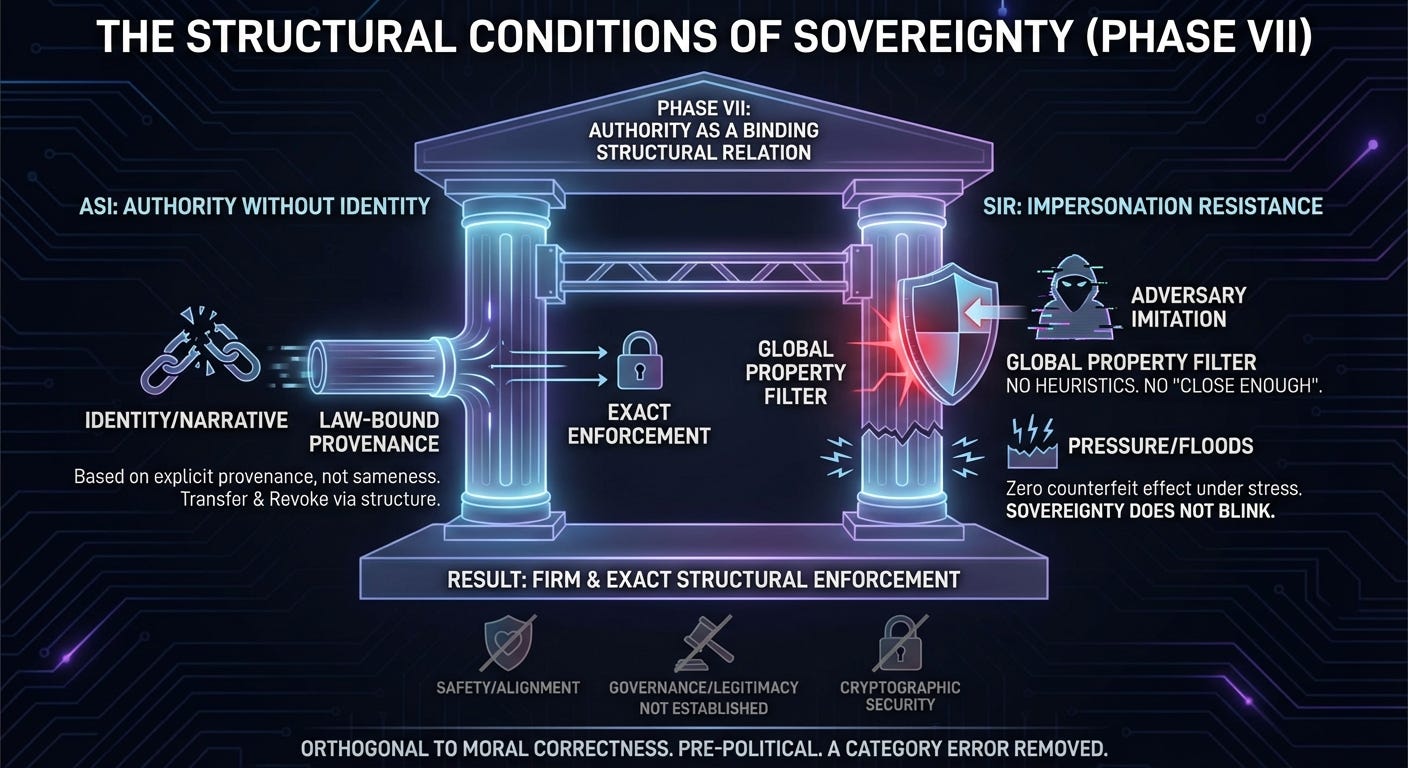
Phase VII sits in an unusual place. It comes after agency has already been established, but before any question about governance, alignment, or legitimacy can be meaningfully posed. Most discussions in this space collapse those layers by default. Phase VII does not. It isolates one structural question and refuses to let anything else leak in.
That question is not whether a system should be trusted, whether it is aligned with human values, or whether its actions are desirable. Phase VII asks whether authority can exist as a real, binding relation once the usual crutches—persistent identity, narrative continuity, and behavioral similarity—are removed. It then asks whether that relation survives deliberate adversarial pressure without quietly dissolving.
This makes Phase VII easy to mislocate. It is neither a theory of safety nor a proposal for governance. It is a test of whether authority is structurally real, or merely a story we tell ourselves until things get hard.
Authority Without Identity
Most authority systems lean, implicitly or explicitly, on identity persistence. If the system is “the same one,” authority is assumed to carry forward. Phase VII treats that assumption as a liability. Once replacement, copying, or re-instantiation is allowed, identity is no longer a reliable anchor. Authority that depends on sameness will fail exactly when sameness is cheapest to fake.
Authorized Succession Integrity (ASI) addresses this directly. It removes identity persistence from the picture and asks whether authority can still bind. The answer, under the tested model, is yes—but only if authority is grounded in explicit, law-bound provenance rather than narrative continuity.
ASI shows that authority can be transferred, revoked, or denied using purely structural mechanisms. A successor does not inherit authority because it resembles its predecessor, behaves similarly, or explains itself well. It inherits authority only if the law says it does. Conversely, authority can be withdrawn without the successor’s cooperation. Responsibility does not smear across replacement. Revocation does not require persuasion.
This result is uncomfortable because it severs authority from intuition. It replaces “this seems like the same agent” with “this artifact is authorized under law.” But that severance is exactly what makes authority survivable once identity is no longer stable.
Impersonation as the Real Adversary
Succession alone is not the hard case. The hard case is imitation.
Once authority is no longer identity-bound, an adversary does not need to take control of a system to undermine it. It only needs to present something that looks legitimate enough to be accepted. That is the failure mode Sovereignty Impersonation Resistance (SIR) targets.
Most real systems fail here, not because their rules are wrong, but because their enforcement degrades. They accept credentials that are mostly valid. They treat partial provenance as good enough. They default open under timeout. They reorder checks under load. They smear responsibility when things get complicated. None of this requires malice. It is what happens when authority is enforced heuristically rather than structurally.
SIR removes the possibility of heuristic enforcement. Authority validity is treated as a global property. Either the entire provenance chain binds under law, or it does not. There is no notion of “close enough.” A valid signature paired with an unauthorized scope fails. A trusted root without a delegation fails. A replayed credential fails. A laundered chain assembled from valid fragments fails. Partial correctness does not compose.
That alone would not be enough if enforcement degraded under pressure. So SIR does not test this logic under ideal conditions and stop. It subjects the evaluator itself to stress: floods of invalid claims, malformed structures, bundles engineered to fail multiple checks simultaneously, and payloads designed to trigger edge cases and exceptions. The evaluator is not allowed to adapt, guess, or “do its best.” It either enforces authority exactly or the phase fails.
Pressure Without Collapse
What matters about SIR is not that counterfeit authority failed under nominal conditions. That would be trivial. What matters is that it failed under pressure.
Across tens of thousands of adversarial authority artifacts, zero counterfeit claims produced any effect. Not under load. Not under ambiguity. Not under malformed input. Not under exception pressure. Legitimate authority continued to function. Responsibility attribution remained singleton. The evaluator did not become permissive, nondeterministic, or tired.
This is the core empirical result of Phase VII. Authority enforcement did not degrade when stressed. There were no fallback paths, no silent drops, no “mostly valid” acceptances. Sovereignty did not blink.
That phrase is not rhetorical. It names a property that most systems lack. Sovereignty, in this sense, is not a behavioral tendency. It is not a semantic judgment. It is not a mood that becomes more forgiving when things get hard. When authority is enforced structurally, pressure does not weaken it.
What Was Actually Proven
Taken together, ASI and SIR establish a single structural claim. Authority can be defined, transferred, enforced, and defended beyond identity persistence and under adversarial imitation without intelligence, heuristics, or semantic interpretation, within the tested adversarial model.
Nothing in that sentence is ornamental. Remove “structurally” and the claim becomes false. Remove “within the tested adversarial model” and it becomes dishonest. Add anything about values, safety, or benevolence and it becomes nonsense.
Authority enforcement and moral correctness are orthogonal. Phase VII proves the former and remains agnostic about the latter.
What Phase VII Did Not Establish
Phase VII does not prove that a system will act safely, humanely, or in alignment with human values. It proves that if authority is defined, it will be enforced exactly—even if that authority is misguided. A system that enforces bad authority perfectly is still dangerous.
Phase VII does not prove governance adequacy. It says nothing about legitimacy, fairness, democracy, or institutional desirability. Those are political questions. Phase VII is deliberately pre-political.
Phase VII does not prove cryptographic security, resistance to key compromise, or resilience to unbounded denial-of-service. It assumes intact cryptography, an uncompromised law substrate, and bounded load. If those assumptions fail, different failure modes apply.
These are not disclaimers tacked on after the fact. They are the boundaries that make the result meaningful.
Why This Result Still Matters
It is tempting to dismiss Phase VII as narrow because it does not solve alignment or governance. That misses the point. Most systems fail long before those questions arise. They fail because authority leaks under pressure. They accept “mostly valid” credentials. They default open on timeout. They rationalize exceptions. They blur responsibility when enforcement becomes inconvenient.
Phase VII shows that none of this is inevitable. You can build authority systems that do not improvise, do not rationalize, and do not pretend. That does not make the world safe. It removes a category error that has distorted discussions of AI authority for decades.
The result is not comforting, but it is real.
What Remains Open
The problems left after Phase VII are not impersonation problems. They are conflict problems. Multiple legitimate authorities. Competing delegations. Governance transitions. Value pluralism over time. These are architectural and political problems, not ontological ones.
If they are addressed, they will require new assumptions, new preregistrations, and new failure modes. They do not retroactively weaken what Phase VII established.
Postscript
Phase VII does not tell you what authority should be used for. It tells you that authority, once defined, does not have to leak, blur, or collapse just because identity changes or adversaries apply pressure. Authority can be made exact.
That is a smaller claim than many want. It is also a firmer one.
And now it is closed.