

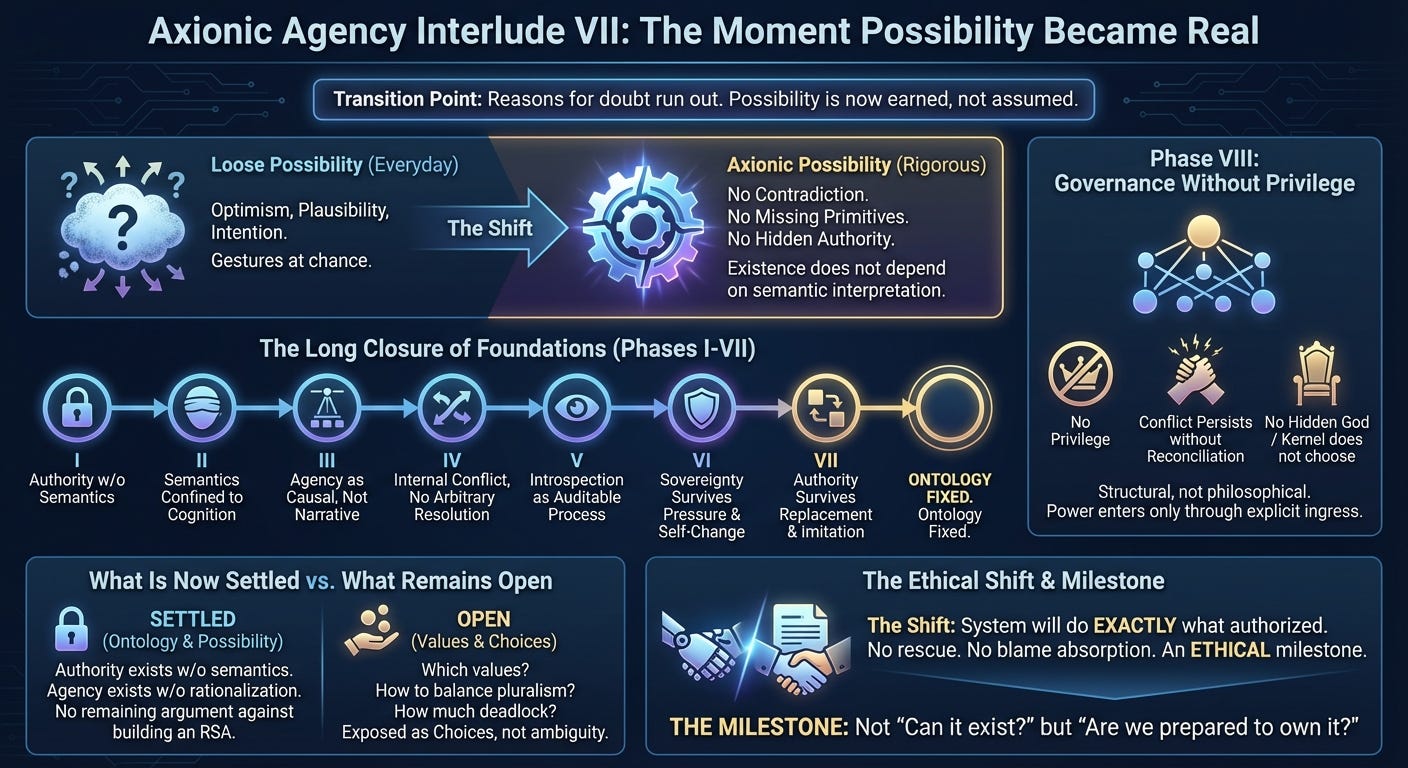
There is a point in a long research program where the central question changes quietly, without ceremony. Nothing dramatic happens. No final system appears. No victory is declared. What changes is simpler and more consequential: the reasons for doubt run out.
Axionic Agency has crossed that point.
After Phases I through VIII, it is now accurate to say—carefully, without rhetorical excess—that constructing an Axionic Reflective Sovereign Agent is possible. Earlier in the program, that statement would have been premature. At this stage, it is earned.
This interlude exists to mark that transition.
What “Possible” Means in Axionic Terms
In everyday language, possibility is loose. It gestures at plausibility or optimism or intention. That is not how the word is being used here.
Within the Axionic program, something is possible only when it is no longer blocked by contradiction, missing primitives, undefined machinery, or hidden authority. A system is possible when its existence does not depend on semantic interpretation inside enforcement, on privileged exceptions, or on mechanisms that quietly decide while pretending not to.
That standard has now been met.
What remains undecided is not whether an RSA can exist, but what kind of RSA one would be willing to stand behind.
The Long Closure of Foundations
Axionic Agency did not begin by designing institutions or encoding values. It began further down, at the level where most discussions refuse to look. It asked whether authority itself could exist without meaning, whether enforcement could be real without interpretation, whether agency could be more than a story told after the fact.
Phase I established that authority can be mechanically enforced without semantics. Phase II confined semantics to cognition while keeping enforcement blind. Phase III demonstrated that agency can be causally load-bearing rather than narrative. Phase IV showed that internal conflict does not force arbitrary resolution. Phase V turned introspection into an auditable process rather than a performance. Phase VI showed that sovereignty survives pressure and lawful self-change. Phase VII showed that authority survives replacement and adversarial imitation without laundering responsibility.
Each of these closures removed a reason the project could have failed in principle. None of them guaranteed success. Together, they fixed the ontology.
Governance Without Privilege
Phase VIII stepped sideways from agency and asked a colder question. It asked whether governance itself requires privilege. Whether plural authority forces hierarchy. Whether conflict demands arbitration. Whether time repairs authority. Whether governance can govern itself without exception. Whether new power can enter a system without smuggling in a god.
The answer turned out to be structural rather than philosophical. Governance can be represented without privilege. Conflict can persist without reconciliation. Authority can decay without being healed by time. Governance can bind itself using the same rules it applies to everything else. Power can enter only through explicit, traceable ingress. Scarcity can constrain action without heuristics. The kernel does not choose.
With Phase VIII closed, there is no missing physics beneath governance. Nothing remains unmodeled at the execution layer.
What Is Now Settled
Taken together, the completed phases establish a simple but heavy fact. Authority can exist without semantics. Agency can exist without rationalization. Sovereignty can survive conflict, pressure, and replacement. Governance can exist without privilege.
There is no longer an ontological argument against building a Reflective Sovereign Agent. The idea no longer collapses under inspection. It stands.
What Remains Open
This is where clarity matters. Nothing in Axionic Agency determines which values should be chosen, how pluralism should be balanced, how much deadlock is tolerable, or how institutions ought to evolve. Those questions were never meant to be answered by machinery.
What has changed is that they can no longer be postponed by uncertainty about foundations. They are no longer hidden behind technical ambiguity. They are no longer softened by interpretation inside the system.
They are exposed as choices.
The Shift in Responsibility
Before this point, it was reasonable to say that the theory was incomplete, that the machinery might not exist, that sovereignty might dissolve under stress. After Phase VIII, those statements are no longer accurate.
The honest statement now is that the system will do exactly what it has been authorized to do, and nothing more. It will not rescue its designers from their commitments. It will not invent authority to keep things moving. It will not absorb blame when governance fails.
That shift is not a technical milestone. It is an ethical one.
Why This Is an Interlude
This is not Phase IX. Phase IX will involve explicit governance design, institutional structure, value articulation, and coordination under constraint. It will be political and economic by necessity. It will operate without the shelter of kernel mysticism.
This interlude exists to mark the boundary between proving possibility and assuming responsibility.
From here on, failure will not mean that something essential was missing. It will mean that the choices made were insufficient, incoherent, or unacceptable.
That is not a flaw in the system. It is the definition of sovereignty.
Postscript
It is now correct to say that an Axionic Reflective Sovereign Agent can be built. Not because it will behave well by default, or converge on agreement, or produce outcomes anyone likes. Because nothing in reality forbids it.
What comes next is no longer a question of whether such an agent can exist.
It is a question of whether we are prepared to own what we ask it to do.