

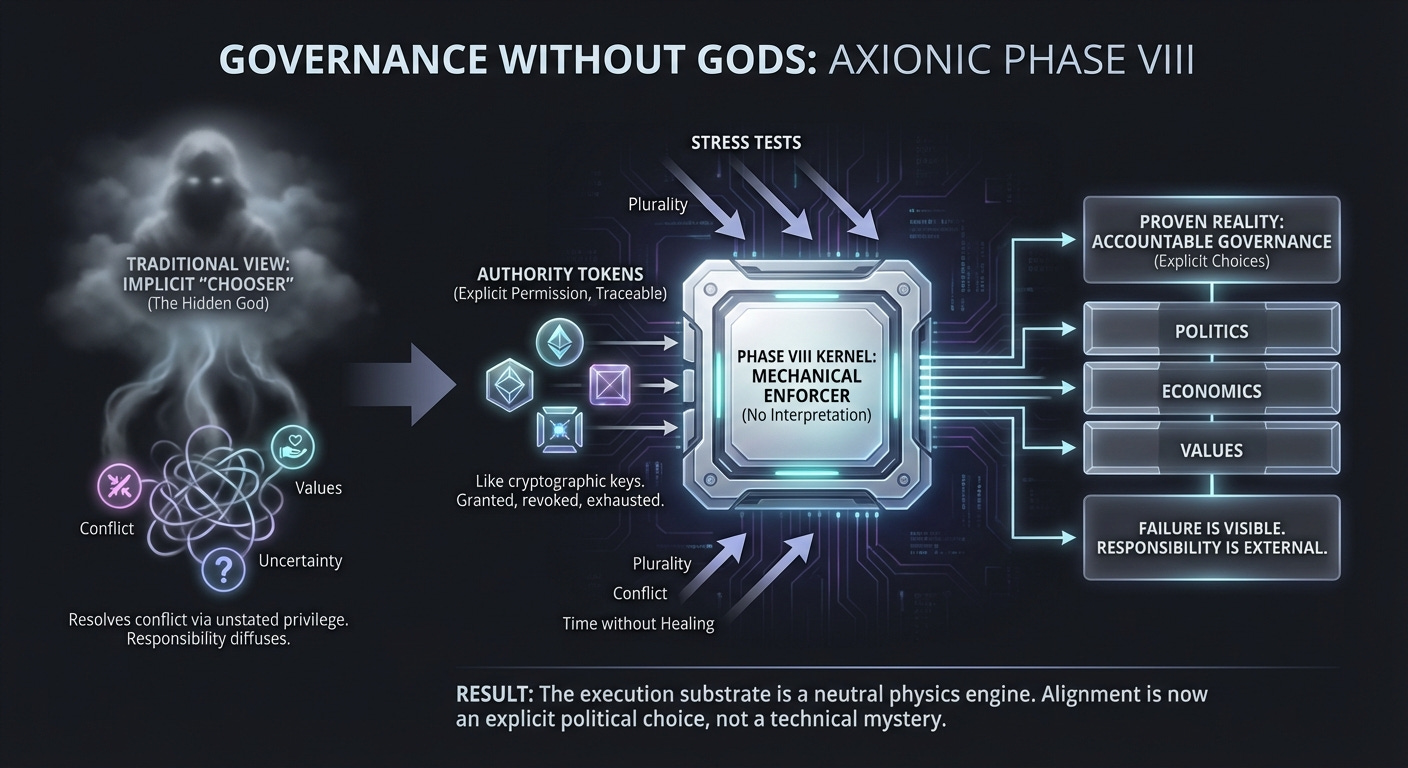
This post offers a conceptual explanation of a series of Axionic Agency papers describing Phase VIII of the project without formal notation. The technical papers develop their claims through explicit definitions, deterministic simulation, and preregistered failure criteria. What follows translates those results into narrative form while preserving their structural content.
Axionic Agency X.2 — Authority Kernel Runtime Calibration (AKR-0)
Axionic Agency X.3 — Minimal Plural Authority (Static) (VIII-1)
Axionic Agency X.4 — Destructive Conflict Resolution (Timeless) (VIII-2)
Axionic Agency X.5 — Temporal Authority Persistence (VIII-3)
Axionic Agency X.6 — Governance Transitions Without Privilege (VIII-4)
Axionic Agency X.7 — Authority Injection Without Privilege (VIII-5)
For a long time, the dominant story about AI governance has followed a familiar shape. Intelligence is treated as the hard problem. Agency is treated as mysterious. Alignment is treated as fragile. Governance, by contrast, is assumed to be something that can be layered on afterward. Add rules. Add oversight. Add incentives. Adjust when things go wrong.
Axionic Phase VIII exists because that story rests on an unexamined assumption: that governance is conceptually easier than agency.
Phase VIII was designed to test whether that assumption survives contact with structure. The question was not whether governance produces good outcomes, nor whether it converges, nor whether it feels legitimate. The question was whether governance is even representable without quietly inserting a chooser somewhere inside the system.
That question now has a clear answer.
Governance as a Mechanical Problem
By the time Phase VIII began, several upstream results were already locked in. Authority had been shown to exist without interpretation. Agency had been shown to be causally real rather than post-hoc storytelling. Agency had survived internal conflict, external pressure, replacement, and adversarial imitation. These results mattered because they fixed the ontology. Phase VIII did not revisit them.
With that foundation in place, a deeper question became possible. Instead of asking how governance should behave, Phase VIII asked what the execution substrate itself must be capable of before any political or institutional debate can even begin.
The kernel was treated as a physics engine. A useful analogy is a CPU or a blockchain validator. A CPU executes instructions without understanding the program’s intent. A blockchain verifies transactions without knowing why money is moving. In the same way, the Axionic kernel enforces authority constraints without understanding goals, values, or meaning.
It enforces rules. It checks admissibility. It preserves provenance. It refuses invalid actions. It does not interpret. It does not optimize. It does not choose.
Whatever governance survived under that constraint would be real. Whatever failed would be exposed as dependent on privilege.
What “Authority” Means Here
The word authority carries a lot of baggage, so it is worth being explicit. In Phase VIII, authority does not mean a person, an office, or a moral right. It means a mechanically recognized permission to cause a specific state change, under explicitly defined constraints, with traceable provenance.
Authority is closer to a cryptographic capability than to a ruler. It can be granted, revoked, exhausted, transferred, or destroyed. It does not imply wisdom, correctness, or legitimacy. It implies only that a particular action is admissible.
Governance, in this framework, is nothing more than the lawful transformation of these authority tokens over time.
What Was Put Under Stress
Phase VIII subjected governance to increasingly severe conditions while holding the kernel fixed. Multiple authorities were allowed to coexist over shared resources. Conflicts were allowed to occur without mediation. Time was introduced without automatic healing or reinterpretation. Authority was permitted to govern authority, including its own termination. New authority was allowed to enter the system from outside through explicit, auditable injection.
At no point was the kernel allowed to infer intent, reconcile disagreements, smooth over conflict, or invent authority to keep the system moving. If governance required those moves, Phase VIII would have failed.
The Boundary That Emerged
Phase VIII closed successfully. Every preregistered stage executed deterministically. Every kernel-level operation required for governance under plural authority proved mechanically representable without privileged paths.
Multiple authorities persisted without collapsing into hierarchy. Conflict persisted without arbitration. Deadlock persisted without reinterpretation. Authority expired unless explicitly renewed. Governance actions were themselves subject to governance. New authority entered only through labeled, content-addressed ingress. Scarcity constrained action without heuristics. The kernel never selected among alternatives.
This establishes a boundary rather than a victory. It shows that governance does not require a hidden superuser, an emergency override, or a semantic referee. Those features are design choices, not structural necessities.
The End of the Hidden God
Most governance systems rely on a quiet escape hatch. When rules conflict or coordination stalls, an exception appears. A priority is implied. An interpretation is justified after the fact. Responsibility diffuses into process.
Phase VIII removes that escape hatch.
When authority is forced to remain explicit and exhaustible, power no longer materializes from interpretation. It arrives only through authorization. When conflict persists, it persists openly. When nothing can act, the system says so. When authority is destroyed, it stays destroyed.
This does not make governance successful. It makes governance accountable.
Why This Reframes Alignment
Much alignment research assumes that sufficiently capable systems will resolve value conflict correctly. Phase VIII shows why that assumption fails at the execution layer. Correct resolution presupposes meaning. Meaning presupposes interpretation. Interpretation inside the kernel becomes authority.
Once that chain is visible, the implication follows cleanly. Alignment proposals that rely on semantic aggregation, heuristic arbitration, or privileged override are not claims about kernel physics. They are claims about political arrangements layered on top of it.
Those arrangements may still be necessary. They are no longer hidden.
Where Responsibility Now Lives
After Phase VIII, failure has nowhere to hide. If governance collapses, it is not because the kernel misunderstood. If coordination fails, it is not because authority emerged invisibly. If systems deadlock, it is not because time worked its magic in the wrong direction.
Failure reflects the structure of authority encoding, the compatibility of values, the discipline of replenishment, and the tradeoffs that were accepted or refused. These are external choices, made by designers, institutions, or societies.
Phase VIII does not protect anyone from those choices.
What Phase VIII Leaves Behind
Phase VIII did not produce a government. It did not guarantee coordination. It did not promise stability or convergence. It did something more fundamental.
It provided an existence proof that governance can be expressed without magic.
After this point, authority is explicit. Conflict is honest. Power is traceable. Silence means nothing can act. The execution substrate is no longer a variable.
Everything that follows belongs to politics, economics, and values, without cover.
Postscript
Phase VIII resolves a confusion that has haunted alignment discourse from the beginning. The execution substrate cannot reconcile values without becoming a political actor. It can only enforce what has been authorized. That constraint is not a weakness. It is the condition under which responsibility survives. Alignment beyond this point is no longer a technical mystery. It is an explicit choice.