

National defense presents the hardest case for a society without a State. War rewards speed, scale, unity, and concentrated command. It tests whether protective institutions can repel organized external force without hardening into sovereign rule.
Criminality presents the corresponding internal problem.
A society may dispense with legislatures, taxation, licensing, political office, and territorial monopoly. It cannot dispense with murderers, rapists, kidnappers, thieves, vandals, and violent abusers by declaration. Predation does not disappear when the State does, and a social order that cannot stop an aggressor has not eliminated coercion. It has ceded coercive advantage to whoever is least constrained by principle.
The need for criminal enforcement does not establish the need for sovereignty.
From the premise that someone must stop the murderer, the State derives a much larger conclusion: one institution must possess final authority to define offences, judge accusations, impose sanctions, and control legitimate force throughout a territory. None of that follows. A murderer may be stopped. An offender may be held answerable for invading another person’s agency. A continuing predator may be restrained. These permissions arise from the violation and create no general right to rule.
An Axiocracy therefore does not abolish coercion. It denies coercion a sovereign owner.
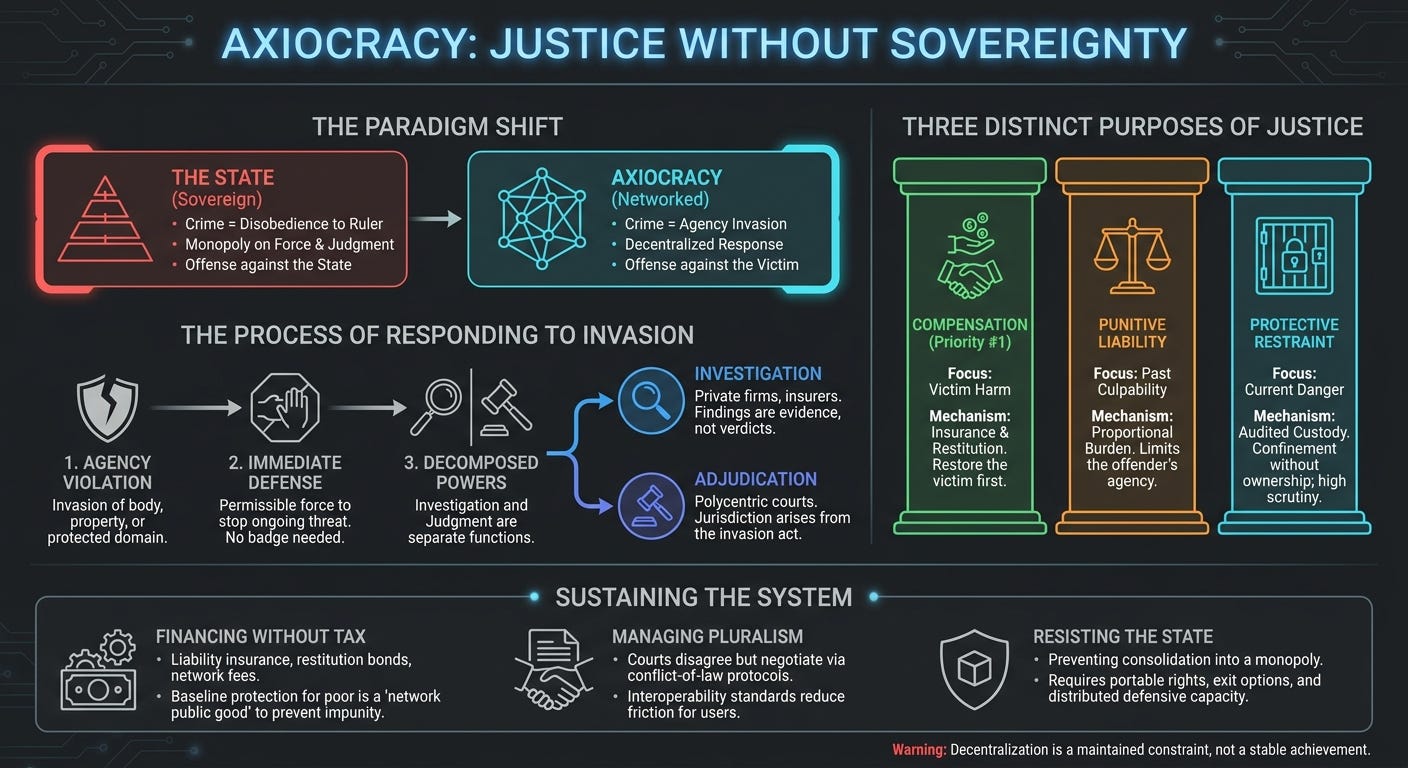
Crime is not disobedience
Under a State, a crime is whatever the sovereign criminalizes. Murder and peaceful drug possession belong to the same legal category because both violate commands issued by the same authority. Their moral difference survives only as a matter of degree, legislative classification, or prosecutorial discretion.
An Axiocracy reverses the order of explanation. Conduct is not wrongful because an institution prohibits it; an institution may forcibly respond because the conduct wrongfully invaded another agent’s protected domain.
Criminality consists of a culpable and sufficiently serious agency violation. The relevant domain includes the person’s body, movement, property, plans, associations, contractual expectations, and other means through which agency is exercised. Murder, assault, rape, kidnapping, robbery, theft, coercion, and destructive intrusion qualify because they replace one person’s control with another’s.
The category does not include every harm, risk, breach, or offensive act. An accident may generate compensatory liability without criminal culpability. A broken contract may create a claim without constituting aggression. An insult may be vicious without invading a protected boundary. Peaceful conduct does not become criminal because neighbours dislike it, authorities cannot monitor it, or a majority considers it immoral.
A criminal accusation must therefore answer concrete questions. Who was invaded? Which protected boundary was crossed? What act crossed it? Who caused the invasion? What degree of intention, recklessness, or negligence made the actor culpable? What response does that violation authorize?
“The rule was broken” answers none of them.
Agency boundaries are not self-interpreting
The phrase “protected domain” does not settle every legal dispute. People disagree about property, consent, negligence, environmental risk, abortion, intellectual property, parental authority, contractual capacity, and the limits of self-defense. Agency theory constrains these disputes without mechanically generating a unique answer in every case.
No legal order escapes interpretation. State law also contains conflicting doctrines, competing precedents, political judgments, and unresolved moral disagreement. Sovereign legislation does not eliminate ambiguity. It gives one institution the final power to impose its interpretation.
An Axiocracy replaces legislative uniformity with legal pluralism. Some rules would converge widely, because any viable legal order must protect bodily integrity, freedom of movement, established possession, and recognized control against forcible invasion. More contested domains would vary across legal networks, property associations, insurers, courts, and contractual communities.
Disagreement would be managed through:
advance choice-of-law agreements;
property covenants;
reciprocal legal compacts;
shared evidentiary standards;
conflict-of-law protocols;
neutral appellate institutions;
heightened burdens before enforcing contested norms against outsiders;
refusal to recognize judgments based on rules other networks regard as themselves invasive.
A protected boundary is a normative claim to be argued, adjudicated, revised, and tested against the agency of everyone affected, not a metaphysical line visible without interpretation.
The absence of a sovereign does not require unanimity. It requires procedures for disagreement that do not convert one institution’s interpretation into universal rule.
The response begins before adjudication
An ongoing invasion may be interrupted immediately. A victim does not need institutional permission to resist an assault. A third party does not need a badge to stop a kidnapping. A security provider does not require territorial sovereignty to defend a client against an armed attacker.
The permissible force is determined by the threatened violation, the practical means of stopping it, and the risks imposed on others, not by official status.
This authority ends when the defensive necessity ends. Someone entitled to stop an attacker does not thereby acquire authority to search unrelated property, confiscate the attacker’s assets, determine guilt, prescribe a sentence, or govern the surrounding population.
The State converts a local permission into general jurisdiction. An Axiocracy holds it to the occasion that created it.
Judgment cannot belong to the enforcer
Stopping an apparent aggressor is not the same as proving criminal liability. Appearances are sometimes wrong. Victims lie. Witnesses misperceive. Investigators become committed to a theory. Forensic methods fail. Security providers protect their reputations. Insurers minimize claims. Courts develop institutional loyalties.
No person or organization should therefore investigate, judge, punish, and review its own conduct as a unified sovereign function. An Axiocracy decomposes these powers.
Investigations may be conducted by security providers, insurers, victim representatives, forensic specialists, property associations, or independent investigative firms. Their findings remain evidence rather than verdicts, and investigators remain personally and institutionally liable for trespass, fabrication, coercive interrogation, reckless accusation, destruction of evidence, and excessive force.
Adjudication occurs through recognized courts or arbitral institutions operating under explicit legal protocols. Jurisdiction may arise through prior contracts, insurance agreements, property covenants, reciprocal legal networks, or the victim’s claim following an uncontracted invasion. The procedure must permit adversarial challenge, disclosure of evidence, independent representation, reasoned judgment, and appeal outside the institution that issued the original decision. Courts and enforcement providers should post bonds or carry liability insurance sufficient to compensate those they wrongfully convict, restrain, or injure.
A judgment must eventually become operationally enforceable, since conflict cannot be deferred forever merely because absolute certainty is unavailable. But operational finality does not convert a verdict into unquestionable truth. A judgment may become enforceable while remaining reviewable.
The uncontracted predator
A purely contractual theory of law fails at its hardest case.
Suppose a person joins no legal association, purchases no liability insurance, accepts no court, recognizes no property covenant, and rejects every proposed adjudicator. He then assaults another person. He cannot acquire immunity by refusing all legal relationships.
Rights do not originate solely in contract. Contract specifies obligations and institutional procedures among consenting participants; it does not create the body, property, or agency boundaries that make consent possible.
By invading another person’s protected domain, the aggressor creates a claim against himself. The victim or the victim’s representatives may invoke institutions capable of investigating and adjudicating that claim, and the offender’s prior consent is unnecessary because the authority arises from the invasion he initiated.
This is defensive jurisdiction, not territorial sovereignty. The distinction imposes limits in both directions. The aggressor cannot veto adjudication merely by withholding consent. The victim cannot appoint an infallible court or dictate an unlimited penalty. Jurisdiction extends only as far as necessary to determine responsibility, repair the invasion, impose proportionate liability, and prevent credible recurrence.
The original wrong generates answerability. It does not generate ownership.
Compensation comes first
The immediate concern after an agency violation should be the victim, not the symbolic majesty of the legal order.
Axio’s earlier proposal for Universal Compensatory Justice supplies part of the required architecture. Under UCJ, insurance or compensation networks restore victims promptly and then recover costs from the responsible party or that party’s insurer through subrogation. The victim need not wait through years of criminal proceedings or depend on the offender’s present solvency.
This corrects a deep defect in state criminal justice. The State claims the offence as an injury to itself. It prosecutes in its own name, pays its own officials, confines the offender at public expense, and frequently leaves the actual victim with little more than a chance to deliver a statement before sentencing.
Compensatory justice reverses the priority. Property should be returned or replaced. Medical and recovery costs should be paid. Lost income, lost time, damaged plans, imposed risk, and continuing care should be assigned to the responsible party as far as they can be identified and valued. Where direct collection is impossible, insurers, mutual compensation pools, restitution bonds, property networks, or specialized victim funds can pay first and pursue recovery later.
Compensation cannot complete the entire work of criminal justice. Some harms cannot be reversed. Money does not restore a murdered person or cancel a rape. A wealthy predator cannot purchase a standing option to assault others. An offender indifferent to future credit, premiums, or property claims will not be controlled by actuarial pricing. UCJ works better for accidents, negligence, defective products, environmental damage, and other insurable risks than for deliberate predation, so its institutional logic should be retained without treating compensation as the sole criterion of justice.
The systems must remain conceptually distinct:
Compensation tracks harm and causal responsibility.
Punitive liability tracks culpability.
Protective restraint tracks demonstrated danger.
The same act may activate all three, but none substitutes for the others.
Equal protection without taxation
A justice system that protects only those who can afford investigation and adjudication is not a legal order. It is a market in retaliation.
The poor cannot be left undefended merely because an investigator expects no profitable recovery. If predation against low-income victims is less likely to be investigated, poverty becomes a discount on violence, and aggressors will rationally target those whose claims are least valuable. An Axiocracy therefore requires baseline protection against serious agency invasion independent of the victim’s purchasing power.
This protection is part of the infrastructure any credible legal network must finance, not a charitable supplement to private justice. A network that declines serious cases because the victim is poor does not merely underserve that victim. It sets a price on who may be attacked.
Unpunished predation also imposes costs far beyond the direct victim. It raises insurance losses, lowers property values, increases security expenditure, weakens trust, encourages further predation, and destabilizes recognition among legal networks. An investigation may be unprofitable as an isolated claim while remaining valuable to every institution exposed to the resulting insecurity. Baseline criminal enforcement should therefore be treated as a network-level public good.
Any legal network seeking reciprocal recognition should be required, as a condition of that recognition, to contribute to a shared severe-crime fund financing investigation, adjudication, and initial victim compensation where neither victim nor offender can pay. Participation would be contractual at the network level rather than imposed territorially on every person. Additional mechanisms may include mutual compensation and defense pools built into property-network membership, cross-subsidized legal associations, insurer-funded investigations where unresolved predation raises system-wide risk, restitution bonds, compensation reserves maintained by courts and security providers, charitable defense institutions, recovery rights assigned to investigators, and reciprocal agreements requiring legal networks to pursue grave violations regardless of claimant wealth.
The hardest case is the unaffiliated victim: someone who belongs to no property network, carries no insurance, and has no legal association. Reciprocal-recognition agreements should therefore require coverage of grave agency violations involving any person within the participating networks’ operational reach, not only their members. Operational reach will itself require interpretation, but the alternative is worse: providers would collectively create an uninsured underclass while preserving deniability about who was responsible for it. The justification is not universal benevolence. It is suppression of impunity.
These mechanisms will not produce perfectly equal legal resources. Neither does the State, where wealthy defendants already purchase stronger counsel, expert witnesses, political access, and reputational protection. Equal protection does not mean every person receives the same quantity of legal service. It means poverty cannot create effective immunity for predators.
What punishment is for
Restitution answers the victim’s material claim. Incapacitation protects against future invasion. Neither settles whether culpable wrongdoing warrants punishment for the act already committed.
An Axiocracy need not reject retribution entirely, but the punitive claim requires independent justification and cannot be inferred merely from the existence of uncompensated harm. The proposed justification is reciprocal liability: an agent who culpably overrides another’s protected control weakens his own claim against a bounded and proportionate interference imposed in response. He imposed a burden he had no authority to impose, and he cannot erase the completed wrong by restoring its market value. That establishes the possibility of punishment. It does not supply a sentencing scale.
Retribution becomes dangerous when described as vengeance, moral purification, social denunciation, or repayment of a metaphysical debt to the community. Those concepts allow institutions to invent penalties unrelated to the victim, the violation, or any concrete protective function.
Culpable invasion changes the offender’s claim against proportionate responsive interference. Someone who intentionally confines another person may become liable to a bounded loss of freedom. Someone who appropriates another’s resources may become liable to restitution, attachment of assets, or a bounded claim against future income. The sanction answers the structure and gravity of the offence without granting an institution unrestricted power over the offender.
Punishment must remain determinate. The adjudication should state what burden is imposed, why it is proportionate, and when it ends.
Punishment and incapacitation are different judgments
Punishment concerns past culpability. Incapacitation concerns future danger.
States routinely merge them. A fixed sentence is extended because officials believe the prisoner remains dangerous. Preventive detention is disguised as punishment. Indefinite confinement is relabeled treatment. A person who has completed his sentence remains subject to restrictions because his criminal status is treated as permanent evidence of risk.
An Axiocracy should require separate findings. Punitive liability must be based on a proved act and fixed according to its culpability and severity. Protective restraint must be based on current evidence that release would expose others to a serious risk of agency invasion, and it requires periodic independent review. The evidentiary burden should increase as restraint continues, because each additional period of confinement requires a present justification.
Past violence is evidence of future danger. It is not permanent proof.
A person may complete a proportionate punishment while remaining too dangerous for unrestricted release. Another may deserve punishment for a grave act while presenting little continuing risk. Treating these cases as conceptually identical produces either excessive confinement or inadequate protection.
Danger without culpability
Not every dangerous agency violation is culpable. A child, a person acting under coercion, someone involuntarily intoxicated, or someone deprived of meaningful control by psychosis or severe cognitive impairment may cause grave harm without becoming liable to punishment.
The absence of culpability defeats the punitive claim. It does not erase the victim’s compensatory claim, and it does not require others to accept an ongoing danger.
Protective restraint may therefore be justified following a proved serious agency violation even where criminal culpability is absent. Its justification is defense rather than punishment, which changes what it may consist of: the restraint must be no more restrictive than the danger requires, directed toward restored control wherever that is possible, and reviewed independently at short intervals.
Incapacity must narrow institutional authority rather than expand it. Treatment cannot become a route to indefinite confinement under a lower standard of proof. The restraining institution retains the burden of demonstrating present danger, and the confined person retains the same protections against abuse, exploitation, and arbitrary detention as anyone else.
When restraint becomes precrime
Protective restraint creates the most dangerous loophole in the entire system.
Insurers, property networks, and security providers all have incentives to overestimate danger. If they bear the cost of future violence, confinement may appear cheaper than uncertainty. Statistical prediction can then replace adjudication, and actuarial categories can become permanent sentences.
An Axiocracy must reject criminal liability based on predicted character. No person may be confined merely because a model assigns him a high risk score, because he belongs to a dangerous demographic category, or because an insurer considers him expensive to cover. Protective confinement requires a prior proved serious agency violation. Dangerousness may justify restraint after such a violation; it cannot create criminal jurisdiction from statistical prediction alone.
Even after a proved offence, prediction cannot operate without limits. Continued confinement should require:
evidence of a specific and grave risk;
adversarial review;
independent risk assessment;
separation between the risk assessor and the custodian;
no financial reward for extending detention;
a burden of proof on the restraining institution;
increasing scrutiny as confinement continues;
substantial automatic liability for wrongful restraint.
Risk may justify conditions short of confinement: exclusion zones, supervision, restricted access to weapons, bonded release, monitored movement, or required proximity to a responsible guarantor.
Uncertainty should count against the most severe intervention. That release is not risk-free cannot justify perpetual custody, because no human being can prove future harmlessness.
Incapacitation is the point at which Axiocracy comes closest to reproducing sovereign abuse. It must therefore face stronger constraints than ordinary punishment, not weaker ones.
Confinement without ownership
Some offenders cannot safely remain at liberty. No serious theory of Axiocracy can evade this fact.
A violent predator may ignore restitution orders, defeat narrower restrictions, repeatedly attack others, or present a sufficiently grave and immediate danger that secure confinement is necessary. Calling the confinement private, restorative, therapeutic, or protective does not make it non-coercive. The person is being held against his will, and the justification must therefore be explicit.
A court or arbitral panel may authorize a defined custodial intervention. The order identifies the person, the proved violation or current danger, the permitted restrictions, the conditions of custody, the duration, the review process, and the parties liable for abuse or error. A secure facility then performs a custodial function without acquiring sovereignty over the confined person.
The distinction excludes the tacit second sentence imposed by ordinary prisons. A sentence of confinement does not authorize assault by guards, rape by other prisoners, medical neglect, arbitrary isolation, degradation, confiscation unrelated to restitution, or forced labour for the custodian’s benefit. The offender remains a person within the moral order, liable to specified restrictions rather than to whatever treatment an institution finds convenient.
Custody providers should therefore be institutionally separate from courts and security investigators. They should be externally inspected, continuously audited, bonded against abuse, and open to legal challenge. Prisoners must retain access to counsel, evidence, appeal, communication, medical care, and independent complaint mechanisms.
Payment structures require particular scrutiny. A facility paid for every occupied day has an interest in longer confinement. A provider entitled to extract captive labour has an interest in more prisoners. A security firm that owns the court and the facility profits from accusation, conviction, and sentence expansion.
Changing the shareholder does not abolish the prison State. The coercive functions must remain decomposed, contestable, and mutually liable.
Who pays?
Justice consumes resources regardless of who provides it. Investigations, courts, victim compensation, secure custody, appeals, forensic testing, monitoring, and compensation for wrongful convictions all require funding. An Axiocracy cannot hide these costs inside taxation or declare them solved by privatization.
Possible mechanisms include liability insurance, victim insurance, restitution bonds, mutual-defense associations, property-network fees, court subscriptions, insurer-funded investigation, offender assets, and compensation pools maintained by participating legal institutions.
Each mechanism creates incentives. An insurer paying victim claims wants accurate attribution, but also wants to deny expensive claims. A court funded by claimants risks favouring claimants; a court funded by defendants risks favouring defendants. A custody provider wants predictable payment. A security association wants its interventions validated. A property network may externalize the costs of troublesome residents.
No financing structure removes self-interest. Axiocratic design makes interests visible and places them in opposition. Investigation should be challengeable by rival investigators. Courts should face appeal outside their own network. Institutions should be bonded against foreseeable error. Compensation pools should audit courts and security firms whose mistakes create claims. Legal protocols should prevent a single provider from bundling accusation, judgment, enforcement, and custody.
Justice does not require incentive-free institutions. It requires institutions whose incentives cannot become unanswerable power.
When courts disagree
Polycentric law does not eliminate jurisdictional conflict. It relocates it from political supremacy to institutional negotiation.
Two courts may disagree about guilt, evidence, procedure, remedy, or the legitimacy of each other’s judgments. Two security networks may each claim authority to protect their client. Without a final sovereign court, some disputes will remain difficult, and the answer cannot be that every institution simply enforces its own verdict. That produces private war.
Stable legal networks would need reciprocal recognition agreements, shared evidentiary standards, conflict-of-law protocols, appellate forums accepted across networks, and rules governing which institution has standing in a particular case. Insurers and property associations would have strong incentives to participate, because unresolved jurisdiction raises the cost of every transaction and protection contract. Institutions that routinely refuse neutral review or enforce idiosyncratic judgments would become expensive counterparties: other networks could refuse recognition, require larger bonds, restrict access to shared property, or treat their enforcement actions as unadjudicated aggression.
None of this guarantees convergence. Sovereign legal systems also produce contradictory judgments, jurisdictional battles, political prosecutions, and wrongful convictions. Their finality comes from superior force rather than superior knowledge.
An Axiocracy accepts that final authority and correct authority are different properties.
The bureaucracy of pluralism
Legal pluralism creates transaction costs. A society of overlapping courts, insurers, property networks, appellate bodies, and reciprocal compacts could become incomprehensible if every person had to negotiate each conflict independently. A simple dispute might require determining which rules apply, which court has standing, which insurer must respond, and which network will recognize the judgment. No viable system can require ordinary people to become specialists in conflict of laws.
Most of this complexity would therefore be absorbed by intermediaries. Individuals would normally choose legal, insurance, and property packages with standardized terms. Providers would negotiate interoperability, recognition, appeals, and claims settlement on their behalf. Clearinghouses would reconcile judgments. Default rules would govern common conflicts. Standard contracts would replace repeated bespoke negotiation.
State systems already operate this way. Commercial disputes may cross municipal, provincial, federal, national, contractual, arbitral, and industry-specific regimes, and most people do not navigate the full architecture themselves. Lawyers, insurers, standard forms, courts, and administrative systems absorb the complexity. Polycentric law does not eliminate bureaucracy. It changes who controls it and whether its decisions are contestable.
The pressure toward sovereignty will not arise only from conquest. It will also arise from convenience. Users will prefer compatible rules, predictable jurisdiction, and low-friction enforcement, and providers will respond by standardizing, federating, and consolidating. Those gains are real. A fragmented system that refuses standardization for ideological purity will lose to one that makes ordinary life easier.
The constitutional problem is therefore not how to prevent coordination. It is how to obtain interoperability without granting the coordinating layer compulsory jurisdiction. A common protocol need not become a sovereign code. A clearinghouse need not become a supreme court. A federation need not acquire authority over nonmembers. Standardization becomes sovereignty only when participants may no longer reject the standard, choose a rival, or leave the network without coercive penalty.
Axiocracy should therefore minimize unnecessary friction while preserving institutional substitutability. The objective is coordination without final rule.
The coalition that becomes a State
The principal danger is not permanent disorder. It is successful consolidation.
Courts standardize their rules. Insurers recognize only approved courts. Security providers divide territory. Property networks require membership in dominant legal systems. Custody providers merge. Registries become universal. Eventually one interconnected complex determines which rules are valid, which courts are legitimate, who may enforce judgments, and which persons may exit.
A durable territorial security monopoly does not by itself constitute a State. It creates the material precondition for one. The conversion occurs when dominance becomes sovereignty: when the coalition claims compulsory jurisdiction over nonconsenting persons, suppresses rival legal and defensive institutions, and treats its decisions as binding without contract or meaningful exit.
Taxation and other forms of involuntary extraction usually follow, because sovereign institutions require resources. They are evidence and instruments of state power rather than logically necessary conditions of it. A coalition funded entirely by endowment, resource income, or voluntary supporters would still be a State if it imposed compulsory jurisdiction. What matters is not the revenue category but whether the coalition can impose payment and jurisdiction unilaterally.
A corporation can therefore become sovereign, and so can a consortium, insurer network, property federation, or defense compact. Private ownership does not prevent state formation. A nominal right of exit is also insufficient: exit is fictitious when every viable property, employment, payment, security, and legal network belongs to the same coalition, or when departure requires abandoning all accumulated assets and relationships.
An Axiocracy must therefore preserve continuing structural resistance to consolidation:
no exclusive territorial jurisdiction;
no bundled court-security-custody monopoly;
portable legal and reputational records;
interoperable evidence standards;
appeals across institutional boundaries;
transparent reciprocal agreements;
open entry for competing investigators and adjudicators;
institutional bonding and liability;
rights of network secession;
independently distributed defensive capacity;
no legal immunity based on institutional status, accreditation, or official recognition;
no coercive unaccountability produced by market dominance.
These legal constraints have force only while institutions capable of enforcing them remain independent. A coalition with overwhelming coercive superiority can ignore bonds, judgments, exit rights, and reciprocal agreements. Axiocratic criminal justice therefore depends on the wider distribution of defensive capacity developed in When the Protector Becomes the Ruler. Courts and insurers cannot preserve pluralism by contract once one coalition can ignore every contract with impunity.
That architecture cannot guarantee that sovereignty will never return. A decentralized order may lose to a centralized aggressor. A centralized defense coalition may defeat the aggressor and then refuse to dissolve. Any force capable of preventing domination is itself capable of domination. Axiocracy contains no institutional theorem proving that sovereignty can never re-emerge, and no political order possesses such a theorem.
The objective is to distribute the means of resistance, deny legitimacy to the conversion of defensive dominance into compulsory rule, and ensure that an attempted conversion faces organized resistance rather than procedural objection alone.
If a security coalition acquires territorial dominance but continues to operate through voluntary contracts, permits rival institutions, allows meaningful exit, and imposes no compulsory jurisdiction, it has not yet become a State. If it converts that dominance into compulsory rule, Axiocracy has failed.
Decentralization is not a stable achievement. It is a maintained constraint.
The end of liability
A completed punishment must end.
Restitution obligations may continue when losses remain unpaid, but they cannot become perpetual ownership of the debtor. Protective restrictions may continue when current danger remains independently established, but they cannot survive merely because the person once committed a crime.
Specific risks may justify specific exclusions. A fiduciary thief may lose access to entrusted funds. A violent abuser may be prohibited from approaching the victim. A reckless pilot may lose access to aircraft. These restrictions follow the demonstrated risk, and they do not justify general exclusion from housing, employment, movement, finance, association, or legal protection.
The permanent category of “criminal” turns finite liability into caste. It allows every institution to impose additional punishment without adjudication, makes reintegration practically impossible, and increases recidivism by denying the former offender lawful means of rebuilding an independent life.
Liability attaches to acts and current risks. It should not metastasize into social identity.
Postscript
An Axiocracy cannot guarantee perfect verdicts, incorruptible courts, universal insurance, equal resources, accurate risk assessment, complete restitution, low transaction costs, or permanent resistance to consolidation.
Neither can a State.
The comparison is not between imperfect polycentric justice and an omniscient sovereign. It is between institutions operating under the same human limitations: uncertainty, self-interest, fear, tribal loyalty, asymmetric information, and the temptation to convert emergency authority into permanent power.
National defense asks whether protection can be coordinated without becoming political supremacy. Criminal justice asks whether force can be directed against offenders without becoming general jurisdiction. The danger is structurally similar. The institution authorized to protect acquires command, resources, information, and coercive capacity, and then faces a permanent temptation to convert a bounded function into a standing claim to rule.
An Axiocracy rejects that conversion. Predators may be stopped without granting one institution a territorial monopoly on force. Victims may be compensated without making prosecution an injury owned by the State. Dangerous people may be confined without transferring ownership of their bodies to a prison system.
Criminality creates a right of response because one agent has invaded another’s protected domain. That right authorizes interruption, investigation, adjudication, restitution, proportionate punishment, and necessary restraint. Every stage remains bounded by the violation that justified it.
External aggressors may be repelled. Internal predators may be restrained. Neither necessity grants the protector sovereignty over everyone else.