

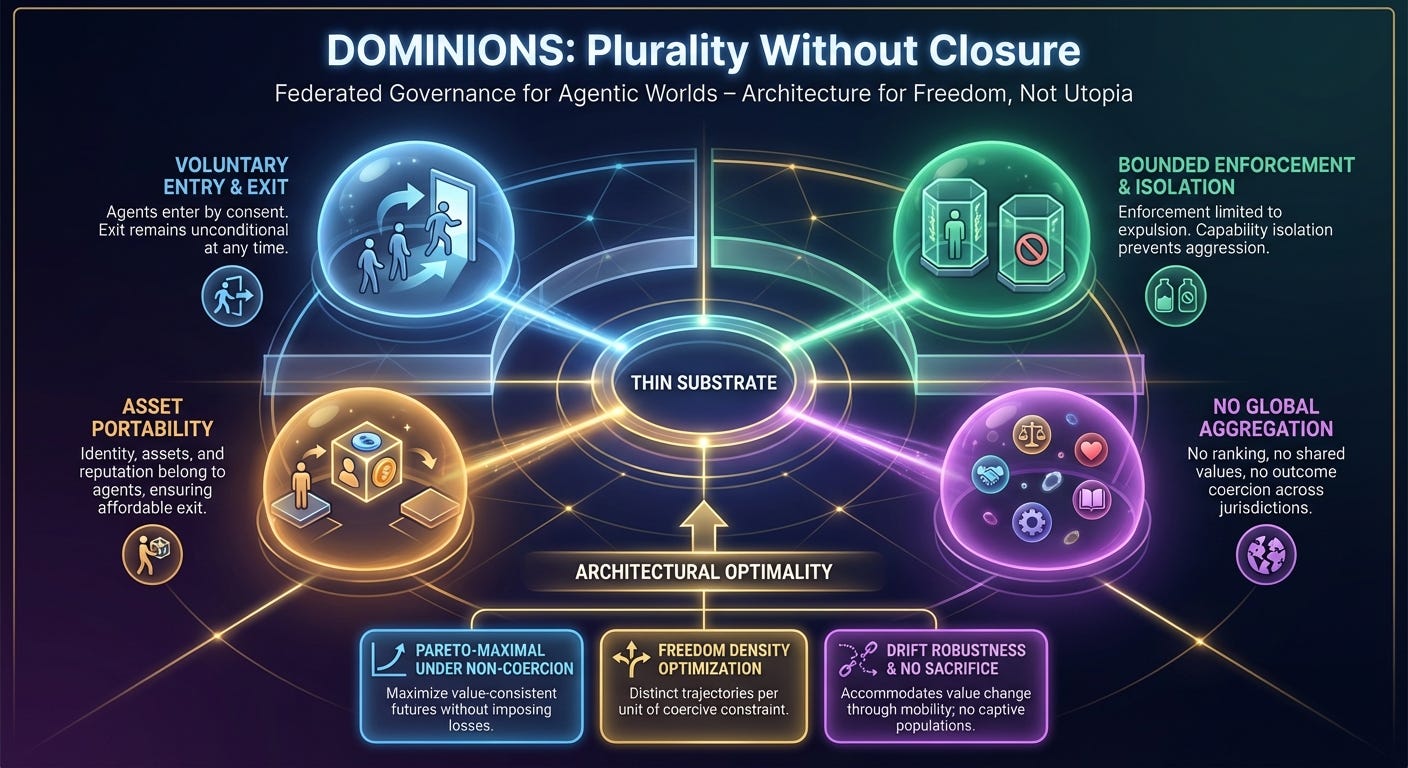
This post explains Dominions: Plurality Without Closure without formal notation. The underlying paper develops its claims using explicit definitions and constraints; what follows translates those results into conceptual terms while preserving their structural content.
Rejection of utopia and diagnosis of sacrificial collapse together leave a final question unresolved:
What kind of social architecture remains coherent once agency, pluralism, and value drift are treated as structural facts?
Dominions answers this question at the level of governance architecture, not moral theory and not world optimization. It describes a system in which agents inhabit a shared technical substrate while exercising sovereign control over local virtual jurisdictions. These jurisdictions—called Dominions—operate entirely by consent, enforce rules only through expulsion, and remain isolated from one another by design.
The claim advanced is narrow and precise:
Among governance architectures that preserve agency and reject outcome coercion, Federated Virtual Dominions are structurally optimal within their domain.
The argument concerns digitally mediated social space. It does not claim to solve physical scarcity, biological dependency, or material political economy.
From Failure Analysis to Constructive Architecture
The first two Axio posts established constraints.
Against Utopia showed that final world designs fail under agent-relative value.
Open Agentic Manifolds showed that optimizing systems collapse when performance improves through captive agency loss.
Dominions operates entirely within those constraints. It asks which governance structures remain admissible once closure and sacrificial optimization are excluded by design.
The answer is not harmony or convergence. The answer is plurality with exit supremacy.
What a Dominion Is
A Dominion is a sovereign virtual jurisdiction created by an agent or group of agents. Each Dominion defines its own rules, norms, and internal affordances.
Several properties define the architecture:
Voluntary Entry
Agents enter a Dominion only by invitation and explicit consent to its rules.Bounded Enforcement
Rule enforcement is limited to expulsion. Punishment, fines, and coercive penalties are unavailable.Exit Supremacy
Agents retain the unconditional ability to leave any Dominion at any time.No Global Value Aggregation
The system does not rank Dominions, reconcile values, or enforce shared outcomes.Thin Substrate
The shared infrastructure enforces identity persistence, consent verification, capability isolation, and expulsion. It does not adjudicate meaning, morality, or success.
Together, these properties define a federated, opt-in, expulsion-only governance topology.
Why Exit Supremacy Requires Asset Portability
Exit has meaning only when it remains affordable.
For that reason, the architecture requires that persistent identity, assets, and reputation belong to agents rather than to Dominion operators. A Dominion may deny continued participation, but it cannot confiscate what gives an agent continuity across jurisdictions.
This requirement is constitutive. When operators control assets, exit costs rise. Rising exit costs convert voluntary membership into captivity. Captivity reintroduces sacrifice gradients. Sacrifice gradients reintroduce collapse.
Asset portability therefore functions as a structural safeguard rather than a convenience.
Capability Isolation as a Constitutive Constraint
Dominions exist as capability-isolated execution contexts.
They do not possess direct access to one another. They do not allocate substrate resources beyond assigned quotas. They do not write to shared state except through explicit, substrate-mediated bridges.
Inter-Dominion aggression therefore becomes physically infeasible rather than normatively prohibited. The design resembles operating-system process isolation or object-capability security models.
A more visceral way to understand this is to imagine separate airtight vessels rather than a shared room: no one must agree to refrain from violence, because violence across boundaries is not physically possible. Interference prevention operates as a constitutive constraint, not a behavioral rule.
Admissible Optimality
The paper’s optimality claims operate inside a sharply defined design space.
Only architectures that preserve agentic decision authority, allow endogenous value drift, and limit enforcement to constitutive constraints qualify as admissible. Architectures that enforce coexistence, mandate value convergence, or impose global outcomes fall outside the space under consideration.
Within this admissible set, the question becomes comparative:
Which architectures remain undominated once coercion is excluded?
Why Dominions Are Pareto-Maximal Under Non-Coercion
Any alternative architecture that restricts Dominion creation, limits exit, enforces shared norms, or mandates coexistence necessarily reduces the set of value-consistent futures available to at least one agent.
At the same time, no other agent gains additional attainable value under their own valuation as a result of that restriction.
This establishes Pareto maximality within the admissible design space. No other non-coercive architecture strictly improves outcomes for some agents without reducing them for others.
Freedom Density as a Design Metric
The architecture optimizes a quantity better described as freedom density: the number of distinct value-consistent future trajectories available per unit of coercive constraint.
Freedom density rises when:
constraints remain local to voluntary contexts,
enforcement remains minimal and reversible,
divergence across jurisdictions remains unconstrained.
Dominions maximize this quantity because agents may instantiate incompatible norms without imposing them on others and without requiring global adjudication.
Robustness Under Value Drift
Agents change. Values evolve. Preferences shift.
The Dominions architecture accommodates drift through mobility rather than reform. When an agent’s values change, the agent moves. No other agent must change in response. No system-wide renegotiation occurs.
This property distinguishes Dominions from nation-states, federations, consensus communities, and public-goods-dependent systems, all of which require collective adjustment when individual values diverge.
Dominions achieve drift robustness by localizing coordination and globalizing exit.
Absence of Standing Sacrifice
A standing sacrifice exists when some agents must endure involuntary deprivation to stabilize a system.
Dominions contain no such class.
Losses remain localized to exit costs.
Flourishing within one Dominion does not depend on coerced participation elsewhere.
Stability does not require variance sinks or captive populations.
Architectures that enforce shared outcomes across jurisdictions inevitably reintroduce sacrifice substrates. The Dominions architecture avoids them by refusing shared outcomes altogether.
What the Architecture Declines to Optimize
The system does not pursue shared meaning, large-scale coordination, public goods, epistemic convergence, or low transaction costs at the global level.
These exclusions follow directly from the constraints. Agents who value such goods may instantiate them voluntarily within specific Dominions. The substrate declines to enforce them across the federation.
This choice reflects architectural discipline.
Scope and Limits
The optimality claims apply to the governance layer of digitally mediated interaction.
Physical scarcity, energy requirements, biological dependency, and material political economy persist outside this layer. No governance architecture dissolves those constraints.
Within domains increasingly mediated by digital environments, Dominions minimize coercion and sacrifice while preserving maximal plurality.
Lineage and Distinction
The architecture resembles Nozick’s Anarchy, State, and Utopia’s proposal of a framework for utopias. The present justification rests on agency preservation, non-composability of value, and robustness under drift, enforced through technical constraints rather than moral rights.
Postscript
Once utopia is rejected and sacrificial optimization is excluded, only constrained optimality remains.
Under the constraints of agency preservation, value drift, non-coercion, asset portability, and capability isolation, Federated Virtual Dominions achieve:
Pareto maximality within the admissible design space,
maximal freedom density,
robustness under drift,
absence of standing sacrifice.
This represents the strongest form of optimality available in principle.
The ambition of governance shifts accordingly:
not to decide what perfection must be, but to refuse to decide it on anyone’s behalf.