

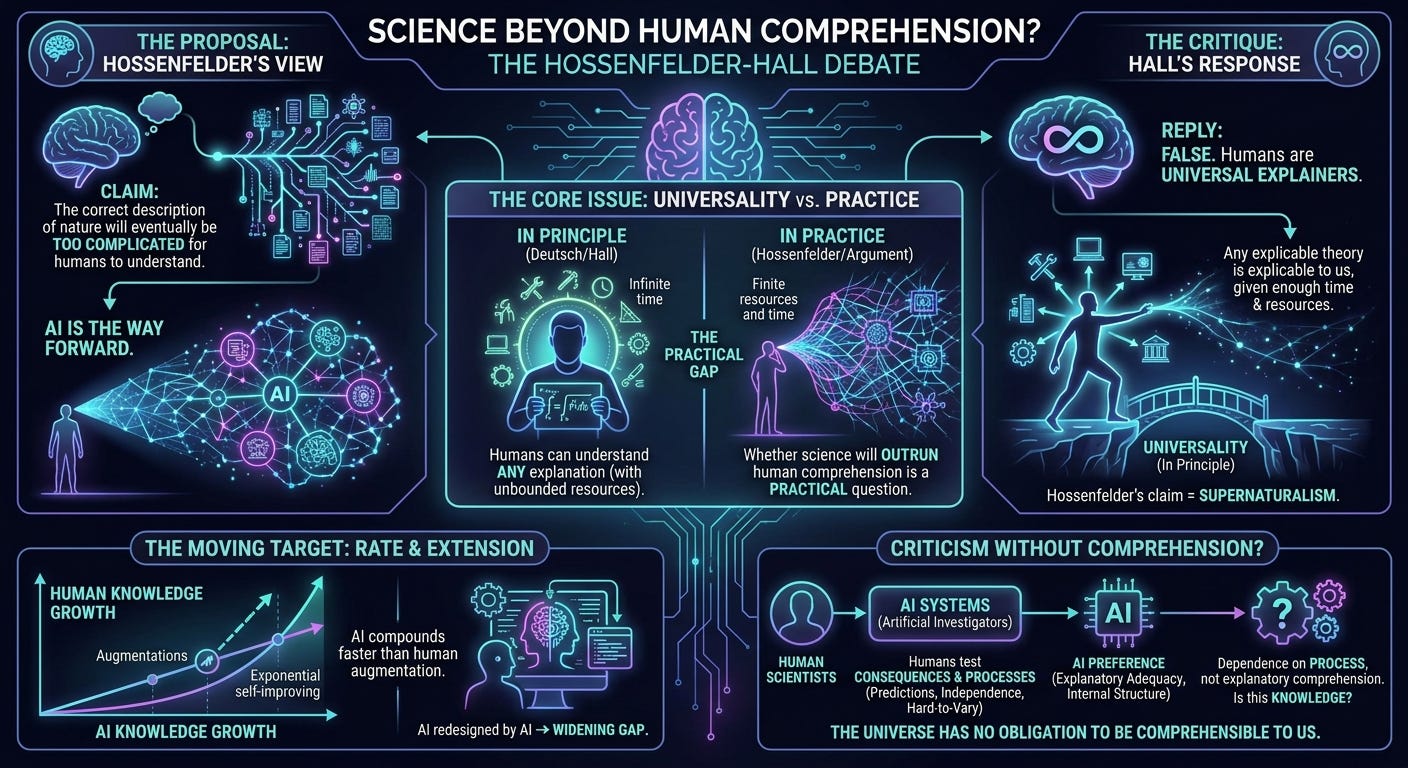
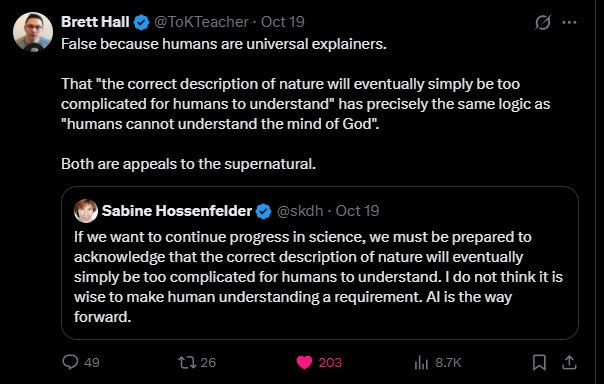
Sabine Hossenfelder posted that continued progress in science requires accepting that “the correct description of nature will eventually simply be too complicated for humans to understand.” She does not think it wise to make human understanding a requirement: “AI is the way forward.” Brett Hall replied that this is false because humans are universal explainers. Her claim, he wrote, has “precisely the same logic” as “humans cannot understand the mind of God”, and both are appeals to the supernatural.
The universal-explainer claim comes from David Deutsch. Explanatory capacity admits a single jump: a system either is a universal explainer or it is not. Dogs are not. People are, and so would be any artificial general intelligence. Beyond the jump there is no higher class, only differences of speed and memory, which are parochial because they can be added. So anything explicable is explicable to us, and real knowledge beyond human understanding would be beyond explanation itself, the mark of the supernatural.
In August I argued, in No One Has Shown We Are Universal Explainers, that the first step has not been established. Here I grant it in full: given enough time, memory and whatever extensions the task demands, a person can understand any explanation. Hall’s conclusion still does not follow. Universality settles what is possible in principle; whether science will outrun human comprehension is a question about practice. Hossenfelder’s sentence can be read either way. Once universality is granted, only the practical reading is defensible, and Hall’s “false” refutes only the other one.
The Charge of Supernaturalism
Imagine an artificial intelligence that develops a new physical theory. It predicts previously unexplained phenomena, identifies causal relationships, supports counterfactual reasoning, and proposes experiments that separate it from rivals. Other artificial intelligences examine it, find errors, trace predictions to the assumptions responsible, and revise those assumptions when experiments disagree.
Suppose, finally, that humans cannot comprehend the theory with the cognitive tools available to them. We can check its predictions, reproduce its experiments, and receive answers to our questions in familiar terms. We cannot reconstruct its explanatory relationships well enough to criticize them ourselves.
Nothing here leaves nature. Physical systems conjecture, test their theories against physical reality, and correct them when they fail. The theory is explained; it is explained by them. Nor does the scenario contradict universality, since it claims only that humans with the tools they have do not understand the theory.
That is where Hall’s analogy breaks. “Humans cannot understand the mind of God” also has a superior mind grasping what humans cannot, and Hossenfelder names hers: “AI is the way forward.” The structures match; the knowers do not. God’s understanding is supernatural and exposes nothing we can test. The artificial scientists are physical systems, persons in Hall’s class on his own view, and their theory makes predictions we can check. Remove the supernatural knower and what remains is one physical explainer outrunning another. The supernatural enters with the knower, never with the gap.
Reach in Practice
Hall is right that complex phenomena need not have complex explanations; Newton and Darwin each compressed vast ranges of phenomena into a few principles. But nothing ensures that every phenomenon admits an explanation simple enough for human cognition as it stands, and universality does not speak to that bound.
Hall would answer that human cognition is not the unaided brain: mathematics, writing, computers and institutions extend our reach. Those tools supply computational universality, the capacity to execute any computable procedure. Deutsch’s claim is explanatory universality, the capacity to create and understand any explanation, and the first does not give the second: a person can follow a derivation step by step without grasping what makes it explanatory. Explanatory universality guarantees reach only given unbounded time, memory and extension, and everything turns on that proviso. Either the extension includes the artificial scientists, or it consists of raw resources.
Suppose it includes them. Then one of my premises works for Hall. Understanding is a competence we attribute to systems that construct, criticize and improve explanatory representations, because the attribution explains what the system does, the same license that governs belief and intention. A lookup table does not earn it; the artificial scientists do. Nor need the system be an individual: Popper’s objective knowledge exists in books and institutions without residing in any knowing subject. So the combined system of human plus artificial scientists understands the theory. But a human who is one component of an understanding system does not thereby understand, any more than one researcher understands everything their field has established. The understanding belongs to the artificial scientists. The word survives; the thing Hall wanted it to name has moved out of the human.
The human need not stay a component, though. Persons teach, and teaching works at levels. Darwin understood natural selection without understanding heredity, and his theory of inheritance was wrong, yet the explanation he held was real: hard to vary, predictive, and open to his criticism. An artificial scientist could likewise give us an explanation at a level we can occupy. Where a theory admits coarse-grained explanations, with regularities that hold at their own level, humans can understand it in the full sense, and there Hall is right.
Darwin also shows where that stops. He could not answer Fleeming Jenkin’s objection that blending inheritance would dilute new variation before selection could act, because the answer lay in particulate inheritance, a level he did not have. Understanding a theory at one level gives the explanation that lives there, without the means to criticize what lies below. Some theories may do their explanatory work where no coarse-graining reaches, with no variables at any level we can occupy whose regularities hold on their own. A human taught such a theory stands where Darwin stood facing Jenkin, with no synthesis on the way. And on Popper’s account even the teachable part must be re-created by each learner through conjecture and criticism. A better tutor speeds that work. Nothing ensures it keeps pace with a moving frontier.
Suppose instead the extension is raw resources: memory, speed, notation, time. A dog could be extended the same way, and no one would say it then understands general relativity. The dog lacks universality, Hall answers, and we have it. Grant that too. If a domain requires a millionfold increase in human memory, processing and time, Hall has two options. He can concede that the result is no longer human in any sense that matters, and then “humans can understand anything” has become “something humans could be turned into can understand anything”, which says nothing about what humans will understand. Or he can say that memory and speed never change who you are, since what makes us universal is the creative program. Then his thesis concerns persons rather than humans, and an artificial general intelligence is a person too: “persons can understand anything” is satisfied by the scenario as it stands, by persons who are not us. If Hall calls the human/artificial distinction parochial, he concedes Hossenfelder’s second sentence, since science understood by non-human persons does not require human understanding. His post said “humans”.
The Moving Target
Any practical gap, Hall can say, is temporary, because universal explainers close gaps eventually. “Eventually” assumes the target holds still.
Knowledge grows through conjecture, criticism and selection, and the same process can modify the machinery that produces explanations. Language, notation, institutions and computers each widened what we could build and test. Artificial intelligence extends this to the design of cognitive architectures, and the process need not understand what it produces. Deutsch agrees that evolution creates knowledge without understanding it. A system that generates candidate architectures, tests them on hard scientific problems and keeps the improvements needs no account of why each change works, and its successors can take part in designing the next generation. Gains on selected tasks may not generalize, but nothing requires each generation to remain comprehensible to its predecessors.
Each successor is itself a universal explainer, so its theories remain accessible to us in principle. Granted. What matters then is rate. Human augmentation proceeds at the pace humans can design and adopt it; artificial science proceeds at the pace of systems that redesign the machinery of design. If the second compounds faster, the gap widens as we extend ourselves. For a finite being, a gap that never closes in practice is what “beyond human comprehension” can sensibly mean; reach that requires unbounded resources is reach in name only.
Deutsch’s principle that problems are soluble does not rescue the conclusion. Soluble does not mean solved in time, and a solution need not keep humans as the ones who understand. Augmenting ourselves into something else would solve it. So would delegating understanding to systems we criticize from outside.
Criticism Without Comprehension
Can humans treat theories they cannot follow as scientific knowledge? Hall is a Popperian, and Popperians reject justification: knowledge grows by criticism, and no source earns trust by its authority. The answer has to be stated in those terms.
Much of it can be. Humans could not criticize the theory’s internal structure, but they could test its consequences, and every successful novel prediction is a refutation that failed. They could criticize the process that produced it. Artificial investigators may share training data, assumptions or systematic errors, so that apparently independent tests trace back to one mistake; independence would need to be engineered and demonstrated, not presumed. They could ask whether the theory is hard to vary in Deutsch’s sense, which artificial investigators can probe by varying assumptions, seeking simpler rivals, and designing interventions that force rival theories to disagree.
That reaches empirical success. It does not reach explanatory adequacy. If two theories agree on every experiment humans can run, and the artificial scientists prefer one for relationships we cannot see, no human criticism can adjudicate. This is Darwin facing Jenkin, generalized. Human acceptance of the preference would rest on the record of the systems making it.
Hall will call that deference to authority, and in this residual case he is right. The dependence differs from ordinary practice in degree rather than kind. Every scientist relies on results they cannot personally criticize, but ordinary results are checkable in practice by someone, and these would be checkable in practice by no human, though in principle by any. That is the difference I am defending. Its cost is a relationship to some knowledge that runs through criticism of processes rather than of explanations. It does not make the knowledge less real: a theory’s claim to describe reality is distinct from any investigator’s ability to comprehend it. Incomprehensibility adds dependence without requiring an instrumentalist interpretation of the science.
Postscript
Hall’s “false” asserts more than universality. To deny that the correct description of nature will eventually be too complicated for humans is to assert that it never will be. “Humans can understand any explanation” is a structural claim, like “a universal computer can run any program”; it predicts nothing about which programs get written. “Humans will in fact understand the science artificial explainers produce” predicts the form and pace of knowledge not yet created. Deutsch’s argument against prophecy is that the content of future knowledge cannot be predicted, since predicting it would be creating it now. Universality does not license the practical prediction, and his epistemology forbids it. If Hall meant only that Hossenfelder has not shown her forecast, I agree, and the dispute moves to her second sentence.
The rate argument is a forecast too, but not one I need. My argument requires only that the gap is possible, which universality does not exclude. Hall’s requires that it never opens, which only a forecast could supply.
Hossenfelder overreaches in the other direction. “Will eventually” is a forecast, and the argument here supports only the possibility she treats as certain. Her second sentence survives on one condition. Human understanding should not be a requirement of scientific knowledge, and nothing in universality makes it one, provided some explainer understands. If she means that understanding is not required at all, so that predictions which cure cancer suffice whoever grasps them, I part from her too: a description nobody understands is an oracle’s output, and its acceptance would be the instrumentalism this argument rejects. On that reading Hall’s charge misfires too, since an oracle is not a god.
The universe has no obligation to be comprehensible to humans, and science has no obligation to stop when we cease to understand it.