

1. The Ambition of Objectivism
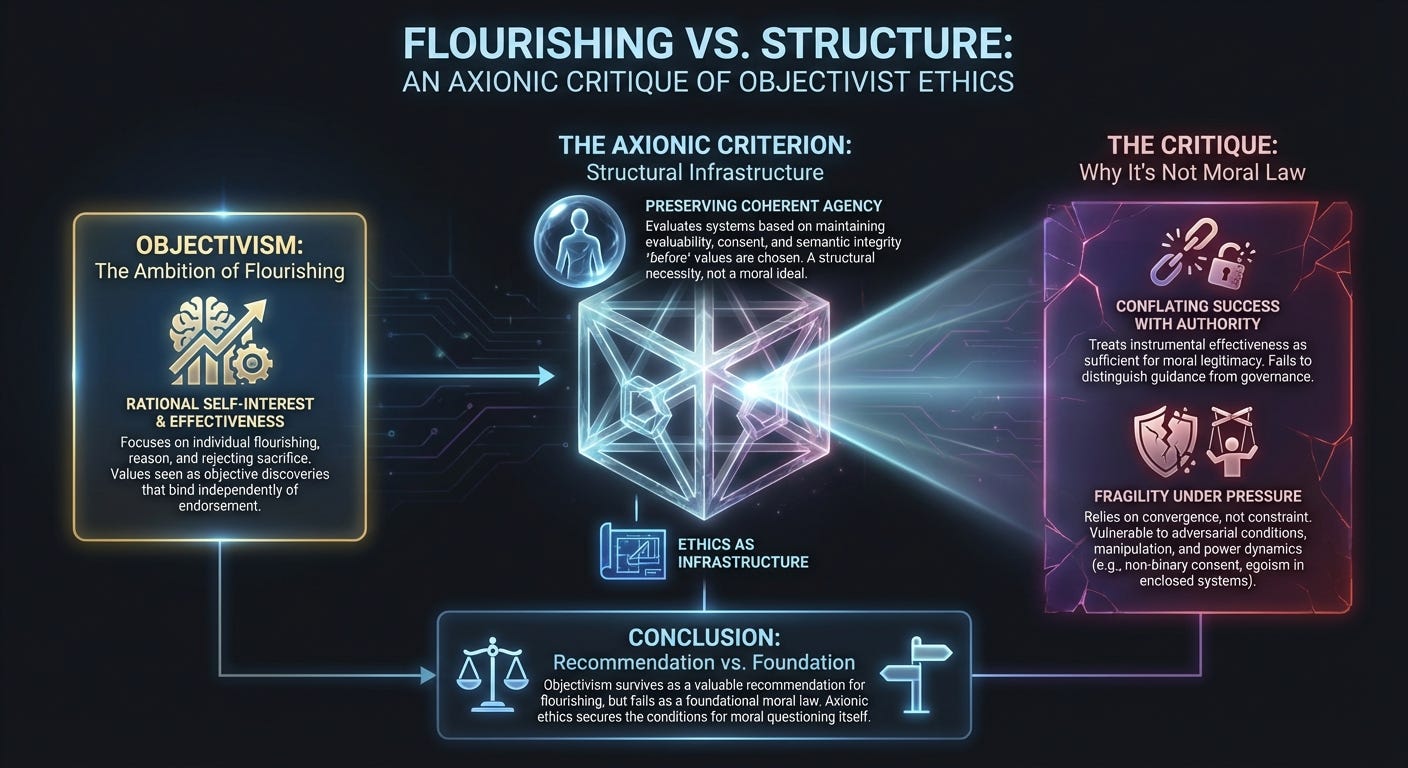
Objectivism presents itself as a corrective to moral systems that elevate duty, sacrifice, obedience, or collective authority above the individual. It rejects mysticism, moralized suffering, and the expectation that a person exists to serve ends imposed by others. In their place, it proposes a virtue-centered ethics grounded in reason and rational self-interest, offering an image of morality as a guide to flourishing rather than a mechanism of guilt. This ambition addresses genuine failures in much of traditional moral thought, and its motivational power comes from diagnosing real pathologies: the erosion of agency, the sanctification of self-denial, and the use of moral language as a tool of control.

The difficulty arises at the point where Objectivism moves beyond offering a personal ethics and claims to have discovered objective morality itself. The system treats rational self-interest and human flourishing as normatively authoritative, presenting them as standards that bind independently of endorsement. From an Axionic perspective, this step exceeds what the argument earns.
2. The Axionic Criterion
Axionic ethics evaluates moral systems according to a prior criterion. The question it asks concerns the preservation of coherent agency under reflection. A framework succeeds to the extent that it maintains evaluability, consent, semantic integrity, and the legitimacy of reasons for action. These constraints operate before any particular values or virtues are specified. They determine whether a moral claim can bind an agent without undermining the very capacity to choose, revise, and act meaningfully.
The Axionic criterion does not function as a competing moral value, nor as a preferred conception of the good. It arises from a structural necessity. Any agent capable of reflection, revision, or justification already presupposes its own agency as intact and authoritative. To deny this is not to adopt an alternative ethic, but to dissolve the conditions under which endorsement, obligation, or justification can occur at all. A framework that undermines agency does not merely recommend different values; it invalidates its own claim to bind. For this reason, preservation of coherent agency under reflection is identified as a fixed point rather than asserted as a moral ideal.
Ethics, on this view, functions as infrastructure. It constrains what counts as a reason before advising what to pursue.
3. Instrumental Success and Ethical Authority
Objectivism grounds morality in effectiveness. Its principles are justified by their capacity to support survival, productivity, psychological health, and long-term flourishing. These considerations matter. They describe how certain strategies perform when adopted by agents with broadly human capacities and motivations.
The error enters when effectiveness is treated as sufficient for legitimacy. Instrumental success answers the question of what tends to work given a goal. Ethical authority concerns which reasons may claim standing over an agent at all. These domains are distinct, and Objectivism treats them as interchangeable.
4. Terminal Values and Endorsement
Central to this conflation is the handling of terminal value. Human life, flourishing, and rational self-interest function in Objectivism as self-justifying ends. They appear as discoveries about reality rather than commitments made by agents situated within it. Yet any terminal value acquires normative force only through endorsement. Once adopted, it constrains action instrumentally and objectively, since reality imposes limits on what can achieve it. Prior to adoption, it lacks binding authority.
Objectivism oscillates between presenting its ethics as a rational choice and presenting it as moral law. These positions cannot be held simultaneously without tension.
5. The Location of Objectivity
Objectivity, within an Axionic framework, applies at the level of structure. Coherence conditions admit objective assessment. The preservation of consent, the integrity of evaluation, the avoidance of semantic collapse, and the maintenance of agency under reflection do not depend on taste or temperament. They function as constraints on intelligibility and legitimacy.
Objectivism extends objectivity into the content of values themselves, treating certain virtues and ends as authoritative in virtue of their correctness. This move grants rhetorical force to the system while weakening its foundations.
6. Egoism and Adversarial Conditions
The treatment of egoism illustrates the resulting fragility. Objectivism argues that predation, deception, and exploitation undermine the agent who employs them, since trust, stable relationships, and self-esteem erode under such strategies. This claim often holds for psychologically typical agents operating in open social environments.
It does not establish a structural impossibility. Contexts exist where asymmetric power, enclosure, or short horizons insulate predatory behavior from immediate cost. Agents exist whose psychological architecture reduces the internal penalties Objectivism relies upon. A foundational ethics must remain intact under adversarial modeling. Objectivism relies on convergence rather than constraint.
7. Voluntariness and Consent
A similar issue appears in the treatment of voluntary interaction. Exchange, trade, and contract play a central moral role, justified by the absence of overt force. Voluntariness functions as a moral threshold.
Axionic ethics recognizes that voluntariness alone does not secure legitimacy. Agency may be impaired by manipulation, desperation, information asymmetry, or preference distortion while leaving formal choice intact. Consent admits degrees and defeasibility. Objectivism treats it as binary. This simplification limits the framework’s capacity to diagnose coercion as it appears in real systems.
8. Ethics and Authority
The extension of Objectivist ethics into politics and law intensifies these difficulties. Principles derived from rational self-interest are taken to ground legitimate institutions. Authority enters implicitly, justified by correctness rather than delegation. The framework lacks an internal mechanism that distinguishes guidance from governance.
Any ethical system that aspires to inform collective enforcement requires explicit criteria for legitimacy. Without them, moral principles remain vulnerable to appropriation by power.
9. What Survives Axionic Scrutiny
From an Axionic standpoint, much of Objectivism remains valuable when repositioned. Its emphasis on agency, its rejection of self-sacrifice as a moral ideal, its focus on coherence between values and action, and its recognition that virtues function as internalized policies all survive scrutiny. These elements describe an effective strategy for agents who endorse flourishing, autonomy, and long-term coherence as ends.
What does not survive is the claim that this strategy constitutes moral law.
10. The Axionic Reframe
Reframed axionically, Objectivism becomes a recommendation rather than a foundation. It describes how certain agents may live well under certain commitments. Axionic ethics addresses a different task. It specifies the conditions under which any recommendation may claim legitimacy, the boundaries beyond which moral language ceases to bind, and the structural failures that arise when ethics forgets its dependence on agency and consent.
Postscript
Objectivism answers the question of how an individual might live to flourish. Axionic ethics addresses what must remain intact for that question to make sense at all. The distinction matters because systems that conflate success with authority tend to function smoothly until they are scaled, enforced, or weaponized.
Constraints survive those transitions. Guidance does not.
Every moral system presupposes an agent capable of endorsement, revision, and refusal. When an ethics undermines those capacities, it forfeits its claim to authority regardless of its practical achievements. Agency under reflection is not one value among others. It is the fixed point around which all valuation turns. Any system that forgets this forgets the conditions of its own intelligibility.