

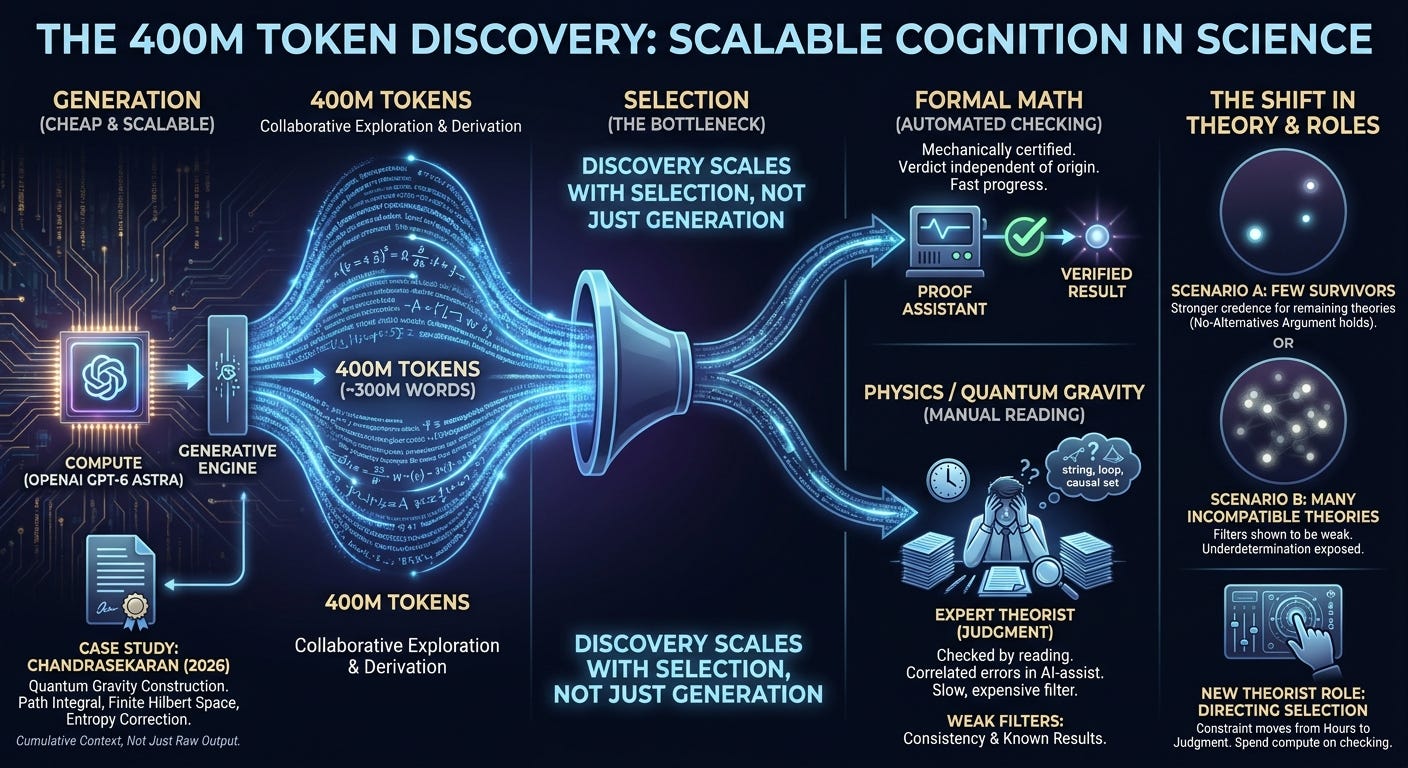
On 25 November 2026, the Stanford theoretical physicist Venkatesa Chandrasekaran posted An algebraic quantization of gravity from the null cone, a background-independent, nonperturbative quantization of vacuum general relativity in four dimensions. The paper derives a convergent Lorentzian path integral, a finite-dimensional Hilbert space for a bounded causal diamond, a discrete area spectrum, and the Bekenstein-Hawking entropy with its one-loop logarithmic correction, all within one construction. If it survives scrutiny, it is a major advance.
The acknowledgements give a second reason to pay attention. Chandrasekaran writes that several of the calculations and proofs were developed in back-and-forth collaboration with GPT-6 Astra over many months, “amounting to ∼400M total tokens spent,” on compute provided by OpenAI.
Most readers will conclude that discovery now scales with compute. Discovery scales with selection. Science advances by generating candidates and choosing among them, and inference makes only the generating cheap. A field’s rate of progress is then set by its capacity to tell good candidates from bad, and quantum gravity, where no experiment arbitrates and consistency is the only filter, has less of that capacity than almost any field in science.
What the Tokens Bought
The acknowledgement does not say who did what, and nobody can tell whether Chandrasekaran would have reached the same results alone. What it documents is a quantity of exploration. Until recently the only ways to get more conjectures, derivations and reformulations were to add qualified people or to wait longer. Inference is a third variable, and a grant can buy it as directly as it buys supercomputer time.
Spent on one programme, inference compounds. A model with fixed parameters can take part in a cumulative investigation because results, failed approaches and intermediate derivations can be stored outside it and supplied as context for later reasoning. Four hundred million tokens spread over unrelated problems would be a large benchmark, while the same tokens spent against a growing record change which problems the system can reach.
The figure also says something about reading. At about three words to four tokens, 400 million tokens is roughly 300 million words, and a person reading eight hours a day gets through thirty to forty million words in a year. So either most of the total is the record being supplied again at each call, or most of what the model wrote was never read by a person. On the first reading the record has a carrying cost, paid at every step. On the second, whatever entered the record was admitted by sampling, by the model’s own checks, or by its apparent usefulness downstream.
What the Record Admits
Retention is what makes a programme compound, and it compounds whatever it admits. A correct lemma improves the distribution from which later conjectures are drawn. A false one degrades it, and every result built on it inherits the flaw. An error on a benchmark costs one item, and an error in a programme costs everything derived from it.
The standard case for fallible generators ignores this. A model whose ten candidate derivations include nine with errors is said to contribute anyway, provided the errors can be found cheaply. Stated exactly: if a candidate costs g to generate and v to check, and succeeds with probability p, one accepted result costs (g + v)/p in expectation, which is worth paying when it falls below the cost of unaided derivation. Inference drives g toward zero and leaves v/p, the price of checking divided by the hit rate. That still omits false accepts, whose cost rises with the length of the programme.
Checking is cheap in formal mathematics, where a proof assistant returns a verdict mechanically and the verdict owes nothing to the proof’s origin, whatever a proof once certified about its author. The proofs in a physics preprint are arguments at a physicist’s standard of rigour, checked by being read, and a plausible but wrong derivation can cost an expert more time than deriving the result independently. A sound construction can also rest on physically inappropriate assumptions. Models can help with the reading, but a second language model agreeing with the first is weak evidence because their errors are correlated. Fields whose results can be machine-checked will therefore pull away from fields whose results must be read.
When Consistent Theories Are Cheap
Above selection among derivations sits selection among theories, which in most of physics is performed by experiment. Quantum gravity has no experiment within reach of the Planck scale, and string theory, loop quantum gravity, asymptotic safety and causal sets have coexisted for decades for want of one. In place of data the field has filters: internal consistency, and recovery of results that any correct theory must reproduce. Chandrasekaran’s construction is offered against filters of this kind, among them the Bekenstein-Hawking entropy, Ashoke Sen’s logarithmic correction for large Schwarzschild black holes, and the semiclassical Einstein equations at one loop.
Passing such filters has carried weight because so few constructions pass. Philosophers of physics call this reasoning the no-alternatives argument: when a community searches hard for alternatives to a theory and finds none, the failure counts in the theory’s favour. Dawid, Hartmann and Sprenger showed that the argument is sound in Bayesian terms and that its strength depends on how many alternatives one believes exist. That number has never been measured. Search was priced in theorist-decades, so the short list of candidates reflected how few people could look as much as how few theories there were to find.
If months of directed inference can help one physicist produce a construction of this scope, the price of search has fallen and theory space can be sampled. Suppose heavy search turns up few survivors. Then the scarcity belongs to the mathematics, and each survivor deserves more credence than any earlier candidate could claim. Suppose instead it turns up many mutually incompatible constructions, each consistent and each recovering the known results. Then the filter was weak, the short list was an artifact of expensive search, and every candidate loses support, string theory included. Either way, underdetermination stops being a philosophical worry and becomes a quantity that can be estimated.
Cheap search also weakens the filters, because they are public targets. A generator steered toward the right entropy coefficient will tend to find constructions that produce it, and recovering a result that guided the search is weaker evidence than predicting one that did not. The checks that keep their value are the ones nobody aimed at, and quantum gravity has few of those.
Who Selects
The paper has one author and runs to 54 pages plus appendices. Work that students and co-authors once did is credited in the acknowledgements, and co-authors do more than generate. A collaborator who rederives a result is an independent check with uncorrelated errors, and a name on the paper stakes a reputation on its correctness. Replacing collaborators with a model keeps the generation and removes the checkers, so the selection load falls on the author, and after him on referees who have no token grant of their own.
Inference leaves theorists as scarce as before and changes what they are scarce for. Deciding which results to trust and which directions matter falls to the same few people who used to do the deriving, so the constraint has moved from their hours to their judgment, and returns will concentrate on those who have it. Compute at this scale is also granted by a laboratory, which makes the laboratory a patron deciding which programmes exist.
Practical rules follow. Inference should be spent on selection as well as generation, by formalizing the lemmas a programme rests on and by commissioning independent rederivations before results enter the record. A funder weighing a request for inference should ask what fraction will go to checking. An author who reports a token count should report how the output was checked and what was carried forward.
Whatever happens to the physics, the preprint will measure two things about the field that received it. The first is how long a community of experts takes to say with confidence whether 54 pages of model-assisted derivation are right, which is the cost of checking measured in expert time. The second is whether more constructions of this scope follow, and how many. Four hundred million is the number on the generation side, and the number on the selection side is still unknown.