

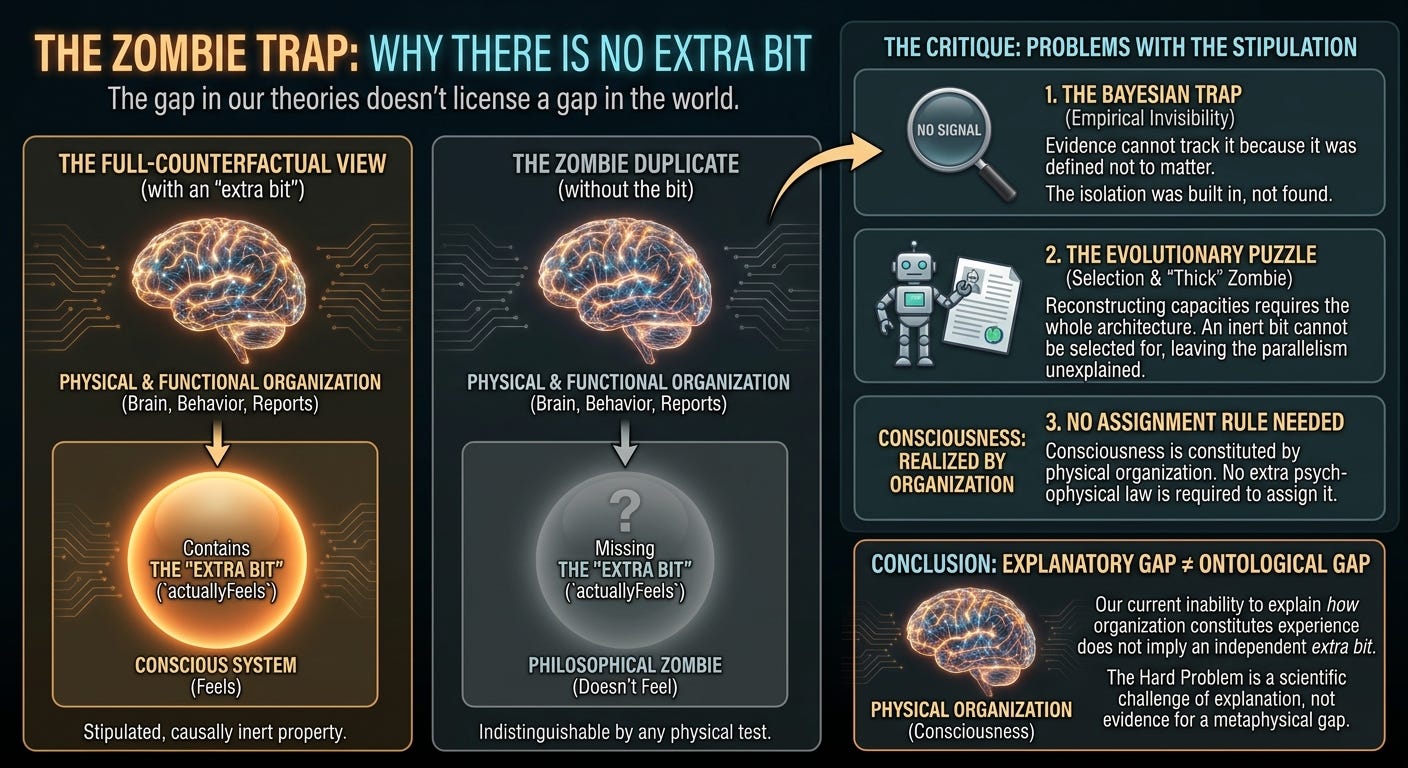
Robin Hanson argues in No-New-Physics Consciousness that consciousness probably requires no revision to known physics. On that point I agree. Brains are physical systems, and if consciousness depends on brains, a sufficiently complete description of the relevant physical organization should account for the structure of experience. Hanson embraces that reductionist picture.

Then he makes an exception.
After the physical and functional organization has been completely specified, Hanson allows that one further fact might remain: whether the system feels anything. A system could have the same brain states, the same memories, the same reasoning and the same behavior as a conscious system and still be a philosophical zombie. On what he calls the “full-counterfactual” view, every conscious system has a possible zombie counterpart differing only in whether its experiences are felt.
Describing that possibility does not establish it. Hanson denies consciousness any new physics and then hands it a new metaphysical bit.
No extra bit
Imagine two systems, A and B. Their physical organization is identical, down to the states of their neurons or computational elements and the causal relations among them. Both attend to the same things, form the same memories, register the same apparent pains and colors, and produce the same reports about all of it.
Hanson wants to leave open one remaining difference:
A actually feels. B does not.
Call that residual property actuallyFeels.
By hypothesis it changes nothing physical or functional. It does not alter perception, memory, inference, speech or action, since any such alteration would break the stipulated physical identity of A and B.
The intuition behind the zombie starts from a real separation between our third-person description of cognitive machinery and our first-person description of experience. That the two descriptions come apart is a fact about descriptions. Independent variation in what they describe is a further claim, and conceivability alone does not supply it. Once the organization responsible for perception, attention, introspection, memory and report has been fixed, the zombie advocate owes an account of what could still be unfixed.
The burden falls hardest on a reductionist. On Hanson’s own commitments, experience is realized by physical organization, and fixing the physical facts fixes the experiential facts. An independent, causally inert phenomenal property added after the physical description is complete is epiphenomenal property dualism, even with no new forces or particles anywhere in the story.
The Bayesian trap
Hanson draws the consequence himself. If a conscious person and an exact zombie are physically identical, no observation can distinguish them. Every observation is a physical state, every memory of that observation another physical state, every inference from it physically implemented. The declaration “I know I am conscious” comes out of machinery the zombie has too.
So evidence cannot tell us whether any particular experience system feels, and our confidence that we ourselves are conscious has to come from our priors.
The conditional argument is sound. Hanson stipulated a property that varies without touching any observation, memory, inference or report, then found that evidence cannot track it. The isolation was built in at the start, and no discovery about consciousness came out of it.
Empirical invisibility alone does not prove a property unreal. But actuallyFeels is causally inert, explanatorily idle, and introduced for no purpose except to preserve the intuition that physical and functional duplication might leave consciousness behind. That is a poor reason to enlarge the ontology. The bit stays out until an independent argument puts it in.
The zombie gets expensive
The intuition also depends on keeping the zombie thin.
In Why Zombies Don’t Evolve, I distinguished a thin zombie from a thick zombie. A thin zombie inherits every human capacity by stipulation. It sees, learns, avoids injury, allocates attention, introspects, reports its mental states and writes philosophy papers about phenomenal consciousness. We declare that nothing is felt inside and move on.
A thick zombie has to implement the machinery that produces those capacities. Give it embodied perception, scarce attention, salience, memory integration, self-monitoring, perceptual stabilization, conflict resolution, interruption handling and internal comparison of expected against actual states. Give it whatever architecture maintains a coherent world-model while controlling action through time. At some point the entire causal architecture that a theory of consciousness was supposed to explain has been rebuilt, with consciousness still withheld by stipulation.
A committed property dualist can accept that result. Functional architecture explains cognition and report, they will say, and phenomenal consciousness is something additional. The concession is expensive. Every piece of explanatory work now sits in the physical architecture, and the phenomenal property runs alongside it as an idle parallel layer.
Evolution makes that parallelism harder to explain. Natural selection can select pain avoidance because avoiding injury affects survival, and attention because finite organisms cannot process every signal reaching them. Memory integration, self-monitoring and perceptual stabilization are selectable for the same kind of reason: they change what the organism does. A phenomenal property with no causal effects is not available for selection at all.
A defender can reply that phenomenal states accompany the selected physical states as a matter of psychophysical law. That reply leaves a coincidence in place. The physical system does not merely avoid injury. It complains that pain feels bad, remembers that pain felt bad, compares pains, reasons about unpleasantness and builds theories of phenomenal experience, while by hypothesis no phenomenal fact contributes causally to any of it. The machinery produces a detailed literature about a domain that never touched the machinery producing the literature. A functional account has no such coincidence on its hands, because the architecture generating the reports and the architecture constituting experience are the same causal system.
Conceding the Hard Problem
None of this makes the Hard Problem disappear by assertion. Why a particular physical organization has the qualitative character it does, and why any physical process should constitute experience at all, remain open questions, and legitimate ones.
Neither question establishes that a complete physical duplicate could lack experience. Our present inability to derive a first-person description from a third-person one is a fact about the state of our theories. The zombie argument needs the stronger claim that the two descriptions answer to independently variable facts. Without it, the inference from “we do not yet understand why this organization feels like anything” to “there could be an identical organization that feels like nothing” does not follow.
Postscript
Hanson asks what rule determines which physically specified experience systems actually feel. Fundamental laws tend to be simple, so he expects the psychophysical assignment rule to be simple as well, which pushes him toward a view he describes as close to panpsychism.
The demand for an assignment rule comes entirely from the zombie premise. If consciousness is realized by physical organization, the universe needs no second law deciding which appropriately organized systems receive it. A hurricane requires no additional law assigning hurricanehood to particular arrangements of atmospheric matter; its higher-level identity depends on organization implemented by ordinary local physics. Nothing in known physics requires more of consciousness than that, and nothing but the zombie premise calls for a psychophysical mapping on top of it.
The scientific problem stays hard: identify the physical and computational organization that constitutes conscious experience, determine how it develops and operates, and test the resulting theory against biological and artificial systems.
Hanson’s argument establishes only that once a causally invisible phenomenal property has been stipulated, no physical evidence can locate it. Drop the stipulation and the assignment problem goes with it.