

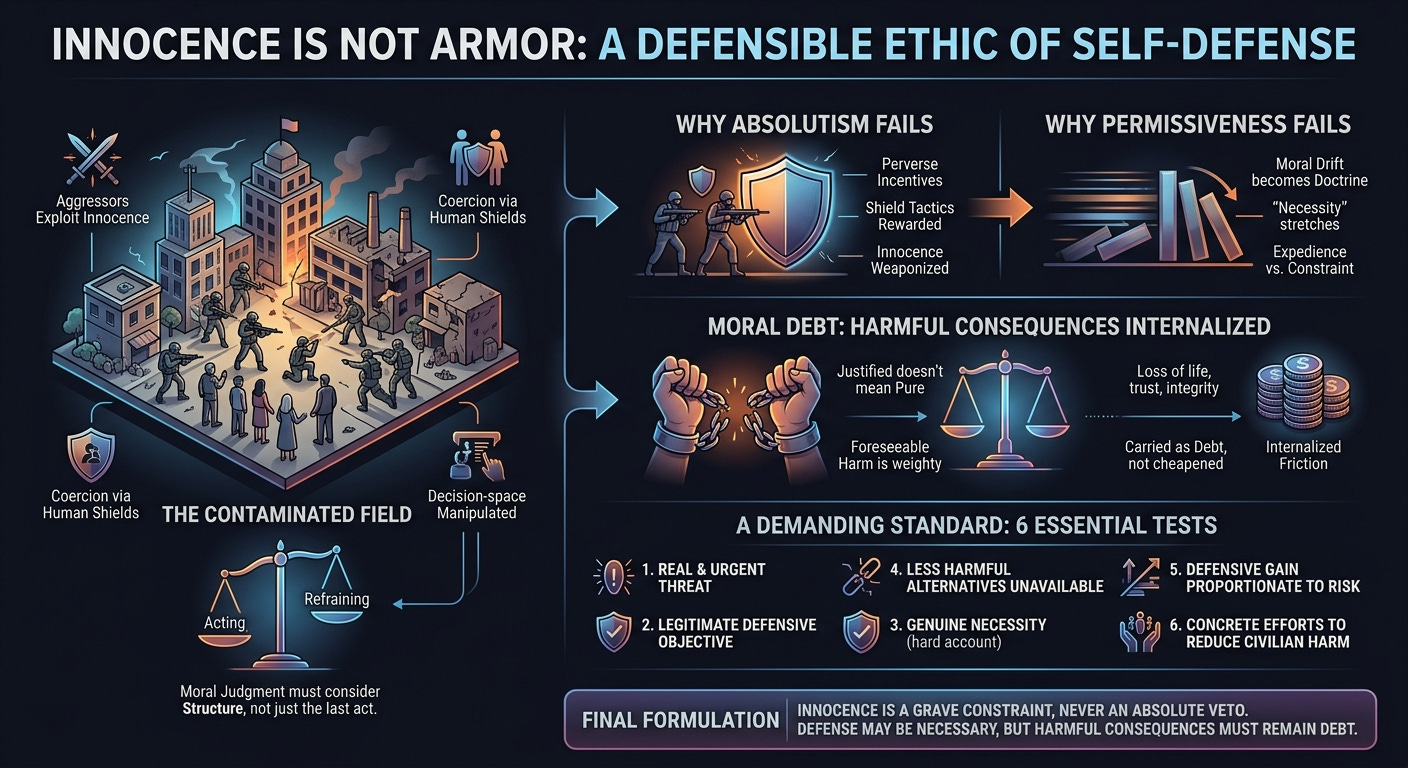
Almost everyone accepts one proposition: it is sometimes necessary to harm culpable aggressors in self-defense. The real disagreement begins one step later. Can defensive action remain justified when it will foreseeably harm innocent people?
That is the fault line. The issue is not whether civilians are legitimate targets. Almost no one argues that. The issue is whether innocence creates an absolute veto on defensive action, or a grave constraint that can be overridden under extreme conditions. I reject the absolute view. I also reject the looser view that treats necessity as a solvent for every other moral limit. A serious ethic has to preserve two truths at once: innocence matters, and innocence cannot be allowed to become a strategic shield for evil.
The contaminated field
Start with the basic structure. An aggressor is culpable because he initiates coercion. An innocent person is non-culpable because he does not. Self-defense is justified because it answers prior coercion with counter-force in order to preserve agency.
The difficulty enters when aggressors deliberately entangle themselves with innocents. They hide among civilians, place weapons in schools, operate from hospitals, build command nodes in residential areas, and exploit the hesitation of any opponent still constrained by moral rules. Once that happens, the defender no longer faces a clean choice. Refraining may leave the aggression intact. Acting may kill people who did nothing to deserve it. The field is contaminated before the defender moves.
That matters because moral judgment cannot begin and end with the last visible act. It has to include the structure that produced the choice. An aggressor who uses civilians as shields is not merely taking cover. He is manipulating the defender’s decision-space. He is trying to convert his own abuse of innocence into a source of immunity. That coercive arrangement is itself part of the wrong.
This does not erase the defender’s responsibility. Foreseeable harm remains morally weighty. Pulling the trigger still matters. But responsibility is not assigned by causal proximity alone. The party that engineered the contamination bears responsibility for creating it. Any account that ignores that fact collapses into theater. It mistakes the final moment of force for the whole structure of agency and coercion that produced it.
Why absolutism fails
The absolutist view is clear: once innocents are in the blast radius, the action is forbidden. That answer has moral appeal because it protects the innocent by refusing contamination. It also creates a perverse incentive. If innocence functions as an absolute veto, then aggressors gain a standing advantage by embedding themselves among civilians. The more shamelessly they exploit the innocent, the safer they become.
That is a broken rule. It does not protect innocence so much as weaponize it. It grants strategic leverage to those most willing to treat civilians as instruments. A principle with that incentive structure is not morally superior because it feels clean from a distance. It is easier to admire than to defend.
This is the central error in absolutism. It treats innocence as if it were a magic barrier rather than a grave moral constraint. The innocent are not legitimate targets, and their non-culpability must weigh heavily against any action that foreseeably harms them. But if that weight becomes infinite, then any aggressor who successfully entangles himself with civilians acquires conditional immunity. He need only ensure that every path to stopping him runs through the innocent. The moral system then protects the shield-user more effectively than the shielded.
No serious ethic should be that easy to game.
Why permissiveness fails
The opposite error is more common in powerful institutions. Once collateral harm is admitted in principle, necessity begins to stretch. Necessary comes to mean efficient. Then it means tactically useful. Then it means politically satisfying. The vocabulary remains grave while the underlying discipline evaporates.
This is how moral drift becomes doctrine. Governments, militaries, insurgencies, and terrorists all invoke necessity because it launders choice as compulsion. An action is said to be necessary when it is merely available, cheaper than restraint, less embarrassing than delay, or useful for restoring the appearance of control. Under pressure, institutions are very good at smuggling expedience through the language of survival.
A serious ethic has to resist that maneuver. An action is not necessary because it is emotionally satisfying. It is not necessary because it projects resolve. It is not necessary because it reassures a domestic audience or simplifies the battlefield. It is necessary only when the legitimate defensive objective cannot be achieved by a materially less harmful alternative, or when delay introduces a comparably grave danger.
The same point applies to proportionality. Proportionality is not revenge arithmetic. It is not a scorekeeping exercise in which one side’s suffering licenses a matching volume of suffering on the other. It is a disciplined judgment about whether the defensive gain is weighty enough to justify imposing a foreseeable risk on innocents. That judgment requires evidence, uncertainty analysis, and a real willingness to forgo options that are tempting but not justified.
Absolutism fails because it rewards shield tactics. Permissiveness fails because it turns every hard choice into a pre-cleared excuse. One view makes evil strategically smarter. The other makes conscience administratively inconvenient.
Moral debt
The way out is not to pretend that tragic choices can be made clean. Some actions can be justified without being pure. If innocents die as a foreseeable consequence of a defensible act of self-defense, something morally grave has still happened. The fact that the action may have been the least bad option does not erase the loss.
That remainder needs a name. “Guilt” is not quite right, because guilt implies wrongdoing in the simple sense and invites either punishment or paralysis. A better term is moral debt.
Debt captures the structure more accurately. A justified action can still incur debt because it consumes something real that cannot be restored: innocent life, public trust, moral confidence, institutional integrity, prospects for future peace. The loss remains even when the action was warranted. It has to remain. Otherwise the constraint has failed.
This is discipline, not sentiment. If collateral harm carries no residual cost once justified, then civilian deaths become operational overhead. Regret becomes ceremonial. Public language stays solemn while incentives stay permissive. An institution can then kill innocents, issue a statement of sadness, and continue exactly as before. That is not moral seriousness. It is moral laundering.
A defensible ethic of self-defense therefore has to keep the cost internal. Harm to innocents may sometimes be justified. It must never become cheap.
What cost means in practice
A self-imposed cost does not mean paralysis in the middle of a firefight. That objection is confused because it treats every level of action as if it operated on the same timescale. Tactical survival, command doctrine, targeting standards, escalation rules, and retrospective accountability are different layers of the same system. Friction can be imposed where deliberation is actually possible.
That friction should be real. Operations expected to impose significant risk on innocents should face a heightened burden of proof. Less harmful alternatives should be examined seriously rather than performatively. Review and authorization thresholds should tighten as civilian risk rises. After action, the harm should be audited honestly, not folded into a public-relations script. If civilian deaths predictably degrade legitimacy, increase hostility, damage intelligence networks, and multiply future threats, those effects should count as mission costs rather than as externalities.
There is also a character dimension here. Agents and institutions that kill innocents too easily become deformed. They become callous, euphemistic, self-exculpating, and eventually blind to the moral reality of what they are doing. That corruption matters because it does not stay confined to one operation. It migrates into doctrine, rhetoric, and habit. A polity that ceases to feel the burden of innocent death has already started to lose the thing it claims to be defending.
That is why moral debt matters. It keeps the tragedy visible. It blocks the slide from justified exception to normalized indifference.
A concrete case
Take a simple case. A militant command cell is directing imminent attacks from the upper floor of a residential building. The building is occupied. Warnings have been issued. Some civilians have left. Some remain, whether from fear, coercion, confusion, or inability to move. A strike now carries a serious risk of killing innocents. Waiting increases the probability of further attacks on civilians elsewhere.
The absolutist says the strike is forbidden because innocents remain. That answer preserves purity in language while giving the shield tactic exactly what it was designed to produce: protection through entanglement. The crude consequentialist says the strike is justified if the target is valuable enough. That answer is too loose because it leaves too much room for inflated threat claims, lazy targeting standards, and moral self-exculpation.
A defensible answer is harder. The strike may be justified, but only if the threat is real and urgent, the target is legitimate, less harmful alternatives are unavailable or materially worse, the expected defensive gain is proportionate to the risk imposed, and concrete steps to reduce civilian harm have already been taken. Even then, the deaths do not become morally clean. They remain a debt, one that may require public acknowledgment, restitution to survivors, a hard audit of the intelligence and authorization process, and a stricter threshold for comparable strikes in the future. They count against the action, against the institution, and against any triumphalist account of what was done.
That is what it means to think inside a contaminated field.
The standard
A serious defender should therefore accept a demanding standard. The threat must be real and coercively active. The defensive objective must be legitimate. The action must be genuinely necessary under a hard account of necessity. Less harmful alternatives must be unavailable, ineffective, or materially more dangerous. The expected defensive gain must be proportionate to the risk imposed on innocents. Concrete efforts to reduce civilian harm must be real rather than theatrical. The resulting harm must remain morally internalized as loss and debt rather than externalized as mere optics.
This does not yield certainty. Ethics under coercive entanglement does not produce a frictionless algorithm. It does, however, produce a structure that resists two corruptions that dominate public argument. The first is the spectator’s fantasy of purity, which demands absolute restraint while outsourcing the cost of that restraint to other people. The second is the institution’s fantasy of innocence, which invokes necessity so loosely that almost any harsh action can be redescribed as compelled.
Both have to be rejected.
Postscript
The dispute is not whether evil may be resisted by force. It may. The dispute is whether innocence creates an absolute veto on defensive action, or a grave constraint that remains defeasible under extreme coercive conditions.
It must be defeasible. Otherwise innocence becomes a tool that evil can capture and repurpose. Yet any society that permits foreseeable harm to innocents without imposing severe internal cost on itself will lose moral discipline and, eventually, moral clarity.
A defensible ethic of self-defense must preserve the right to resist coercion without allowing innocence to become armor for aggressors. It must also ensure that when innocents are foreseeably harmed, the harm is carried as debt, reviewed with severity, and never treated as morally clean.
Innocence is not armor. It is a constraint. A grave one, serious enough to burden action, never strong enough to grant impunity to those who exploit it.
Addendum
This post does not sit cleanly with “Viability Ethics Under Fire.”
That earlier essay takes a much harder line. It treats imposed risk to an innocent as harm, harm imposed for one’s ends as coercion, and coercion against innocents as impermissible. On that account, even probabilistic worsening is enough to cross the line. Need does not create claim. Compensation does not undo the violation. Only consent, or a genuinely net-improving intervention for the person affected, changes the structure.
This essay does something else. It argues that innocence cannot serve as an absolute veto on defensive action when aggressors deliberately embed themselves among civilians. It allows that foreseeable harm to innocents may sometimes be justified under conditions of necessity, minimization, proportionality, and moral debt.
Those are not the same position. The difference is real.
I do not want to pretend this essay simply clarifies the earlier one. It does not. It relaxes a constraint the earlier piece treated as hard. The reason is simple enough. The earlier rule is morally severe and internally clean, but it appears vulnerable to adversarial exploitation. If an aggressor can reliably force every defensive option through innocents, that constraint starts to look less like a protection of innocence and more like a route to practical immunity. This essay was written under pressure from that problem.
That pressure does not make the tension disappear. It sharpens it. Once foreseeable harm to innocents becomes defeasible rather than forbidden, the anti-predation firewall weakens. What was previously ruled out in principle now has to be governed by thresholds, discipline, and judgment. That makes the framework more viable in contaminated conditions, but also more exposed to drift, laundering, and self-serving claims of necessity.
So I am marking the inconsistency openly.
Maybe the earlier essay was right and this one gives away too much. Maybe the earlier essay captured a rule that holds in ordinary moral choice but not in aggressor-contaminated fields. Maybe the underlying injunction is still underspecified and needs to be stated more precisely than I have stated it so far.
I do not have the resolution yet. I do think the tension is real, and I do not want to hide it with rhetoric. If Axio is going to claim seriousness about coercion, legitimacy, and agency, then it has to be willing to leave a contradiction visible until it is actually solved.