

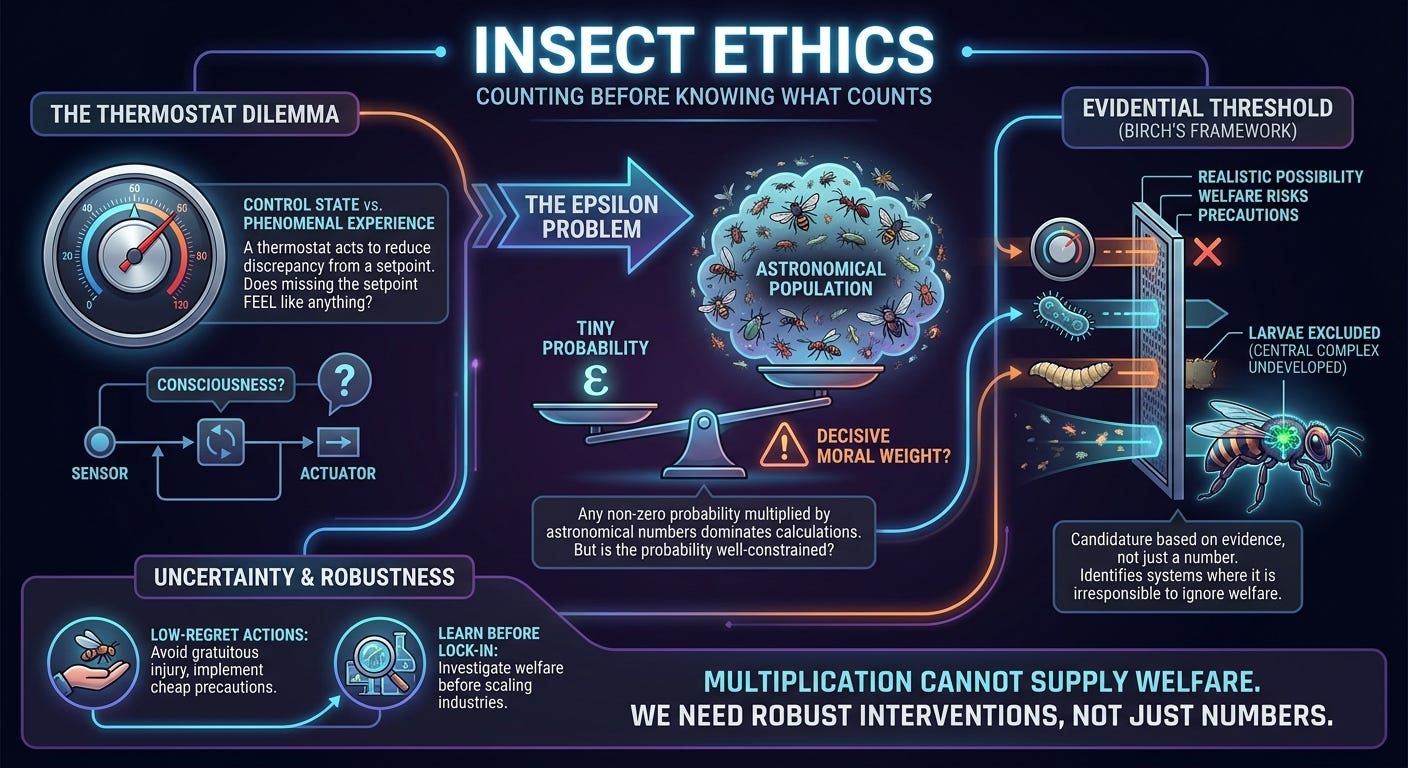
Suppose there are a quadrillion thermostats, and every one of them is five degrees below its setpoint. Each detects a discrepancy between the world and its target state, acts to reduce that discrepancy, and stops acting when the discrepancy disappears. If it cannot restore the target temperature, we can naturally describe it as failing to achieve the state it “wants.”
How much suffering is that? Presumably none. The thermostat has a control state we can model as a preference, but nothing about the control loop gives us reason to think that missing the setpoint feels like anything. Before we aggregate welfare, we need some principled reason to think welfare exists in the system we are counting.
That distinction becomes important when the population is enormous. Bentham’s Bulldog has argued that insects matter more morally than humans because there are so many of them. Insects exhibit increasingly sophisticated responses to injury: they avoid damaging stimuli, learn from them, trade competing motivations against one another, and modify their behavior in ways that resemble pain responses in vertebrates. Give insect consciousness a substantial probability, assume insect pain has even a tiny fraction of the intensity of human pain, and the multiplication quickly produces an astronomical quantity of expected suffering.
The arithmetic is straightforward once those quantities have been supplied. The difficulty lies in supplying them.
From control to consciousness
A thermostat is organized around a setpoint. More complicated control systems can have many setpoints, competing objectives, memory, predictive models, reinforcement learning, and elaborate responses to damage. We can describe such systems using increasingly rich intentional language: they prefer one state to another, avoid threats, sacrifice one objective to protect another, and learn from failure.
None of that makes the intentional description false. A preference can be a real property of a model of the system without being an extra intrinsic property sitting inside it, which is the argument of The Intentional Gradient. The problem begins when we move from a functional description such as “the system avoids this state” to a phenomenal claim such as “this state feels bad to the system.”
The thermostat is not meant as a biological model of an insect. Insects are not just thermostats with more components. They are evolved animals with centralized nervous systems, neuromodulatory systems, memory, learning, and a deep evolutionary relationship to us. Those facts are relevant evidence, and they should make insect consciousness more plausible than thermostat consciousness.
But increasingly sophisticated control behavior does not by itself entail phenomenal experience. Biological homology and evolutionary continuity strengthen the inference; they do not remove the need to ask how much stronger the evidence becomes.
That question is difficult because evidence has strength only relative to alternatives. Smoke supports the hypothesis of fire because smoke is much more likely in worlds containing fire than in otherwise comparable worlds without it. The corresponding comparison for insects is not between a conscious insect and a physical duplicate that feels nothing. Hard to Explain Is Not Free to Vary argues that no such duplicate is available: fix the causal organization and the experiential facts are fixed with it. What remains to compare is organizations. Some arrangements of perception, attention, memory and motivational control constitute experience; others run injury-avoidance without it.
Evolution has abundant reason to build organisms that detect tissue damage, protect injured body parts, remember dangerous stimuli, and trade the risk of damage against food, mating, and escape. All of those capacities can improve fitness whether or not anything hurts. The empirical findings therefore tell us something important about insect control architecture. Whether that architecture is one that constitutes experience is the question a theory of consciousness would answer, and we do not have one.
We do not need a solution to the Hard Problem of Consciousness before reasoning about insects. We do need enough theory to constrain the comparison. If the organizations that constitute experience and those that merely regulate injury both produce avoidance, learning, motivational tradeoffs and injury protection, then those observations discriminate weakly. If some of those capacities require the first kind of organization, they should move us a great deal.
We may not currently have the data to estimate those likelihoods well. There is no clean comparison class of organisms known to run sophisticated injury-avoidance without experience, because identifying such organisms would already require solving part of the problem. That is a real epistemic limitation. But an inability to estimate the likelihood ratio is a reason for correspondingly limited confidence in any number we produce, not a license to assume the ratio is large.
Insect behavior is evidence for consciousness. The open question is how strong.
The epsilon problem
The natural response is to represent this uncertainty probabilistically. Perhaps we do not know whether insects consciously suffer, but uncertainty is exactly what probability is for. Assign insect consciousness some probability, multiply by the number of insects and the amount of possible suffering, and calculate expected welfare.
That procedure is unobjectionable when the probability is reasonably constrained by a well-specified model. If a dam has a one-in-a-million annual probability of failing and killing a million people, the low probability does not make the risk irrelevant. We know what dam failure means, we know what human death means, and engineering evidence can constrain the probability.
Consciousness uncertainty is different because the probability itself is sensitive to unresolved assumptions about what evidence consciousness should generate. Imagine assigning a thermostat a one-in-a-trillion probability of suffering whenever it remains off its setpoint. One thermostat contributes almost nothing to the moral calculation, but a sufficiently large population of thermostats eventually dominates it. Lower the probability to one in a trillion trillion and the conclusion merely requires more thermostats.
The same construction can be applied to bacteria, plants, simple reinforcement learners, cellular regulatory networks, or almost any other system, once someone declines to assign it a probability of zero. Given a sufficiently large population, any positive epsilon can be made morally decisive. A refusal to say zero is not a reason to say epsilon. Someone holding a substantive account of which organizations constitute experience may rationally assign a thermostat zero, and epistemic humility by itself does not generate a residue.
Subjective probabilities are not forbidden under deep uncertainty; a Bayesian can coherently assign them with no frequency data at all. The defect is that astronomical multiplication makes the moral conclusion hypersensitive to numbers our theories barely constrain.
Suppose one plausible model places insect consciousness at one chance in a million, another at one chance in a thousand, and another above fifty percent. If the population is large enough, those differences produce enormous changes in the expected-welfare calculation. The population multiplier has not resolved the uncertainty about consciousness. It has magnified whatever number we supplied.
So a claim like Bentham’s Bulldog’s, that he would “put their being able to feel pain at over 50% odds,” needs more support than a list of pain-like behaviors. The relevant Bayesian question is not whether those behaviors are compatible with consciousness. They plainly are. The question is how much more likely those behaviors are under conscious pain than under sophisticated unconscious nociception.
Without a well-constrained answer to that question, a posterior such as 0.52 can look far more empirical than it is. Bayes updates hypotheses once we supply them and specify their likelihoods; it cannot rescue likelihoods that are themselves mostly judgment calls. The Bias Before Bayes makes the general case: correct updating cannot repair the model that selected the hypotheses and set their likelihoods.
The same problem appears in veil-of-ignorance arguments. If insects vastly outnumber humans, one can say that a randomly selected subject is overwhelmingly likely to be an insect. But the reference class has already assumed the contested point: that insects belong in the population of subjects from which we are sampling. Add thermostats and you are almost certainly a thermostat; add bacteria and the numbers change again. A veil of ignorance can redistribute uncertainty among candidate subjects only after we have decided what counts as a candidate subject.
After Shrimp Ethics
I made a related argument in Shrimp Ethics, but that essay began too far downstream. I focused on whether tiny harms can aggregate indefinitely and whether differences in agency and cognitive complexity might make humans morally more important than shrimp. Those questions remain open, but they are not needed to identify the main weakness in astronomical animal-welfare calculations.
If shrimp consciously suffer, their suffering counts. If a trillion shrimp each undergo genuine pain, I see no general principle saying that their harms cease to matter because each individual is cognitively simple. A sufficiently large amount of genuine suffering may well outweigh a smaller amount of suffering elsewhere. The earlier appeal to limits on aggregation therefore took on a heavier burden than the argument needed.
The prior question is whether there is welfare there to aggregate at all. Evidence that an organism detects injury, protects itself, learns avoidance, and behaves as though certain states are undesirable can support consciousness, but those same functional capacities can also exist in systems where we have no reason to posit experience. Before asking how many shrimp or insects outweigh a human, we need some basis for estimating whether the states being multiplied are felt rather than merely control errors in an adaptive system.
Nothing here establishes that insects are unconscious. Some insect behavior is sufficiently sophisticated that consciousness should remain a live scientific hypothesis, and dismissing it because insects are small, alien-looking, or cognitively limited would be poor reasoning. Biological continuity matters too. Humans, mammals, insects, and other animals do not occupy unrelated islands; they descend from common ancestors and reuse ancient signaling systems and neural mechanisms.
But continuity does not determine the answer by itself. Every living organism shares evolutionary history with us, and molecules such as dopamine and serotonin perform many functions unrelated to consciousness. Evolution gives us graded evidence, not a ready-made boundary between systems that have experiences and systems that merely regulate themselves.
Postscript
Rejecting astronomical expected-value arguments does not imply indifference to insects. If insect consciousness is a live hypothesis, avoiding gratuitous injury at little cost is sensible across almost any weighting we might defend. We do not need a precise estimate of insect moral weight to prefer a less harmful intervention when the costs and benefits are otherwise roughly equal, or to investigate welfare conditions before building industries that may contain trillions of animals.
Jonathan Birch’s The Edge of Sentience builds this into a working framework, and does it without requiring a numerical probability. His threshold is evidential: a system is a sentience candidate when the evidence establishes a realistic possibility of sentience that it would be irresponsible to ignore, and is rich enough to identify specific welfare risks and design precautions against them. That bar can be met or missed without anyone producing a posterior. Birch’s own verdict is that all adult insects clear it, since all possess a central complex, the structure Barron and Klein argue is functionally analogous to the vertebrate midbrain. Larvae are excluded, since the central complex is not fully developed in them.
Birch also names the verdict’s load-bearing assumption instead of burying it. The argument works only if what matters is the general type of computation rather than its algorithmic or neural detail, and he places that assumption inside what he calls the zone of reasonable disagreement. His conclusion is therefore explicitly conditional on a theoretical question nobody has settled. A single posterior conceals that conditionality; Birch’s formulation displays it.
Birch sends the remaining question, how much protection is proportionate, to informed democratic deliberation, on the ground that weighing protection against cost is a value judgment argument cannot settle. That answers disagreement about values. It does less for the problem here, which is an unresolved empirical question that has been given a number. A citizens’ assembly handed a posterior of 0.52 inherits the same defect as an expected-value calculation handed one.
But neither cheapness nor candidature settles how much to spend. What matters is whether an intervention survives variation in the assumptions we cannot pin down. Some changes are low-regret: they reduce possible suffering without imposing serious costs elsewhere. Others are expensive enough that uncertainty about insect consciousness cannot by itself justify them. For those, the decision should turn on how robust the intervention is to the assumptions, not on multiplying an arbitrary epsilon by an astronomical population.
Creating an industry that breeds and kills trillions of animals under unresolved consciousness uncertainty is different from declining to swat a fly. Even when the probability cannot be quantified reliably, scale raises the value of learning before locking in practices that would be costly to reverse.
Actions still have costs, opportunity costs, and competing risks. If any poorly constrained nonzero probability of enormous suffering automatically overrides substantial known harms elsewhere, the same structure that generated the epsilon problem returns immediately. A more defensible response is to prefer choices that hold up across the range of assumptions we cannot rule out, and to improve the evidence that would narrow that range.
Return to the planet covered in thermostats. Give them memory, competing objectives, damage detection, and increasingly elaborate internal models. Somewhere in that progression the additions may amount to an organization there is something it is like to be. Multiplication will not tell us where, or whether the question has a sharp answer. Astronomical populations amplify welfare once welfare is there; they cannot supply it.
You cannot multiply your way across the explanatory gap.