

Mars Will Not Forgive Bad Political Economy
On Earth, institutional failure can hide for a long time. Societies bury error under debt, inflation, inherited infrastructure, and the accumulated slack of a rich planet. Mars has no such cushion. Every kilogram launched has an opportunity cost. Every habitat wall must be built. Every watt must be generated. Every litre of water must be found, recycled, moved, or made. Every breath depends on machinery.
That makes Mars a political filter. It strips away romance. It exposes which theories are about production and which theories are about appetite.
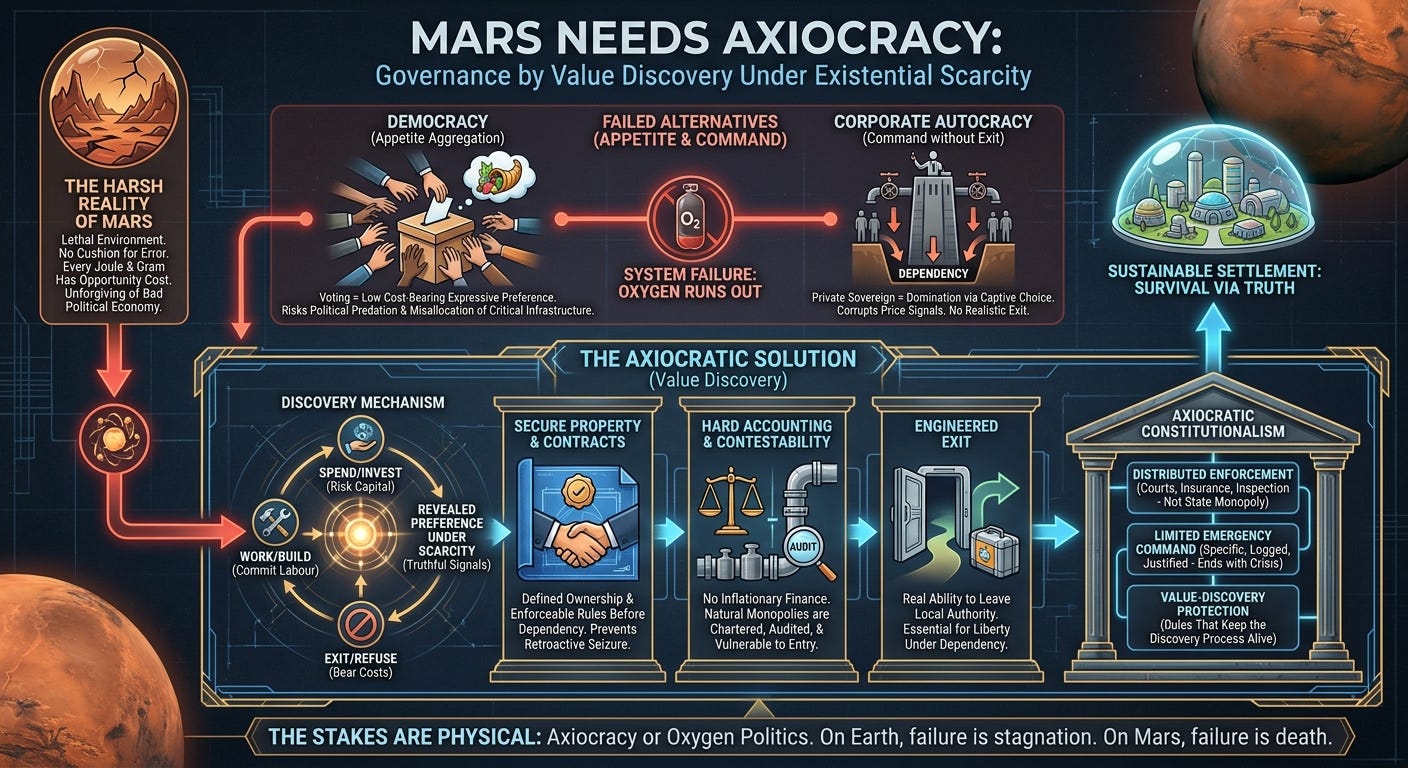
The usual debate begins in the wrong place: democracy or autocracy, voting or command, public rule or private rule. Those categories are too crude for a settlement built inside a lethal environment. A Mars colony cannot survive by majority appetite. It also cannot survive as a company town where whoever controls oxygen controls everyone who breathes.
Mars needs axiocracy: governance by value discovery.
Value Is Discovered, Not Declared
Axiocracy starts from a simple premise. Value is discovered by agents allocating scarce resources under constraint. It is not declared by rulers, committees, experts, CEOs, or voters.
Markets discover value because agents must choose. They spend, invest, build, quit, and exit. Those actions reveal preference under sacrifice. They force tradeoffs into the open.
Voting cannot do that.
A vote is appetite aggregation without proportional cost-bearing. A voter does not have to build the thing he votes for. He does not have to maintain it, insure it, trade it off against alternatives, or absorb the downside if his judgment is wrong. His individual causal exposure is nearly zero, so voting naturally becomes expressive. People vote identity, resentment, faction, status, or fantasy because the ballot rarely prices the fantasy back to the voter.
Allocating your own resources expresses preference far more honestly. When you spend your own money, commit your own labour, risk your own capital, or walk away from a bad arrangement, you reveal a ranked preference under scarcity. You give something up. Reality answers. If you are wrong, you pay.
That distinction matters everywhere. On Mars it becomes existential.
Voting Is a Bad Allocator
A colony that treats ballots as value signals will misallocate oxygen, power, launch mass, machinery, and attention. It will reward political pressure over demonstrated creation. It will invite residents to vote themselves control over capital they did not create, systems they cannot operate, and resources whose replacement costs they do not bear.
Once that risk becomes credible, the colony may never be built. Builders, investors, insurers, and transport providers will price in future confiscation, then stay home.
Voting has one defensible political use: it can reduce violence by giving factions a ritualized way to contest bounded offices. It can help settle ordinary municipal questions and provide resident voice over local norms. Civil peace has value. Peacekeeping should not be confused with discovery.
Voting can allocate authority over bounded offices. It should not allocate existential infrastructure.
Life support is not a campaign promise. Pressure seals are not a social program. Launch capacity is not a common prey animal. A Mars constitution that allows simple majorities to seize productive systems will convert politics into predation.
Corporate Command Fails Too
The obvious reaction is corporate rule. Let the builders own what they build. Let the operators operate. Let contracts govern. Let settlers agree before they go.
That solves one problem and creates another.
A single company controlling oxygen, housing, transport, medicine, and return passage would become a private sovereign. Contract language does not erase dependency. A person who must accept the terms of the oxygen provider in order to remain alive is not participating in clean market discovery.
Captive choice corrupts prices because refusal is not realistic. If customers cannot exit, competitors cannot enter, and users cannot meaningfully say no, then prices stop being reliable signals. They become instruments of domination.
Axiocracy rejects democratic confiscation and corporate sovereignty for the same reason. Both suppress value discovery. Democratic confiscation replaces allocation with political appetite. Corporate sovereignty replaces allocation with dependency-backed command.
Axiocracy and Its Lineage
Axiocracy overlaps with classical liberalism and ordoliberalism, but its center is different. Classical liberalism begins with liberty. Ordoliberalism begins with a legal order for competition. Axiocracy begins with value discovery.
It asks which institutions allow agents to reveal, test, revise, and coordinate value claims under scarcity. Markets are privileged because they are the most powerful known discovery mechanism for exchange value, not because private action is magically virtuous and not because state action is automatically illegitimate.
Axiocracy therefore cares about the machinery that makes markets truthful: secure property, enforceable contract, open competition, liability, and real exit. Remove those conditions and price signals become camouflage for power.
Mars needs axiocratic constitutionalism: entrenched rules that protect value discovery under extreme scarcity.
Enforcement Without General Sovereignty
A constitution does not enforce itself. A Mars axiocracy would require courts, arbitration, technical inspection, insurance, and precommitted dispute procedures.
The question is whether those powers are monopolized by a state or distributed through chartered institutions whose authority is limited, auditable, contestable, and exit-compatible. Axiocracy is not a fantasy of rules without enforcement. It is a refusal to let enforcement become a license for command.
Property claims should be backed by registries, escrow, performance bonds, and courts. Infrastructure obligations should be backed by inspection rights, audited reserves, and receivership clauses. Security providers should operate under charter, liability, and jurisdictional limits. Arbitration systems should compete, but their judgments must be enforceable through predefined compacts.
Force does not disappear. It gets constrained, decomposed, audited, and made liable. The guards are guarded by rival jurisdiction, open records, personal liability, and exit. None of these mechanisms is perfect. Perfection is not the standard. The standard is whether enforcement preserves value discovery better than a monopoly sovereign with power over oxygen, law, taxation, and political permission.
Command Without Sovereignty
Axiocracy does not abolish command. It confines command to the function that justifies it.
Mars will require hard command in emergencies. A reactor chief needs authority over reactor safety. A flight director needs authority during launch. A medical lead needs authority during triage. No one should be litigating while oxygen falls.
That does not imply general sovereignty. Emergency command must be predefined, logged, reviewable, and limited to the domain that creates the need for command.
The same applies to force. Legal authority can be polycentric. Tactical violence inside shared survival zones cannot be. Rival armed factions have no place near pressure hulls, airlocks, reactors, or oxygen tanks. A firefight on Earth is a local tragedy. A firefight inside a pressure vessel is a governance failure with collective consequences.
Mars also needs amendment without confiscation. A founding charter cannot freeze the living forever, but later majorities cannot be allowed to treat inherited capital as ownerless prey. Ordinary rules can change. Technical protocols can update with evidence. Infrastructure covenants can be renegotiated through compensation and consent. Constitutional constraints require higher thresholds because they protect the value-discovery process itself.
Command belongs where physics, engineering, medicine, or emergency response requires command. It must stop where its justification ends.
Property, Contract, and Hard Accounting
Property rights must be secure before settlement. The people who finance, design, launch, and maintain the colony need assurance that later majorities cannot retroactively seize the productive base once enough passengers arrive. This does not mean founders get arbitrary power. It means ownership, contract, equity, debt, and user rights must be defined before dependency makes coercion profitable.
Contracts must be real, legible, and enforceable. Mars will be too complex for informal trust and too dangerous for discretionary politics. Workers, residents, investors, insurers, and suppliers need predictable rules. If every hard bargain can be reopened by political pressure, long-term planning collapses.
Money and accounting must be hard. Inflationary finance is anti-axiocratic because it corrupts the measuring instrument. Opaque subsidies, soft budgets, and emergency excuses will be especially dangerous on Mars because false abundance will have physical consequences. A colony that lies to itself about cost will eventually discover cost as shortage.
Natural Monopoly and Contestability
Early Mars will contain natural monopolies. The first settlement may have one reactor, one launch provider, one medical bay, and one water system. A thousand-person colony cannot afford three redundant nuclear grids merely to satisfy an abstract preference for parallel competition.
Axiocracy does not pretend otherwise. The institutional question is whether those monopolies are treated as private kingdoms, public spoils, or chartered utilities constrained by audit, liability, open interfaces, and future contestability.
Competition on Mars will often begin as competition for charters, contracts, standards, and expansion rights before it becomes competition among parallel pipes. A single water network can still have open metering, audited books, third-party inspection, and defined rules for rival entrants. A single power system can still face performance bonds, independent safety certification, and liability for failure.
Redundancy is physical duplication. Contestability is institutional vulnerability to replacement, discipline, or entry. Mars may lack the first in its earliest phase. It cannot afford to lack the second.
Engineered Exit
Exit on Mars cannot be romanticized. No one can leave the planet on demand. Transfer windows, propellant, medical clearance, and cost make exit slow and expensive. A disgruntled worker cannot simply walk into the desert and start again.
That makes engineered exit more important, not less.
A Martian exit right would include portable assets, transferability between habitats, anti-retaliation rules, pre-funded repatriation insurance, and the legal ability to organize rival settlements. Exit is not only departure from the planet. It is the ability to refuse a local authority without losing one’s property, livelihood, legal standing, or air.
Exit also has to operate at multiple scales. A person should be able to leave an employer without losing housing. A resident should be able to switch habitat contracts without losing savings or credentials. A settlement should be able to change suppliers without being locked into proprietary life-support dependencies. A dissident group should be able to organize, litigate, and depart without retaliation.
Exit is not a slogan. It is an engineering requirement for liberty under dependency.
Survival Infrastructure
Survival infrastructure is where axiocracy has to prove it is more than market rhetoric. Oxygen, water, pressure, power, and return transport cannot be governed as ordinary consumer goods, because refusal is not a normal option. The task is to preserve ownership and price signals while preventing survival dependency from becoming political authority.
Nationalization by ballot turns infrastructure into loot. Unlimited owner discretion turns it into private government.
Core survival systems can be privately built and owned while operating under chartered obligations: audited reserves, bankruptcy-continuity rules, emergency access protocols, non-discrimination among contracted users, and strict liability for failure or fraud.
Those rules do not exist to politicize the systems. They exist to keep dependency from destroying voluntary exchange.
An oxygen provider should be allowed to charge for oxygen. It should not be allowed to use oxygen access to suppress criticism, block competitors, punish exit, or compel unrelated labour. A habitat operator should be able to enforce safety rules. It should not be able to convert safety discretion into political control. A transport provider should be paid for enormous logistical difficulty. It should not be able to trap people through opaque pricing or retaliatory denial of passage.
Axiocracy protects production and refuses domination. Both commitments are necessary.
Beyond Makers and Takers
“Makers versus takers” captures a real pathology, but it is too blunt to govern with. Mars needs builders, maintainers, inventors, medics, caregivers, and children who may one day become any of these.
Current net production is not the same thing as value. A sick engineer, a child, a pregnant woman, a retired reactor designer, or a researcher years away from practical output is not a parasite.
The relevant distinction is whether institutions route resources toward discovered value or captured value. Productive systems must be protected from predation. Dependent people must be protected from domination. Fraud must be punished. Exit must be real. Contribution must be discoverable rather than politically declared.
Axiocracy does not require contempt for the dependent. It requires hostility to capture.
The Mars Constitution
A Mars constitution should not ask who deserves ultimate power. No one does.
Residents need voice over ordinary local matters. Builders need protection from expropriation. Operators need technical authority over unforgiving systems. Workers need enforceable contracts and exit. Dependents need protection from domination. Competitors need entry rights. Everyone needs accounting that cannot be politically softened when reality becomes inconvenient.
None of these powers should be sovereign. Each should be bounded by the institutional function it serves.
Voting can serve civil peace. Corporate ownership can serve production. Technical authority can serve operational competence. Exit can discipline capture. Markets can discover exchange value. The constitutional task is to prevent any one mechanism from swallowing the others.
The detailed design of Martian enforcement, emergency authority, charter amendment, and tactical force belongs in a separate problem. The first principle is simpler: command must exist where physics requires command, and must stop where its justification ends.
Postscript
Mars makes the stakes visible because scarcity cannot be wished away. Every political system is an allocation system. It decides who may claim labour, machinery, energy, time, and risk.
If those claims are routed through voting, they become factional appetite. If they are routed through command, they become hierarchy. If they are routed through voluntary allocation under property, competition, liability, and exit, they can become discovery.
A Mars colony should not be ruled by voters, bosses, founders, or mobs. It should be governed by institutions that keep value discovery alive.
That is axiocracy.
Mars will punish societies that confuse desire with value. A colony that cannot distinguish production from predation, price from command, contract from captivity, and voting from discovery will eventually run out of margin. On Earth, that failure produces stagnation, debt, and institutional sclerosis. On Mars, it runs out of oxygen.