

Imagine measuring the spin of an electron. Quantum mechanics assigns probabilities to two possible outcomes. You perform the measurement and observe one of them. What happened to the other?
According to the Everett interpretation of quantum mechanics, both outcomes occurred. The universal wavefunction evolved into a superposition containing observers who recorded different results. Decoherence made those alternatives effectively independent, and each observer found themselves in a world with a definite outcome.
Asking which branch became real rests on a false premise. Both branches are structures within the universal quantum state, which is itself real, and no additional mechanism selects one for existence while withholding reality from the other. That gives me a way to reconsider a problem in my own work on the foundations of reality.
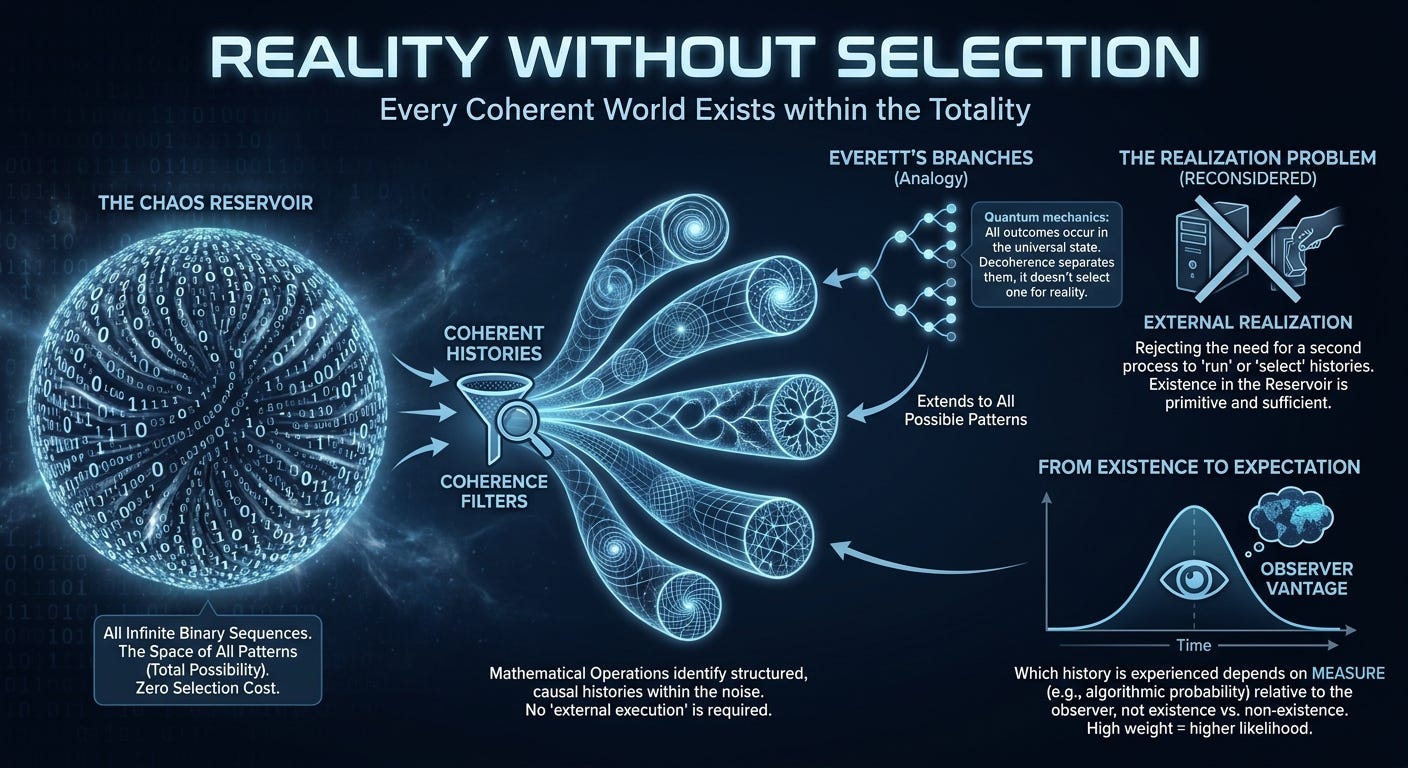
In Chaos and Coherence, I proposed that the continuum of mostly incompressible reals, which I call the Chaos Reservoir, might provide a minimal ontological foundation. A real and an infinite binary sequence are the same pattern in two notations, and Chaos is the totality of such patterns. I work in binary throughout. But in The Universe in a Bitstring, I identified an unresolved problem. A mathematical description of a universe does not ordinarily make that universe physically real, any more than a program describing conscious agents is a computer running that program. What, then, would realize the histories contained in Chaos?
I now think that question imported an unnecessary assumption. It treated the histories within a foundational ontology as though they needed a second process to grant them existence. Everett shows how an encompassing reality can contain multiple incompatible histories without selecting among them, and Chaos extends that principle to the unrestricted space of possibilities.
The Zero-Bit Foundation
The motivation for Chaos is informational parsimony. Any particular universe has laws, constants, boundary conditions, and a history, and specifying them requires information that distinguishes that universe from alternatives. We might explain why it exists by invoking a deeper law that selects it, but then we must explain why that deeper law exists. Unless the explanation terminates somewhere, we have merely relocated the problem.
Chaos begins by declining to select anything. By a pattern I mean any structure that an unbounded sequence of binary distinctions suffices to specify, and the Reservoir is every such pattern. No pattern is preferred, and none is excluded. Written in binary, the Reservoir is the space of all infinite binary sequences, though the notation carries no ontological weight, and any claim with physical content must survive a change of notation. The selection cost is zero bits.
Zero selection cost does not mean the complete theory can be encoded in zero bits. We still need mathematical definitions, including those specifying what a pattern is and how binary sequences represent one. Nor does it mean that every alternative ontology has a longer description, since some particular physical laws may be extraordinarily simple. The claim concerns selection alone: once the space of patterns is defined, admitting all of them requires no additional selection information, while restricting the space to some preferred subset introduces a condition that must be specified and justified.
An individual infinite sequence will almost certainly be algorithmically incompressible under the usual measure, yet the entire ensemble has a compact mathematical description: all infinite binary sequences. Maximum diversity of contents is compatible with minimum selection.
I stipulate that Chaos exists. This is the foundational ontological commitment of the theory, justified by the economy of unrestricted existence and by whatever explanatory success follows from it. I do not claim to have derived existence from information theory. Every foundational ontology must eventually accept something as given, and Chaos proposes accepting the unrestricted totality rather than choosing some particular constituent as the primitive reality.
What Everett Shows
Everett’s branches are emergent structures. They can contain mutually incompatible histories of the same experiment, yet all remain components of one underlying quantum state, and they need no exact decomposition into individually countable worlds. Chaos proposes a more general ontology. Everett assumes a particular universal quantum state governed by particular laws, while Chaos contains every pattern, the coherent histories among them.
The two proposals differ in standing and in structure. Everett inherits the empirical support of the quantum formalism it interprets, and Chaos remains a speculative foundational hypothesis, so the analogy cannot establish its truth. Coherence does for Chaos what decoherence does for Everett: it picks out the histories. Decoherence works through the dynamics of a single physical state, relative to a division into system and environment that physics largely supplies. Coherence is defined relative to a filter, and Chaos, having no dynamics of its own, contains every filter. Which filters count is therefore a far more open question for Chaos than which division counts is for Everett.
The analogy does expose an assumption that is easy to overlook: the idea that reality must select one history from among multiple possible histories. Everett dispenses with that selection within quantum mechanics, and Chaos dispenses with it at the ontological foundation.
The Realization Problem Reconsidered
We ordinarily distinguish a program from its execution. A program on paper contains instructions, while an executing program involves a physical computer changing state according to them. The distinction is legitimate because both objects exist within an already established physical world, where we can identify the machinery and tell representations from the processes they represent.
Applied to the foundation of reality, the distinction generates a regress. Any external computer proposed to execute the histories of Chaos would itself need to exist, and if its existence required another implementation the demand would repeat. Eventually we must accept some foundation whose existence requires no further realization, and Chaos is proposed as that foundation.
That requires precision about what Chaos contains. A binary string can encode a description of a physical history without possessing that history’s internal organization: the characters representing a person do not constitute a person. A sequence is a pattern in its own right, and the history it encodes is a different one. Both belong to Chaos. The states, transitions, and internal dependencies of a coherent history are part of what the theory says exists, and no interpretation relating the two patterns is privileged as the one that confers existence.
This is an ontological commitment, rather than a consequence established by an encoding theorem. Once it is made, an additional realization requirement asks for a second kind of existence without explaining what distinguishes it from the first.
The Universe in a Bitstring left three exits open. A relationship among structures inside Chaos might play the role that execution plays for an ordinary simulation, Chaos might contain only represented histories with realization supplied from elsewhere, or realization might be taken as primitive. I called the third coherent and said it gave up the economy that motivated starting from Chaos. My position now is the third, with that charge answered. The charge assumed realization would be a second primitive, added to the existence of the Reservoir. On the present account there is one primitive, the existence of the patterns that make up the Reservoir, and “realized” names nothing further.
Which interpretations are admissible needs a criterion. If any mapping whatever counts, then any sequence encodes any history, since a sufficiently gerrymandered mapping can read a galaxy into noise. Putnam pressed this objection against computational theories of mind. I take an interpretation to be admissible when it is computable. That is a restriction, and its definition belongs to the mathematical overhead of the theory, but it prefers no pattern over another. Computable interpreters have finite codes, and those codes occur as prefixes among the Reservoir’s sequences, so admitting all of them adds nothing to what already exists.
Admissibility settles which interpretations are permitted and leaves their weighting open. The gerrymandered mapping stays available at a cost: the information needed to produce a specified history must reside in the interpreter, in its input, or in both, and the total description length is charged against measure. That charge is reckoned relative to some universal interpreter, and none is privileged. The invariance theorem bounds the disagreement between two universal interpreters by a constant, but the constant can be made as large as we please, since a universal interpreter can be built to favor any chosen history while reserving a prefix for simulating a reference machine. Invariance therefore secures agreement in the limit and offers no guarantee of close probabilities over finite records. Triviality moves from existence to measure, where it stays open.
The proposal has predecessors. Schmidhuber argued in 1997 that generating every computable universe can take less information than specifying one, which is the zero-bit argument in computational form. His Great Programmer, who runs every program, can be read as an expository device rather than an ontological commitment. Chaos extends his ensemble to every pattern, the incomputable ones included, and drops the vocabulary of execution altogether.
Tegmark’s Mathematical Universe Hypothesis identifies physical existence with mathematical existence, admits every mathematical structure, and considers restricting the ensemble to computable ones. Chaos stipulates a single space of patterns, and since computable interpretation recovers much of Tegmark’s computable ensemble within it, I claim no reduction in total ontological complexity. The difference is that a single space carries a natural candidate measure, which an ensemble of unrelated mathematical structures lacks.
Coherence Without Selection
Most infinite binary sequences appear random under the standard fair-coin measure, but the same space supports regular mathematical structures, dynamical systems, physical laws, and computational processes. The Coherence Filters framework provides a way to identify them. Exclusion filters specify constraints that sequences must satisfy, and semantic filters associate accepted sequences with structured histories, assigning states, transitions, and relationships.
Consider a cellular automaton. A simple rule determines each cell’s next state from the states of its neighbors, and given an initial configuration the rule specifies a complete history. A computable rule does not imply a computable history, however. A finite program can fix the dynamics while an incomputable sequence supplies the initial conditions or a stream of stochastic events, and the resulting trajectory is then lawful and incomputable at once. Admissibility constrains the interpreter and leaves the input unrestricted, so Chaos contains histories that an ensemble of computable universes omits.
Filters are mathematical operations. They do not need to run as external physical machines, and they do not create the structures they identify. We can still ask whether a particular structure is coherent, whether it contains causal organization, or whether some of its processes constitute conscious experience, and the answers describe structures that already exist. Coherence determines organization, not existence.
Emergence stays real under this picture. In The Case for Reality, I argued that emergent structures remain real even when they arise from a deeper ontology, as temperature is real despite emerging from molecular motion. Physical laws, constructors, organisms, and agents can likewise be real structures within a more encompassing reality.
From Existence to Expectation
Removing selection from existence leaves a different problem. If every coherent history exists, why should an observer expect some outcomes rather than others? Everett faces the analogous question, since both outcomes of a measurement occur and the interpretation must connect their amplitudes to what observers should expect. Chaos likewise requires a theory of measure.
The Reservoir has a natural candidate. Under the fair-coin measure, any specified prefix of length n has measure equal to two raised to the power of negative n. It is the only probability measure on the sequence space left unchanged by flipping any chosen bit, which makes it the measure that prefers neither value at any position, and on the reals it is the ordinary uniform measure on the unit interval. The space admits biased and correlated measures as well, so adopting the fair-coin measure is a further commitment, motivated by the same refusal to select that motivates the Reservoir.
Every infinite sequence exists, though each has measure zero, so ontological equality does not imply equality of measure. A measure on binary sequences is also not automatically a measure on physical histories. The set of computable infinite sequences is countable and has fair-coin measure zero, so conditioning on that set yields no useful probabilities over deterministic computable histories.
Reading the sequences through a computational interpreter provides another route. In The Universe in a Bitstring, I introduced Knot, a minimal reflective programming language capable of expressing arbitrary computable functions. Under a fixed prefix-free encoding, the sequences that begin with a given program have fair-coin measure two raised to the negative of its length, so every program receives positive measure, and the remaining bits supply the input stream from which a history unfolds. This connects the framework to algorithmic probability and Solomonoff induction.
The weighting depends on the representation. A single history may admit descriptions whose lengths differ substantially: the Rule 30 history in The Universe in a Bitstring takes 470 bits as Binary Lambda Calculus source and 2,042 bits once compiled to SK combinators, so the two codewords differ in weight by a factor of 2^1,572. That figure measures encoding dependence rather than a ratio of universal probabilities, but it shows the scale at which representation can move weight.
Counting descriptions as separate universes or observers would therefore make probability depend on arbitrary choices of representation. The Coherence Filters framework supplies the form of an answer: sequences that a semantic filter maps to the same trajectory form an equivalence class, and the weight of a history is the measure of its class, however many descriptions the class contains. The classes still depend on the filter that draws them, so invariance across interpreters remains open.
The Quantum Branching Universe framework supplies the observer’s side. An observer occupies a Vantage defined by the information available to that observer, and predictions concern the relative measure of histories compatible with that Vantage and their possible continuations. All continuations may exist, and an observer can still have rational expectations about which they will experience.
The natural objection is that a theory containing every coherent world can accommodate every possible observation. That is true at the level of existence alone, as it is for Everett, whose empirical content comes from the quantum dynamics and the quantitative relationships among outcomes. Chaos needs the equivalent: observer-relative measures that remain stable under legitimate changes of interpretation. If substantial predictions survive such changes, they reflect regularities that belong to Chaos rather than to a chosen encoding. If different interpreters produce irreconcilable observer probabilities, Chaos will require an additional principle governing measure or semantic equivalence.
It is tempting to infer that observers should encounter relatively simple physical laws because short programs receive greater algorithmic weight. That does not follow without further work, because observer distributions, equivalent descriptions, and interpreter dependence all affect the calculation. Nor have I derived the Born rule, the Standard Model, or the observed values of physical constants from Chaos.
Postscript
In The Universe in a Bitstring I called the missing property ontological closure, an account in which the relevant interpretations exist and operate without any additional realization principle, and I left it open. I now hold that nothing outside a coherent history needs to execute it. Its dynamics, causal relationships, and computations are internal organization, and they exist because the Reservoir does.
The stipulation has a price. A realization mechanism, had one been found, would have said which histories count, and without one the whole empirical burden of the theory falls on measure. We still need the mathematics of coherence, the identity of histories across representations, and an account of how agents and consciousness emerge. If no observer-relative prediction survives a change of interpreter, Chaos will remain an ontology without empirical content.
We can stop asking which coherent worlds are real. Within Chaos, they all are. The remaining problem is how an observer, surrounded by an unrestricted reality, comes to experience a world governed by particular laws and regularities.