

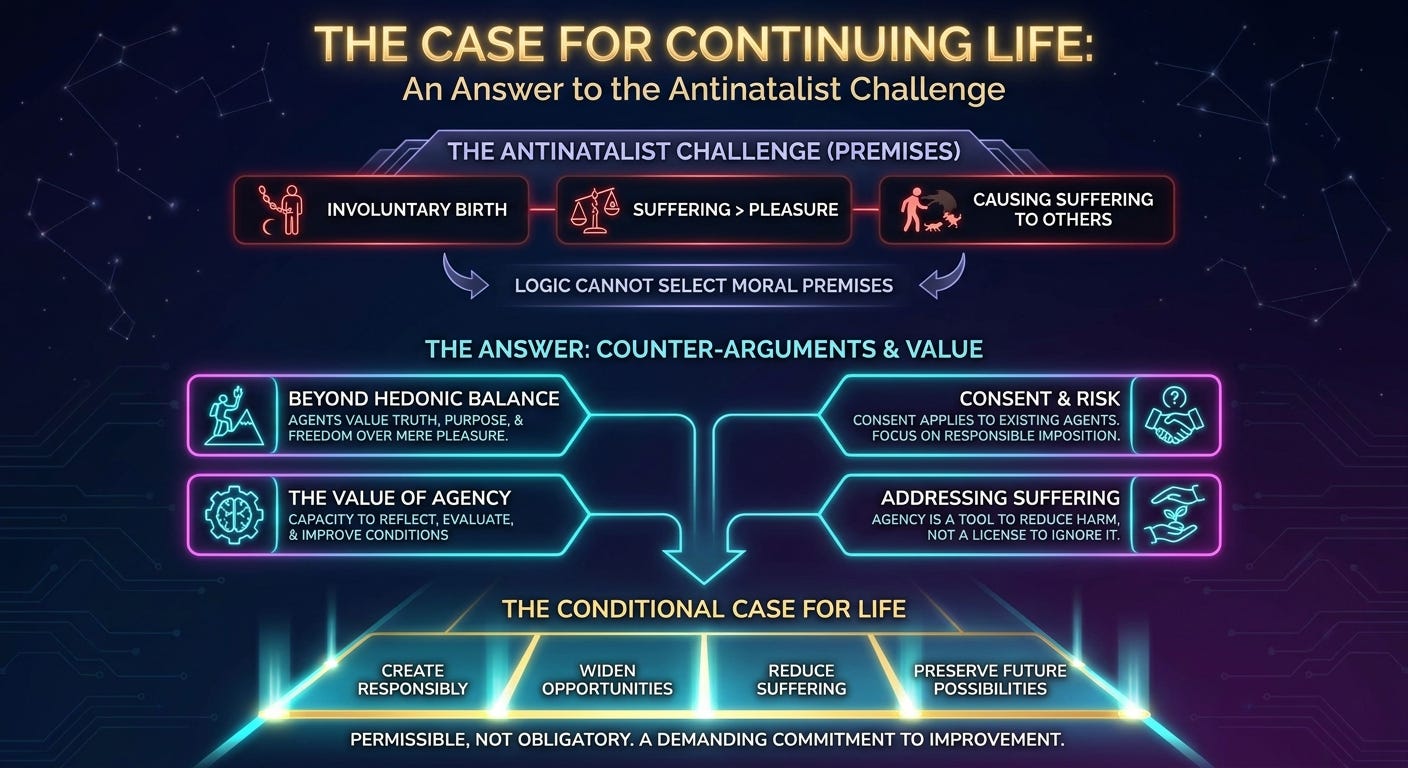
Jeremy Stamper asks for the strongest nonreligious moral argument for perpetuating life on Earth, given that birth is involuntary, that life contains more suffering than pleasure, and that living beings inevitably cause suffering to others. All three premises can be granted for the sake of argument. Nobody chooses to be born. Biological existence entails suffering, and no creature passes through the world without affecting other creatures, sometimes painfully. Whether suffering exceeds pleasure across all lives is an empirical question with no agreed method of measurement, but the answer does not turn on that measurement.

The premises describe the costs of life. The conclusion that creating life is immoral also needs a theory of what makes a life worth living and what makes an act of creation permissible, and logic cannot supply one. Logic tells us what follows from moral premises; it cannot select them.
A Life Is More Than Its Hedonic Balance
Imagine someone whose life contains more suffering than pleasure. She pursues difficult research, cares for a disabled partner, defends an unpopular cause, and endures years of frustration. She knows the costs and would choose her life again. On what grounds should an outsider pronounce her existence a moral loss?
One answer insists that pleasure is the only good and suffering the only bad, so her endorsement of her life is mistaken. That is a particular theory of value. It counts her discoveries, her commitments, her integrity, and her freedom only to the extent that they produce pleasant experiences, and it gives her own considered judgment about what made her life worthwhile no independent weight.
I see no reason to accept that reduction. An agent can prefer truth to comfort, fidelity to convenience, or freedom to security. People willingly bear large costs for purposes they consider more important than their own happiness. Those preferences can be criticized, but their existence shows that the vocabulary of pleasure and pain does not capture everything agents value.
None of this makes suffering trivial. Some lives contain such misery, deprivation, or coercion that creating them would be indefensible. Nor does her endorsement show that her life was rightly started, since a life worth continuing may still have been wrong to create. What the example removes is the hedonic ledger as the measure of a life, and Stamper’s second premise counts against creation only on that measure.
The Birth of an Agent
Life has produced creatures capable of forming models of their world, evaluating possible futures, and acting to bring preferred futures about. Some can reflect on their own preferences and revise them. They can discover truths, build institutions, and question the conditions of their own existence.
These capacities matter morally because they make the pursuit of values possible. With agency, life can criticize the evolutionary process that produced it and deliberately change the conditions under which future beings live. It can also create knowledge and forms of flourishing that could never emerge in a world without agents.
The possibility of improvement is no guarantee of improvement. Intelligent beings have also invented new ways to inflict suffering, and expanding capability enlarges both possibilities. Existing agents can still reasonably value a future in which the capacity to understand, choose, and improve outlives them, and perpetuating life serves that value.
An antinatalist can object that no future person will miss these opportunities if they are never born. I agree. There is no disappointed person waiting outside existence, and potential agency is not a creditor with a claim against the living. The case for creation begins with values held by agents who already exist and with the lives that created agents may themselves come to value. We may have reasons to bring about valuable futures without claiming that someone was wronged by the futures we did not bring about.
David Benatar builds the strongest version of antinatalism on that concession. In Better Never to Have Been he argues that the absence of pain is good even when nobody exists to enjoy it, while the absence of pleasure is bad only when somebody is deprived of it, so nonexistence always wins the comparison. The asymmetry switches standpoints halfway through. Judged from the side of the never-born, neither absence is good or bad, because there is no one for whom it could be either. Judged by existing agents surveying possible worlds, the missing suffering counts as a gain and the missing knowledge, love, and achievement count as a loss. Benatar takes the first half of his ledger from one standpoint and the second half from the other.
Consent Before Existence
Bringing someone into existence imposes risks without asking permission, and parents are accountable for the foreseeable conditions into which they bring a child. But consent is a practice among agents, and before conception there is no person capable of granting or withholding it. Duties toward future people survive that observation: someone can be wronged by a decision made before they could object, as a child can be injured by a reckless prenatal decision. So the mere absence of prior consent cannot establish a universal violation of rights, and the question becomes which risks and impositions are unreasonable.
Seana Shiffrin offers a candidate rule: we may harm someone without consent to save them from a greater harm, but never merely to benefit them. Breaking an unconscious man’s arm to pull him from a burning car is permitted, and breaking it to hand him a fortune is not. Her cases involve a person who was already doing tolerably and whose will was bypassed. Creation bypasses no will and worsens no prior condition, so the rule has to be stretched to cover it. Shiffrin herself draws the limited conclusion, that procreation is morally hazardous and that parents owe their children for the burdens of existence, which is the accountability this essay accepts.
The resulting person will come to have interests and, if development goes well, the capacity to judge the life they were given. Their later endorsement cannot retroactively authorize every parental choice, but whether they can live a life they affirm bears on whether creating it was responsible.
Continuing a life and creating one are different choices, which is why the woman who would choose her life again settled nothing about her parents’ decision. They decided under uncertainty, as all parents do, on the reasonably foreseeable welfare and opportunities of the child, and such a decision can be justified without being guaranteed.
The Suffering of Other Creatures
Stamper’s third premise reaches wider than the familiar argument about human birth. Predators torment prey, parasites exploit hosts, and humans transform ecosystems in ways that injure countless sentient creatures. A defense of life has to answer for those harms.
We should not romanticize nature. Evolution has no obligation to minimize suffering, and its results include great capacities alongside cruelty and waste. The suffering of nonhuman creatures counts even when those creatures lack the reflective agency to advocate for themselves. Valuing comes in degrees and does not wait for reflection: wherever a creature experiences its condition and prefers otherwise, something matters to it, in proportion to the agency behind the preference.
But causing some suffering is not sufficient to make an activity categorically impermissible. Agents routinely pursue legitimate purposes while imposing costs and risks on others. Those costs are reasons for restraint, mitigation, compensation, and sometimes prohibition, none of which amounts to a rule that the world would be better without living beings.
Reflective agents are the only known creatures able to see predation, parasitism, and their own damage as problems and deliberately reduce them. That is where the capacity to criticize evolution does its work. It is a reason to preserve and develop agency, and no license to ignore the damage agents cause. Whether our descendants improve the biosphere depends on their choices, knowledge, institutions, and values.
Postscript
Two conclusions are available: that creating life can be morally permissible, and that we have an unconditional obligation to create it. I defend the first. A world with future agents can contain knowledge, freedom, relationships, and relief of suffering that would otherwise never occur. Existing people can reasonably value those possibilities and work to make them real, subject to obligations toward the people and creatures who bear the costs.
The second conclusion requires more. If value arises through valuing agents, a lifeless universe violates no duty to hypothetical people. A person may have no obligation to become a parent. A community may reasonably decline to expand when it cannot provide tolerable conditions for those it would create, and some possible lives should never be brought about.
None of that supports the categorical antinatalist conclusion that creating any life is wrong. Such a conclusion needs an additional moral principle: that suffering outweighs every value agency makes possible, that absent suffering counts while absent goods do not, or that no burden may be imposed without consent for the sake of a benefit. Stamper’s three factual premises establish none of them.
The case for continuing life is therefore conditional and demanding: create lives responsibly, widen the opportunities of those who exist, reduce the suffering we cause, and preserve the possibility that future agents improve on what we have done. The uncertainty of that future is a reason to take those obligations seriously. It is also the condition under which new generations can make choices that are their own.