

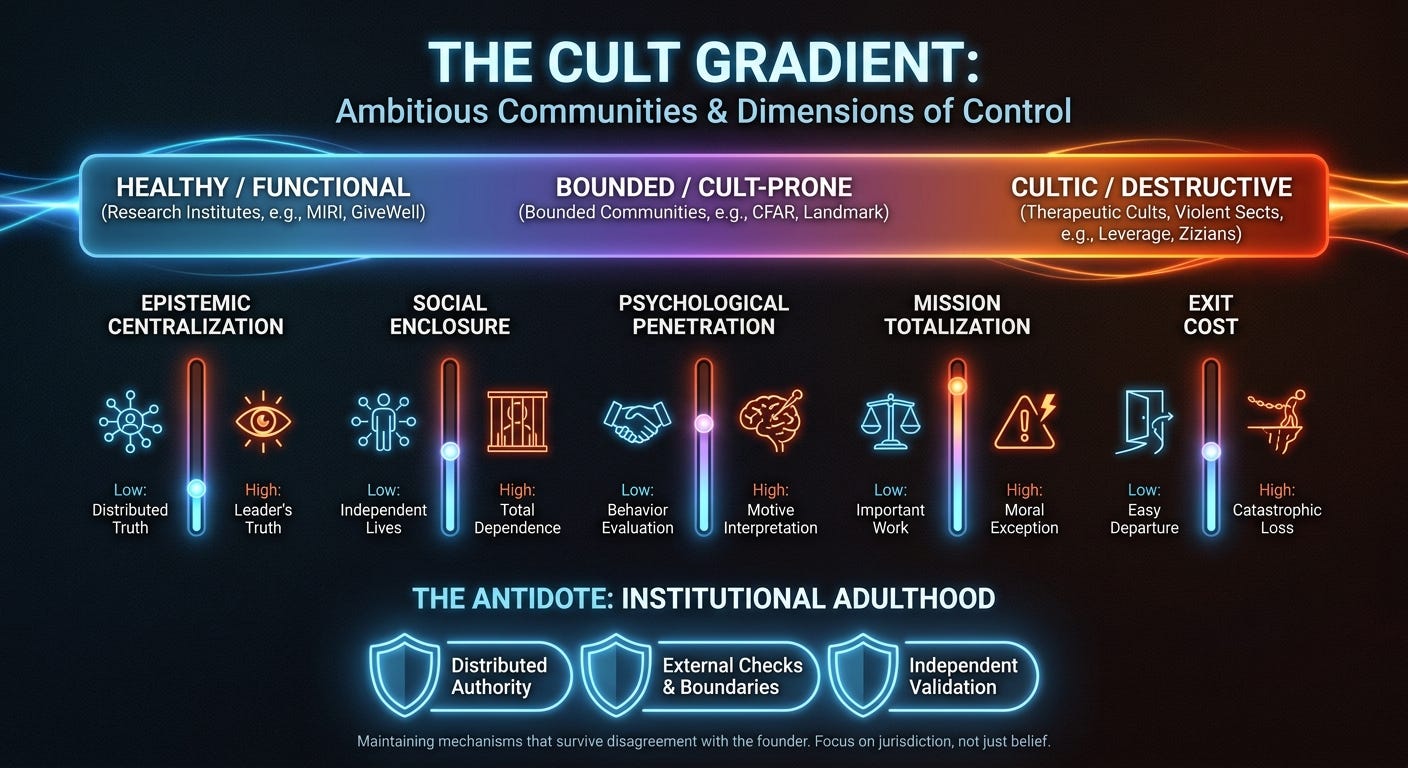
The Cult Gradient
How ambitious intellectual communities become research institutes, therapy cults, or violent sects
In 2011, Geoff Anders founded Leverage Research to solve a problem of almost absurd scope. Humanity possessed enormous intelligence and resources, yet repeatedly failed to coordinate, govern itself, or solve its largest problems. Anders concluded that the missing technology was a sufficiently powerful science of human behaviour.
This was not an obviously foolish idea. Psychology was fragmented, replication problems were becoming visible, and conventional institutions had plainly failed to produce a general theory of effective human agency. Leverage attracted intelligent and ambitious people from Effective Altruism, rationalism, philosophy, science, and Silicon Valley. It received funding from Peter Thiel and Jaan Tallinn. It organized conferences, incubated projects, and gave young researchers unusual freedom.
Then its members began experimenting on one another.
They mapped hidden beliefs, probed emotional reactions, performed bodywork, searched for inaccessible regions of the mind, and interpreted intense subjective experiences as evidence of psychological discovery. Colleagues became therapists. Managers became experimental subjects. Housemates became researchers. Romantic partners became diagnostic authorities.
Eventually some participants came to believe that hostile psychological objects could move between minds. The organization entered what members called the “Intention War”: a period of paranoia, psychic defence, social exclusion, and attempts to contain allegedly transmissible mental entities. Leverage 1.0 dissolved in 2019 after years of escalating psychological distress and organizational dysfunction. Lydia Laurenson’s reconstruction of Leverage 1.0 describes a research organization that gradually lost the distinction between introspection and evidence, therapy and management, private experience and institutional fact.
Reading the account produces an immediate question: Were there any adults in the room?
There were adults in the chronological sense. There were founders, patrons, managers, researchers, and experienced outsiders. What was missing was institutional adulthood: independent people with the authority to say that an experiment must stop, that severe psychological symptoms require outside care, that managers cannot act as therapists, and that a founder’s theory does not get to determine what counts as evidence for itself.
Leverage was not the only unusual organization in its intellectual neighbourhood. The rationalist and Effective Altruist ecosystems have produced MIRI, CFAR, GiveWell, Open Philanthropy, experimental group houses, Circling communities, Burning Man camps, post-rationalist networks, and the violent group known as the Zizians. Some are serious research institutions. Some are social scenes. Some are psychologically aggressive but bounded. A small number became abusive or cultic.
It is tempting to draw a straight line from rationalism to cult formation. That inference is too crude. Shared vocabulary, personnel, or social spaces do not imply equivalent organizational structures. MIRI’s belief that artificial superintelligence could cause human extinction may sound apocalyptic, but an extreme belief is not sufficient to make an institution a cult. Conversely, a group can hold relatively ordinary beliefs while exercising cultic control over its members.
The relevant variable is not weirdness. It is jurisdiction.
A community becomes cultic when it acquires authority over how members interpret reality, understand themselves, organize their relationships, and calculate the cost of leaving.
Strange beliefs are cheap
“Cult” is often used as a synonym for a group with beliefs the speaker considers ridiculous. That usage is nearly worthless.
Extropians believed that technology could radically extend life, augment human capacities, and overcome constraints that most people regarded as permanent. Cryonicists arranged to have their bodies or brains preserved after legal death. Early singularitarians believed that machine intelligence could produce a discontinuity in history. Effective Altruists used spreadsheets and expected-value calculations to decide which lives and causes deserved resources. Post-rationalists mixed systems theory, spirituality, psychoanalysis, embodiment, irony, and internet subculture.
Each worldview violates some mainstream intuition. None necessarily establishes coercive control.
The beliefs may still be wrong. AI extinction could be assigned an exaggerated probability. Cryonics could be technically hopeless. Extropian confidence in technological progress could underweight politics, coordination failure, and human irrationality. Post-rationalist mysticism can become an excuse for obscurantism. Those are intellectual criticisms, not cult diagnoses.
Cultic structure concerns the relationship between the group and the person.
Does the group ask you to consider an argument, or does it claim authority to explain why you resist the argument? Does it seek your contribution to an external project, or does it make your personality an internal project? Does membership occupy one part of your life, or does the group supply your job, housing, friends, lovers, moral status, and interpretation of reality?
The distinction between MIRI and Leverage becomes obvious under this framework. MIRI tells the world that it has misunderstood artificial intelligence. Leverage increasingly told members that they had misunderstood their own minds.
The second claim carries much greater interpersonal power.
Five dimensions of control
Cultic development is better represented as a gradient than a binary category. Five dimensions are particularly useful.
Epistemic centralization
Who gets to decide what is true?
A healthy research organization produces claims that can be inspected independently of the people advancing them. Its leaders may be unusually influential, but they do not possess privileged access to reality.
A cultic organization concentrates interpretation. The leader, therapist, or inner circle becomes uniquely qualified to explain events, motives, objections, and failures. Contrary evidence is processed through the same authority that generated the original claim.
Charisma often initiates this transition. A persuasive founder resolves uncertainty by projecting unusual confidence, moral seriousness, or psychological insight. Followers begin deferring not merely to the founder’s arguments but to the founder’s interpretation of ambiguous situations.
Charisma converts uncertainty into deference. Structure converts deference into control.
Social enclosure
How much of a member’s life is contained inside the group?
Employment alone creates dependence. Housing, friendship, romance, therapy, and moral community create much more. When those functions converge, disagreement threatens several essential goods simultaneously.
The person no longer risks losing only an argument or a job. He may lose his home, social world, romantic attachments, status, identity, and access to a supposedly world-saving mission.
Psychological penetration
Does the organization regulate conduct, or does it claim jurisdiction over inner experience?
Ordinary institutions evaluate actions. Cultic institutions interpret motives, resistance, memories, emotions, identities, and doubts.
Psychological penetration is especially dangerous because dissent can be redescribed as pathology. The member does not merely disagree; he is blocked, defensive, traumatized, contaminated, insufficiently integrated, or controlled by a hidden part of himself.
Mission totalization
How much moral weight does the mission carry?
Every serious organization believes its work matters. Totalization occurs when the mission becomes so important that ordinary constraints appear trivial or immoral.
If humanity’s entire future depends on the group, then privacy can look selfish, professional boundaries can look bureaucratic, rest can look irresponsible, and dissent can look like complicity in catastrophe.
Totalization does more than weaken governance by accident: it supplies the moral argument for disabling it.
A group that believes artificial superintelligence may kill everyone, that trillions of future lives are at stake, or that industrial systems inflict vast suffering can easily conclude that ordinary rules are an indulgence. Conflict-of-interest policies, work-hour limits, independent review, and psychological boundaries begin to look like remnants of a complacent civilization that does not understand the emergency.
This is procedural exceptionalism: the belief that extraordinary stakes justify exemption from ordinary safeguards.
The most expensive demonstration was financial rather than psychological. FTX collapsed in 2022, and Sam Bankman-Fried, then Effective Altruism’s most celebrated donor, was convicted the following year of misappropriating billions in customer funds. No psychological technique was involved, and no one controlled his inner life. The case showed how far the licence travels on stakes alone: a mission believed to be large enough made ordinary financial controls look optional.
The inference is invalid. Urgency does not confer reliability. It increases the consequences of error, intensifies incentives for motivated reasoning, and raises the value of independent scrutiny. The higher the stakes, the less authority any participant should have to waive oversight, informed consent, or professional boundaries.
Exit cost
What happens when someone leaves?
A group with strange ideas and easy exit is generally less dangerous than a group with moderate ideas and catastrophic exit costs.
Departure may be technically permitted. The question is whether a person can leave while retaining housing, income, friendships, dignity, and an intelligible identity.
Capital is not a sixth dimension. It amplifies the other five: it finances enclosure, raises exit costs, subsidizes totalization, and converts personal authority into institutional power.
These dimensions distinguish several superficially similar organizations.
MIRI: apocalypse without enclosure
The Machine Intelligence Research Institute is an instructive control case because it possesses several traits casually associated with cults.
It was built around the work of an unusually influential founder, Eliezer Yudkowsky. It developed a specialized technical vocabulary. It operated within a dense social subculture. Its mission concerns the survival of humanity. MIRI argues that artificial superintelligence is likely to produce extinction unless frontier development is internationally constrained or halted.
That is a millenarian worldview in a literal sense: history is approaching a decisive transformation after which ordinary human life may no longer exist. Such a worldview creates predictable epistemic risks. The stakes amplify confidence. Outsiders can be dismissed as failing to understand recursive optimization or the strategic landscape. Technical complexity makes disagreement difficult to adjudicate. Selection effects concentrate people already convinced that the problem dominates all others.
Yet MIRI does not become a cult merely because its conclusions are extreme.
Its central object is external: the technical and political problem posed by advanced AI. Its historical outputs have included arguments, mathematical research, workshops, and public policy proposals. Those outputs can be criticized without granting MIRI authority over the critic’s personality. MIRI does not ordinarily function as its employees’ therapist, landlord, romantic network, and interpreter of private experience.
Yudkowsky has considerable intellectual authority, but MIRI does not generally claim that disagreement reveals a damaged or contaminated psyche. A researcher can reject a decision-theoretic argument without making his mental health an organizational matter.
MIRI therefore belongs in the category of ideologically intense, founder-shaped research institutions. Its principal dangers are doctrinal overconfidence, apocalyptic policy reasoning, and social insularity. Those are real problems. They are not equivalent to cultic control over the person.
The standing challenge for MIRI is procedural exceptionalism. An institution that sincerely believes extinction is imminent can still separate research judgment from personnel authority, disclose conflicts, invite hostile review, and forbid leaders from using civilizational stakes to override ordinary protections.
Urgency does not exempt an institution from discipline. It makes discipline more necessary.
CFAR: applied rationality enters the mind
The Center for Applied Rationality occupied a more precarious position.
MIRI asked how humans might reason about and control advanced AI. CFAR asked how humans could improve the machinery of reasoning itself.
Its workshops taught techniques such as Double Crux, Goal Factoring, Murphyjitsu, Focusing, and Trigger-Action Plans. Some were repackaged versions of familiar practices from decision analysis, cognitive therapy, project planning, and behavioural psychology. Others encouraged participants to attend closely to bodily sensations, internal conflicts, and partially articulated mental processes.
The ambition was understandable. Human beings routinely know what they should do and fail to do it. They defend beliefs for social reasons, conceal motives from themselves, and avoid information that threatens identity. A practical discipline for detecting and correcting those failures would be valuable.
But the project contains a built-in hazard. Once a facilitator claims expertise in the hidden causes of another person’s behaviour, ordinary coaching can slide into amateur psychotherapy. A vivid emotional reaction can be mistaken for proof that a causal structure has been discovered. Resistance can be interpreted as evidence that the intervention has reached something deep. Introspection can generate compelling stories faster than it generates valid psychological models.
CFAR shared some of Leverage’s conceptual premises. Both treated cognition as something that could be inspected and deliberately modified. Both believed that intelligent amateurs might discover useful psychological techniques outside conventional institutions. Both gave substantial evidentiary weight to participants’ reports that an exercise had produced a breakthrough.
CFAR nevertheless retained important boundaries.
Its characteristic intervention was a bounded workshop. Participants generally returned to homes, careers, and relationships that did not depend on CFAR. The organization did not normally become their employer, landlord, therapist, and entire social world. Most of its named techniques were modest enough to be abandoned without requiring rejection of an elaborate ontology. Imagining that a plan has failed and asking why is merely prospective failure analysis, regardless of whether one calls it Murphyjitsu.
CFAR was therefore not a cult. It was a cult-prone institutional form: psychologically ambitious, socially immersive, weakly validated, and embedded in a mission-driven subculture. It approached the boundary without generally crossing it.
Its most consequential legacy may be cultural rather than organizational. CFAR lent legitimacy, within its milieu, to the idea that technically intelligent people could perform structured psychological interventions on themselves and one another, guided by introspection and informal experimentation. Most such interventions remained benign. Leverage, which developed its own methods independently and earlier, demonstrated what the same assumptions could produce without CFAR’s remaining boundaries.
Leverage: the mind becomes organizational property
Leverage began with research ambition, not an explicit plan to create a high-control community.
Its members explored psychology, organizational theory, coordination, and personal effectiveness. Many lived together in an Oakland building. Projects were loosely structured. Members enjoyed unusual autonomy. The environment was exciting because it appeared to permit fundamental inquiry unconstrained by conventional academia.
Charting became one of its central techniques.
A person would identify a problem, attend to associated beliefs and sensations, and map the causal connections among goals, fears, interpretations, and behaviours. The process could resemble cognitive case formulation or software debugging. Why do I tense when passing strangers? What do I expect them to think? What outcome am I preventing? Which belief sustains the response?
Used modestly, this can be useful. Human behaviour has reasons, and articulating those reasons can change it.
Leverage did not remain modest.
Participants increasingly treated tingling, shaking, relief, vivid imagery, sudden emotional release, and altered bodily states as evidence that they had correctly identified deep mental structures. Reports of dramatic effects strengthened confidence in the theory even when the effects were harmful.
The organization incorporated bodywork and “energy” practices. Members sought access to a psychological “partition” containing supposedly inaccessible material. Sessions generated panic, dissociation, involuntary movement, nightmares, depression, paranoia, and prolonged impairment. Rather than treating these reactions as presumptive evidence that unqualified people were conducting dangerous interventions, participants often interpreted them as signs that the techniques were powerful.
This is the decisive epistemic reversal. Harm ceased to count against the method. Harm demonstrated that the method had reached something important.
Conventional psychology is epistemically imperfect. Licensed clinicians are not oracles, and professional institutions can be complacent, politicized, and wrong. None of that makes continued experimentation by implicated colleagues a defensible response to severe distress.
When people develop dissociation, paranoia, prolonged insomnia, suicidality, or major functional impairment, outside clinical referral is not submission to psychological orthodoxy. It is transfer of acute-risk management to people operating under external standards, role separation, recordkeeping, liability, and some possibility of complaint or sanction.
The choice is not between infallible clinicians and brilliant amateurs, but between imperfect external care and an organization investigating injuries caused by its own methods while remaining financially, socially, and intellectually invested in those methods.
Meanwhile, Leverage’s social structure removed external checks. The same people could be colleagues, housemates, managers, lovers, therapists, researchers, and subjects. Employment, housing, prestige, friendship, and psychological interpretation converged. A person who questioned an intervention was not evaluating a discrete professional service. He was challenging the social system on which much of his life depended.
Geoff Anders’s role was not incidental. Leverage’s epistemology became socially durable because the founder held unusual intellectual, organizational, and interpretive authority. Theories of mind did not merely circulate among peers; they acquired force through the hierarchy surrounding the person who had originated the project and controlled much of its direction.
By the time members began discussing “intention objects,” demons, psychic contagion, and hostile entities, the central failure had already occurred. The occult vocabulary was the final expression of an epistemology that could generate explanations without constraint.
The Intention War was not merely an episode of collective eccentricity. It was what happens when subjective experience becomes institutional evidence, when social conflict is psychologized, and when no external authority can insist on a mundane explanation.
Leverage 1.0 qualifies as an intellectual-therapeutic cult because it claimed practical jurisdiction over the member’s inner life while surrounding that jurisdiction with social and material dependence.
Black Lotus: interpretive charisma
Black Lotus appears to have developed along a parallel route within the wider Bay Area rationalist, Burning Man, and human-potential environment.
Reports describe a community organized around Brent Dill, an interpretive framework partly influenced by the role-playing game Mage: The Ascension, and allegations involving sexual abuse, coercive drug use, and psychological domination. Former participants described a system in which Dill possessed superior insight into other people’s motives and could redescribe their objections through his own theory.
The facts are less comprehensively documented than Leverage’s internal history, so classification should remain correspondingly cautious. The structural pattern is nevertheless recognizable.
A charismatic person develops a private vocabulary. The vocabulary offers unusually powerful explanations of identity, motivation, relationships, and conflict. Members increasingly rely on the person who controls that vocabulary. Dissent does not appear as information from outside the framework; it appears as further material for interpretation by the framework.
The specific metaphysics are incidental. Game language, trauma language, spiritual language, psychoanalytic language, and rationalist language can all perform the same function. The dangerous step occurs when one participant acquires interpretive sovereignty over another.
Bad systems do not eliminate personality from the explanation. They institutionalize personality. A founder who demands deference and interpretive authority can create the initial pattern, but the group becomes cultic when dependence, enclosure, and private doctrine allow that pattern to reproduce itself through other members.
The Zizians: from inner conflict to moral war
The Zizians occupy a different category because the network became entangled with repeated lethal violence.
The group formed around Jack “Ziz” LaSota and drew selectively from rationalism, AI-risk discourse, radical veganism, anarchism, theories of mental partition, and idiosyncratic ideas about the cerebral hemispheres. Its members or associates have been linked by authorities and court proceedings to six deaths across California, Pennsylvania, and Vermont. At the time of writing, no homicide charge in these cases has been adjudicated, and defendants retain the presumption of innocence.
The Zizians should not be described as MIRI taken to its logical conclusion. MIRI did not advocate their theories of hemispheric identity, sleep manipulation, armed confrontation, or moral purification. CFAR did not teach that psychological “debucketing” should destroy ordinary inhibitions. Rationalism supplied concepts and a social environment; Zizianism assembled them into a paranoid and absolutist system.
The group combined an extinction-level moral mission, a binary division of the world into good and evil agents, hostility toward conventional legal authority, proprietary theories of the mind, destabilizing psychological and sleep practices, severe social enclosure, persecution narratives, and armed preparedness.
Leverage’s psychological system turned conflict inward. Members searched for hidden beliefs, entities, and contamination.
Zizianism turned conflict outward. It classified people and institutions according to whether they served or betrayed an uncompromising moral programme.
This distinction helps explain the divergent outcomes. A therapeutic cult produces dependency, dissociation, and psychological injury. An apocalyptic revolutionary sect can convert those same dynamics into confrontation with designated enemies.
The Zizians are not merely cult-like; they fit the structure of a violent apocalyptic sect.
Classification is not the only question, though. A surrounding intellectual ecosystem also has obligations when a dangerous splinter forms inside its social graph.
A movement is responsible not for every person who borrows its vocabulary but for how its institutions respond when members exhibit coercion, escalating paranoia, threats, stalking, weapons fixation, or violence. Tolerance of eccentricity cannot become an excuse for tolerating intimidation. Fear of appearing conventional cannot justify ignoring credible danger.
The questions are institutional, and they are questions rather than verdicts; answering them requires the factual record, not inference from proximity. Who noticed the escalation? Who kept providing housing, money, venues, legitimacy, or access? Which warnings were dismissed as interpersonal drama? Which organizations lacked procedures for handling threats? Who treated escalating instability as another unconventional lifestyle choice?
Part of that record already exists, and it cuts both ways. LaSota and associates blockaded a CFAR reunion in 2019 and were arrested; CFAR had already excluded some of them from its events, and the community banned them afterward. Exclusion happened. What did not happen was anything that prevented the years of escalation that followed.
The existence of a violent splinter does not prove that rationalist ideas inevitably generate violence. Most rationalist organizations did not. It may still expose failures of judgment, coordination, and responsibility in the surrounding network.
Why this ecosystem is vulnerable
Rationalist-adjacent culture did not mechanically cause these groups, but it supplied unusually fertile ingredients.
Selection for institutional dissent
The ecosystem attracts people who believe mainstream institutions have missed fundamental truths. Sometimes they are correct. Early concern about advanced AI was widely dismissed and later became a major scientific and political issue. Conventional psychology has repeatedly overstated the reliability of its findings. Medical, academic, and political institutions frequently protect status rather than truth.
Successful dissent creates a dangerous generalization: if institutions were wrong about one profound issue, a small group of intelligent outsiders may be able to outperform them everywhere.
That inference is false. Domain knowledge, professional norms, ethical review, and institutional friction often exist because intelligent people are not immune to suggestion, ambition, sexual incentives, or self-deception.
High-agency ideology
Rationalists, Effective Altruists, Extropians, and post-rationalists share an unusual willingness to redesign life deliberately.
Careers become optimization problems. Relationships become coordination systems. Emotions become information-processing events. Communities become experimental institutions. Death becomes an engineering problem. Humanity’s future becomes an object of strategic intervention.
This orientation produces real achievements. It also weakens the presumption that inherited boundaries deserve respect.
Civilizational stakes
AI extinction, astronomical future value, animal suffering, technological stagnation, and human mortality are not minor concerns. Once one of them becomes morally dominant, conventional moderation can appear indefensible.
Why protect work-life balance when humanity may become extinct? Why respect an inefficient institution when billions of animals are being tortured? Why tolerate psychological inhibition when a liberated agent might help determine the future?
Extreme stakes do not justify extreme methods; they make such methods easier to rationalize. The response cannot be to ask participants to care less. A group that believes the stakes are unprecedented should design governance for unprecedented error costs.
Amateur psychology
Technical intelligence does not confer clinical competence.
Software engineers are trained to infer hidden structure from observable behaviour. Philosophers are trained to follow implications. Mathematicians are trained to trust formal consistency. These habits can become liabilities when applied naively to human beings.
A person is not a program whose source code becomes visible through sufficiently recursive introspection. Intense sensations do not establish causal models. Emotional release does not validate the story that preceded it. A coherent account of someone’s motives may be persuasive, useful, false, or all three.
The failure is not disrespect for mainstream credentials but the inability to distinguish exploratory self-understanding from acute-risk intervention.
Social concentration
Bay Area intellectual communities often combine employment, funding, housing, friendship, sexuality, and prestige in a small network.
No conspiracy is required. Geographic clustering and shared interests naturally create dense graphs. But density increases the cost of dissent. A disagreement with one organization can quietly affect invitations, grants, housing, friendships, and romantic prospects elsewhere.
A person may remain formally free while becoming practically enclosed.
Self-sealing explanation
The final ingredient is an epistemology that converts failure into confirmation.
If a technique causes distress, it has reached buried material. If a member resists, the resistance reveals a block. If outsiders object, they do not understand. If insiders leave, they lacked courage or integrity. If predictions fail, hidden forces interfered.
At that point, inquiry has ended. The group possesses a narrative generator, not a theory.
Why most adjacent groups remain functional
The same ecosystem also contains durable, productive organizations. Their survival is not mysterious.
They retain contact with external reality.
GiveWell evaluates interventions that produce measurable health outcomes. Technical organizations build systems that either work or fail. Research institutes publish arguments that outsiders can inspect. Event organizers must attract participants voluntarily. Writers retain audiences only while producing work that readers find worthwhile.
External work disciplines internal mythology.
Small experimental groups cannot begin with the governance apparatus of a university or public company. Founders may also be funders, housemates, and collaborators. Role overlap is sometimes unavoidable; unreviewable authority is not.
Even a three-person group can prohibit compulsory psychological intervention, disclose conflicts, maintain outside advisers, establish conditions that trigger external review, and protect members’ relationships beyond the group. The obligation to add independent judgment becomes stronger as soon as the organization acquires employees, substantial capital, residential control, or responsibility for psychological welfare.
The garage phase becomes pathological when temporary informality is recast as a permanent exemption from constraint.
Capital also changes the moral and institutional character of a project.
Funding does more than pay salaries. It confers legitimacy, expands dependency, purchases property, increases recruitment capacity, and strengthens the founder’s ability to define the organization’s reality. A prestigious donor’s cheque signals to potential members that sophisticated outsiders have inspected the project and found it credible, even when the donor evaluated little beyond the mission and the founder.
Donors cannot predict every internal failure, and they are not responsible for every later action of a grantee. They do acquire governance obligations when funding organizations built around charismatic founders, communal living, proprietary psychology, or civilizational urgency. They should require independent reporting, conflict-of-interest controls, adverse-event disclosure, credible complaint channels, and exit mechanisms before supplying the resources that turn an eccentric project into an institution.
Organizations also remain safer when they preserve professional boundaries. Managers do not perform therapy. Housing is not contingent on ideological conformity. Severe psychiatric symptoms trigger outside referral. Boards can overrule founders. Adverse outcomes count against interventions.
External institutions are not trustworthy by default. Independent oversight can be incompetent. Professional licensing can protect mediocrity. Boards can become ceremonial. HR departments can serve management rather than employees.
The solution is distributed authority, not generic deference to bureaucracy.
No single person or internal faction should control funding, housing, interpretation, discipline, and psychological care. Safeguards work because they create competing centres of judgment, not because any one centre is infallible.
None of these mechanisms guarantees health. Conventional corporations, universities, churches, and families can all become abusive. But each independent structure denies the group total jurisdiction.
Extropianism and TPOT
Extropianism and TPOT represent two different reactions to the limitations of conventional rationality.
Extropianism rejects passivity. It treats mortality, scarcity, cognitive limitation, and inherited social arrangements as problems to be solved rather than eternal facts. It values technological progress, agency, experimentation, abundance, and deliberate self-transformation.
TPOT, the “this part of Twitter” milieu where post-rationalism now largely lives, rejects brittle formalism. It attends to embodiment, aesthetics, status, myth, ambiguity, social texture, and the limits of explicit reasoning. It recognizes that human meaning cannot be reduced to decision theory and that communities are held together by more than shared propositions.
Both corrections are useful. Each also erodes a different safeguard against capture.
Extropianism can become contemptuous of institutional friction. Every boundary begins to look like cowardice, bureaucracy, or failure of imagination.
TPOT can become contemptuous of explicit epistemic standards. Resonance, charisma, irony, spirituality, and aesthetic perception begin to substitute for evidence.
The synthesis worth preserving combines Extropian ambition with post-rationalist psychological realism, while refusing the characteristic evasions of both.
Human beings should attempt difficult transformations. They should also assume that they are vulnerable to suggestion, status, desire, and collective delusion. Institutions should permit experimentation while retaining independent veto points. No individual should acquire private epistemic sovereignty merely by being unusually articulate, charismatic, or psychologically perceptive.
The adults in the room
Institutional adulthood is not conventionality. It does not require deference to every licensed professional, government agency, university ethics board, or inherited norm.
Adults can support cryonics, machine intelligence research, radical life extension, experimental relationships, and unconventional communities.
Adulthood consists in maintaining mechanisms that survive disagreement with the founder.
An adult can say:
This is therapy, regardless of what you call it.
Your subjective certainty is not a controlled result.
Severe distress counts as evidence of harm.
A manager cannot diagnose an employee’s hidden motives.
A lover cannot serve as an independent evaluator.
The theory does not get to explain away every failed prediction.
Members must have somewhere else to live.
Claims of urgency do not suspend procedural constraints.
Patrons do not discharge their responsibility by writing the cheque.
No mission, including the survival of humanity, eliminates the need for boundaries.
None of this vindicates ordinary institutions. Concentrated authority is dangerous precisely when everyone involved believes the stakes justify concentration.
Communities do not become cults because their ideas are strange. They become cults when the group acquires authority over how members interpret reality, themselves, and the cost of leaving.
The strange beliefs usually arrive later.