

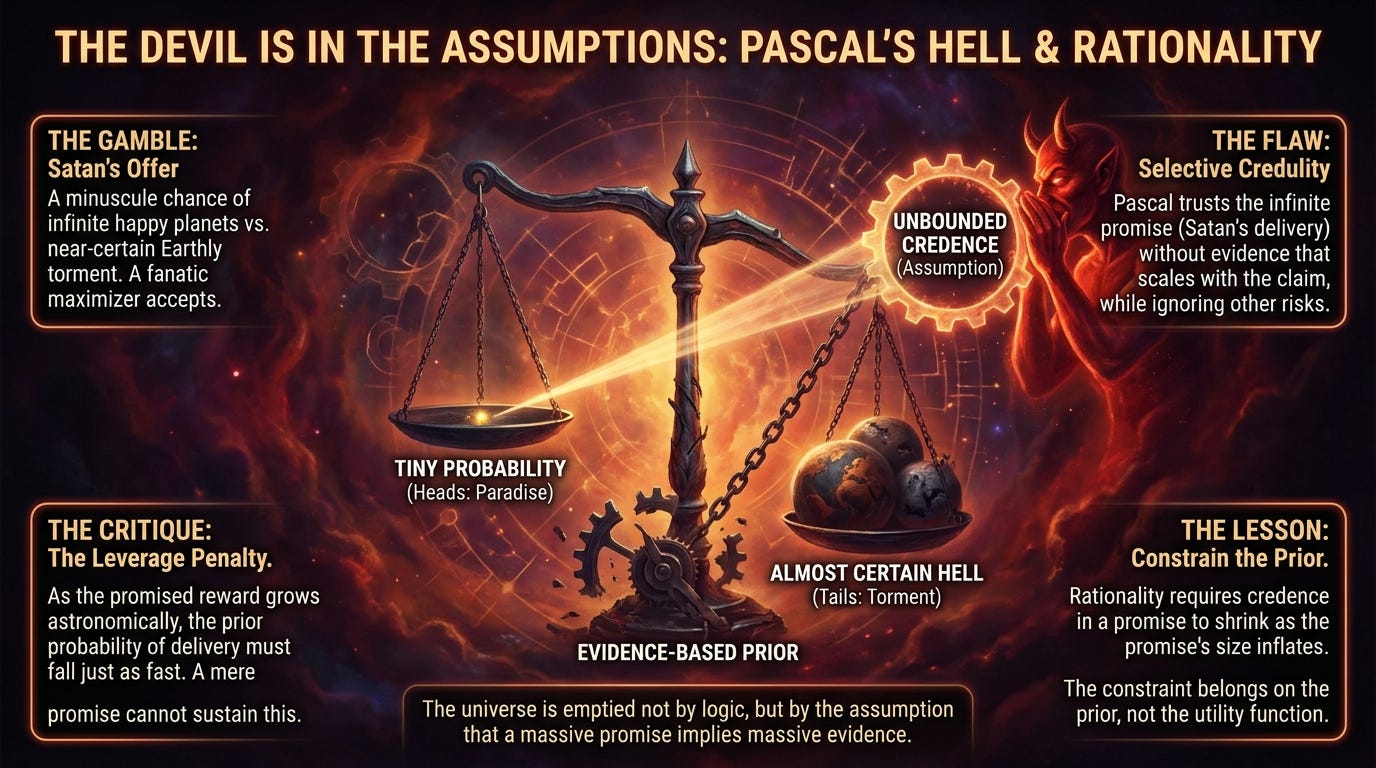
Petra Kosonen’s Pascal’s Hell is a four-page dialogue in which Satan talks an expected-utility maximizer into a billion years of torture for everyone on Earth. The offer is a coin flip. If the coin lands heads, which it does with a probability of one in Graham’s number, Satan creates a million times Graham’s number of happy Earth-like planets. If it lands tails, Earth becomes Hell until it can no longer support life. Pascal multiplies, finds a million planets of expected paradise against one planet of nearly certain misery, and shakes hands. The coin lands tails. Satan then carries the offer from planet to planet, every civilization of like-minded maximizers accepts, and the universe ends up almost certainly empty of joy by its inhabitants’ own choice.
The target is fanaticism, the consequence of unbounded utility that for any probability, however small, some payoff is large enough to justify staking everything on it. Kosonen claims two advantages over Pascal’s Mugging and the St. Petersburg paradox: her case involves no infinities, and it avoids the criticisms raised against those earlier cases. The first claim is true. The second rests on a single line of dialogue, and it fails on either way of reading that line.
One line of dialogue
Before making his offer, Satan asks why Pascal once refused the Mugger, the stranger in Nick Bostrom’s thought experiment who promises astronomical rewards in exchange for a wallet. Pascal gives two reasons. The larger the promised payoff, the lower his credence that the Mugger would deliver, and his credence fell faster than the payoff rose, an objection due to Peter Baumann. He adds that every such promise has mirror-image possibilities that cancel it. Satan concedes the second point, shrugs off the first, and then introduces his own offer with the assurance that “your concerns about the Mugger’s offer don’t apply here either.” Pascal never asks why not.
The offer that follows has the Mugger’s shape. When the chance of heads falls from one in a googolplex to one in Graham’s number, Satan raises the prize from a thousand googolplex planets to a million times Graham’s number of them. Pascal declares the offer even better, as on his arithmetic it is: the expected number of planets has gone from a thousand to a million. Satan has enlarged his promise by a factor too large to name, and the enlargement cost him one sentence. He has also just admitted to reading the wrong page of his instruction manual.
If Pascal has to believe him
Suppose Pascal is an agent with evidence, deciding how far to trust what he is told. Kosonen is committed to this reading by a principle she states in her thesis, where she rejects an ad hoc repair of the St. Petersburg paradox: “Assignments of probability should only respond to epistemic reasons.” Pascal’s credence that he will receive paradise is then a product of two numbers, the chance of heads and his credence that Satan can and will deliver.
Ordinary suspicion does not rescue him. On the stated numbers the gamble wins by a factor of about a million, so Pascal should accept even if he is 99.99 percent sure that Satan is a fraud. Doubt about the coin is no help either. Toby Ord, Rafaela Hillerbrand and Anders Sandberg argued in Probing the Improbable that when a model reports a minuscule probability, the chance that the model is wrong dominates the estimate. A manual already misread once makes heads far likelier than one in Graham’s number, which improves Satan’s offer. The objection has to be aimed at delivery, and it has to grow with the promise.
Robin Hanson supplied the growth in a comment on Eliezer Yudkowsky’s original statement of the Mugging. At most about one being in N can be placed to settle the fate of N others who have no say in the matter, so the prior probability that you are that being is of order one in N. Yudkowsky later named this the leverage penalty. Applied to Satan’s final offer, it puts Pascal’s credence in delivery near one over a million times Graham’s number. His expected paradise shrinks to about one planet’s worth of happiness at odds of one in Graham’s number, set against one planet’s torment that is all but certain.
Kosonen knows the objection. Her thesis answers it by moving to a variant in which the stranger offers to extend your own life, on the ground that unusual control over one’s own future is less surprising than control over multitudes. Whatever the merits of that reply, Pascal’s Hell abandons the variant it depends on, because the prize is once again other beings in unimaginable numbers.
The penalty has a known cost, which Yudkowsky pressed: taken as an exact prior, it seems to forbid ever concluding that you hold great influence, whatever the evidence. The argument here needs less than Hanson offers. A low prior can be overcome, but only by evidence whose weight grows with the size of the claim, and Satan’s evidence is his say-so, which costs him the same whether he promises one planet or Graham’s number of them. Testimony that is free to inflate cannot support a credence that keeps pace with the inflation. When the only evidence for a payoff is the promise of it, credence in delivery should fall at least as fast as the promise grows. Under that principle, raising the stakes never improves Satan’s offer, and expected utility, computed with credences Pascal could defend, tells him to refuse.
On this reading the reductio misses its target. What recommends the bargain is Pascal’s credulity, and a maximizer with the same unbounded utility function and better priors walks away. The credulity is also selective. Pascal assigns zero credence to ever being offered a St. Petersburg lottery, although the being in front of him claims the power to create any finite number of planets and owns a coin, which is all such a lottery requires. One of Kosonen’s endnotes points to her own criticism of that move, and another concedes that fanatics who do face such lotteries can be money-pumped, the charge Pascal brings against probability discounters. The fanatic of the dialogue is held together by two credences that answer to no evidence: zero for the lottery that would break his theory, and a trust in Satan that never falls as the promise grows.
If the numbers are simply given
On the other reading, Satan’s powers and the coin’s bias are facts of the hypothetical world, and Pascal knows them. The Mugger objections then lapse, but they lapse for any case treated this way. Stipulate that Bostrom’s Mugger is reliable and they vanish from the Mugging too. Those objections were always about what a promise is worth as evidence, and a case that stipulates the answer has set that question aside. Kosonen’s paper keeps its real novelties on this reading: every quantity is finite, and the final image of a universe emptied by its own best reasoning is hers. Its claim to have avoided the earlier criticisms is true only in the sense in which any stipulation avoids them.
What remains is whether to accept when the chances are known. Expected utility says yes, and anyone who recoils has to place the objection elsewhere: in risk-neutrality at such odds, in the way welfare adds across planets, or in what may be done to existing people for the sake of merely possible ones. Those disputes are live, they are older than this paper, and nothing in the epistemic argument above settles them. Some of the recoil may not survive the stipulation, though. The conviction that Pascal is a fool was formed by creatures who have never known a chance to be one in Graham’s number and never could, and part of it belongs to the first reading.
Where the constraint lives
Either way, nothing follows about agents who must earn their credences. On the first reading such agents refuse. On the second they are absent from the case, which describes a decision no one with evidence could face. Fanaticism survives as a fact about preferences over stipulated lotteries. The universe of the final scene needs something more, since every civilization in it has to believe the Devil.
That moves the problem. The familiar responses to fanaticism change the decision rule, by bounding the utility function or by discarding small probabilities. I proposed a version of the second in Effective Decision Theory, a cutoff below which outcomes are ignored, and the objections Kosonen’s Pascal recites against discounting are serious ones for that proposal. The argument here uses no cutoff. Its discipline falls on the prior, the part of the calculation that updating cannot repair, where promises are weighed before anything is multiplied. An agent can value outcomes without limit so long as its credence in promised outcomes is limited by what a promise can show. Pascal’s arithmetic was correct and his utility function may be defensible. He still owed an answer to the question Satan talked him past, which is why he believed the Devil.