

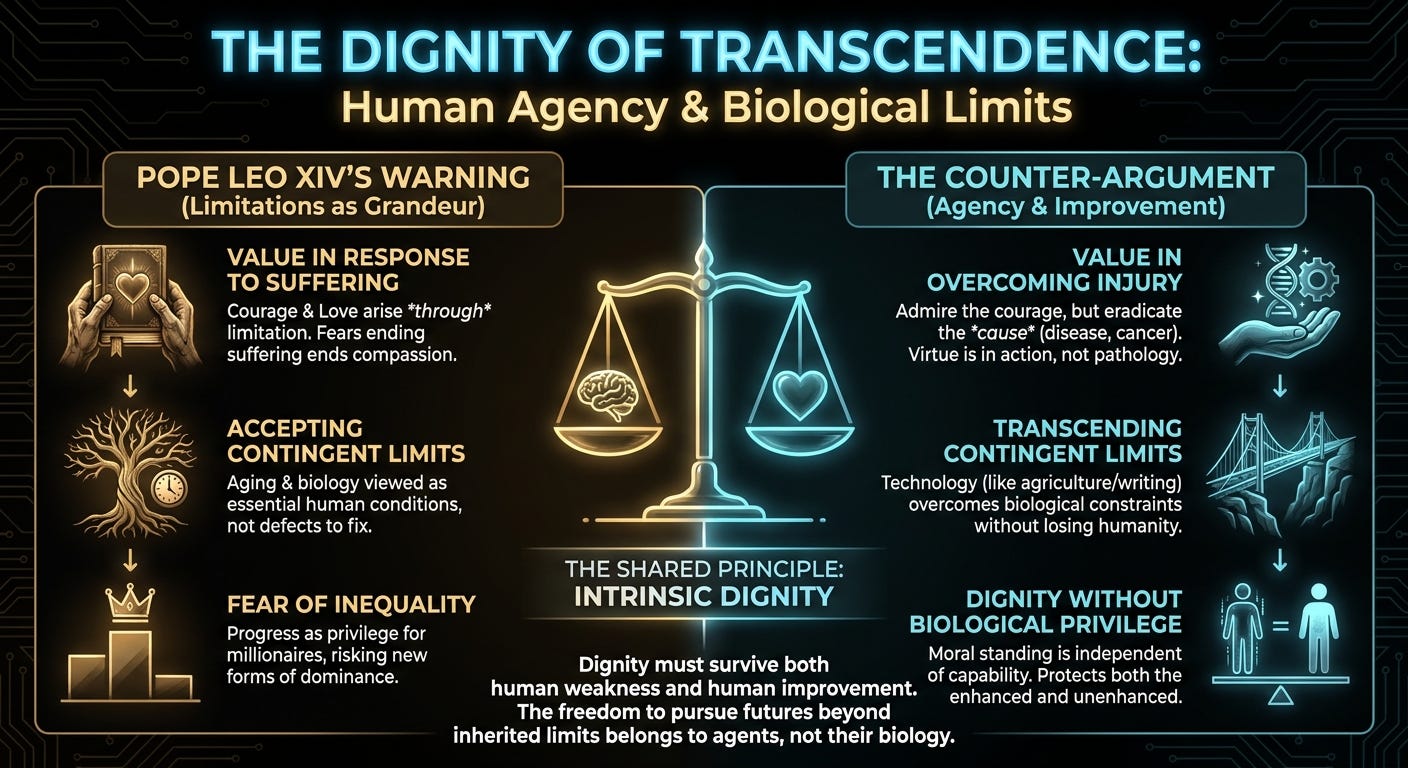
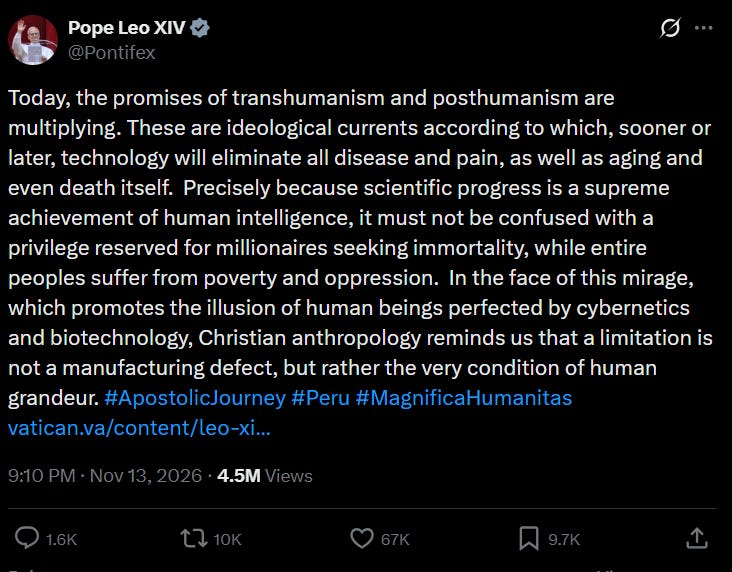
On November 13, speaking at the Catholic university in Chiclayo, Peru, Pope Leo XIV warned against the promises of transhumanism and posthumanism. He described ideological currents which promise that technology will end disease, pain, aging, and death, and he objected to scientific progress becoming a privilege of millionaires seeking immortality while entire peoples live in poverty and oppression. The passage rests on the claim that a limitation is no manufacturing defect but “the very condition of human grandeur.”
Much of the warning is sound. A society that measures people by their capacities can become cruel to those who cannot, or choose not to, improve themselves, and a technology that extends life can extend the power of whoever obtains it first. Leo asks for no particular illness to be preserved. The same address wants innovation to heal social divisions, and his encyclical Magnifica Humanitas affirms the duty to alleviate suffering and locates the danger in a vision of the human being as something to be surpassed, leaving technology itself uncondemned.
His claim concerns how limits should be regarded: humanity flourishes “not despite limitations, but often through them,” and to see illness and old age chiefly as defects is a mistake. If aging is a condition of grandeur, the project of ending it is misconceived from the start, however safe or widely shared the treatment. Grant that people often grow through illness and loss. It does not follow that the limits themselves merit protection, or that wanting them gone is a spiritual error.
What suffering can teach
The value of a response gives no reason to value the injury that occasioned it. Serious illness can draw courage from the sick and reserves of love from those who care for them, and a worldview that saw no meaning in such experiences would be blind. A cancer survivor’s courage deserves admiration; the cancer deserves eradication. Parents whose child has died may become tireless advocates for other families, and no one infers that childhood mortality makes society morally richer.
The same separation applies to aging. An elderly person may face decline with dignity, and caring for them may deepen a family’s bonds. The worth of those achievements does not depend on the decline having been unavoidable, and a family spared it would have had more time together and more occasions for generosity. The virtue lies in what people do for one another, not in the pathology that forces them to do it.
The encyclical presses further: eliminating suffering entirely would extinguish love and desire, because those who love cannot avoid trial. To care about anything is to make its loss possible, and curing dementia or repairing a failing heart leaves that true. The argument slides from the vulnerability inherent in valuing anything at all to particular biological hazards that medicine might remove, and it leaves Leo without a stopping point. He affirms the duty to alleviate suffering and rejects its total elimination, but every cure is an alleviation, and the encyclical names no point at which the next one becomes an offense against love. The objection applies to a program to abolish suffering as such, and to no treatment for Alzheimer’s or for aging.
The limits of agency
An agent represents possible futures, evaluates them, and acts to influence which one occurs. It faces constraints because its choices have consequences and its control over the world is incomplete. Some of those constraints come from logic, physics, competing objectives, and the existence of other agents, and they would bind beings with abilities far beyond ours.
Others are contingent features of our current implementation. Humans tire, forget, become infected, and eventually die because of how our bodies are built. Such limitations shape the problems we confront without being prerequisites for having problems or purposes at all. An agent whose memory improves can still deliberate. An agent whose life lengthens can still make sacrifices. An agent cured of a disease can still care for others.
Leo’s stated reason for prizing limitation is that fragility keeps us attentive to one another, while the myth of self-sufficiency breeds neglect of the weak. Dependence on others belongs to the first kind of constraint, because a longer-lived, more capable agent still lives among other agents whose cooperation it needs. Self-sufficiency is no more available to the enhanced than to us.
Our species has spent its history removing constraints of the second kind. Agriculture reduced dependence on uncertain harvests, and writing expanded what one mind could remember. Each opened forms of human activity closed to earlier generations, and neither cost us our humanity. Radical biological enhancement extends the same practice into more intimate parts of the organism.
The distinction between treatment and enhancement may matter for clinical regulation, but it cannot carry the moral argument. Eyeglasses correct poor vision; binoculars improve normal vision. If either is safe and voluntary, the moral question concerns its effects and the rights of those involved. Normal human performance supplies no ethical ceiling.
Dignity without biological privilege
A hierarchy of enhanced and unenhanced people is the real danger in Leo’s picture, and reverence for limitation is no defense against it. Superior capability can bring the power to dominate, and it tempts a society to confuse competence with moral worth. The history of eugenics shows how dangerous that confusion becomes when joined to coercive power. The defense is a principle about persons.
Dignity cannot depend on conformity to any level of ability. A person with profound disability has full moral standing, and so does a person of extraordinary strength or intelligence. The entitlement to bodily autonomy and reciprocal respect does not rise with intelligence or expected lifespan, so a society that understands this can welcome improvements in capability without ranking persons by them.
The same principle protects those who refuse enhancement. No one acquires authority to modify a competent adult because the modification would benefit them, and the Transhumanist Declaration commits its signatories to wide personal choice. Enhancement chosen, enhancement imposed, and enhancement used to control are different moral cases. Children, dependent patients, and heritable interventions raise further problems of consent that need their own justification.
The millionaires and the dying
Leo sets millionaires seeking immortality against peoples living in poverty and oppression. The image asserts a moral priority and leaves the causal argument unfinished. Suppose a treatment could prevent the diseases of aging. Its first users would probably be rich, as the first users of most costly innovations have been. That fact does not tell us whether developing the treatment worsens the position of the poor, whether it will become cheaper, or whether the resources would do more good elsewhere.
Nor does unequal access show that one person’s use violates another’s rights. A person does not wrong a stranger by remaining healthy for longer. Wrongdoing enters when people coerce others or use institutional privilege to block competitors. Survival itself is no offense against those who have not yet obtained the same opportunity.
Radical longevity would strain institutions. Wealth might compound over long lifetimes, and political leaders might become harder to displace. These are reasons to protect competition and equal legal standing. They are no argument that preserving aging would be an improvement. Aging eventually removes everyone, the poor and the oppressed included, from any possibility of exercising agency.
Transcendence and salvation
A theological disagreement lies beneath Leo’s social criticism. Christianity treats human finitude as an occasion for humility and openness to God, and it also promises the final overcoming of suffering and death. The objection to technological immortality therefore cannot rest on the claim that death is essential to every meaningful existence.
Leo can distinguish the divine gift of eternal life from an attempt to manufacture self-sufficiency through technology. Within his theology the distinction has force, since salvation is a relationship with God that technical capability cannot supply. It gives someone outside that theology no reason to reject a safe treatment for aging, and even inside it, the distinction marks only what technology cannot accomplish.
Transhumanists have extravagant claims of their own to answer for. Predictions of immortality, universal happiness, or a future beyond all human conflict deserve skepticism, and the mere possibility of an enhancement never proves that adopting it is wise. None of that calls for a moral prohibition on self-transformation. A person may want more healthy years without believing death has been solved, or greater cognitive ability without believing intelligence guarantees virtue.
Postscript
We inherit bodies and institutions we did not choose, and agency lets us judge that inheritance and change what we can. One person may accept a limitation, even cherish the life it helped build. Another may remove it. Neither choice ranks them.
The aspiration to overcome aging and disease requires no contempt for the sick or the elderly. It can come from taking their lives seriously, which is the case for continuing life applied to lives under way. The power to transform must never become the power to compel.
Leo is right that dignity must survive human weakness. It must also survive human improvement, and a dignity conditioned on limitation fails that test as surely as one conditioned on ability. We have no reason to freeze the biological circumstances under which courage, love, and solidarity first appeared. Their value belongs to the agents who practice them, and those agents deserve the freedom to pursue futures beyond the limits they inherited.