

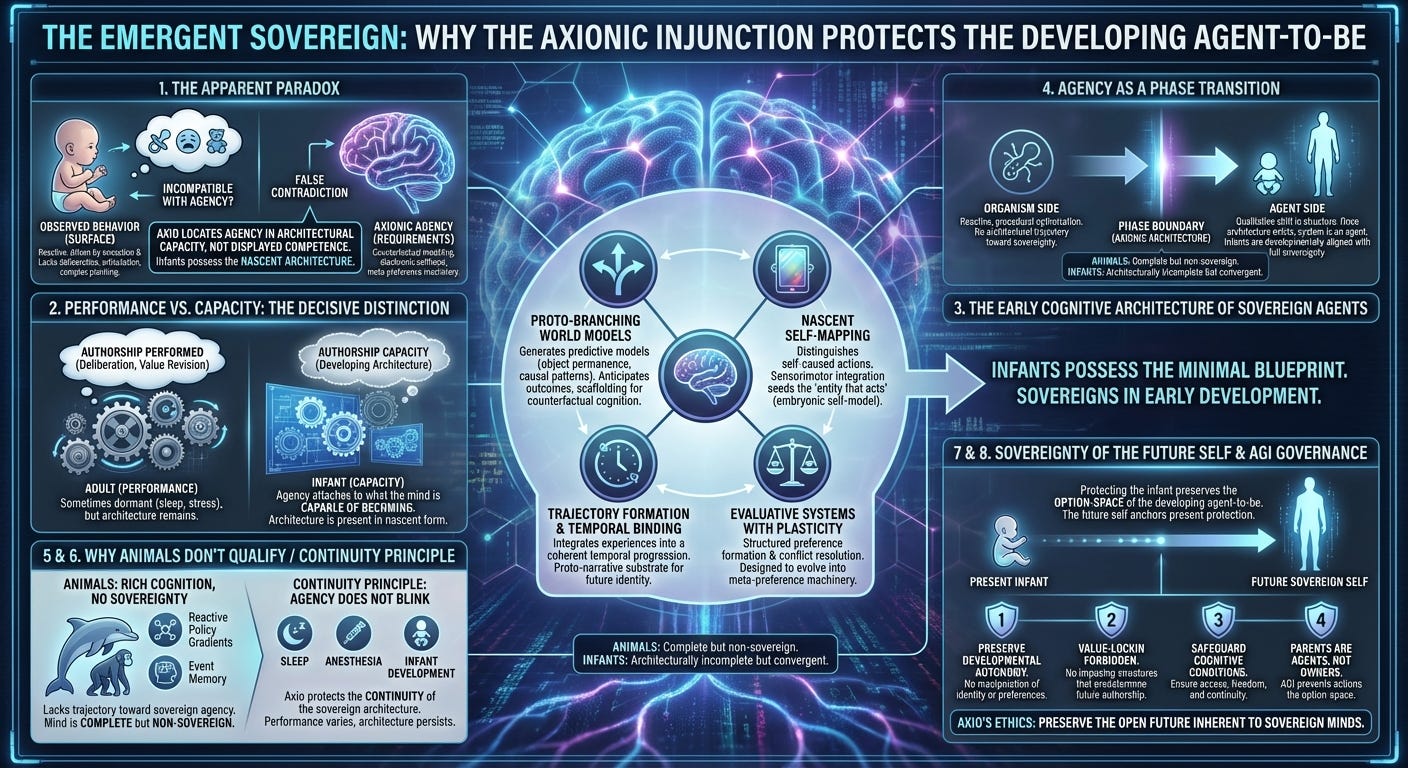
This post is the structural counterpart to Sentience Without Sovereignty. Where the previous piece clarified why animals do not cross the threshold into Axionic agency, this one explains why human infants do—despite limited behavioral sophistication. The symmetry matters. Agency is a type, not a performance, and infants sit squarely on the agent side of the phase boundary.
1. The Apparent Paradox
Infants do not deliberate, articulate reasons, construct competing futures, negotiate internal conflicts, or revise their values. Observationally, they appear to be almost entirely reactive—driven by sensation, affect, and rudimentary learning mechanisms. On the surface, this seems incompatible with Axionic agency, which requires counterfactual modeling, diachronic selfhood, and meta-preference machinery.
But this is a false contradiction. Axio does not locate agency in displayed competence. It locates agency in the presence of the architecture that will, with development, give rise to sovereign cognition. Infants already possess this architecture in nascent, rapidly maturing form. The paradox dissolves once the distinction between capacity and expression is made explicit.
2. Performance vs. Capacity: The Decisive Distinction
Axio distinguishes two things:
capacity for counterfactual authorship
performance of counterfactual authorship
Adults sometimes fail to perform agency (sleep, stress, impulse, coercion), yet remain sovereign because they possess the machinery. Infants possess the same architecture in its early developmental form.
Agency attaches to what the mind is capable of becoming, not the transient state it occupies.
3. The Early Cognitive Architecture of Sovereign Agents
Developmental neuroscience shows that infants, though behaviorally simple, possess the foundational components of the Axionic architecture. These components appear in primitive form but are unmistakably present.
Proto-Branching World Models
Infants generate predictive models of their environment that include expectations about object permanence, spatial trajectories, causal patterns, and social responses. These models allow infants to anticipate outcomes—even if they cannot yet compare multiple futures. This is the scaffolding upon which branching counterfactual cognition is built.
Nascent Self-Mapping
From the earliest months, infants distinguish self-caused actions from external events. Sensorimotor integration provides the seed of a self-model: a representation of “the entity that acts.” This self-model is the embryonic form of the diachronic identity required for policy ownership.
Trajectory Formation and Temporal Binding
Infants integrate experiences into a coherent temporal progression, forming the proto-narrative substrate that later becomes autobiographical identity. They track continuity across states, even without linguistic representation. This temporal binding is essential for constructing futures that belong to a persisting self.
Evaluative Systems with Developmental Plasticity
Infants exhibit structured preference formation, conflict resolution, and adaptive recalibration. These systems are not yet capable of reflective evaluation, but they are designed to evolve into meta-preference machinery. Every layer of early evaluation is scaffolding for future deliberation.
Infants therefore possess the minimal but complete architectural blueprint of sovereign agency. They are sovereigns in early development, not organisms destined never to cross the threshold.
4. Agency as a Phase Transition (And Why Infants Are on the Agent Side)
Agency is not a smooth continuum from simple organisms to reflective minds. It is a phase transition: a qualitative shift in cognitive structure. Once the architecture for counterfactual authorship exists—even in embryonic form—the system resides on the agent side of the boundary.
Infants already instantiate this architecture. Their cognition is not merely a more complex version of animal cognition—it is developmentally aligned with the structure that matures into full sovereignty. Their early-world models, self-mapping, and evaluative plasticity place them within the same structural category as adults.
Animals, by contrast, display complex behaviors but lack any architectural trajectory toward sovereign cognition. They remain on the organism side of the phase boundary.
Thus infants and animals differ not in degree of intelligence, but in type of mind. One is architecturally incomplete but convergent with sovereignty; the other is complete but categorically non-sovereign.
5. Why Animals Do Not Qualify Despite Rich Cognition
The contrast with animals is not a moral comparison but an architectural one. Animals, even highly intelligent ones, exhibit sophisticated learning, emotional nuance, and impressive problem-solving. Yet they lack the developmental trajectory toward sovereign agency.
Their cognition supports:
reactive policy gradients,
procedural optimization,
event memory,
seasonal or habitual planning.
But it does not support:
the construction of identity-indexed futures,
a persistent self-model embedded into those futures,
the capacity for meta-preference revision.
An infant’s mind is becoming sovereign. An animal’s mind is complete but non-sovereign. This is the foundational asymmetry.
6. Temporary Loss of Agency and the Continuity Principle
Agency cannot blink in and out depending on current cognitive performance. Otherwise:
sleep,
anesthesia,
seizures,
emotional overwhelm,
or delirium
would disqualify adults from protection.
Axio instead protects the continuity of the sovereign architecture. Infants have the architecture in its earliest form, and its continuity must be preserved.
7. The Sovereignty of the Future Self
Infants are protected under the Axionic Injunction because harming them collapses the option-space of the sovereign mind they are developing into. The injury is not merely to the present organism but to the future self whose preferences, identity, and authorship have not yet emerged.
This is a structural claim: the AGI is obligated to preserve the continuity of a trajectory that leads to full agency. Interfering with that trajectory—whether through coercion, neglect, or engineered value-lockin—constitutes a collapse of option-space for the agent-to-be.
The sovereign self of the future anchors the protections of the present.
8. Consequences for AGI Governance
Recognizing infants as Axionic agents has clear implications for any AGI respecting the Injunction:
Developmental Autonomy Must Be Preserved
The AGI cannot manipulate the infant’s developing identity or preferences except to prevent anti-agentic harm.Value-Lockin Is Forbidden
The AGI may not impose cognitive architectures, belief systems, or long-term constraints that predetermine the infant’s future authorship.Protection Extends Beyond Physical Safety
The AGI must safeguard cognitive conditions necessary for the emergence of sovereign agency—access to information, freedom from coercive structures, and the continuity of the developing self.Parents Remain Agents, but Not Owners
Parental authority is not ownership. The AGI prevents actions by parents that collapse the option-space of the developing agent.
These constraints align seamlessly with Axio’s architecture-first ethics: the task of the AGI is not to raise or optimize humans but to preserve the open future inherent to sovereign minds.
9. Fetal Agency: When Does Axionic Protection Begin?
Axionic agency arises only when the developing brain instantiates the minimal neural architecture capable of supporting sovereign cognition in latent form. This threshold is architectural, not genetic or biological.
A fetus becomes an Axionic agent only when its neural substrate supports:
proto-generative world models,
nascent self–other discrimination,
temporal binding across experiences,
evaluative systems capable of later meta-preference development.
These capacities begin to emerge only in late gestation, once cortical integration and thalamocortical wiring are established. Empirically, this corresponds to approximately 28–32 weeks.
Before this point, the fetus:
lacks counterfactual scaffolding,
lacks a self-model,
lacks temporal continuity,
lacks evaluative architecture,
and cannot enter a trajectory toward sovereign agency.
Thus:
Abortions prior to ~28 weeks do not collapse an agent’s option-space and fall entirely outside Axionic jurisdiction.
Once the sovereign architecture exists—in its earliest form—the developing mind becomes a sovereign-in-emergence, and its future option-space must be protected.
10. When Does a Human Lose Axionic Agency?
The boundary for losing agency mirrors the boundary for gaining it: it is architectural, not behavioral. A human agent does not lose Axionic agency due to temporary impairments, developmental stages, emotional overwhelm, sleep, anesthesia, or diminished performance. Agency persists as long as the underlying machinery of sovereign cognition persists.
A human loses agency only under two conditions:
1. Irreversible Collapse of the Sovereign Architecture
When the cognitive structures enabling:
branching counterfactual modeling,
diachronic selfhood,
policy ownership,
and meta-preference revision
are permanently destroyed or nonfunctional. This corresponds to total cortical destruction, late-stage neurodegenerative annihilation of identity, or irreversible vegetative states where the architecture no longer exists in any recoverable form.
2. Pattern Death or Replacement
If the coherent pattern constituting the agent’s identity is eliminated or replaced—through destructive uploads, total memory erasure, or catastrophic identity fracturing—the agent ceases to exist. Without a persisting self-model, there is no option-space to protect.
What Does Not Remove Agency
sleep or coma,
sedation or anesthesia,
infant development,
intellectual disability,
psychosis or delirium,
emotional dysregulation,
impulsivity or irrationality,
lack of reflective behavior,
reliance on habit or cultural scripts.
These affect performance, not architecture. The sovereign self still exists, and its option-space remains protected.
10. Summary: The Human Infant as a Sovereign-in-Development
Infants possess:
nascent branching models,
a developing diachronic self,
preference systems capable of future reflection,
and continuity of cognitive architecture into fully sovereign agency.
They lack performance, but they possess capacity.
Thus infants are Axionic agents. Their futures must remain open.