

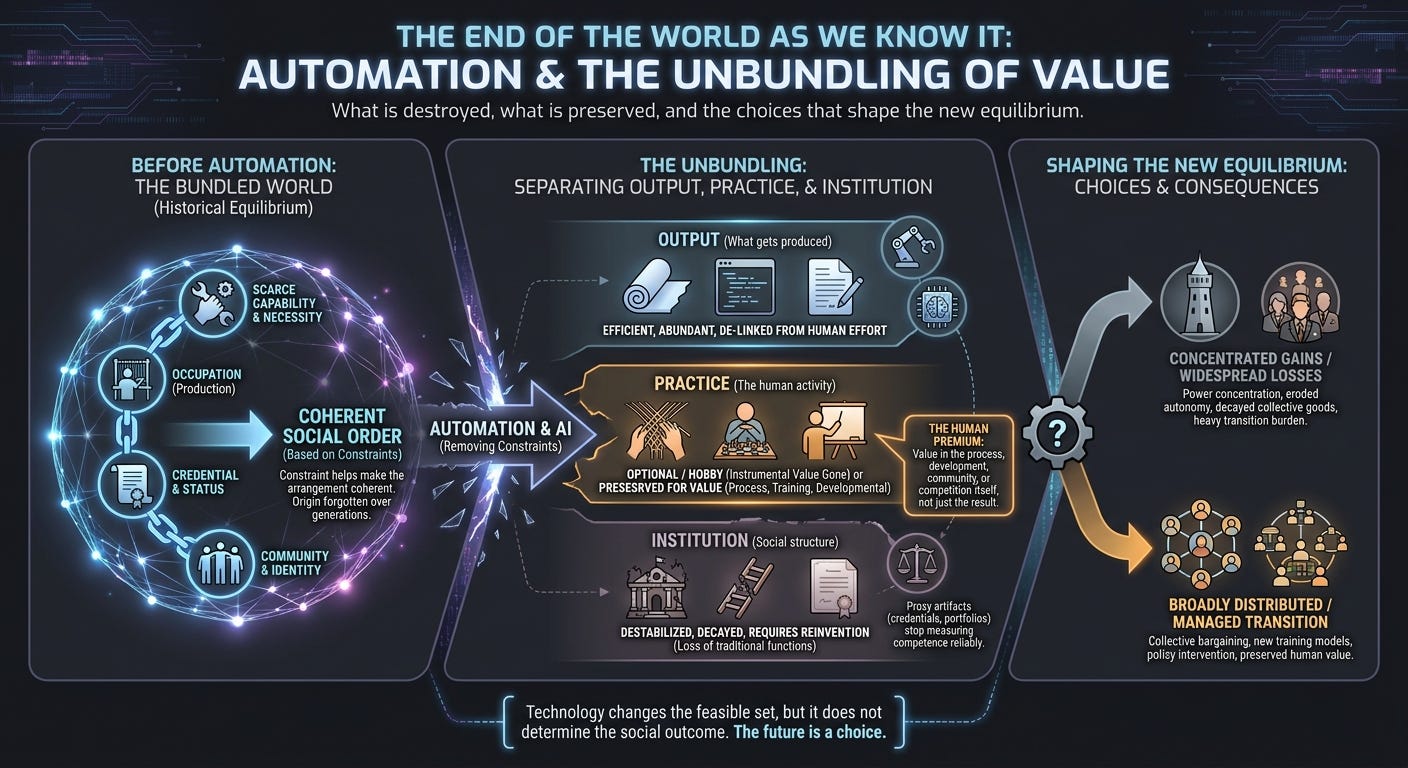
Automation does destroy worlds. Mechanized agriculture did not merely make farming more productive; it changed where people lived, which skills mattered, and what kinds of lives were economically viable. Industrial machinery did the same to many crafts and trades. Computing automated most clerical calculation, and search reduced the need to hold retrievable information in memory. Each transition preserved some outputs, improved others, and destabilized institutions that had formed around the old constraints.
So when people say artificial intelligence may destroy the world as we know it, they may be right. That is not yet an argument against AI.
A social world is an equilibrium that forms partly around technological constraints: what must be done, what is scarce, and who is capable of doing it. Law, ownership, bargaining power, and historical accident shape the resulting institutions too, but technology sets the feasible space they develop in. When the constraints change, the equilibrium can become unstable. Automation can therefore feel catastrophic even when it works.
Worlds form around constraints
Suppose producing cloth requires skilled human weavers. Because weaving is necessary, it becomes an occupation. Because the skill is scarce, it commands income and acquires status. Because it takes time to learn, training systems form around it. Communities organize around the occupation, traditions develop, and identities follow.
The chain looks roughly like this:
scarce capability → productive necessity → occupation → credential → status → identity → culture
None of those later institutions is created by technological constraint alone, but the constraint helps make the whole arrangement coherent. Once such an arrangement has existed for generations, its origin becomes easy to forget, and a historically contingent production system begins to look like a natural social order.
Then automation weakens or removes the constraint that supported it. A machine makes the cloth. Software performs the calculation. An AI system translates the document, writes the code, or proves the theorem. The productive requirement changes first; the institutions built around it change later.
That lag explains much of the conflict over automation. People are rarely defending only a task. They are defending a bundle of income, competence, status, community, and meaning that became attached to that task. The bundle is real, but the historical mechanism that bundled its components together need not be permanent.
Artifacts as evidence
Before automation, producing a difficult artifact established two things at once: the artifact had value, and producing it demonstrated something about the person who made it. A translation conveyed information and demonstrated mastery of two languages. A finished illustration was both an image and evidence that someone could draw.
These functions were bundled because the artifact was difficult to produce without the relevant human capability. Automation weakens that inference. If an AI system can generate the proof, the translation, or the image, the artifact may remain useful, but what we can infer about the person presenting it changes.
Institutions use artifacts as proxies. Publications stand in for research competence, essays for understanding, credentials for skills that were once hard to acquire without the underlying capability. When automation makes the proxy easy to produce, the proxy stops measuring what it used to measure.
The remedy is to identify the property we care about and assess it more directly. A defensible credentialing system should identify capabilities relevant to the role it controls; if authorship no longer reliably identifies understanding, authorship must stop doing all the credentialing work.
The same pattern appears in occupations more broadly. Status attaches to abilities because they are scarce and necessary. When the scarcity changes, status pressures migrate toward whatever remains difficult, though institutions can preserve obsolete prestige hierarchies for a long time. Cheap arithmetic raises the relative value of conceptual reasoning; cheap retrieval raises the value of judgment; cheap code generation raises the value of architecture, specification, and responsibility; cheap proof generation raises the value of conjecture selection and explanation.
What kind of value was it?
Automation arguments become confused when every valuable activity is treated as though it had the same kind of value. Some activities are valuable because of the outcome they produce, some because of the process itself, some because they develop capabilities we need later, and some because they sustain institutions or communities. The Human Premium separates these more finely; the coarse version is enough here.
Valued only as a means of producing cloth, hand weaving is instrumental. If a machine produces equivalent cloth more cheaply, the productive case for requiring hand weaving has weakened. Running a marathon is different because the point is not to arrive 42.2 kilometers away; the human effort under specified constraints is part of the achievement. Chess is similar. If Stockfish supplies every move, the resulting sequence may be stronger chess in one sense, but it is no longer the same human competitive activity, because the process is partly constitutive of the good.
Mathematical training introduces another case. A machine-generated proof may establish the theorem perfectly well, while constructing proofs unaided may still be necessary to develop mathematical judgment. The practice has lost some productive necessity without losing its developmental value. What a Proof Used to Prove works that case through in detail.
So “scarcity is not value” is too crude. Scarcity can contribute to value. Difficulty can create achievement value, competitive scarcity can make rankings meaningful, and rarity can matter aesthetically. The mistake is to infer, from the fact that an activity acquired value under scarcity, that the scarcity should be preserved.
A difficult process may remain worth doing. That does not imply that every useful output must continue to require that difficult process.
Preserving practice without preserving necessity
Automation can make an activity optional without making it worthless. We should preserve a constrained practice when performing under that constraint produces something we still value. That may justify AI-free examinations, manual proof exercises, or simulator training even when the corresponding production systems become heavily automated.
This distinction is already familiar. Pilots train for failures that automated systems usually prevent, doctors learn diagnostic reasoning even when software can assist, and students solve problems by hand even when tools can produce the answer instantly. The productive necessity may disappear while the training necessity remains.
But conceptual separation does not imply causal independence. Economic viability can sustain the very practice we are trying to preserve, paying for training, mentorship, equipment, and the years required to become excellent. If automation destroys the commercial market for a craft, saying that people remain free to practice it as a hobby understates the loss. The activity may survive while the ecosystem that produces expert practitioners collapses.
Converting an occupation into a hobby therefore preserves one layer while destroying another. Unbundling output, practice, and institution does not assume the three can be separated without consequence; it distinguishes them well enough to find which dependencies are real.
The losses are real
There is a bad defense of automation that says displaced people can simply find something else to do. History does not justify that confidence. Automation can destroy genuine goods: communities can collapse, local knowledge can be lost, and institutions that performed useful social functions can decay before replacements exist. Economic gains can concentrate among a small number of owners while transition costs fall heavily on everyone else.
A craft may survive recreationally while the apprenticeship system, professional identity, and shared standards that surrounded it disappear. Those losses should not be waved away because aggregate output increased. Some goods are collective rather than individual. Community is not a commodity each person can replace after a local economy collapses, and a tradition may depend on enough people participating in it together.
Nor should we assume that every inherited practice can be decomposed into independent goods. Practices shape preferences, standards of excellence, and forms of judgment. Sometimes we understand what an institution was doing only after changing it. That is a reason for caution and experimentation, but not a reason to freeze every inherited arrangement.
Automation often causes loss. Whether a given loss is decisive depends on what is being lost, whether it depends on the old production constraint, and what preserving it would cost. Economic cost matters, but so do autonomy, concentration of power, and transition burden. A replacement can be technically possible and still be worse.
Output, practice, and institution
Automation disputes become easier to understand if three layers are separated. The output is what gets produced, the practice is the activity through which people produce it, and the institution is the social structure that formed around that activity. A new technology can improve the output while making the old practice optional and destabilizing the institution built around it. All three can happen at once.
AI may produce correct mathematics while reducing the amount of unaided theorem proving and weakening academic systems that use theorem production to allocate prestige. AI may produce useful software while reducing demand for routine programming and undermining the career ladders through which junior developers historically became senior engineers. AI may produce competent visual work while reducing paid opportunities for commercial artists and weakening institutions built around commissioned work.
Saying the output remains valuable does not answer every concern about the practice or institution. But saying the institution is threatened does not show that the output should remain artificially scarce. Unbundling an old institution removes one argument for preserving it; it does not establish that whatever replaces it is desirable.
That replacement is not determined by technology alone. Automation does not deploy itself. Firms, governments, workers, and professional bodies choose among technologically possible arrangements, and they do so under different incentives and unequal bargaining power. Technology changes the feasible set. It does not determine who captures the gains, who bears the costs, or which social arrangements emerge.
The Writers Guild’s 2023 agreement governs the use of generative AI without banning it: AI-generated material does not count as literary or source material for contractual purposes, writers may use AI with company consent, and companies cannot require them to use it. SAG-AFTRA’s 2023 agreement established consent and compensation requirements around digital replicas. The technical capability existed independently of those rules; collective bargaining changed which deployments became contractually permissible.
The same technical capability supports very different institutional outcomes. Automation can increase productivity while concentrating ownership or distributing gains broadly; it can weaken worker autonomy or expand it; it can eliminate some opportunities while creating others. Those consequences are shaped by the technology, but they do not follow mechanically from it.
Why AI may be unusually disruptive
Historical analogies should not be used to trivialize AI. Previous automation often targeted narrower classes of work. Mechanization replaced specific forms of physical labor, while software automated bounded information-processing tasks. General-purpose AI may operate across a much broader range of cognitive work: interpreting information, applying abstractions, planning actions, and producing judgments.
That capability sits upstream of many professional occupations. Programming, law, design, and management all depend heavily on such work. Two features distinguish the resulting disruption from earlier waves: its breadth, and its reach into the adaptation layer itself.
Previous waves of automation displaced one class of work while increasing demand for humans who could learn, supervise, or move into more cognitively demanding roles. AI may automate parts of those adaptation tasks too. The usual advice, retrain for higher-level work, becomes less reassuring when the higher-level work is itself inside the automation frontier.
AI may also damage the apprenticeship systems through which expertise is produced. Junior work is repetitive, constrained, and relatively easy to automate, but it is also how novices acquire pattern recognition, tacit knowledge, and professional credibility. Removing that work creates two problems. One is skill acquisition: if novices no longer perform the tasks through which experts historically developed, institutions need new training mechanisms. The other is selection: those tasks also gave organizations observable evidence about which novices were capable of advancing.
Even if alternative training succeeds, the old mechanism for identifying talent may disappear. That is a reason to know what the work was doing before eliminating it.
Which parts should survive?
When someone says automation is destroying a field, the objection should be unpacked. What valuable thing is being lost? Is the value in the output, the process, the training effect, the institution, the community, or the competitive constraint? Does that value require the old production method, or did the old production method merely happen to carry it?
We should then ask whether the good can survive under different technological conditions, what preserving it would cost, and who receives the gains and bears the transition costs. Those questions do not guarantee a favorable verdict on automation. A technology can increase productive capacity while producing a worse social equilibrium, by concentrating power, eliminating developmental pathways, or destroying collective goods that are expensive or impossible to reconstruct.
None of those possibilities should be hidden behind aggregate productivity statistics. But neither should an old institution be protected because valuable things became bundled with it under historical conditions of scarcity. That a practice once carried income, prestige, identity, and community does not show that every one of those goods requires the practice to remain economically necessary forever.
This framework does not dictate a single policy response. It tells us what a policy must justify: which good it protects, why that good depends on the intervention, and what new harms the intervention creates.
We should preserve constrained practices when the constraint itself produces something worth having. We should preserve institutions when their functions remain valuable and cannot be replaced without unacceptable loss. We should preserve traditions when we judge the tradition itself worth carrying forward. What we should not preserve automatically is the old bottleneck merely because an entire social world grew around it.
Postscript
Industrialization, electrification, and computing each reorganized large parts of human life around new technological constraints. AI may do the same on a larger and faster scale. There is no reason to assume the resulting world will preserve our current professions, credentials, status hierarchies, or ideas about productive adulthood.
That prospect is destabilizing because those institutions structure real lives and carry real goods. Automation exposes which parts of a social order depended on necessity, which depended on scarcity, which depended on process, and which remain valuable after those constraints weaken.
The prospect that an institution will vanish does not by itself tell us whether preventing that disappearance is worth the cost. Nor does technological possibility determine what replaces it. What follows depends on choices about ownership, bargaining, and training, and on which human practices we keep valuing after they cease to be economically necessary. The world as we know it is not entitled to survive merely because we know it.