

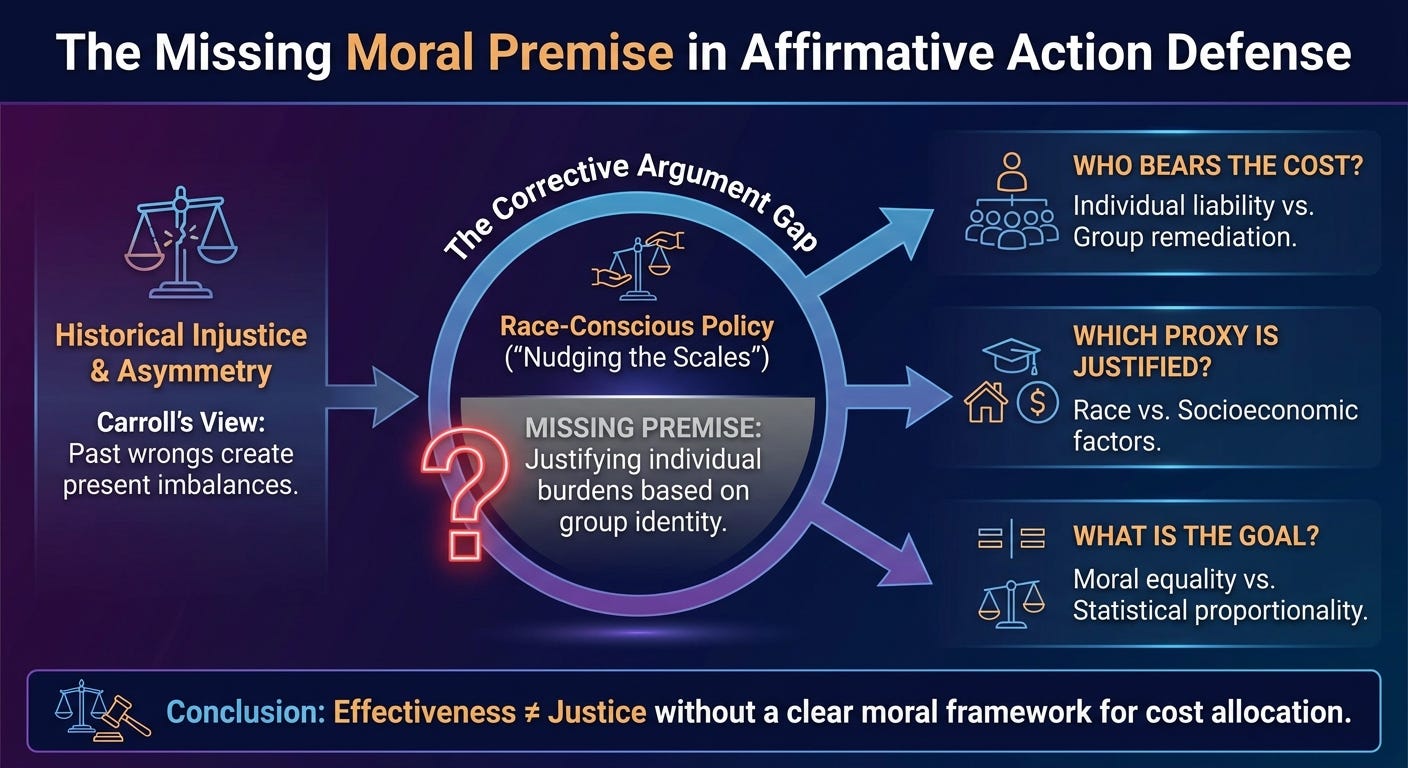
Last month, Sean Carroll defended affirmative action and DEI largely on empirical grounds. Diversity, he argued, produces benefits, and race-conscious policies can be effective at producing diversity. That argument was incomplete, because effectiveness does not establish justice. A policy can achieve its intended outcome while imposing unjust costs on people who did nothing to deserve them.
In a follow-up AMA, Carroll was asked the obvious question directly. Dominic German summarized Carroll’s position as supporting race-conscious hiring because it increases diversity, then asked whether that was fair. He added:
“DEI still feels like discrimination based on skin color. Shouldn’t we want skin color to be as trivial a detail as hair color or eye color?”
Carroll’s answer improves on his previous one in an important respect. He now makes clear that his defense is not merely consequentialist: diversity is beneficial, he says, but race-conscious treatment can also be justified by “fairness and equitability” (1:07:56).
His argument is roughly this. Race should ideally be morally irrelevant, but it is not irrelevant in the society we actually inhabit. Historical and present discrimination have produced asymmetric conditions between racial groups, and treating everyone identically under those conditions can preserve the consequences of earlier discrimination. We may therefore need to “nudge the scales a little bit” (1:07:56) through race-conscious policy to move society toward genuine equality.
That is a serious argument. It is also missing its central moral premise.
From asymmetry to discrimination
Carroll is right that formal equality does not erase history. If one group was legally excluded from universities, professions, housing, capital accumulation, and political power, ending the exclusion does not instantly eliminate all of its effects. A rule that becomes race-neutral today can operate over conditions partly created by racial discrimination yesterday.
Nothing in the objection to affirmative action requires denying this, or assuming that existing admissions, hiring, and economic institutions constitute a pristine meritocracy. Educational opportunity, family wealth, social networks, legacy preferences, neighborhood conditions, and institutional practices can all reflect historical advantage and disadvantage.
The problem appears in the next step, when Carroll moves from the proposition that racial injustice has created persistent social asymmetries to the conclusion that institutions may deliberately treat present individuals differently according to race in order to reduce those asymmetries.
That conclusion does not follow without another premise. A theory of corrective justice has to answer who was wronged, who committed the wrong, who owes remediation, who is entitled to receive it, who may permissibly bear its cost, and why membership in a racial category should determine any of those answers. Carroll need not provide a complete theory in an AMA. But the principle that would answer those questions is exactly what his reply leaves unstated.
“Nudge the scales” makes the problem sound abstract. Admissions and hiring decisions do not apply to scales; they apply to people. If one applicant’s probability of admission falls because another applicant receives a race-based preference, a real cost has been imposed on a real individual, and whether that cost is justified is the question.
Broken symmetry is not a theory of justice
Carroll illustrates his position with an analogy from particle physics. The underlying equations of the Standard Model can exhibit a symmetry between particles whose observable properties differ once that symmetry is broken by the physical state of the universe. It would therefore be absurd, he argues, to insist that electrons and neutrinos must be treated as physically identical merely because an underlying symmetry relates them (1:08:45).
The analogy works as far as it goes. A formally symmetric rule applied to an asymmetric world need not produce symmetric results, and social history matters. But it stops exactly where the moral question begins, because a Higgs field does not need a theory of justice and an admissions committee does.
Physical symmetry breaking tells us that two entities can occupy different states despite an underlying symmetry. It says nothing about responsibility, rights, liability, compensation, consent, desert, or permissible burdens. That two racial groups occupy statistically different social positions therefore cannot by itself establish that an institution may intentionally disadvantage an individual because of ancestry.
Physics can describe an asymmetric state. It cannot tell us who may permissibly be made to bear the cost of changing it.
Equality is doing several different jobs
Carroll also moves among different meanings of equality without distinguishing them. Moral equality holds that a person’s race should not determine fundamental moral status. Equality of treatment holds that institutions should not assign different rules or opportunities according to race. Statistical equality holds that racial groups should appear in institutions at rates roughly corresponding to their prevalence in the population.
These claims are not equivalent. Moral equality does not entail demographic proportionality, and demographic disproportionality does not by itself establish discrimination.
Suppose an institution applies a defensible admissions process without explicit racial discrimination. Different groups may still appear at different rates because they differ in age distribution, geography, applicant rates, educational preparation, occupational preference, immigration history, socioeconomic composition, or many other variables. Some of those differences may themselves reflect injustice; others may not. The aggregate disparity alone cannot tell us which is which.
Yet Carroll says we should try to hire people and admit students “at a rate which is approximately reflective of the rates at which different people live in our society” (1:10:15). That wording need not commit him to strict proportionality. But once population share is introduced as a benchmark, he owes an account of why that benchmark is the morally relevant one.
If a group constitutes 15 percent of the population but 8 percent of applicants to a particular program, what representation should count as equitable? Fifteen percent, eight percent, or something else? Without an answer, demographic disparity becomes evidence of injustice by assumption, and corrective intervention becomes indefinite, because every unequal group outcome supplies another reason to nudge the scales.
Race can be the basis of an injury
Race is not itself an injury. But race can be the basis on which an injury is inflicted. An employer who rejects an applicant because she is Black has committed a discriminatory rejection; a person who receives worse treatment in policing, medicine, education, or lending because of race has suffered a real and present wrong.
This matters because a serious objection to affirmative action should not pretend that race is merely a proxy for poverty or poor schooling. A wealthy Black applicant may still experience discrimination specifically because she is Black, just as a poor Asian or white applicant may suffer different disadvantages unrelated to race.
But recognizing race-based injury does not settle the remedial question. From the fact that person A suffered discrimination because of race, it does not follow that person B, who shares A’s racial category but did not suffer that injury, acquires a compensatory claim against person C, who belongs to another racial category and did not cause it. That transition requires argument.
A sound remedial system should track the relevant wrong as closely as practicable. Perfect individual measurement may be impossible, since some discrimination is diffuse, some cumulative, and some difficult to prove at the level of a single applicant. Institutions may therefore need proxies when direct measurement is costly or noisy.
But the need for approximation does not settle which proxy is justified. If poverty, school quality, neighborhood deprivation, family wealth, or documented barriers track the relevant disadvantage more directly, they should generally be preferred. Race may sometimes supply relevant evidence, but using ancestry itself as an allocative rule still requires a separate justification.
Benefit, responsibility, and liability are different
A structuralist response might say that members of advantaged groups are not truly innocent, because they may have benefited from institutions that historically disadvantaged others. That observation can be causally true without resolving the moral question.
Three different claims are being conflated. Causally benefiting from an unjust system is one; bearing moral responsibility for creating, maintaining, or endorsing it is another; being legitimately required to bear costs in remedying it is a third. Someone can inherit an advantage without having caused or endorsed the injustice that produced it.
Perhaps inherited benefit can sometimes contribute to remedial liability. But that principle itself requires justification, limits, and proportionality. How much benefit creates how much liability? Does liability track individual benefit or racial category membership? When does it expire? What happens when advantages and disadvantages intersect?
Calling someone a beneficiary does not answer those questions. It relocates the missing premise.
The hypothetical hypocrite
Carroll then abandons the strongest part of his case. He lists examples of contemporary racial injustice involving immigration enforcement, voting rules, military personnel decisions, housing discrimination, refugee policy, White nationalism, and other controversies. He then says that if someone can “sort of live with” all of this but becomes outraged when universities or employers favor other racial groups, that person needs “an update” on his sense of fairness (1:10:15).
Taken as a claim about selective outrage, this is correct, and it is worth granting plainly. Someone who tolerates racial disadvantage in policing, voting, and housing but objects only when the direction reverses is not applying a principle. He is defending an interest. Carroll calls that incoherent (1:09:24), and it is.
But German gave no sign of holding it. He asked whether race-conscious hiring is fair and said he had agreed with much of Carroll’s earlier answer. The obvious alternative position is that racial discrimination is objectionable regardless of which race benefits, and there is no contradiction in opposing discriminatory policing, racial exclusion, racially motivated personnel decisions, and race-based affirmative action simultaneously.
The reply is therefore conditional in a way that never closes. If the questioner is a hypocrite, he needs an update. If he is not, the question remains unanswered, and Carroll does not take up the second case. Establishing that some opponents of affirmative action are inconsistent does not establish that race-conscious admissions and hiring are justified, which is what German asked.
The strongest case for corrective discrimination
There is a better defense of Carroll’s position than the one he gives. Persistent institutional injustice can produce advantages and disadvantages that outlive the people who created them, so corrective policies may sometimes impose costs on people who did not personally commit the original wrong.
That possibility cannot simply be dismissed. Existing selection systems can themselves embed inherited privilege, and formally neutral rules can preserve earlier injustice. Corrective intervention may therefore sometimes be warranted even when no present decision-maker is consciously discriminating.
But none of that establishes racial preference by itself. A serious corrective-justice argument must still explain why race is the appropriate classification, why the burden imposed on third parties is proportionate, why more individualized or better-targeted remedies are inadequate, and what condition ends the corrective regime. Those are not implementation details. They are the moral argument itself.
Without that explanation, “historical discrimination had persistent effects” does almost all of the rhetorical work while leaving the distributive question unresolved.
A better principle
A defensible remedial system should track the relevant wrong as closely as practicable. Account for poverty where an applicant overcame it and for educational deprivation where a student attended an exceptionally bad school; account for identifiable racial discrimination where a person suffered it and doing so is feasible. An institution that discriminated may owe remediation to those harmed by its own conduct.
Where direct measurement is impossible, proxies may be unavoidable, and administrative feasibility belongs in the analysis. A policy that cannot be implemented is not much of a policy, and simplified rules can be legitimate when precision is prohibitively expensive. But administrative simplicity does not convert a morally questionable classification into a justified one. The choice of proxy is itself a moral and empirical question, and it should depend on how well the proxy tracks the relevant disadvantage, what errors it produces, and who bears the cost of those errors.
This does not require pretending race is irrelevant. It requires distinguishing evidence about injustice from a general rule for allocating opportunities. Recognizing that race matters socially is compatible with rejecting the proposition that people should routinely receive different treatment because of racial category membership.
Seeing racial injustice does not require treating individuals as interchangeable representatives of racial groups.
Postscript
Carroll is right that we do not live in a world where skin color is as socially trivial as eye color, that pretending otherwise can conceal real injustice, and that historical discrimination can produce consequences persisting long after discriminatory laws are removed.
None of those claims answers German’s question. If an institution gives one person a lower chance of admission or employment because of ancestry in order to improve the aggregate position of another racial group, it has imposed a racial burden on an individual.
Perhaps such discrimination can sometimes be justified. But then it has to be justified by showing why this person may bear that cost, why another person has the corresponding claim, why race rather than a more direct measure of injury is the appropriate rule, and why demographic proportionality is the relevant target.
Nudging the scales does not answer those questions. The entire dispute lies inside the moral premise Carroll leaves unstated: when a racial group has suffered injustice, institutions may intentionally impose race-based disadvantages on individuals from other racial groups who did not cause that injustice, in order to correct the resulting social asymmetry.
That proposition is neither obvious nor incoherent to reject. It is the proposition that requires an argument, and Carroll still has not given one.