

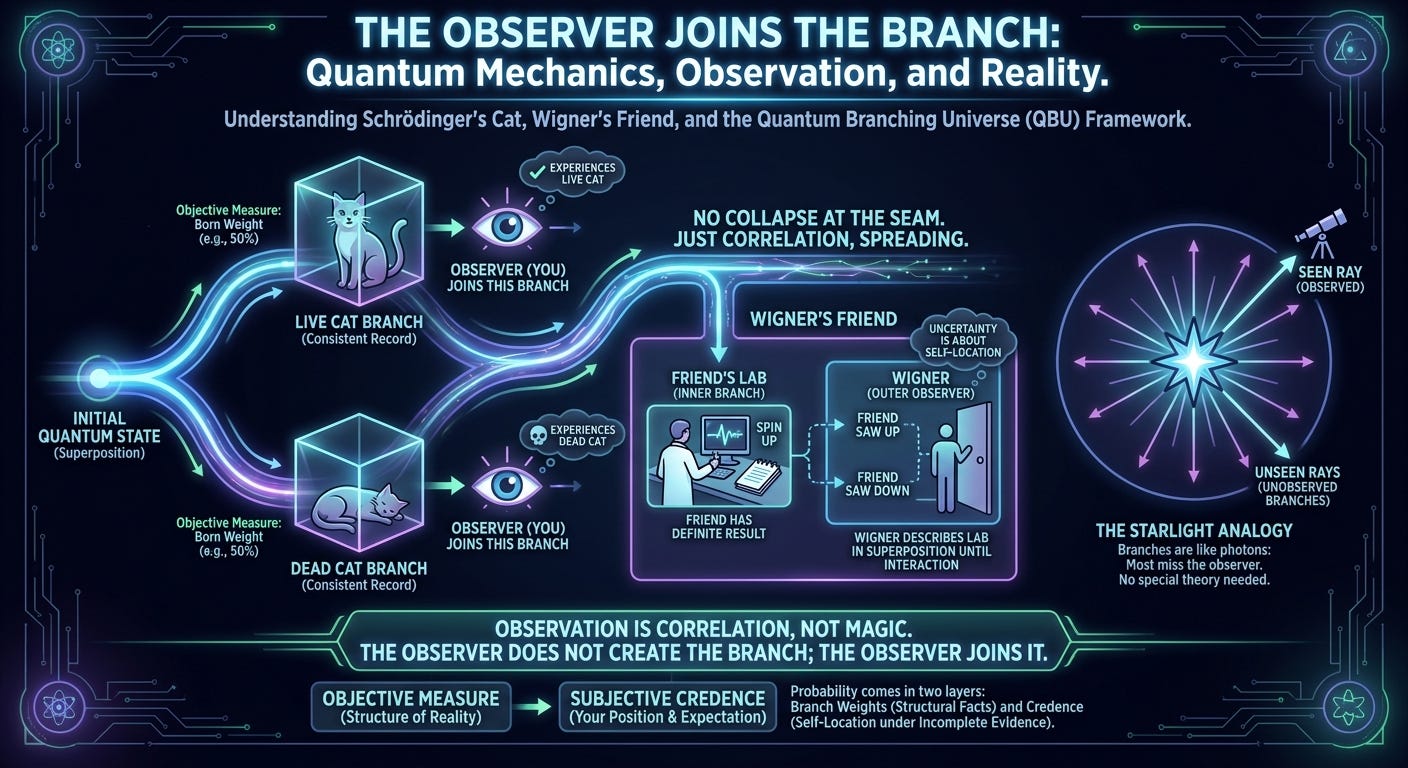
Schrödinger’s cat is usually told as a riddle about an animal caught between life and death. A radioactive atom may or may not decay. A detector is wired to a vial of poison. Decay breaks the vial and kills the cat; no decay leaves it alive. Before anyone lifts the lid, quantum mechanics seems to describe the whole arrangement as a superposition: atom decayed and not, poison released and not, cat dead and alive.
The absurdity is an artifact of a classical assumption the standard telling never makes explicit. It quietly assigns the atom to the quantum world, the cat to the classical one, and the detector to some uneasy borderland in between, and then it asks where the weirdness is supposed to stop. At the detector? The poison? The cat’s brain? The human hand on the lid? The moment a result reaches consciousness?
The Everettian answer is blunt and clarifying. It does not stop. The same quantum state evolves all the way up. The atom entangles with the detector, the detector with the vial, the vial with the cat, the cat with the air in the box, the box with whoever opens it. There is no hidden collapse waiting at the seam between small and large. There is only correlation, spreading.
That sounds worse at first and is actually better, because it deletes the ugliest part of the puzzle. The cat is never one animal with a smeared vital status. There is a branch holding a live cat and a branch holding a dead one, each carrying a definite macroscopic record. The live cat is alive. The dead cat is dead. The superposition belongs to the total state, not to anything the cat undergoes inside its own branch.
Hold one picture while we work through this, because it does most of the labour. A star throws photons in every direction. A vanishingly small fraction land in any eye or telescope; the rest pour into empty space, unseen forever, and no one thinks to call the star wasteful or to demand a theory in which it emits only the light that someone will catch. The photons are just what the rules produce. An observer is an eye. The wavefunction is the star. Keep that in view and most of the mystery turns out to be the mistake of assuming nature aims its output at us.
Superposition is a fact about the whole, not the cat
“Both at once” is the phrase that does the damage. It suggests a visible contradiction, as though the cat ought to look biologically blurred. But superposition is a relation inside the full mathematical state, not a property smeared across one creature. Once the alternatives entangle with a large environment, they stop interfering with each other for any practical purpose, and that is decoherence — the process that makes branches stable rather than ghostly.
The live-cat branch carries photons, chemical traces, and neural states all consistent with a live cat. The dead-cat branch carries a different record, consistent with a dead one. These are not two transparencies laid over each other waiting for a mind to pick one. They are two dynamically separated histories inside a single quantum state. So the “paradox” is misnamed. It comes entirely from trying to keep one classical world while using an equation that never selects one. If the equation says the correlations keep spreading, and if every macroscopic observer inside each resulting branch sees something definite, then the missing ingredient was never consciousness. The missing move was to stop treating your own branch as the only consequence the theory is allowed to have.
The unsettling part does not vanish. It relocates. The hard question is no longer how a cat could be alive and dead from its own point of view, because it cannot. The hard question is what an observer should expect to see before opening the box, when more than one future version of that observer is going to exist. And that question already has an answer, once you separate two things that the word “probability” usually fuses.
Objective measure, subjective credence
In the Quantum Branching Universe framework — QBU — probability comes in two layers, and almost every confusion about many-worlds probability is a collision between them.
The objective layer is measure. Branches carry weights grounded in the squared amplitude of the state. If the atom has a 70 percent amplitude-squared weight to decay and 30 percent not to, the experiment yields a dead-cat branch of measure 0.7 and a live-cat branch of measure 0.3. These are structural facts. They owe nothing to belief, ignorance, or anyone looking.
The subjective layer is credence. An observer reasons from inside the branching structure with incomplete evidence about which branch he occupies. Before the box is open, you do not yet know which of your future continuations you will turn out to be, so you set your credence to the objective measures, absent some further evidence that would justify departing from them. Open the box and your credence shifts, because now you hold branch-locating evidence you lacked a moment ago.
A non-quantum case isolates the self-location issue. Suppose you are told, truthfully, that tonight you will be copied, and the two copies will wake in identical sealed rooms — one room, unknown to either, tagged “up,” the other “down.” Each copy wakes feeling like a single continuous person who remembers one room. Before you sleep, “which room will I wake in?” has no single answer; both copies wake, both are you. Yet a rational credence over the two is perfectly well-defined. Nothing collapses when a copy opens its eyes. The world simply hands that copy evidence about which room it is in. Opening Schrödinger’s box has the same self-locating structure, with one quantum fact added: the continuations are weighted by amplitude measure rather than counted as equal tickets. The objective state holds both cat-branches with their measures; your pre-opening uncertainty is uncertainty about self-location among your own future continuations; lifting the lid does not make one branch real, it tells you which one you are in.
Critics who ask how probability can survive if every outcome happens have fused the two layers. Objective probability is branch measure. Subjective probability is rational self-location under incomplete evidence. The Born weights describe the structure. Credence describes your position inside it.
Opening the box
Before you look, the future contains two continuations of you: one will meet a live cat, one a dead cat. Arrange the experiment for 99 percent survival weight against 1 percent death, and both outcomes still occur, but they do not carry equal measure. As the previous piece argued, you are not a ticket drawn from a branch-counting lottery. You are an observer inside a weighted structure. Counting branches gives the wrong answer because branches are not equiprobable units. Weighing them gives the Born rule, because squared amplitude is the objective measure over your continuations.
From the inside, none of this feels exotic. It feels like ordinary uncertainty resolving. You reach for the lid; you experience one cat, not two; afterward there are two versions of you, each with a single definite memory — one of a live cat, one of a dead one. No mysterious moment of physical collapse is needed anywhere in that account. The “collapse” is just what the update looks like from within one branch. Before looking, your evidence fits both continuations. After looking, it fits one. The global state still holds both; your local evidence has narrowed. Subjective collapse is Bayesian updating inside a branching universe, and that is the whole of it.
Which is why “the observer creates reality” is exactly the wrong lesson. The observer becomes correlated with a process that was already branching. Looking does not summon the live cat or the dead cat into being. Looking drops the observer into the same record structure as the detector, the vial, the cat, and the air in the box. The observer does not create the branch. The observer joins it.
The friend inside the lab
Wigner’s friend pushes on the same point until it cannot be ignored. Wigner waits outside a sealed laboratory. Inside, his friend measures a quantum system and gets a definite result — spin up, say. She sees it, writes it down, remembers it. For her, the event has happened, full stop.
For Wigner outside, treating the entire lab quantum-mechanically, the friend together with her apparatus and notebook may still be represented as a superposition of “friend saw up” and “friend saw down.” That looks like a flat contradiction. She says there is already a definite result. He says the lab is still in superposition. Who is right?
Both, relative to their physical situations. The friend sits inside one branch of the lab, and her records are definite relative to that branch. Wigner, not yet having interacted with the lab, has not become correlated with the result, so his description of the sealed room still includes both friend-branches — because from outside, the lab’s alternatives have not yet registered anywhere in his environment. There is no call to demote her experience. She is not waiting for Wigner to make her observation real; it is real inside her branch. His later observation does something far more pedestrian than completing hers: it entangles him with an already-branched lab. After he opens the door there is a Wigner who meets the friend who saw up, and a Wigner who meets the friend who saw down.
The whole apparent contradiction is a difference in evidence, not a difference in physics. The friend can assign near-certainty to her outcome because her memory and notebook and the lab around her all encode it. Wigner, outside, lacks those records, so a full quantum description leaves him with both friend-branches and their weights. This makes reality not one bit subjective. The global state is objective. The branching is objective. The amplitude-squared weights are objective. What varies between the two of them is evidential position inside that one structure — and this is just ordinary self-locating uncertainty wearing unfamiliar clothes. You can hold the entire map and still not know where on it you stand. Everett’s contribution is that the map’s branches are weighted, and the weights are fixed by the geometry of the state. The friend and Wigner differ in credence because they differ in evidence. They do not differ in physics.
No royal observer
The deep lesson is that nobody sits at the top of the chain. The friend does not collapse the wavefunction for the universe. Wigner does not collapse it from some higher seat. A super-Wigner outside Wigner’s building would not collapse it either. Each observer becomes part of the system being described, and each acquires definite local records on becoming correlated with one branch — and there the regress simply stops being interesting.
This dissolves the arbitrary Heisenberg cut between “quantum system” and “classical observer.” Draw the cut wherever it helps the calculation — around the atom, the detector, the cat, the friend, the whole lab — but do not mistake it for a boundary out in the world. Underneath any placement, the story is the same: unitary evolution, decoherence, objective branch measure, local self-location. That is what lifts Wigner’s friend above the level of a curiosity. It exposes the instability of any view that treats measurement as a primitive act while refusing to say what counts as a measurer. If a conscious friend does not settle the matter for Wigner, consciousness is not the magic ingredient. If Wigner does settle it, someone owes a principled reason why his looking outranks hers, and there is no candidate for the rank. The clean move is to stop hunting for the royal observer. Measurement is the formation of durable correlations among systems. Cats and notebooks and physicists all become records; some records carry experience; none has the authority to delete the others.
The starlight objection
Now the standard complaint: many-worlds is ontologically extravagant. Why believe in all those unseen branches when only one ever shows up in experience?
This is the star again, and the same error. We do not accuse the star of profligacy because most of its light misses every eye. We do not reach for a new theory in which it emits only the photons that will be caught. The photons follow from simple rules, and the ones that reach no one are not an embarrassment. Branches work the same way. If unitary quantum mechanics generates a branching structure, the number of branches is not a postulate someone added; it is a consequence of the dynamics. Occam’s razor cuts against complexity in assumptions, not abundance in consequences, and a theory with spare rules and many outputs can be leaner than one with fewer outputs preserved by special machinery bolted on to suppress the rest.
The one-branch intuition comes from casting our observed branch as the target of the process — as though the universe were aiming a single result at a single mind. It is not aiming the photons at the eye, and it is not aiming the branch at the mind. Observers are local systems inside a much larger structure, most of which lies outside any one observer’s experience. So the real choice is not modest one-world against extravagant many-worlds. It is between accepting the full consequence of simple dynamics and adding interpretive apparatus to prevent that consequence from existing. QBU takes the first option: keep the unitary dynamics, keep the global state, treat observers as local systems inside what results.
Why not just go relational?
A nearby interpretation draws a similar moral from Wigner’s friend. Relational quantum mechanics makes states relative to physical systems: the friend has a definite result relative to herself while Wigner, outside, describes the lab differently. The resemblance to the language used here is real and worth admitting.
But QBU commits to more. It treats the branching structure and its measures as objective features of the state. Credence is relative to evidence; the branch weights are not. The friend and Wigner know different things because they are differently located inside one physical structure that is there for both of them. Relational quantum mechanics declines that global ontology, and the refusal is not free — it pays elsewhere, by giving up the observer-independent global state that QBU takes seriously. Leaner-feeling is not the same as simpler. It avoids branches by treating quantum states as relational rather than as a single observer-independent global structure. The starlight point lands here too: avoiding unseen branches is not automatically parsimony, and may be nothing more than discomfort with unseen consequences. If the global state evolves into separated macroscopic records, then calling those records real is not adding structure. It is declining to delete structure the theory already produced.
None of this proves QBU on its own, and it is not offered as a proof. It explains why the "too many worlds" objection has so little force. Branch abundance is settled; what divides the interpretations is which one gives the cleanest joint account of the equations, the definiteness we actually experience, the Born weights, and the absence of any privileged observer.
Observation without magic
The pop version of quantum mechanics hands observation an occult job: the world stays vague until a mind looks, consciousness reaches into physics and forces an outcome, reality waits on attention. This is close to exactly backwards. Observation is one more physical interaction — special to the observer only because it changes the evidence he holds. A detector observes. A camera observes. A notebook observes. A cat observes its surroundings. A human adds memory, reportability, and conscious access, and those features are not what make the branch structure form. They are what make it known from the inside.
That single distinction blocks both errors. The mystical one: mind creates the outcome. The deflationary one: if every branch exists, observation means nothing. Observation means something precise. It is how a system becomes correlated with a branch and picks up local evidence about which branch it is in. The observer does not create the branch. The observer joins it.
Postscript
Schrödinger’s cat asks what to expect on opening the box. Wigner’s friend asks how one observer can hold a definite result while another still writes a superposition. The same machinery handles both: a third-person state with many weighted branches, and a first-person observer with incomplete branch-locating evidence. Objective probability supplies the measures; subjective credence supplies what a rational agent should expect from inside one of them.
The cat is the simpler case, because the observer stands outside the box before looking. The friend adds a nesting: she has already self-located relative to the measurement, while Wigner has not yet self-located relative to her record, and when he opens the lab he too becomes branch-indexed. The seeming contradiction comes entirely from demanding a single absolute fact of the form “the result has happened” without saying which physical observer-state has access to it. Strip that demand and the tension is gone.
The cat was never half alive. The friend was never waiting on Wigner to make her measurement real. The global state holds weighted branches; each observer picks up definite evidence from inside one of them. Keep that clear and the mystery stops pointing toward collapse, or consciousness, or a watcher at the top of the chain. It points where the equations had been pointing the whole time: observers are physical systems inside the wavefunction, not judges standing outside it — eyes catching a little of the light, not the reason the star shines.