

The last post about self-locating uncertainty ended on a teaser. The fix for the broken theories of self-location, I said, was to stop counting observers and start weighing them — and I mentioned in passing that in quantum mechanics this idea of “weight” is completely natural, because different branches of reality carry different amounts of it.
This post is about that case. It turns out to be the cleanest, sharpest version of the whole story — and the place where, just recently, something genuinely new happened.
Here’s the setup. You run a quantum experiment rigged so that one outcome is overwhelmingly likely — say, 99% to flash green, 1% to flash red. You press the button. The detector flashes.
In the ordinary picture of quantum mechanics, one outcome happens and the other doesn’t, and “99%” means what it always meant: the green light will probably come on. But there’s a rival picture — the many-worlds, or Everettian, picture — that takes the equations at face value and refuses to bolt on any collapse, any magic moment where one outcome is chosen and the rest are deleted. On that picture, both outcomes happen. The world splits. There is a version of you who sees green and a version of you who sees red, each equally real, each walking away with a perfectly definite memory of what they saw.
Now ask again: what could “99%” possibly mean?
It can’t mean “green will happen and red won’t” — both happen. It can’t mean “I’m unsure which one will occur” — you know, with certainty, that both occur, and that a copy of you ends up in each. Every outcome is real. Every outcome has a witness. So where did the odds go?
This is the Everettian probability problem, and it is much harder than it first looks.
The tempting wrong answer: count the worlds
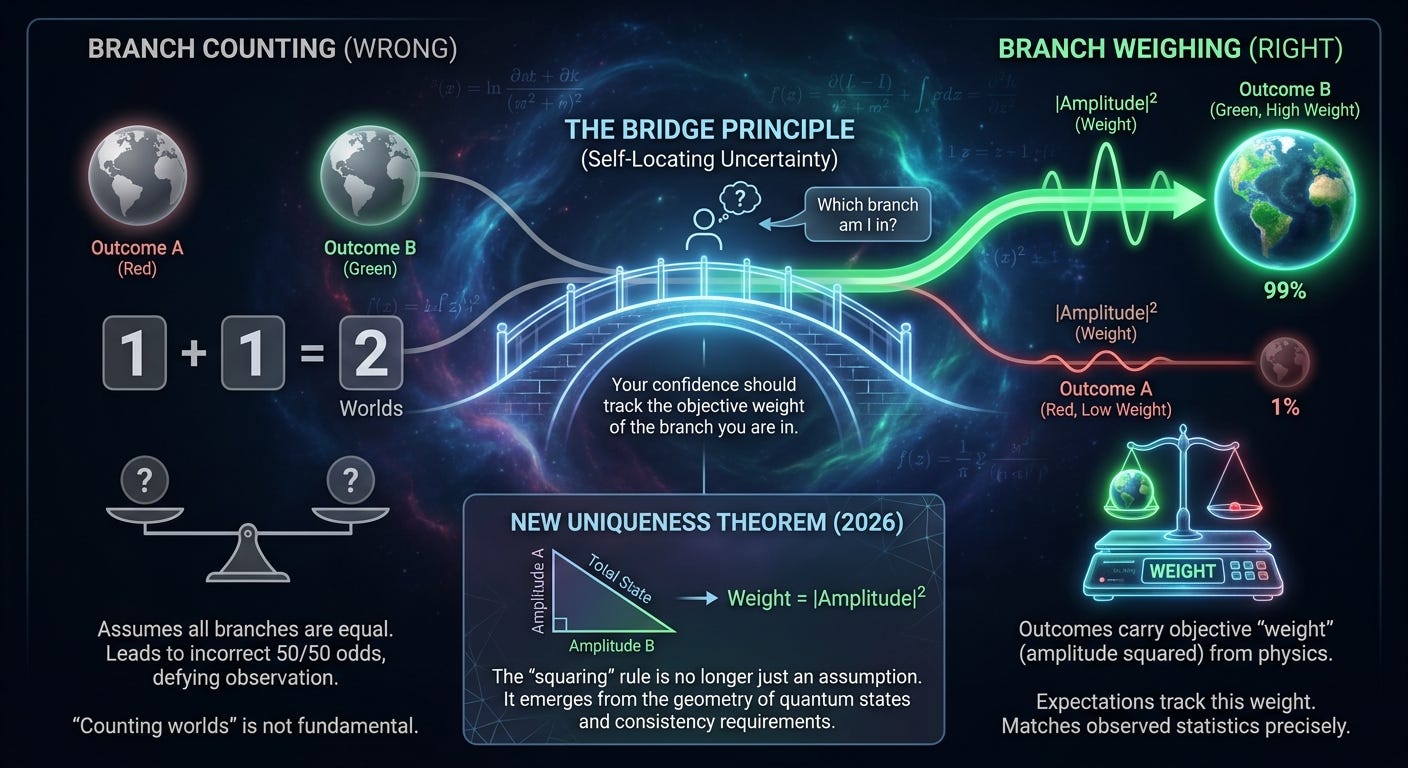
If both outcomes happen, maybe the natural move is to count them. Two outcomes, two worlds — so isn’t each one 50/50?
If you felt the pull of that, notice what it would commit you to: our 99/1 experiment would secretly be a 50/50 experiment. So would every two-outcome quantum experiment, no matter the amplitudes. The entire statistical edifice of physics — a century of measured frequencies that match the textbook rule to staggering precision — would be wrong. We’d see green about half the time. We don’t.
So branch-counting gives the wrong numbers. But the deeper trouble is that there is no right number to count. Worlds aren’t pebbles. They aren’t fundamental objects the universe keeps an inventory of; they’re emergent patterns that come into focus as a measurement bleeds out into its environment. How many are there after a single measurement? It depends on how finely you choose to slice — how much of the environment you bother to track, where you draw the lines. You can always split one “world” into two more just by looking closer. A quantity you can change by changing your own bookkeeping cannot be what probability is made of.
This is the same mistake as last time, wearing a new costume. The anthropic theories went wrong by treating counting observers as the basic operation. Branch-counting goes wrong by treating counting worlds as the basic operation. Counting was never the right tool.
Stop counting worlds. Weigh them.
Here is what the count throws away: the outcomes don’t come with equal billing. Each branch carries an objective weight — in quantum mechanics, this is the amplitude, squared — and that weight is not a label someone pencils in afterward. It’s the very quantity that already runs the physics. It governs how the waves interfere, how fast a measurement settles into a definite record, how repeated trials come out. The 99 and the 1 are doing real work in the equations long before anyone asks a question about probability.
A quick guardrail, because it’s easy to slip here: the high-weight branch is not “more real” than the low-weight one. They are both completely real. Nobody in the red branch is faint, or ghostly, or half-there; they are as solid to themselves as you are to you. “Weight” is not a measure of how much a world exists. It’s an objective quantity attached to each world that — the claim goes — your expectations ought to track. Keeping those two ideas apart is most of the battle, and it’s a distinction the popular telling usually fumbles.
And notice the contrast with the anthropic case. In cosmology, the whole problem was that nobody agreed on what the measure even was — the “weight” of a situation was exactly the thing in dispute. Quantum mechanics simply hands it to you. The weight is right there in the formalism, the same number physicists have used for a hundred years. That is why the quantum case is the cleanest possible place to make this argument: you get the measure for free.
The bridge: it’s the same move as last time
Physics gives you the weights. But a weight sitting in an equation is a fact about the world, not yet a fact about what you should expect. You still need a rule connecting the two — a bridge from “this branch carries more objective weight” to “you should expect to find yourself seeing this outcome.”
That bridge is exactly the principle from the last post: under self-locating uncertainty, your confidence should track the total objective weight behind the situations that match your evidence. Point it at branches. Before the measurement, you know both futures will exist, each continuous with you-right-now, each carrying its weight. The rule says: spread your expectation in proportion to that weight.
You might object that there’s nothing here to be uncertain about. Before you press the button, you know exactly what’s coming — both branches, one of each you — and if that were the only way to pose the question, the talk of “expectation” really would be hollow. But there’s a sharper place to stand. Step forward to the instant after the split and before you’ve looked at the detector. You are now, definitely, in one branch and one only — yet nothing you know tells you which. That is a genuine uncertainty, and it doesn’t evaporate just because you know every physical fact about the universe. It’s the predicament of waking up as one of two indistinguishable copies, or of Sleeping Beauty: full command of the third-person story, real ignorance about which character you are. That indexical “which one am I?” is the question the weight answers.
For a clean measurement, that delivers precisely the rule physicists already use — weight each outcome by its amplitude squared. The textbook recipe, the one confirmed to absurd precision, turns out to be measure-conditioned self-location applied to a universe of branches. Same move as the anthropic case; far cleaner measure.
And it dissolves the thing that looked most paradoxical: why we observe probabilities at all. Run the lopsided experiment a thousand times. There are now branches for every possible sequence of greens and reds — including a branch that saw red nearly every time. That strange branch genuinely exists. But add up the objective weight of all the branches that disagree wildly with the 99% expectation, and it is vanishingly small. The witnesses to anti-textbook statistics are real, but they carry almost no weight — and weight is what your expectations track. So you should expect to see the ordinary frequencies, and you do.
The honest version
Now the part the careful version of this argument insists on — and the reason it’s worth trusting.
It does not claim to conjure probability out of thin air. It rests on two assumptions, named out loud:
The weight is the amplitude squared — and not some other function of the amplitude.
Your confidence should track that weight — the bridge principle.
Grant both and the famous rule follows. Refuse either and it doesn’t. That’s the whole machine; no sleight of hand. The first companion paper makes a point of setting these on the table rather than smuggling them in, because nearly every rival account of quantum probability quietly assumes something just as strong somewhere and calls the result a derivation.
Two hard questions survive even after you grant the setup. Why the square of the amplitude, rather than some other power of it? And — the deepest worry of all — even granting that the indexical “which branch am I in?” is a real uncertainty, is the attitude it supports genuinely probability, or just probability’s mathematics worn by an unfamiliar kind of ignorance? Critics from Albert to Kent push hard right here, and the honest reply concedes that part of the dispute is about words. What is not in dispute is that the weights reproduce the statistics we actually measure — whatever we end up calling the confidence that tracks them.
The honest answer, for a while, was: these are real, unsolved, and at least now they’re isolated cleanly enough to argue about one at a time.
What changed recently
That was the state of play. Then a new mathematical result moved the first of those two hard questions from “assumption” toward “theorem” — and the second companion paper is about what happens when you feed quantum mechanics into it.
The result (a 2026 paper by Lela) is a uniqueness theorem. Strip away the machinery and it says: once you require a weight to behave consistently when you slice worlds more finely — to never contradict itself as you refine the picture — the amplitude-squared weight is the only one that survives, given two structural conditions. Every other candidate weighting breaks somewhere.
The theorem is deliberately neutral; it doesn’t claim that any real physical system actually meets its two conditions. The second companion paper’s job is to argue that Everettian quantum mechanics, and perhaps only Everettian quantum mechanics, does.
One of the two conditions is the interesting one. It demands that you be able to split a world into sub-worlds of any weight ratio you like. Can you? In the many-worlds picture, yes — and the reason is almost mundane. Inside any large, stable record — a detector reading, a memory, a mark left on the environment — there is always room for one more unused bit: a spare switch the record doesn’t yet depend on. Flip it gently, in a way the existing record can’t feel, and you’ve split that world into two of whatever proportions you chose, without disturbing anything already written down. The universe always has spare switches lying around. That is what lets Everett meet the condition.
The other condition — roughly, that two situations with the same weight-structure must receive the same weight — stops being a bare stipulation too. It follows from a weak and reasonable principle: your confidence can’t depend on differences that no possible evidence could ever reveal. Two situations that would look identical to every measurement you could conceivably make should get the same weight. Hard to object to.
Put it together and the payoff earns a slogan: the squaring is no longer a physical posit you have to swallow whole. It falls out of the geometry of quantum states — the same right-angle, Pythagorean relationship you met in school, now holding between quantum possibilities — not from any extra assumption about physics. The exponent is purchased by geometry, not stipulated by fiat. And the bridge principle shrinks to its barest form: you no longer need the full “track the measure” rule, only the modest assumption that self-locating confidence exists and adds up the way probabilities do. The uniqueness theorem supplies the rest.
The trick only a many-worlds theory can pull
There’s one move in the second paper too good not to share, because it’s the rare spot where many-worlds helps instead of hurting.
The theorem needs the weight to come out the same no matter which way you could have sliced a world. In a single-world universe, those alternative slicings are mere hypotheticals — roads not taken — and you’d simply have to assume they all agree. That assumption is exactly the kind of thing skeptics jam a crowbar into.
But in many-worlds you don’t have to assume it. You can hand the choice of how to slice over to a quantum coin — let the branching itself decide which slicing happens. And then every way you “could have” sliced the world is a way some sibling version of you actually does slice it. The hypotheticals all come true, side by side. “These different choices must agree” stops being a stipulation about roads not taken and becomes a consistency requirement among things that all really happen. No single-world theory can make that move, because no single-world theory has the spare actualities lying around to make it with. It is the one place where the famous extravagance of many-worlds — all those extra realities — finally pays for itself.
What this still doesn’t solve
Same rule as the last post: name the open problems instead of hiding them.
The deepest one is unchanged. Whether indexical self-locating confidence, in a fully deterministic branching world, amounts to genuine probability or to a look-alike attitude wearing the same math is exactly as unsettled here as it was for the anthropic puzzles. The numbers are cleaner; the question underneath is the same one, and this account leans on self-location being legitimate rather than proving it from nothing.
It still takes one genuine principle on faith — that your confidence answers only to what evidence could in principle reveal. Reasonable, widely held, but a posit, not a proof. Someone is free to reject it, and at least one recent rival does exactly that, building a rule that counts worlds and deliberately disagrees with the textbook odds. That fight is live.
The new theorem is new. It’s a 2026 preprint, not yet put through the wringer by the rest of the field. The argument inherits whatever standing that result ultimately earns.
The low-weight witnesses are still there. The version of you who saw red almost every time is real, carries on, and is fully convinced of the wrong odds — and a critic will press that this lets the theory mint perfectly rational observers for whom science reliably misfires. The reply is that confirmation tracks weight, not existence: that branch no more refutes quantum mechanics than a fair coin landing heads a thousand times running refutes probability — both are real possibilities of negligible weight, and confirmation was never a head-count. What genuinely remains is narrower but real: in a single world the maverick run merely could happen and almost never does; here it flatly does. That much the account owns rather than erases.
These are honest debts, written into a closing ledger rather than swept under a rug — which, if you read the last post, is the whole house style.
Postscript
Step back and the two posts tell one story twice.
Faced with “where am I, among all the observers?”, the fix was: don’t count the observers, weigh them. Faced with “which outcome should I expect, when all of them happen?”, the fix is the same: don’t count the worlds, weigh them. Both times the error was treating counting as fundamental. Both times the repair is to ask how much objective weight stands behind the situations that match what you actually know.
The quantum case is where the idea is at its strongest — because there, unlike in cosmology, we know what the weights are, and now have a real argument for why they take the form they do. A rule physicists have trusted half-blindly for a century turns out to be self-location done correctly, with the once-mysterious squaring handed over to plain geometry.
What’s left at the bottom is the same question lurking under both posts: whether “which one am I?” is a real question at all, when the honest answer is all of them. That one is still open. But everything built on top of it is in far better shape than the counting we started with.