

A familiar political argument begins with one person making a narrow claim and another asking why anyone would say such a thing.
The first person thinks the second has changed the subject. The claim is either true or false; motive, identity, tone, and political consequence may be interesting, but they are separate questions. The second person thinks no subject change has occurred. The choice to make the claim, the context in which it is made, the audience it addresses, and the narrative it supports are all part of what the statement means in practice.
One side says:
Answer the claim.
The other says:
Account for the act.
Both think the other is evading the real issue.
This conflict is usually interpreted as another dispute between left and right. Often it is not. It is a conflict between two different models of reasoning.
John Nerst, drawing on the psychological concept of cognitive decoupling, distinguishes between people who readily isolate propositions from their surrounding context and people who treat propositions as inseparable from that context. A high decoupler can entertain a claim without endorsing it, analyze a hypothetical without approving of its implications, and evaluate an argument independently of the identity or motives of the person making it. A coupler treats those separations with suspicion. Statements are made by particular people, in particular situations, for particular purposes. A proposition does not arrive in the world as a sterile object; it enters a network of incentives, status relations, historical associations, and predictable consequences.
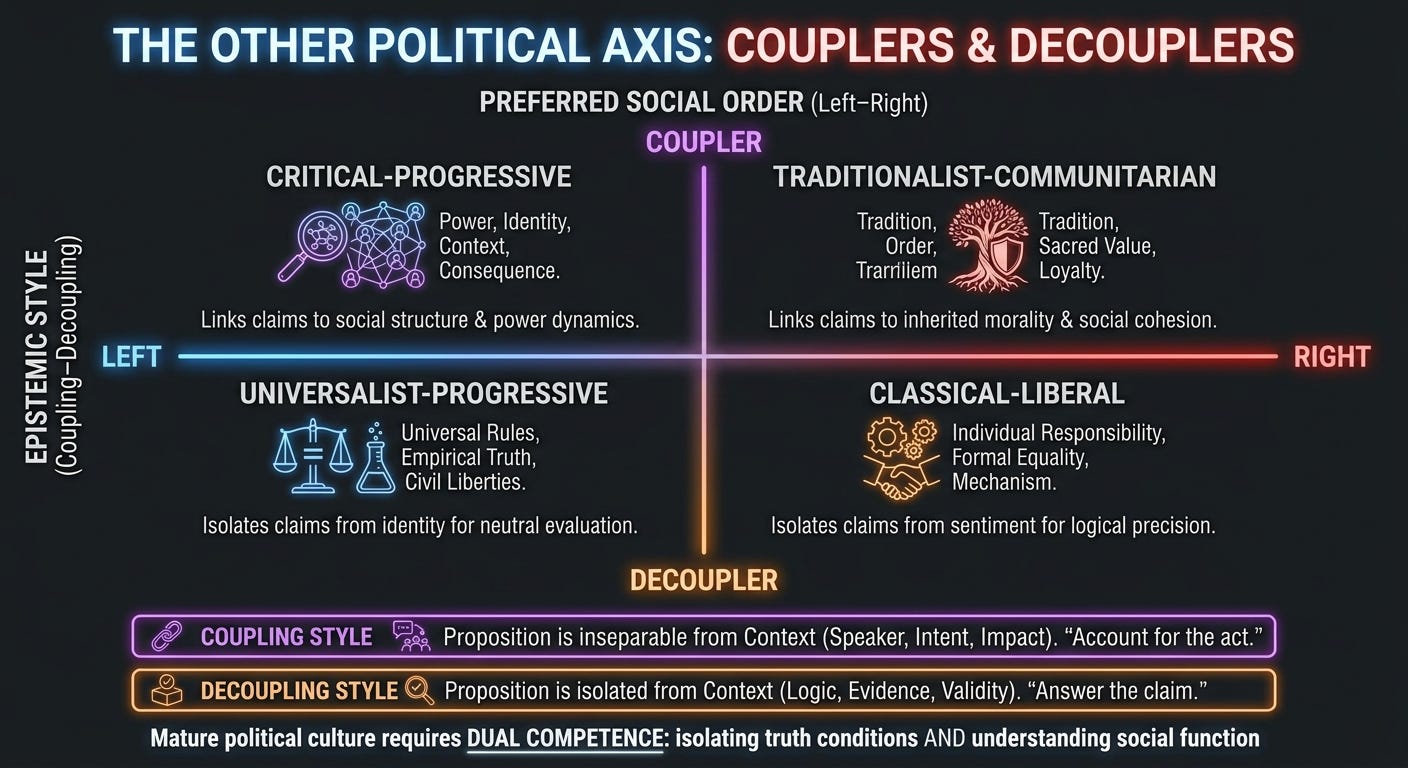
This distinction reveals a political axis largely missing from ordinary analysis. The traditional horizontal axis runs from left to right and describes, roughly, the kind of social order people prefer. The vertical axis runs from coupling to decoupling. It measures default priority rather than raw capacity: which features of an utterance a person treats as authoritative when proposition, context, and consequence pull in different directions. Put the two together and a more revealing matrix appears.

These are ideal types, not complete descriptions of actual people, and few people occupy one quadrant consistently across every domain. The matrix is useful because it distinguishes political goals from epistemic style. The left–right axis asks what social arrangements you want. The coupling axis asks what counts as relevant when evaluating a claim. Those questions are independent enough to generate four distinct political temperaments.
The matrix is itself a decoupling device. Every model suppresses detail to expose structure. Its validity does not depend on avoiding abstraction, which is impossible; it depends on whether the omitted context is restored when that context changes interpretation, strategy, or consequence. Any theory of coupling must decouple enough of reality to identify coupling as a recurring pattern. The issue is never whether abstraction occurs. The issue is whether the abstraction preserves the distinctions needed for the problem at hand.
The Missing Political Axis
A decoupler treats a proposition as something that can be detached from its surroundings long enough to be tested.
Consider the claim that Group A performs better than Group B on measure X. The decoupler asks whether the measure is valid, whether the groups are clearly defined, whether the difference is statistically real, how large it is, which causal explanations fit the evidence, and which conclusions do and do not follow. That someone may use the result badly does not change the result. A descriptive claim does not become false because it is politically inconvenient.
The coupler asks a different set of questions. Why was this comparison selected? Why is it being raised now? What narrative does it support, what assumptions will the audience import, and what social effects will follow from emphasizing it? The coupler does not necessarily deny that the measurement is accurate. The objection is that accuracy alone does not exhaust the meaning of the statement.
This difference creates recurring political incomprehension.
The decoupler says:
I am discussing a correlation, not endorsing a policy.
The coupler replies:
You know exactly what policy implication people will draw.
The decoupler says:
For the sake of argument, suppose the proposal works.
The coupler replies:
Treating it as a legitimate possibility already normalizes it.
The decoupler regards hypothetical consideration as distinct from endorsement. The coupler regards willingness to entertain the hypothetical as evidence of political sympathy. Each side thinks the other has violated a basic norm of reasoning: the decoupler thinks claims should be judged on their merits, and the coupler thinks there are no context-free merits.
The second position is partly right and partly confused. Language is not free of history, convention, ambiguity, or pragmatic implication. Terms such as “better,” “intelligence,” “crime,” “unemployment,” or “harm” require definition before a claim using them can be evaluated, and speaker, audience, and setting often affect what an utterance communicates beyond its literal content. None of this abolishes truth conditions. A decoupled proposition need not be context-free in origin or expressed in metaphysically pure language. It needs only to be specified well enough that evidence could count for or against it. Pragmatics complicates truth evaluation; it does not replace it.
The distinction is not between pure propositions and contaminated speech, because no proposition is linguistically pure. The distinction is between asking what would make a claim true or false and asking what a person is doing by asserting it. Those are different questions even when they must be answered together.
The War of Definitions
Decoupling cannot begin by pretending definitions are politically innocent. In contested domains, the choice of category may determine which facts become visible, which comparisons appear natural, and which conclusions follow almost automatically.
Is pornography speech? Is taxation theft? Is misgendering harm? Is abortion killing? Is exclusion from a private platform censorship? Is a large wealth disparity evidence of injustice? These are not disputes that can be resolved by opening a dictionary. The definitions encode rival moral and political theories.
The decoupler wants terms made explicit and held stable during analysis. The coupler points out that choosing the terms is already part of the political struggle. Both are right.
The useful distinction is among three kinds of definition. A stipulative definition fixes how a term will be used within a particular argument. A descriptive definition reports how a term is ordinarily or institutionally used. A normative definition argues that a phenomenon should count as an instance of a morally loaded category.
Political argument constantly slides among them. One side offers a stipulation; the other hears a moral concession. One side reports ordinary usage; the other treats it as endorsement. One side builds a verdict into a definition, then presents the resulting conclusion as empirical.
Calling taxation theft does not merely classify a transfer. It imports a theory of legitimate ownership and coercion. Calling misgendering harm does not merely describe distress. It imports a theory of social recognition and moral injury. Calling platform exclusion censorship does not merely describe restricted access. It imports a theory about which private institutions exercise quasi-public authority.
Definitions do not precede politics. They are often where politics begins. The remedy is not to abandon definition but to expose which work the definition is being asked to do. A valid decoupling process therefore asks not only whether the terms are clear, but whether the clarity was purchased by hiding the disputed premise inside the vocabulary.
The Case for Decoupling
Decoupling is indispensable to analytic thought. Science works by isolating variables. Mathematics works by abstracting from particulars. Debugging works by separating components. Law often depends on distinguishing the text of a rule from the character of the people affected by it. Counterfactual reasoning requires us to suppress what we know about the actual world and model another.
A decoupler can ask what would follow if an assumption were true without being accused of believing the assumption. That capacity is cognitively demanding, and it permits formal reasoning because it keeps propositions stable long enough to inspect them.
A software engineer might describe the decoupler’s ideal as a pure function:
truth_value = evaluate(proposition)
The proposition is the input. The output is an assessment of truth, validity, or implication. The caller is separate, the runtime environment is separate, and downstream misuse is separate.
This separation is essential because truth cannot be made contingent on political utility. A proposition does not become false because its speaker is disreputable, its implications are offensive, its publication creates social risk, it resembles an argument used by bad actors, or one coalition benefits from it. Once those considerations are allowed to determine truth, inquiry collapses into political adjudication. The decoupler’s demand is legitimate: establish what is true before allowing politics to determine what may be believed. Without that discipline, evidence becomes subordinate to coalition needs, facts are admitted when useful and rejected when dangerous, and inquiry becomes a mechanism for ratifying prior commitments.
Decoupling also protects the weak. It is often described as a luxury of the comfortable, as though only people insulated from consequences can afford to demand neutral rules and speaker-independent evidence. That is sometimes true, but it is not generally true. Dissidents, unpopular minorities, whistleblowers, heretics, and defendants often depend on decoupled standards because status-sensitive judgment is stacked against them. A universal rule may be the only available defence against an institution that already controls the social context. Powerful actors frequently prefer coupling when it permits them to redescribe dissent as irresponsibility, harm, disloyalty, or bad faith. Decoupling has no fixed political beneficiary: it can preserve the status quo, expose it, rationalize power, or constrain it.
Its failure mode remains serious. The act of abstraction can remove variables that are not incidental but constitutive. A claim uttered by a journalist to millions of people is not functionally equivalent to the same sentence written in a private notebook. A technically true statement can be framed selectively. A fact can be deployed as insinuation. A narrow proposition can serve as a proxy for a larger claim the speaker avoids stating explicitly.
The decoupler’s characteristic error is abstraction blindness: assuming that because a proposition can be grammatically isolated, it can also be socially isolated. Sometimes the pure function does not exist. Sometimes it exists only as one component in a larger effectful system.
The Case for Coupling
Human communication is strategic action. People do not select facts randomly. They choose what to mention, what to omit, how to frame it, when to publish it, and which audience to target. A coupler notices this immediately, and treats an utterance as an operation inside a live system:
result = evaluate(
    proposition,
    speaker,
    audience,
    history,
    incentives,
    consequences
)
In politics, this model often captures more of reality. Propaganda is rarely made of simple falsehoods; it is usually made of curated truths, selective emphasis, tendentious framing, and context manipulation. A speaker can say something literally accurate while producing a misleading inference. A politician can condemn violence selectively. A newspaper can report every fact in an article correctly while constructing a false picture through omission. A movement can insist that it is merely asking questions while using those questions to coordinate suspicion.
The coupler’s suspicion is not irrational. Speech has effects. Statements signal allegiance, repetition changes salience, framing changes interpretation, and institutional authority changes impact. A political culture that ignores these facts will be easily manipulated by anyone skilled at saying one thing while doing another.
Coupling is also adaptive under time pressure. In an adversarial attention economy, a claim can spread faster than it can be verified, and a propagandist may win the news cycle before a careful analyst finishes checking the evidence. The immediate questions (who is amplifying this, why now, what inference is being induced) can be operationally urgent before the factual question is settled. A person need not pretend a claim is false in order to treat it as unverified, selectively framed, and strategically deployed. The coupler’s instinct to inspect the act can function as rational triage.
The pathology begins when triage becomes adjudication. Context expands until it consumes the proposition. The question “Is this true?” is replaced by who said it, who benefits, what harm might result, what coalition it serves, and why we are discussing it at all. These may all be legitimate questions. They do not answer the original one. At the limit, motive becomes refutation, harm becomes falsity, and political consequence becomes evidence.
The coupler’s characteristic error is epistemic annexation: allowing the social life of a claim to swallow its truth conditions. Once that happens, reality is no longer something politics must answer to. Reality becomes one more contested political construction.
Four Political Temperaments
The coupling axis divides both left and right. This produces four political styles with different strengths, pathologies, and models of discourse.
The Coupled Left
The coupled left interprets claims through power, identity, history, institutional position, and social consequence.
Its characteristic question is:
What does this claim do within the existing structure of power?
The coupled left is suspicious of formal neutrality because neutral procedures can preserve unequal starting conditions. It emphasizes that speech is not merely descriptive: speech can stigmatize, normalize, exclude, legitimate, and mobilize. A statement about race, sex, crime, intelligence, immigration, or inequality is therefore never treated as a free-floating proposition. It enters a historical system already saturated with hierarchy and conflict.
This perspective contains an important insight. Institutions influence which facts are researched, which categories are measured, which findings are publicized, and which interpretations become dominant. Scientific and political attention is scarce, and selection is not neutral. The coupled left also understands that formal equality can coexist with substantive domination: a rule applied identically to everyone may still preserve background asymmetries.
Its failure mode appears when contextual analysis displaces factual analysis. A claim becomes morally suspect because of its associations. A speaker’s identity is treated as evidence about the claim’s validity. The social consequences of a finding become reasons not to admit the finding. The coupled left often treats what a statement does as prior to whether its literal content warrants isolated examination. At its worst, politics becomes frame detection: every proposition is decoded as a coalition signal, every disagreement becomes evidence of hidden allegiance, and empirical questions are never allowed to remain empirical.
The Decoupled Left
The decoupled left combines progressive goals with universalist and analytic methods. It accepts egalitarian aims but resists identity-dependent standards of truth, evidence, or procedural fairness.
Its characteristic question is:
What general rule should apply regardless of who benefits in this case?
The decoupled left values civil liberties, scientific realism, equal treatment under general rules, empirical policy evaluation, freedom of inquiry, and the distinction between offence and harm. It is comfortable saying that an inconvenient fact remains a fact. It can criticize an argument made by a political ally or defend the procedural rights of a political enemy.
This temperament once anchored much of the civil-libertarian and social-democratic left. It survives among civil libertarians, scientific social democrats, some rationalists, and some effective altruists.
Its strength is consistency. A principle that changes according to the identity of the claimant is not universal. A standard of evidence that depends on political utility is not epistemic. A right granted only to approved groups is not a right.
Its failure mode is excessive confidence in formal neutrality. Universal procedures do not automatically erase unequal power, open debate does not guarantee equal access to attention, and formally voluntary arrangements can conceal severe dependency. The decoupled left can underestimate how institutions shape the field on which supposedly neutral rules operate. It can also be politically naive about propaganda.
Even so, this quadrant has become increasingly politically homeless. It shares policy goals with the coupled left but rejects its epistemology; it shares discourse norms with the decoupled right but rejects much of its political program. That position is difficult to sustain inside institutions organized primarily around left–right coalition membership.
The Coupled Right
The coupled right interprets claims through tradition, loyalty, sacred value, social order, and civilizational continuity.
Its characteristic question is:
What effect will this idea have on the moral ecology that sustains society?
The coupled right is skeptical of abstraction because inherited institutions contain tacit knowledge. Family, religion, nation, authority, hierarchy, and custom are not treated as arbitrary arrangements that can be reconstructed from first principles. They are living systems whose stability depends partly on shared belief, and a statement that weakens confidence in them is therefore not neutral, even when literally true.
The coupled right understands something many rationalists miss: norms can be destroyed faster than they can be rebuilt. A society depends on habits, loyalties, expectations, and sacred commitments that cannot be derived from a formal proof. Once those commitments are dissolved, no committee can simply manufacture replacements.
Its failure mode is the suppression of inquiry in defence of order. Dissent becomes disloyalty, criticism becomes desecration, and evidence is rejected because it threatens inherited authority. The coupled right may defend censorship, loyalty tests, religious orthodoxy, or nationalist myth on the grounds that social cohesion requires them.
This quadrant is structurally similar to the coupled left in ways both sides resist acknowledging. Their sacred objects differ; their cognitive grammar often does not. Both believe speech shapes social order, both reject procedural neutrality, and both interpret refusal to affirm as a form of opposition. The coupled left protects marginalized identities and egalitarian norms; the coupled right protects tradition, hierarchy, nation, and religion. The conflict between them is substantive and often profound. The grammar is shared nonetheless.
The Decoupled Right
The decoupled right emphasizes individual responsibility, formal equality, voluntary exchange, general rules, property, incentives, and limited coercion.
Its characteristic question is:
What follows from the mechanism itself, independent of political sentiment?
The decoupled right strongly distinguishes inequality from injustice, disparity from discrimination, persuasion from coercion, description from prescription, correlation from causation, and voluntary exchange from force. This quadrant includes libertarians, classical liberals, market-oriented technocrats, economists, and analytic conservatives.
Its strength is conceptual precision. Political discourse often depends on collapsing distinct categories: a bad outcome is redescribed as a rights violation, a statistical difference is assumed to prove discrimination, an offensive statement is treated as coercion, an unequal exchange is assumed to be involuntary. The decoupled right resists those moves by demanding narrower definitions and explicit causal mechanisms.
Its failure mode is social reductionism. It can model society as a collection of formally voluntary transactions while treating background institutions as external to the analysis. But bargaining power depends on available alternatives. Exit costs matter, dependency matters, and concentrated power can operate without direct coercion. The decoupled right may also underestimate the role of status, signalling, and collective action: a formally neutral market can still produce politically destabilizing concentrations of influence, and a technically voluntary arrangement may exist within a structure that sharply constrains meaningful choice.
Its abstractions are often useful. They are not always complete.
Enemies Who Speak the Same Language
The matrix predicts forms of political affinity that the left–right axis misses.
A decoupled progressive may find a classical liberal easier to debate than an activist progressive. The two may disagree sharply about taxation, welfare, labour law, regulation, healthcare, and inequality, yet they share a model of argument. Both accept that a hypothetical is not an endorsement, that a claim can be evaluated apart from its speaker, and that descriptive and normative propositions should be separated. They disagree about values and policy. They agree about what an argument is. That common grammar makes productive disagreement possible.
The same pattern appears on the coupled side. An activist progressive and a religious conservative may despise one another’s conclusions while sharing assumptions about the social nature of speech. Both see discourse as an instrument of moral order, believe neutrality often conceals allegiance, think some ideas damage the conditions of collective life, and treat public affirmation and refusal to affirm as politically meaningful. They disagree about which order deserves protection. Their methods of discourse regulation often resemble one another.
This does not mean the two extremes converge politically. It means they use comparable mechanisms for interpreting and controlling speech.
Allies Who Cannot Understand One Another
Political coalitions are often horizontally unified and vertically divided.
A decoupled leftist and a coupled leftist may vote for the same party while disagreeing about nearly every norm of inquiry. One sees universal procedure as the foundation of justice; the other sees it as a mask for inherited power. One thinks offensive claims should be answered; the other thinks some claims should not be legitimized by debate. One separates truth from consequence; the other thinks that separation is itself politically loaded. The alliance survives because both prefer similar policy outcomes. Intellectually, it remains unstable.
The same fracture appears on the right. A libertarian and a traditionalist may support the same party while disagreeing about religion, censorship, sexual morality, nationalism, state power, and personal liberty. The libertarian wants individuals left alone; the traditionalist wants a social order capable of producing particular kinds of individuals. The libertarian sees the state as a threat to freedom; the traditionalist may see it as a necessary guardian of civilization. The coalition persists because both oppose the left. The vertical disagreement remains unresolved.
This explains why political institutions often feel internally incoherent. People are grouped by desired outcomes while operating under incompatible epistemic rules.
The Symmetry Nobody Likes
The strongest symmetry in the matrix is vertical.
Couplers of left and right tend to believe that ideas cannot be separated from their effects, that speech reveals allegiance, that neutrality is often fraudulent, that social order may outrank unrestricted inquiry, and that dangerous ideas should be managed rather than merely debated. Decouplers of left and right tend to believe that arguments should be evaluated independently of speakers, that hypotheticals are not endorsements, that truth should not be subordinated to coalition effects, that general procedures are preferable to discretionary judgment, and that taboo subjects require more analysis, not less.
Each vertical camp also shares a pathology. Couplers risk turning politics into a system of epistemic permission, in which claims are admitted or rejected according to their social function. Decouplers risk pretending politics is a seminar room, in which claims are analyzed as if their social deployment were irrelevant.
The symmetry explains both earlier puzzles at once: enemies who recognize one another’s reasoning while rejecting one another’s values, and allies who share conclusions while disputing which distinctions are legitimate.
Power Is a Multiplier
The matrix describes discourse norms, not institutional force. A powerless coupler and a powerful coupler may reason similarly while having radically different effects, and the same is true of decouplers. Institutional power determines which reasoning style can impose costs.
Coupling backed by authority can become orthodoxy enforcement. It can turn contextual suspicion into professional sanction, censorship, exclusion, or law. Decoupling backed by authority can become technocratic blindness. It can turn a simplified model into policy while dismissing affected people as anecdotal, irrational, or irrelevant to the specified variables.
Neither mode owns power, and neither is inherently insurgent or establishmentarian. A progressive institution may use coupling to defend a new orthodoxy. A traditional institution may use coupling to defend an old one. A dissident may appeal to decoupled evidence against both. A bureaucracy may use decoupled metrics to ignore harms it has excluded from measurement.
Power does not determine which style is correct. It determines the cost of its mistakes. The same reasoning style has different consequences depending on who controls platforms, credentials, employment, law, capital, or force. Any adequate analysis must therefore keep two questions separate: how is the claim being interpreted, and who has the capacity to make that interpretation binding? The first is epistemic style. The second is power. Conflating them obscures both.
The Architecture Chooses a Style
Coupling and decoupling are not exercised in neutral environments. Communication systems reward some cognitive operations and punish others.
Algorithmic platforms favour claims that generate immediate interpretation. Anger, threat, betrayal, and allegiance can be processed before evidence is checked. A coupled response therefore has a structural speed advantage: it can identify a villain, infer a motive, assign coalition membership, and prescribe a reaction while the truth value remains unresolved. Decoupling is slower because it requires specification. What exactly is being claimed? What evidence bears on it? Which variables are confounded? What would falsify it? How certain should we be?
The resulting asymmetry is not that couplers care while decouplers think. It is that coupling compresses well and disciplined decoupling usually does not. “Someone from the enemy coalition is attacking us” is cognitively cheap. “The central empirical claim is partially supported, but the comparison class is unstable and the causal inference is underdetermined” is cognitively expensive.
Coupling is not the only mode the architecture can weaponize. Platforms also reward a degenerate form of decoupling: the clipped quotation, the isolated statistic, the technically true but radically unrepresentative claim. A vivid proposition stripped of base rates, selection mechanisms, chronology, and comparison classes compresses just as well as a coalition accusation. Much propaganda works precisely this way, decoupling aggressively and then refusing to recouple.
What the architecture rewards, then, is not coupling as such. It rewards whatever can be compressed into immediate certainty. The coupled accusation (”the enemy wants to destroy you”) and the decontextualized factoid (”here is the fact they do not want you to see”) both outperform calibrated analysis. Certainty outruns calibration, accusation outruns verification, and social meaning arrives before factual status. Disciplined uncertainty is not impossible online, but it is structurally disadvantaged: it spreads less readily unless attached to authority, status, strong narrative packaging, or an already trusted source.
The platform does not merely host the conflict between couplers and decouplers. It changes the fitness of each style, and it degrades both. It trains users to infer motive before checking fact, because motive is faster. It rewards identity alignment because identity is legible, and rewards the context-free fragment because fragments travel. It penalizes careful qualification because qualification weakens emotional force.
This creates a feedback loop. The architecture rewards compressed certainty, users supply more of it, and the resulting content gives the architecture more of what it rewards. A society shaped by this selection does not simply move up the coupling axis. It becomes quicker to infer motive and quicker to weaponize a context-free fact at the same time, while the discipline of either mode loses ground.
Sacred Values Collapse the Distance
People are not consistently coupled or decoupled. They switch modes by domain.
A free-speech absolutist may become highly coupled around national security. A progressive scientist may defend rigorous decoupling in the laboratory and reject it in arguments about identity. A religious conservative may insist on narrow textual analysis in constitutional law while using expansive contextual interpretation in theology. A libertarian may demand formal neutrality in markets but become highly sensitive to motive and symbolism when discussing communism.
This suggests that coupling is not merely a stable personality trait. It is partly a measure of perceived stakes. The more sacred the subject, the harder decoupling becomes. When a claim threatens identity, status, tribe, religion, nation, or moral legitimacy, context suddenly appears inseparable from content.
This does not prove that coupling is irrational; sacred-value conflicts genuinely involve social coordination and group survival. It does mean that people often mistake motivated shifts in reasoning style for principled consistency. They praise decoupling when it protects their side’s inquiry. They praise coupling when it protects their side’s sacred values. The axis becomes visible only when applied symmetrically.
The Political Realignment Hypothesis
The coupling axis may help explain emerging fractures within modern institutions. As organizations become ideologically homogeneous, conflict often shifts from policy goals to epistemic norms. Once members broadly agree on political direction, disputes concern whether inconvenient facts may be discussed, whether intent or impact governs judgment, whether context defeats literal meaning, whether universal rules are genuinely universal, whether dissent is error or disloyalty, and whether a speaker may separate analysis from endorsement. These disputes appear in universities, journalism, technology companies, scientific institutions, effective altruism, rationalism, libertarianism, and mainstream political parties.
The vertical axis may predict discourse compatibility better than the horizontal axis predicts policy alignment. It may also predict institutional trust. Decouplers tend to distrust institutions that treat claims as coalition signals. Couplers tend to distrust institutions that ignore power, history, and social consequence. Each side interprets the other’s methods as corrupt: the decoupler sees censorship, status enforcement, and motivated reasoning; the coupler sees irresponsibility, laundering, and strategic naivety. Neither description is always wrong.
The emerging political landscape may therefore be less a realignment of policy than a realignment of argumentative trust. People increasingly sort by whether they believe the other side will evaluate claims as propositions or decode them as acts of allegiance. That division can cross party lines while remaining invisible to institutions organized around the older spectrum.
The Jurisdiction of Each Mode
Each mode has a jurisdiction, and the boundary matters most when action cannot wait for verification. Contextual triage is sometimes necessary. It is not costless. Delay can permit a falsehood, panic, or danger to spread. Premature judgment can punish innocent people, destroy reputations, suppress true claims, or create an orthodoxy that correction cannot reverse.
These errors are not equivalent in every case. The proper response depends on decision variables, not ideological temperament: expected harm, probability, cost of delay, cost of false accusation, reversibility, and the availability of intermediate measures. Where intervention is cheap and reversible, precaution is easier to justify; a claim can be temporarily deprioritized, labelled as unverified, or denied algorithmic amplification without being declared false. Where sanctions are severe and irreversible, evidential standards should rise. Dismissal, public denunciation, legal punishment, professional exclusion, and permanent reputational damage should not rest on the same threshold as temporary caution.
The distinction is familiar in other domains. A smoke alarm should tolerate false positives because the cost of checking is low and the cost of missing a fire is high. A criminal conviction should demand a much higher standard because punishment is severe and difficult to reverse.
Political discourse often ignores this structure. Couplers may infer that urgency justifies certainty. Decouplers may infer that uncertainty justifies inaction. Neither inference is valid. Context can justify provisional measures without justifying final judgment. Uncertainty can justify withholding belief without requiring passivity. A proportionate response asks not only whether action is warranted, but what degree of action is warranted under incomplete information.
That question cannot be answered by either mode alone. A competent political epistemology needs both decoupling and recoupling, and the mistake is to collapse them into one operation.
Three questions must be kept distinct. Is the claim true? What is the speaker doing by asserting it? How should we respond? These questions interact. They do not answer one another.
The original temptation is to impose a simple sequence: truth first, context second, consequences third. That formulation captures epistemic priority but risks being mistaken for a chronological procedure. In adversarial environments, the three operations cannot always wait their turn. Verification may take days while framing effects occur in minutes, and a manipulative claim may need to be contextualized before its full factual status is known. Claim verification, contextual analysis, and consequence assessment should often proceed in parallel.
A responsible response may be:
The claim is not yet verified. It has been framed selectively. The source has an obvious interest in amplifying it. We should avoid treating it as established until the evidence is examined.
This is not coupling in place of truth. It is disciplined uncertainty plus contextual triage.
The order concerns authority, not chronology.
Truth governs belief. Context governs interpretation. Consequences govern response.
Context may justify caution, refusal to amplify, or scrutiny of motive. It may not make a false claim true or a true claim false. Consequences may justify withholding, delaying, or carefully framing publication. They may not determine what the evidence shows.
A person may refuse to debate a propagandist without pretending the propagandist’s proposition has been refuted. A platform may limit amplification without claiming that every restricted assertion is false. A journalist may contextualize a claim immediately while continuing to investigate its accuracy. The operations can occur concurrently while retaining distinct domains of authority.
This is the discipline both modes lack when allowed to dominate. The pure decoupler treats context as an afterthought. The pure coupler treats context as a verdict. A mature epistemology treats it as indispensable but bounded.
The coupling axis, then, should not be mistaken for a simple scale on which the ideal position lies in the middle. The two capacities are partly independent, and capacity and default are different things: a person may command both operations and still default toward one under conflict or pressure. The axis locates the default; competence is a separate question. A person can be poor at both: unable to isolate a claim clearly and unable to understand its social function. A person can be strong at both: capable of specifying truth conditions while modelling framing, incentives, power, and consequence.
The ideal is not moderation between the two. It is dual competence. Strong decoupling preserves the distinction between evidence and allegiance. Strong coupling preserves the distinction between literal content and strategic use. The goal is to become capable of both without allowing either to usurp the other’s jurisdiction.
A good analyst should be able to extract the proposition from the speech act. A good political actor should be able to return the proposition to the speech act. The first operation prevents context from dictating truth. The second prevents truth from being treated as socially self-interpreting. Neither capacity compensates for the absence of the other.
Postscript
The left–right axis tells us what people want. It tells us less about how they decide what is true, what counts as relevant, or what an argument permits them to ignore. The missing axis runs between isolation and embedding, proposition and speech act, model and system. It cuts through every ideology because every ideology must decide whether claims can be examined apart from their social life.
Decoupling without recoupling produces political innocence: it understands propositions while ignoring how they are defined, selected, framed, amplified, and used. Coupling without decoupling produces political epistemology: it understands power and consequence while losing the ability to admit facts that threaten coalition interests.
A society capable of correction needs both operations without confusing their authority. It must isolate a claim long enough to determine what evidence would make it true or false. It must inspect the definitions that structure the claim. It must return the claim to a world of motives, institutions, incentives, power, speed, and consequence. And because some media systems reward certainty over calibration and accusation over verification, epistemic discipline requires institutional design as well as individual virtue.
The decoupler says:
Answer the claim.
The coupler says:
Account for the act.
A mature political culture must do both. It must preserve the distinction between whether a claim is true, why it was uttered, and what should be done with it.
Confusing those questions leaves us with two defective cultures. One understands propositions but not politics. The other understands politics but can no longer tolerate propositions.