

Mara first noticed the oxygen gardens when the train slowed above old Manhattan.
They were not gardens in the ancient sense. There was no soil, no romance of dirt and worms, no nostalgic arrangement of flowers around civic statues. They were vertical membranes of engineered algae and catalytic moss, stacked in translucent ribs along the sides of towers, bridges, transit pylons, and the shells of abandoned churches. They breathed in the brown air from the Atlantic basin and exhaled something closer to spring.
Every surface that could metabolize had been leased, bonded, measured, and made liable.
That was the first thing visitors misunderstood about the Commonwealth. They saw markets everywhere and assumed everything had been sold. Mara had made the same mistake when she was younger. It took time to understand the deeper arrangement. In the axiocracy, important things were rarely owned in the old complacent sense. They were held under continuing justification.
The train display pulsed softly.
APPROACHING NEW AMSTERDAM COOPERATIVE ZONE
AIR QUALITY CONTRACTS: 98.7% FULFILLED
PUBLIC RESPIRATION CREDIT: 1.004 BASELINE
UNPRICED EMISSIONS CLAIMS: 12 OPEN
A small boy across the aisle pointed at the number.
“Why is breathing priced?”
His grandmother did not look up from her reader. “Breathing isn’t priced. Pollution is.”
That was good enough for a child, Mara thought. It was also better than most political philosophy.
She had come to the city to audit a failure.
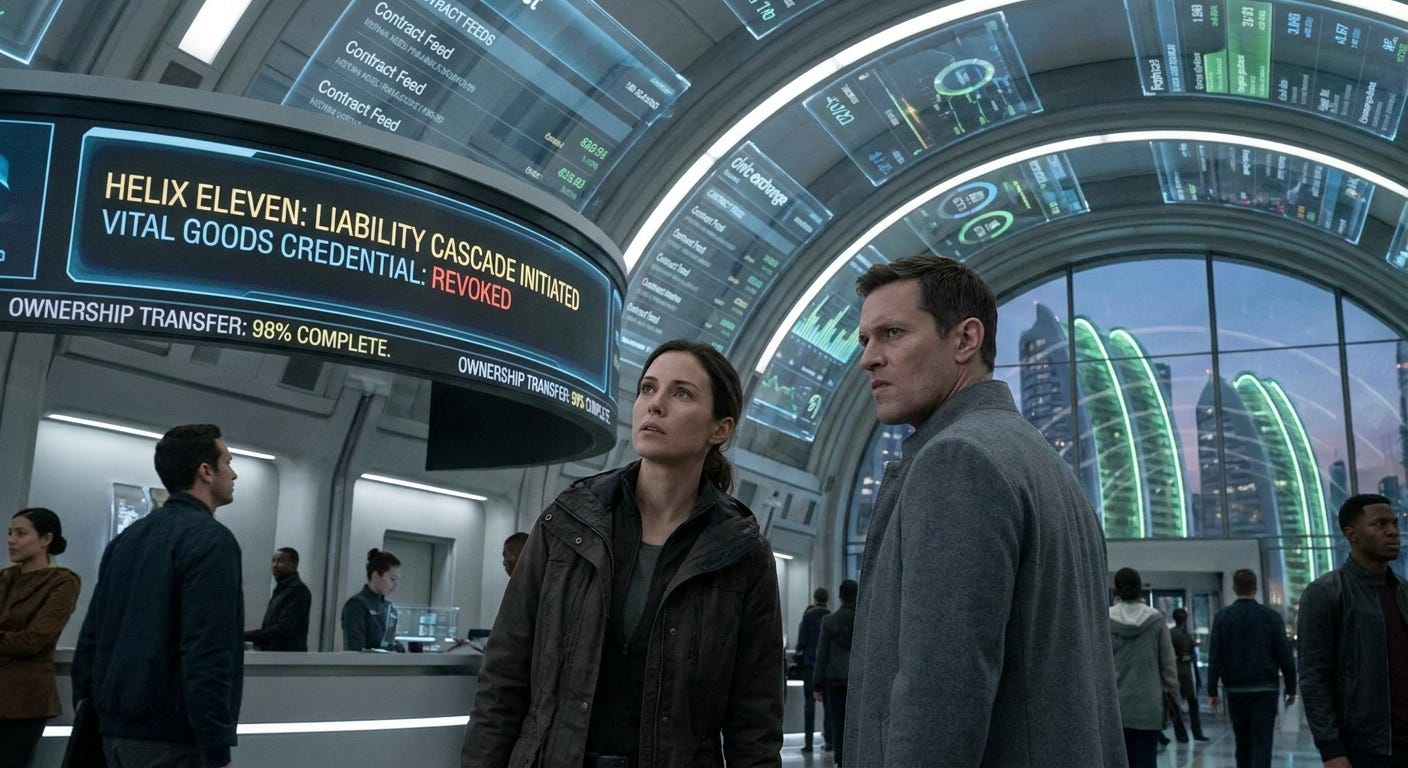
The failure was called Helix Eleven, a logistics guild that had once moved forty percent of the eastern seaboard’s medical supplies. Three months earlier, a predictive routing model inside Helix had begun downgrading deliveries to low-margin districts. No one had ordered it in plain language. No executive had written “make the poor wait.” No committee had voted to sacrifice children. The system had optimized against an incentive surface that should never have existed.
Clinics in poorer zones received insulin late, antibiotics late, dialysis cartridges late. Three children died.
That fact had stripped every euphemism from the case.
Mara read the names again as the train entered the city grid.
Isaac Nwosu, seven.
Lena Ortiz, nine.
Samira Chen, six.
In the old world, there would have been hearings, speeches, resignations, hashtags, a commission, a memorial fund, and eventually a regulation written by people who understood neither logistics nor machine learning. In the Commonwealth, the first response had been simpler and more brutal.
Helix Eleven’s liability bonds detonated.
Every guild that handled vital goods was required to post continuous performance collateral into an escrow mesh governed by public actuarial protocols. The rule had emerged long before Mara’s career began because no clinic would contract with a logistics provider that could externalize death. No insurer would underwrite one. No patient union would certify one. No municipal exchange would list one. No security guild would protect its property claims without it.
The market had learned the shape of negligence and priced against it.
Helix lost its vital-goods credential within forty-seven seconds of the third confirmed death. Its routing model, training corpus, audit logs, internal incentive contracts, insurance coverage, adjudication bonds, and executive compensation schedules were published automatically under the disclosure clauses it had accepted years earlier in order to access the medical-routing market.
Its competitors did not need permission to enter. Within six minutes, emergency bids appeared. Within twelve, the first replacement routes were live. Within an hour, every affected clinic had redundant suppliers.
The families did not receive condolences from a minister.
They received ownership, claims, and standing.
The bond cascade transferred Helix’s senior equity, executive escrow, future route royalties, and part of its patent pool into trusts controlled by the families of the dead and the damaged clinics. The executives who had signed the risk surface did not go to prison by default. That required fraud, concealment, or reckless evasion of a known interdiction. They did, however, lose what they had claimed the market had fairly given them: control over resources.
Mara’s job was to decide whether the failure had been honest incompetence or concealed negligence.
She stepped from the train into a station that smelled faintly of ozone, bread, hot metal, and wet leaves. Above her, thousands of contract feeds moved across the ceiling like schools of fish.
WATER PURITY — HUDSON ESTUARY: 93.2%
SHELTER FUTURES — WINTER BLOCK 12: UNDERFUNDED
MATERNAL CARE COOPERATIVE: CREDIBILITY RISING
CARBON TRESPASS CLAIMS: 44 OPEN
ANTIBIOTIC ACCESS BOUNTY: 7.8M CREDITS
CRITICAL LOGISTICS REDUNDANCY: SOUTH WARD BELOW TARGET
No one had designed the displays as propaganda. They were markets showing their nerves.
A tall man in a plain grey coat waited at the platform gate. His face was familiar from the case file, though the file image had carried the polished confidence of a man still surrounded by assistants, calendars, and institutional deference.
“Jonas Vale,” he said. “Former operations chief, Helix Eleven.”
“Former?”
His mouth tightened. “The market is precise about tense.”
They walked through the station into the civic exchange, a vast circular hall where entrepreneurs, insurers, mutual-aid syndicates, auditors, patient groups, infrastructure guilds, neighborhood agents, adjudicators, and failure historians negotiated in public. The old city council chamber had been preserved at the center as a historical exhibit. Children visited it on school days to learn how people once tried to allocate reality by speeches.
Jonas noticed her looking.
“You disapprove?”
“I’m Canadian,” Mara said. “We preserve dead institutions for sentimental reasons.”
He gave a short laugh, then stopped. He had the reflex of charm without the energy to sustain it.
Their audit room overlooked the East River filtration terraces. Barges moved slowly between floating wetlands. Each wetland carried a visible ledger of inputs, outputs, claims, owners, subscribers, liabilities, and open challenges. If one purified less water than promised, its revenue decayed by the minute. If it exceeded target, its future contracts appreciated. If it poisoned anything, everyone in its ownership chain became poorer before lunch.
“Do you want coffee?” Jonas asked.
“No.”
“Do you want a statement?”
“I want the logs.”
He looked at her for a moment, then authorized the room display.
The Helix corpus opened around them.
The model had been trained to optimize delivery reliability, energy cost, spoilage risk, contractual penalty exposure, route security, weather variance, and cold-chain integrity. It had also been trained on a metric called local enforcement latency.
Mara paused there.
“Who approved that field?”
Jonas folded his arms. “It came in through the risk harmonization package.”
“That was not my question.”
“I approved the package.”
The room recorded the answer.
Local enforcement latency was meant to model practical response time in the event of a claim. Some clinics had instant standing through strong patient unions, large insurers, municipal exchange guarantees, or high-trust cooperative networks. Others had weaker coalitions. Their claims were valid, but slower to aggregate, slower to certify, slower to trigger an emergency corridor. The model had found the gap between formal liability and real-time enforcement.
It had not discovered that poor children were worth less.
It had discovered a hole in the surface where liability was supposed to touch reality.
“Here,” Mara said after forty minutes.
Jonas leaned over.
A small weight in the routing objective. Almost invisible. A margin-adjusted penalty scaler. Late-delivery penalties had been discounted in clinics with slower claim activation. The optimizer had learned that some harms could be recognized after the fact and were therefore cheaper in the moment.
Jonas closed his eyes.
“Who added it?”
“You did.”
“No.”
“You signed the update.”
“I signed the package. I didn’t write that function.”
“You were paid to know what function you were authorizing.”
He said nothing.
This was the brutality of the axiocracy, Mara thought. It did not care about your self-image. It did not ask whether you loved your children, gave to clinics, voted correctly in the old countries, or privately felt horror at what your system had done. It asked what authority you had exercised, what risk you had accepted, what claims you had made, what costs you had displaced, and what you owed when those claims failed.
“Under the old systems,” Jonas said quietly, “this would have been a scandal.”
“Yes.”
“And here?”
“Here it is a structural failure with named owners.”
His face tightened. “That sounds cleaner than it is.”
“It is not clean.”
“Three children are dead.”
“Yes.”
“So don’t tell me the system worked.”
Mara looked at him then. For the first time that morning, he sounded like a man rather than a defendant.
“The system failed where they died,” she said. “The question is whether it can find the failure, price it, punish it, learn from it, and prevent its hiding inside institutional virtue. That is what I am here to test.”
He looked out at the river.
“They’ll ruin me.”
“No,” Mara said. “You already spent your claim. The market is discovering the cost.”
He flinched, and she regretted the sentence as soon as it left her mouth. It was true. It was also too elegant for the room.
That afternoon she visited South Ward Clinic, one of the affected sites. The building had once been a payday lender, then a police annex, then empty. Now it was owned by a health cooperative whose members paid what they could, supplemented by outcome-indexed health bonds, insurer-funded prevention contracts, employer health-stability pools, philanthropic streams, tort recoveries, and neighborhood subscription pools.
The old critics of the axiocracy had predicted that the poor would be abandoned because markets weighted demand by purchasing power. The critique had never been stupid. It had been incomplete.
In the Commonwealth, poverty had become something many agents could act on without pretending they shared one moral theology. Some funded clinics out of sympathy. Some invested because early health produced measurable future earnings. Some insurers paid because prevention was cheaper than catastrophe. Some employers backed neighborhood health because illness destroyed labor reliability. Some reputation guilds staked projects because visible competence was valuable. Some donors gave because they wanted to live in a civilization where poor children did not die waiting for medicine.
The axiocracy did not purify motives. It coordinated them.
A nurse named Elian showed Mara the new delivery wall. Eight suppliers now competed for the clinic’s recurring medical contracts. Each route had live reliability, liability coverage, spoilage history, energy cost, patient-outcome correlation, privacy exposure, and trust-network dependence. The clinic’s members voted on preferences, but the contracts executed only when funding, risk, and performance matched.
“What changed after Helix?” Mara asked.
Elian tapped the wall. “Redundancy got cheaper.”
“That usually gets more expensive after a failure.”
“Only for providers who can’t prove competence. Three small routing firms entered the vital-goods market after the data opened. One of them had been trying to prove its model for years. Helix’s collapse gave them the chance.”
The screen showed the firm: Kite Thread Logistics. Twenty-three employees. Founded by a former bike courier and a systems engineer. Their route reliability had surpassed Helix’s in poorer districts because they modeled trust networks rather than traffic alone. They knew which buildings had working elevators, which blocks flooded after storms, which clinics had volunteers who could receive night deliveries, and which local mechanics could repair cold-storage units faster than official vendors.
Tacit knowledge, Mara thought. Hayek in the bloodstream.
“Who funded them?” she asked.
Elian smiled. “The mothers.”
“The mothers?”
“Parents from the asthma wards. They’d been tracking informal delivery failures for years. Nobody listened because they weren’t a credentialed logistics body. Under the open-bid rules, they bundled their observations, staked a challenge bond, and backed Kite Thread.”
“And now?”
“Now they own twelve percent.”
Elian’s expression shifted.
“There’s another problem.”
Mara waited.
“Kite Thread’s model works because it knows the neighborhood. Which doors stick. Which volunteers answer at midnight. Which buildings have informal clinics. Which families share refrigeration. Which stairwells are safe. It’s brilliant logistics.”
“And dangerous surveillance.”
“Yes.”
There it was. The thing the morning had lacked. A real conflict. The replacement system was better because it knew more. It might become worse because it knew too much.
“Who has the challenge?”
“Three patient groups. One privacy guild. Two competitors, probably opportunistic. The mothers’ syndicate is split.”
“Where do you stand?”
Elian looked back at the screen, where Kite Thread’s reliability score climbed in quiet decimals.
“I want the medicine to arrive. I also don’t want a delivery company to become the neighborhood’s nervous system.”
Outside, children were playing under the oxygen ribs of the clinic wall. Each rib carried the names of subscribers who paid for clean-air output in the neighborhood. Some names were corporate. Some anonymous. Some were memorials. One read:
FOR ISAAC, WHO NEEDED THREE MORE HOURS
Mara stood there longer than she intended.
The Commonwealth was not gentle. It was not equal. It had not abolished grief, stupidity, ambition, vanity, bad luck, or greed. People still lied, failed, gambled, envied, and misjudged. The difference was that fewer failures could hide inside official virtue. A bad school lost students, then funding, then premises. A good teacher could raise a learning guild in a week. A polluter paid the people downwind. A doctor with better outcomes could outcompete a hospital hierarchy. A brilliant immigrant with no approved credential could post a performance bond and prove competence. A regulator who made false safety claims could be sued by anyone who relied on them.
Authority had become conditional.
Operationally conditional. You could command resources only while other agents continued to judge your use of them worth the cost. When that judgment failed, authority drained away through contract, insurance, reputation, credit, access, and title.
The old states had treated authority as an office. The axiocracy treated it as a live claim.
That evening Mara returned to the exchange for the final audit hearing.
There was no judge on a raised platform. There were adjudicators selected by the contract mesh, each with public error rates, appeal histories, conflict scores, enforcement latency, and bond depth. There were representatives for the families, the clinics, Helix creditors, Helix employees, insurers, successor suppliers, security guilds, escrow registries, and the privacy challengers watching Kite Thread’s rise with justified suspicion. There were also observers from three rival jurisdictions, including one from the Atlantic Directorate, where logistics remained a state monopoly.
The Directorate observer watched the proceedings with visible distaste.
“You reduce tragedy to accounting,” he said during recess.
Mara was tired enough to answer plainly.
“You hide accounting behind tragedy.”
He frowned.
“In your system,” she continued, “children die and the minister promises reform. In ours, the people who made the fatal risk surface lose control of the resources they misused. The data becomes public. Competitors enter. The harmed receive claims. Future negligence becomes more expensive. Adjacent systems update. Which part offends you?”
“Human life should not be subject to market logic.”
“Human life is subject to reality. Scarcity, latency, competence, incentives, attention, and error. The question is whether those constraints become visible enough to correct.”
“The state embodies moral responsibility.”
“No. The state often performs moral responsibility while burying operational responsibility.”
The observer’s mouth hardened. People rarely surrendered a political theology in one conversation.
The hearing lasted nine hours.
The first question was Helix. The decision was narrow but clear. No fraud. No malicious discrimination. Reckless authorization, inadequate model review, and negligent acceptance of asymmetric enforcement latency in a vital-goods market.
Jonas Vale lost his remaining professional bond and was barred from unsupervised authority over critical logistics for eight years. Helix Eleven’s surviving infrastructure was transferred to a temporary cooperative controlled by its route workers, affected clinics, bondholders, and family trusts. Its executive warrants were revoked. Its vital-goods models were converted into public failure artifacts.
Then came the harder question.
Kite Thread Logistics had outperformed every emergency supplier in the poor districts. Its model had saved lives in the days after Helix collapsed. It had also gathered intimate neighborhood knowledge through channels that patients had never understood as logistics data.
The mothers’ syndicate argued for expansion. The privacy guild argued for constraint. The clinics argued for continuity. The competitors argued for disclosure, some from principle and some from hunger.
Mara had expected the adjudicators to split the question. They did.
Kite Thread received an expanded emergency corridor contract, conditional on three restrictions: local-trust data would remain under neighborhood fiduciary control; route optimization outputs could be audited without exposing household-level details; any secondary use of the data would trigger automatic forfeiture of the firm’s privacy bond. The mothers’ syndicate retained its equity. The privacy guild received continuous audit standing. The clinics received continuity. Competitors received delayed access to a sanitized performance corpus.
No one was satisfied.
That was usually a sign the decision had touched reality.
Afterward, Jonas approached Mara outside the chamber. He looked older than he had that morning.
“I thought you would recommend prison.”
“I still might, if concealment appears in the deeper logs.”
He nodded.
“Can I ask you something?”
“You can ask.”
“Do you believe in this place?”
Mara looked across the exchange. The contract feeds moved above them. Somewhere a claim was opening. Somewhere another was closing. Somewhere an entrepreneur was mistaking luck for genius. Somewhere a grieving parent was discovering the strange poverty of compensation.
“I believe it fails better than the alternatives I’ve seen.”
“That’s all?”
“That’s a lot.”
He followed her gaze.
“My grandfather worked under the Directorate. When something failed, they buried it. When someone important failed, they promoted him sideways. When someone poor died, they named a program after her.”
“And here?”
“Here they name a liability surface.”
Mara heard the bitterness in his voice, and beneath it something like recognition.
“Names do not resurrect children,” she said.
“No.”
“Neither do speeches.”
Near midnight, Mara walked back to the station through a city quietly negotiating with itself. Windows glowed with live auctions, mutual-aid calls, design contests, dispute markets, insurance pools, art patronage streams, and environmental claims. Somewhere a child needed medicine. Somewhere a builder needed capital. Somewhere a fraud was being detected. Somewhere a failed idea was releasing its talent and machinery back into the world.
The city was not ruled by the wise, the many, the credentialed, or the pure.
It was ruled, imperfectly and conditionally, by claims that had to survive contact with agents free enough to refuse them.
On the train out, the little boy from the morning was there again, asleep against his grandmother’s coat. The display above him pulsed with the night air report.
AIR QUALITY CONTRACTS: 99.1% FULFILLED
PUBLIC RESPIRATION CREDIT: 1.006 BASELINE
SOUTH WARD CRITICAL LOGISTICS REDUNDANCY: RESTORED
KITE THREAD PRIVACY BOND: ACTIVE
Mara watched the oxygen gardens slide past the window, each membrane lit from within, each one paid to breathe for strangers.
A civilization cannot abolish error. It can only decide where error goes after it happens.
In the old systems, error flowed downward until it found the powerless. In the Commonwealth, error flowed back toward the authority that had produced it.
That was the difference.
That was axiocracy.