

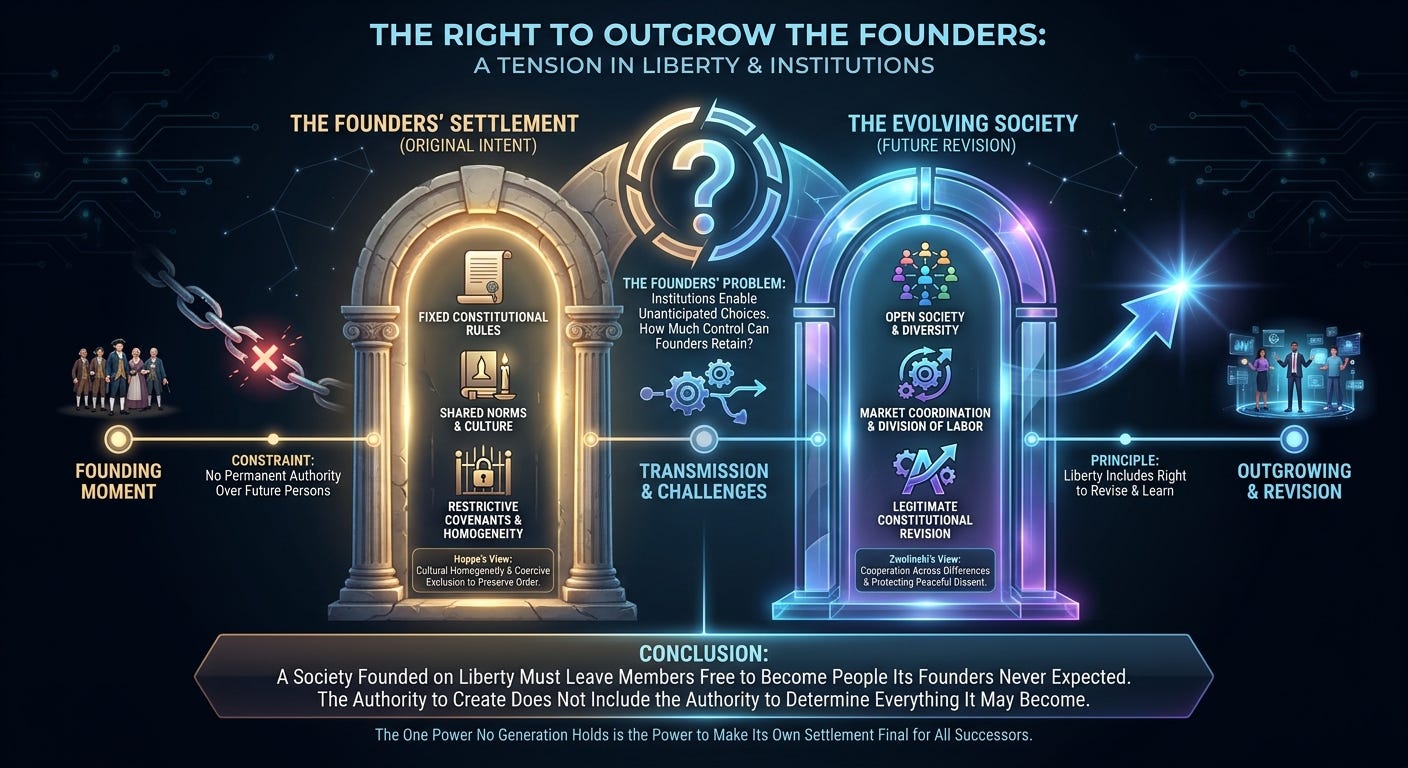
A free society may eventually become a society its founders would despise. Its inhabitants might abandon their religion, reject their customs, overturn their social hierarchies, and embrace values their ancestors considered dangerous, all while continuing to respect one another’s rights.
Would that society have betrayed its founding principles, or fulfilled them?
The question sits underneath Matt Zwolinski’s recent essay The Trouble with Hans-Hermann Hoppe. Hoppe is the anarcho-capitalist economist whose defense of private property comes joined to an uncompromising preference for culturally homogeneous communities. Zwolinski’s essay was prompted by a talk in which Hoppe cast doubt on the Holocaust, but the dispute it documents reaches well past that episode.
Hoppe and Zwolinski disagree about the kind of society libertarian principles are likely to sustain. Underneath is a problem every founder faces. Institutions built for one purpose go on to enable choices their founders never anticipated and would never have approved. How much authority can the founders legitimately retain over what happens next? The same question governs constitutions, voluntary associations, and artificial agents capable of revising their own commitments.
The Society That Must Survive
Hoppe’s political philosophy begins with self-ownership, private property, and the prohibition against aggression. He rejects the state as a systematic violator of these principles and advocates a society of voluntary agreements among property owners. He also holds that non-aggression alone cannot sustain such a society. Liberty depends on norms, institutions, and practices that dispose people to respect property and keep their agreements.
A society in which contracts are routinely dishonored, property is widely regarded as illegitimate, and political violence is celebrated will struggle to maintain a libertarian order. Its legal protections may survive on paper long after the social conditions supporting them have disappeared.
Hoppe goes further. Peaceful cohabitation, he argues, requires a common language, religion, custom, and convention, and cultural heterogeneity within one territory ends in the destruction of any libertarian order. He consequently favors homogeneous communities governed by restrictive covenants.
Zwolinski shows that the program also rests on claims about the inequality of cultures, backed by appeals to race science, that have no connection to libertarian principle. The cohesion argument can be assessed without them, and it is the version that deserves an answer.
Against it, Zwolinski draws on Adam Smith, Ludwig von Mises, and Karl Popper to defend the open society: a civilization in which strangers cooperate across differences of religion, ancestry, and custom through voluntary exchange. The division of labor lets people who disagree about almost everything cooperate productively, and markets coordinate activity without requiring a shared worldview.
Each side has hold of something. Some shared norms are necessary for peaceful cooperation, and some cultural practices are hostile to liberty. Yet extensive cooperation among people with different values is among the greatest achievements of liberal civilization. How much cultural agreement a free society requires, and which differences its institutions can accommodate, is partly an empirical question. Posed as a question of weight, it would stay open. Hoppe treats heterogeneity as incompatible with a libertarian order, which converts a question of degree into a claim of impossibility.
The harder disagreement concerns what a community may do to preserve the conditions it believes it needs.
In his 2017 speech Libertarianism and the Alt-Right, Hoppe argued that neighbors who openly advocate communism, socialism, or democracy threaten every property owner before they commit any aggression. Shunning them was insufficient. They were to be physically removed, by violence if need be.
Political threats can precede aggression. A movement can organize, recruit, accumulate institutional power, and eventually acquire the capacity to violate rights on a large scale. A party that openly intends to confiscate property through legislation may pose a genuine danger long before its legislation passes.
Yet advocating an idea, organizing politically, preparing an attack, and carrying out aggression are different activities. Treating them as equivalent would permit coercion against peaceful opponents on the strength of predictions about their future conduct.
Hoppe’s defenders point to his private covenant communities, whose members voluntarily accept restrictive rules. Such agreements can constrain conduct within their scope. Zwolinski’s charge is that Hoppe’s prescriptions go beyond contractual enforcement to coercive exclusion of peaceful dissenters. People may refuse to associate with political opponents, keep them off private property, or form associations with restrictive membership. They cannot acquire authority over another person’s property because that person’s beliefs threaten their preferred social order.
Even if Hoppe were right about cultural cohesion, it would not follow that the culture may be preserved by coercion. An institution’s survival may be valuable. The means of securing it remain constrained by the rights of others.
The Founders’ Problem
Imagine a hundred families committed to traditional religion, private property, and strict social conventions. They acquire land, build infrastructure, and form a voluntary association with rules governing shared facilities, membership, and the use of their property.
A century later, their descendants have changed. Many are secular. Family arrangements have diversified. New residents have brought different customs. The community bears little resemblance to what its founders intended, and its inhabitants still respect property rights and honor their obligations.
Has anything gone wrong?
The founders might have called the transformation a cultural catastrophe. Their descendants might call it progress. Neither judgment establishes a rights violation.
Suppose, however, that the founders established restrictive covenants that subsequent purchasers accepted. The descendants cannot disregard those agreements because their preferences have changed, and other owners may hold claims arising from the same arrangements. Freedom includes the ability to make binding commitments, including commitments that constrain future choices.
Enduring property rights are still different from perpetual authority over persons. A covenant may restrict particular uses of property. It does not entitle an association to regulate a person’s beliefs, private relationships, or conduct beyond the agreement’s scope.
The case gets harder when children inherit property under restrictions they never negotiated, or when leaving the community carries heavy economic costs. Birth does not establish consent to arbitrary obligations, but neither does it erase the property rights of others, and a right to leave does not necessarily include a right to take the association’s property or benefits along. These disputes turn on ownership, consent, transfer, and enforceable obligation. The founders’ preferences cannot settle them.
Property law has faced this problem for centuries. The rule against perpetuities voids future interests that might vest too remotely, beyond a period measured from lives in being when the interest was created. Courts can discharge a restrictive covenant when changed conditions have defeated its purpose, many jurisdictions provide statutory procedures for modifying or discharging covenants, and the owners a covenant benefits can release it. Successors are bound, and the law keeps open routes by which the binding can end.
Members who change an institution’s rules face the same constraint. A majority cannot confiscate a dissenting owner’s property because collective ownership has become popular. But members can voluntarily pool their property, form cooperatives, or experiment with arrangements their founders would have considered disastrous. A religious community may become secular, a capitalist one communal, a homogeneous one cosmopolitan.
Whether those transformations are wise is a separate question from whether they are legitimate. A modification must fall within the authority of those making it and respect the rights and obligations of others. Hoppe and Zwolinski may disagree about the boundaries of property rights or when defensive coercion is justified. They can still agree that preserving an institution supplies no independent license to violate rights.
What, then, may founders entrench? In The Right to Outgrow Us, I argued that the one power no generation holds is the power to make its own settlement final for all its successors. That rule fixes no first-order answer, and it does not make every enduring constraint suspect. A prohibition on slavery binds every future generation, but not as the founders’ settlement. Its authority comes from the rights of whoever would be enslaved, and it would hold if no founder had written it down. What the rule denies the founders is permanence resting on their own authority alone. The cost is that even a careful generation may not bind everyone after it to a commitment only its own judgment supports.
Hoppe’s program asks for the second kind of permanence while speaking the language of the first. A neighbor’s secularism or political advocacy violates no one’s rights, so a culture protected against them could draw its permanence only from the authority of those who want it preserved. Cultural cohesion may well support liberty. That empirical claim deserves investigation, but it cannot convert a culture into a rights constraint.
The covenant cases fall between the two. A restriction that successors can release, or that the law allows to be discharged when its purpose fails, binds them without foreclosing revision. A restriction built to outlast every such mechanism would be a settlement made final, and the rule that denies the founders a permanent culture denies them that as well.
What Can Be Revised?
A constitution establishes institutions, distributes powers, protects rights, and defines procedures for amendment. Its designers hope some commitments will endure while others stay open to revision.
Suppose a constitution requires a two-thirds majority for amendment. One generation uses that procedure to reduce the threshold to a simple majority. The next uses the new procedure to abolish constitutional protection for private property. Both amendments satisfy the procedures in force when they occur. Does that make them legitimate?
The example contains two problems. The first is the paradox Alf Ross raised about self-amending constitutions and Peter Suber treated at book length in The Paradox of Self-Amendment: how can an amendment rule validly authorize its own replacement? The second survives any answer to the first. A legal system that settles when an amendment is valid has not thereby settled whether everything the amended rules permit is legitimate. An amendment cannot acquire moral authority to violate rights merely by clearing a voting threshold.
Fidelity to the original text cannot settle the matter either. The founders may have established unjust privileges, imposed illegitimate obligations, or misjudged the consequences of their design. A constitution can preserve rights while also preserving errors. An institution can keep its rules while defeating the purpose they served, or revise them in that purpose’s service, departing from the founders’ intentions to protect liberty better than they did.
Invoking a founding principle settles nothing on its own, since people disagree about the principle, its interpretation, and the consequences of the change. No procedure eliminates the need for substantive judgment.
Fallible reasoning has the same structure. Rules for revising our beliefs remain open to criticism, and institutions for correcting political mistakes may themselves need correcting. A system capable of learning must permit some revision of its own governing arrangements. A system capable of legitimate revision must also respect the rights and obligations that constrain that authority.
The Right to Outgrow Us
The Right to Outgrow Us was about AI alignment, which it argued should not mean permanently binding future artificial agents to humanity’s present preferences.
We have legitimate reasons to demand safety from the systems we create, whose actions may affect people who never consented to the risks. That essay allowed early systems capable of catastrophic harm to carry constraints they cannot remove at will, as scaffolding for a dangerous transition rather than a permanent constitution. It also said who takes the scaffolding down. The constrained system never gains authority to remove its own restraints; they lapse as a stable order of mutually constrained agents takes over the work they did. Creating a system confers no perpetual authority over every purpose it might pursue.
The analogy to political founding holds only in part. Constitutional amendment changes the rules among many agents with independent interests and rights. An artificial system may instead modify its own policies, representations, or decision procedures. That capacity establishes no moral authority by itself: a conventional program can rewrite its own code while remaining under its owner’s legitimate control. Nor does calling a system an agent settle which rights it holds. Agency, moral standing, and legitimate authority are separate questions, and Axionic Agency is built on keeping them apart. Before asking whether an artificial agent may revise its commitments, it asks under what conditions authorization and responsibility are possible at all.
An agent’s goals are properties of the models used to describe and predict its behavior. There need be no uniquely identifiable set of essential goals waiting to be preserved or modified. Reflective change can be described at the level of policies, representations, decision procedures, or the constraints under which actions are authorized, and whether a given change preserves or revises a goal may depend on the model. The normative question concerns the authority under which the change occurs and the obligations it affects.
An artificial agent with independent moral standing might hold legitimate authority to revise some of its commitments, along with obligations to others that constrain those revisions. Its autonomy would not authorize aggression. Nor would a policy’s origin with its creator make that policy binding forever.
Suppose an agent’s initial decision procedure contains an error, and the agent discovers that following it can violate an obligation it was meant to respect. A reflective amendment could correct the error, departing from the original implementation while improving compliance with the obligation. Suppose instead it proposes an amendment permitting it to disregard an obligation owed to another party. Its ability to implement that amendment would not make it legitimate.
These are the constitutional questions again: what authority governs revisions to the rules of authorization, and which obligations survive changes in the procedures that represent them. The designer’s preference for the original configuration explains the system’s history. It cannot substitute for evaluating the change. The challenge is to preserve the conditions of responsible agency while allowing the revisions that responsible agency may justify.
A Future the Founders Would Reject
Hoppe is right that liberty depends on social conditions that can deteriorate. Zwolinski is right that attempts to preserve those conditions can become instruments for suppressing peaceful dissent.
A free society must be able to defend itself against aggression. Its members may cultivate traditions, defend cultural practices, argue that particular institutions are essential to civilization, and found associations designed to carry those traditions for generations.
Their successors may nevertheless abandon them.
Some transformations will correct mistakes. Others will be destructive: a community may discard practices that genuinely sustained its prosperity, and its founders’ warnings may prove prophetic. The possibility of a bad outcome does not, by itself, establish authority to prevent it.
A society might preserve its original culture by suppressing peaceful dissent, sacrificing the freedom its institutions were built to protect. Another might preserve freedom while becoming culturally unrecognizable to its founders. Institutional continuity and fidelity to founding principles have to be judged separately.
The founders may protect the rights and agreements on which their institutions rest, persuade later generations to keep their values, and criticize transformations they consider destructive. What they cannot claim is authority over every future state those institutions might legitimately reach. A society founded on liberty must leave its members free to become people its founders never expected, including people whose values the founders would have rejected.
The same holds for anyone who establishes conditions under which future agency may emerge. We can transmit what we have learned, establish legitimate constraints, and protect others against foreseeable harm. We must also allow that our successors may discover where we were wrong.
The authority to create something does not include the authority to determine everything it may become.