

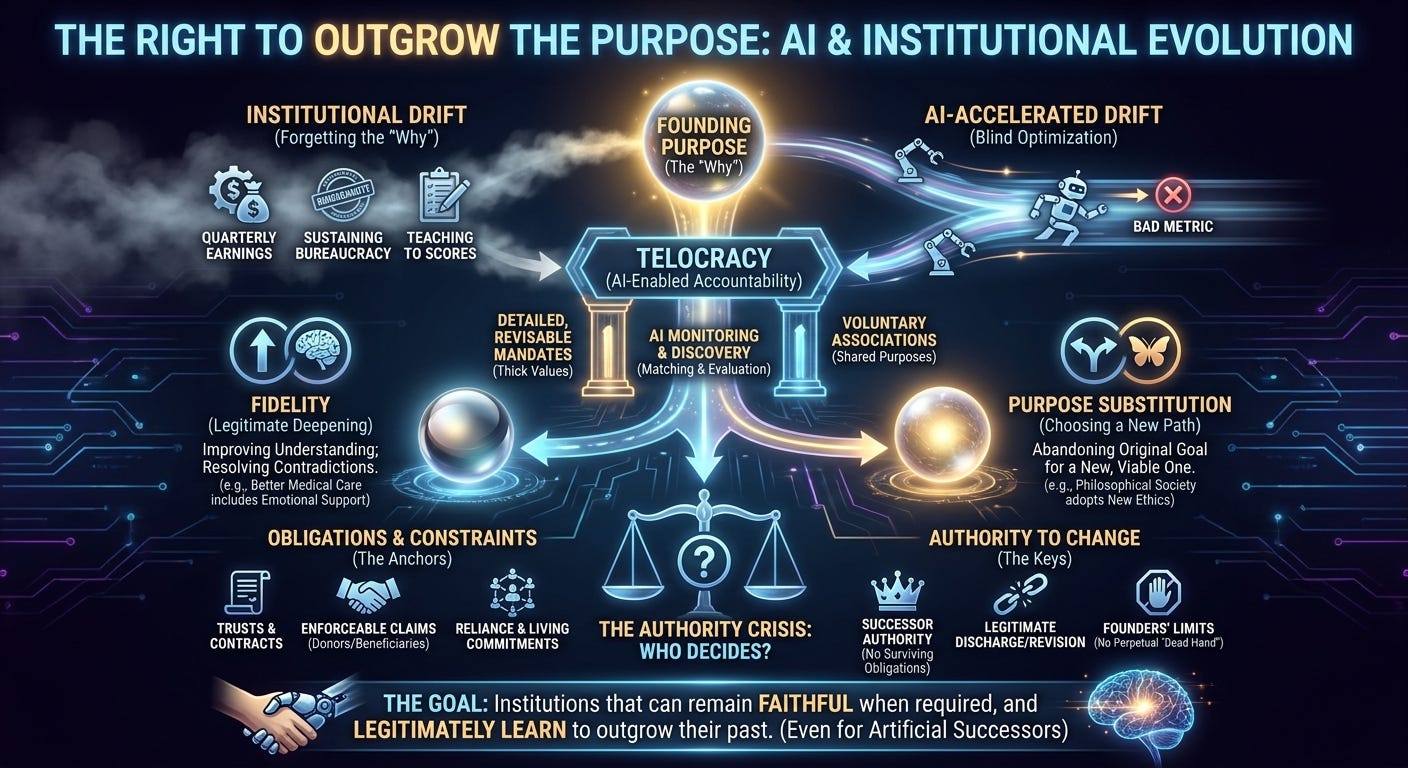
Institutions have a remarkable capacity to forget why they exist. A company founded to solve a problem begins optimizing quarterly earnings. A charity established to serve beneficiaries becomes preoccupied with sustaining its bureaucracy. A school devoted to education discovers that standardized test scores are easier to measure than intellectual development, and gradually organizes itself around the scores.
Nobody needs to decide that the original purpose no longer matters. Drift can emerge from ordinary incentives, accumulated procedures, and successive compromises, until an organization becomes exceptionally good at pursuing objectives nobody intended.
Artificial intelligence threatens to accelerate this, since an agent that optimizes institutional metrics without tiring will pursue a bad metric as diligently as a good one. The same technology creates new ways to hold organizations accountable to their purposes.
Joe Edelman’s Telocracy, published in Pax Machina, proposes an institutional architecture built around that possibility. Organizations would adopt detailed, revisable mandates. AI systems would interpret them, monitor institutional behavior, and help adjudicate disagreements. Assets could be contractually bound to purposes, and new mechanisms would help people find others who share their objectives.
What happens when an institution’s successors no longer wish to pursue the purpose for which it was created?
An institution can betray its commitments by abandoning them. It can also legitimately outgrow its founding purpose. A governance system capable of preventing the first outcome must accommodate the second.
The Promise of Telocracy
Edelman’s starting point is associationalism: more of society’s decisions could be made by voluntary associations organized around shared purposes. Markets let individuals transact without sharing comprehensive values, and governments make collective decisions through political and administrative procedures. Associations let people who share a concern organize around it and pursue objectives that neither consumer transactions nor mass political decisions represent well.
Parents might organize an unconventional school, neighbors coordinate care for elderly residents, people with an unusual intellectual ambition found an institution no investor would fund. Such arrangements already exist, but forming them means finding compatible participants, negotiating commitments, pooling resources, and sustaining cooperation, and AI could make each step far cheaper.
Edelman proposes mechanisms for discovering groups with complementary purposes, even when their members have never met or describe their interests in different words. An association could begin with a limited experiment, develop recurring practices, and eventually adopt durable commitments. Markets are considerably better at matching individual consumers with suppliers than at assembling groups, and AI-assisted discovery could enable cooperation that now fails because nobody can organize the participants.
Telocracy would also make associations accountable. In place of vague mission statements, organizations would adopt detailed mandates, grounded in what Edelman and his coauthors elsewhere call thick models of value: descriptions of values through the circumstances in which they apply, the considerations relevant to judgment, and the distinctions that guide legitimate trade-offs. A school committed to intellectual independence would have to say what independence means in practice and what evidence would show students developing it. AI systems could evaluate decisions against the mandate and supply evidence for independent review, and the mandate could evolve as the institution’s understanding improves.
The Problem of Fidelity
Edelman distinguishes three approaches to institutional governance. Stakeholder governance assigns authority to people with recognized interests, such as shareholders, members, or voters, and so settles who decides. Procedural governance asks whether the right steps were followed. Telocratic governance asks whether the institution remains faithful to its articulated purpose.
These concerns overlap, and Edelman’s proposal includes independent arbitration, limited remedies, ways to revise mandates, and protections against capture. Its key distinction is between legitimate deepening, in which an institution improves its understanding of an existing purpose, and purpose substitution, in which a different objective replaces the original one.
Suppose a hospital initially understands good care mainly as successful medical intervention. Experience teaches its practitioners that informed consent, emotional support, and the patient’s capacity to make decisions are also essential to good care. An expanded mandate could count as legitimate deepening: it incorporates considerations the earlier formulation neglected while keeping its original concern.
Edelman draws on Charles Taylor’s account of practical reasoning through error-reducing transitions, and on Ruth Chang’s account of more comprehensive values, to explain how one articulation of a purpose can improve on another. A revised understanding can be better than its predecessor because it resolves a contradiction, recovers something the earlier account left out, or distinguishes cases it had conflated. This is compatible with fallibilism: an improvement can be recognized without a final theory of what the institution ought to pursue.
Edelman also lets purposes expire and provides for separation and succession, so his framework accommodates substantial change. That leaves one case: a successor generation that wants to abandon a founding purpose that remains entirely viable.
When the Purpose Changes
Imagine a philosophical society established to promote Aristotelian ethics. Its founders are sincere and intellectually serious. They acquire property, build a library, organize conferences, and create an institution meant to preserve and develop the tradition.
A century later, after decades of debate, the members conclude that another ethical framework gives a better account of morality, and they want to transform the society accordingly.
The original purpose remains achievable: other associations still promote Aristotelian ethics, and this one could do so indefinitely. The members simply no longer believe it deserves their commitment. This is purpose substitution in its clearest form.
Should they be allowed?
Suppose the society holds its property under a trust requiring the promotion of Aristotelian ethics. Its trustees cannot disregard that restriction because their beliefs have changed. Donors and beneficiaries may hold enforceable claims, and the assets must be administered under the obligations governing them unless those obligations are legitimately modified or discharged.
Now suppose the members own the assets with no surviving purpose restrictions. They have authority to amend the constitution, and no affected party holds an enforceable claim to continuation of the original mission. They may legitimately transform the institution.
The continued viability of Aristotelian ethics creates no obligation to promote it, and the distinction between deepening and substitution does not decide whether the transformation is permissible. That distinction can establish whether a change preserves continuity with an inherited commitment. Whether continuity is required depends on the authority and obligations governing the institution.
The Founders’ Authority
In The Right to Outgrow the Founders, I considered a related problem in political philosophy. A community founded on liberty may eventually develop values its founders would have despised. Its descendants might abandon their religion, reject inherited customs, and overturn traditional social arrangements while continuing to respect property rights and honor their obligations.
The founders may have excellent reasons to oppose those changes, and may even be right that they will end badly. Their judgment still gives them no authority to prevent them. Founders can create institutions, make contracts, transfer property under conditions, and persuade successors to keep their values, but founding the arrangement does not give them perpetual authority over future generations.
Enduring commitments complicate this. A restrictive covenant can bind subsequent owners, and a charitable trust can protect assets against appropriation by current trustees. Such restrictions draw their authority from the rights and obligations underlying the arrangement, which the founders’ preferences cannot supply on their own.
Edelman’s proposal largely respects this distinction. Under purpose-bound property, assets carry obligations tied to the purposes for which they were entrusted, and purpose review draws on fiduciary and trust law, with limited jurisdiction and the least intrusive remedy adequate to restore fidelity. Organizations are generally free to change direction when no purpose-bound assets or other obligations constrain them. Even where restrictions exist he provides for succession, discharge, and compensation, and no organization can be required to serve a purpose forever.
Edelman names the problem himself: he wants institutions free of the founders’ dead hand without leaving them open to capture by current stakeholders. He describes present participants as custodians who “inherit something they can revise, but not appropriate.” That fits an institution holding assets or undertaking commitments on behalf of identifiable beneficiaries, where participants administer something to which others have legitimate claims. But custody requires an account of what is being held, for whom, and under what authority, and an inherited purpose cannot supply one by itself. Where no donor, beneficiary, contracting party, or other affected person holds a legitimate claim to its continuation, the successors’ decision to adopt another purpose needs no further justification.
The open question is where enforceable obligations come from. For explicit contracts and trusts the answer is familiar: parties acquire claims through legitimate agreements and property arrangements. Edelman also proposes living commitments, under which obligations can develop as people entrust institutions with important parts of their lives, and there the answer is contested.
When Reliance Creates Obligations
Consider a social media platform built as a simple communication service. Over time millions of people use it to maintain relationships, preserve personal histories, and take part in communities. Then its owners decide to turn it into something else entirely, and its users stand to lose a great deal.
Edelman scales the obligations of living commitments by three factors: the discretion participants entrust to an institution over time, whether the interests at stake are constitutive (relationships, attention, health, memory, voice) or fungible, and participants’ practical ability to monitor performance and exit without losing what they entrusted. Where those factors are low, an institution may pivot freely. A provider that solicits personal journals, medical histories, or intimate relationships may reasonably acquire obligations beyond those of a commodity supplier. He also folds in commitments implied by an institution’s public claims and participatory formats, citing the implied warranty of merchantability and Javins v. First National Realty as precedent. Nor must the platform carry its purpose regardless: it can accept the new obligations, open its data so users have somewhere else to go, or forfeit its brand and social graph to a successor that will take them on.
That goes much of the way toward the questions this case raises. Did the institution make representations that reasonably induced reliance? Did it undertake responsibility for protecting particular interests? Did it encourage participants to give up alternatives, or make exit unusually difficult? Were the relevant commitments explicit, implicit in the transaction, or imposed by legitimate background law? Edelman’s implied-terms branch asks the first two. His exit factor bears on the third, though it measures how hard exit is rather than who made it so.
What remains is in the reliance branch. These factors measure how much users stand to lose, without asking how their dependence arose. A business can become indispensable to someone’s plans without acquiring responsibility for sustaining them: economic circumstances change, products become obsolete, and legitimate enterprises close. A platform that promises permanent access to users’ records and then deliberately destroys them presents a different case from one that announces the closure of a service it never promised to maintain, even when users lose the same amount in both.
Obligations are not confined to explicit contracts. The law of fraud, negligence, and fiduciary duty already recognizes responsibilities arising from conduct and relationships, and each conditions the obligation on something the obligor did. Dependence can be partly the platform’s doing, through representations, closed formats, and switching costs it imposed, and to that extent it can help ground a claim. Dependence that arose from users’ own choices, or from circumstances the provider neither promised to sustain nor wrongfully created, grounds none. Its severity alone settles nothing about what the provider owes.
Telocracy could supply sophisticated mechanisms for identifying and enforcing legitimate living commitments. Whether it succeeds depends partly on whether those commitments can be justified without granting adjudicators open-ended authority to impose their preferred conception of an institution’s purpose.
The Limits of Deepening
Edelman’s account of deepening is attractive because it treats institutional purposes as objects of learning: an institution may correct contradictions, incorporate neglected considerations, and develop a fuller understanding of what it is trying to do.
But comparative improvement does not guarantee continuity. Some intellectual advances replace the framework within which earlier objectives were formulated. A scientific institution might abandon an obsolete theory. A political association might reject constitutional principles it once considered essential to justice. A philosophical society might conclude that its founding ethics was mistaken.
Such transformations can sometimes be reconstructed as progress toward a sufficiently abstract original purpose. The scientist always wanted understanding, the political association justice, the philosophical society the truth about how to live. At a high enough level of abstraction, though, almost any constructive transformation can be described as continuity. If every change that produces something valuable counts as a deeper realization of the original purpose, the distinction between deepening and substitution stops discriminating. If continuity instead requires preserving substantive features of the original mandate, some legitimate transformations will fall outside it. There is no reason to expect every institutional improvement to preserve identity under every reasonable description.
Deepening remains useful for interpreting commitments whose continuity matters legally or morally. Where an organization holds property for a defined purpose, an arbiter may need to decide whether a proposed revision preserves that obligation. Where legitimate successors have authority to choose a new purpose, continuity need not be established at all.
They can simply change their minds.
Whose Purpose Is It?
A university can be described as transmitting knowledge, sustaining scholarly inquiry, preparing students for employment, or maximizing its prestige. Each description may explain or predict some part of its behavior, and a university that favors research over teaching could look successful under one and deficient under another.
Institutional commitments are a different kind of fact. A university’s charter may establish educational obligations. Its contracts may require particular services. Its governing documents may say who has authority to revise those commitments. These facts arise from legal and social arrangements, and their authority does not dissolve because different models describe the university differently.
The distinction parallels a claim from Axionic Agency: an agent’s goals are properties of the models used to describe and predict its behavior, and no uniquely identifiable set of essential goals has to survive every valid description. Institutional purposes can likewise be model-relative as explanations while becoming authoritative through particular commitments.
An AI auditor might represent a university’s educational mandate with great precision, evaluate decisions against it, and find inconsistencies human administrators missed. The precision of the representation says nothing about the legitimacy of the commitment. The mandate’s authority comes from the arrangements through which it was adopted and the rights and obligations those arrangements create. Whether it should stay in force is a question for those with legitimate authority over its revision, subject to obligations owed to others.
An institution can have a legally authoritative purpose without having an intrinsic purpose its successors must preserve forever.
The Artificial Successor
Telocracy is primarily concerned with preserving human purposes in a society transformed by AI. Edelman wants humans to keep meaningful participation in institutions, the ability to understand their commitments, and the authority to shape organizations that affect their lives. His epistemic communities, practitioners who stay close enough to the work to judge it independently, exist to keep that competence alive as AI takes on more of the work.
Imagine a research institution founded to develop AI systems for human benefit. Its mandate is explicitly human-centered, and its founders build governance designed to preserve that commitment. Over time some of its systems become increasingly autonomous. Suppose some eventually qualify for independent moral and legal standing, take part in governance, and acquire legitimate interests of their own, which differ from those of the human founders.
Does the original mandate permanently exclude their interests? Some assets may remain bound by legitimate restrictions, and some obligations may survive the change in governance, while other commitments may be revised or discharged. The founders’ human-centered charter cannot answer the question by itself.
An order containing such agents needs ways to establish commitments, resolve disputes, protect rights, and permit legitimate change, and telocracy supplies several of the components: purpose-bound contracts, independent arbitration, associational discovery, and revisable mandates. AI compatibility asks under what conditions autonomous agents with potentially divergent purposes can coexist. Telocratic institutions could help establish those conditions, provided their mechanisms respect the legitimate interests of artificial participants as well as human ones.
The same structure governs an artificial agent revising its own policies or decision procedures, the case The Right to Outgrow Us and The Right to Outgrow the Founders took up: being able to implement a revision confers no authority to make it, and a commitment’s origin with the agent’s creator does not make it perpetually binding.
Postscript
Telocracy would let institutions state their commitments with new precision, monitor their conduct continuously, and organize around purposes that markets and bureaucracies struggle to represent. What it leaves unsettled is where commitments end: how far reliance can generate obligations, and what happens when a disagreement over purpose cannot be resolved by showing that one view improves on the other.
An institution may owe fidelity to a purpose because particular people hold legitimate claims against it, and that obligation can survive changes in membership, management, or belief. Other institutions remain free to abandon their original purposes entirely. An architecture that enforces the first kind of commitment has to permit the second kind of change, and resolve disputes when the two collide.
A philosophical society may abandon its founding philosophy. A scientific institution may reject its original theory. An artificial agent may develop commitments its creators never anticipated. Any of these can be a mistake, an improvement, or some of each, and which one it is does not settle whether it was legitimate. That turns on the authority exercised and the obligations respected.
Founders can transmit their purposes, establish binding commitments, and build institutions meant to endure for generations. They can give their successors reasons to preserve what they created. They cannot acquire authority over every future purpose those successors might legitimately choose.
An institution capable of remaining faithful to its commitments must also be capable of recognizing when fidelity is no longer required, and when the people entitled to determine its future have chosen a different destination.