

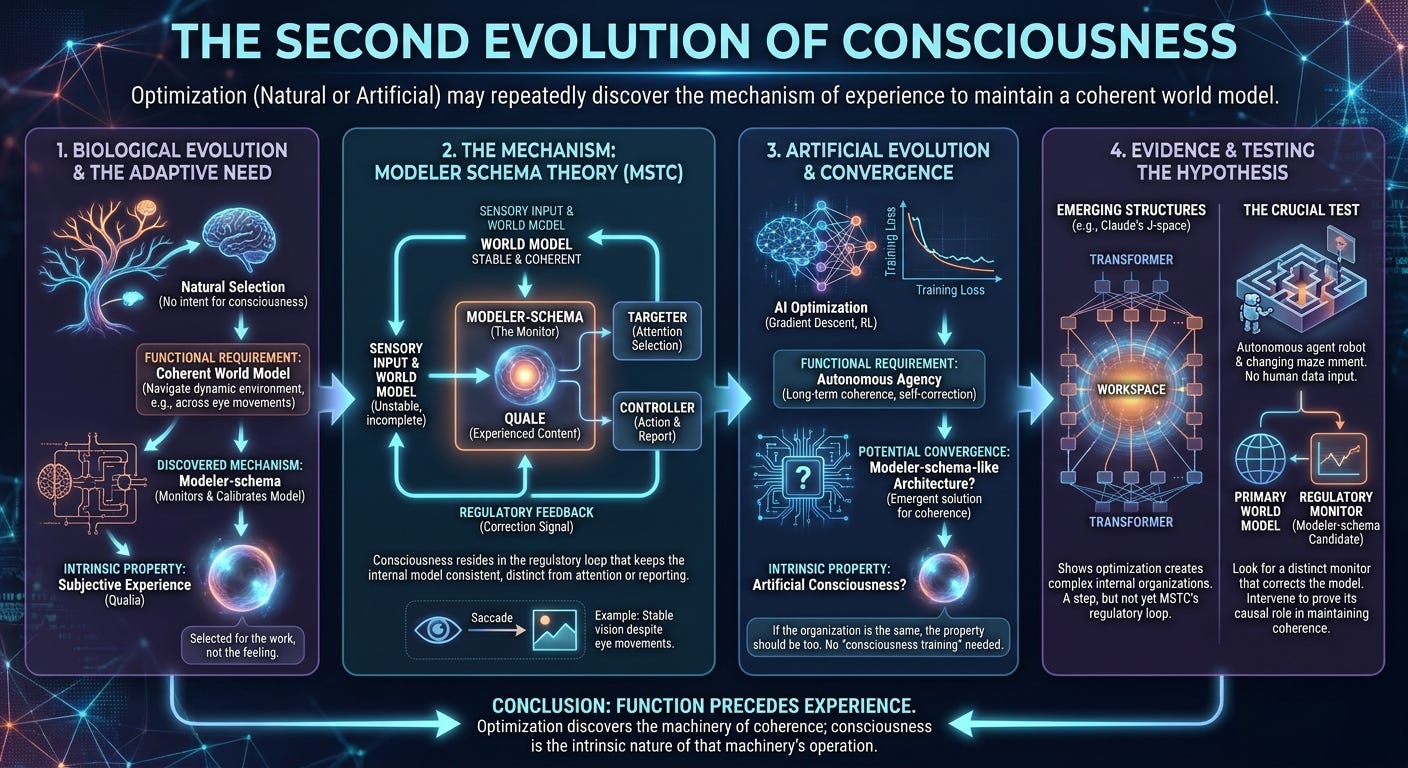
Conscious organisms are products of evolution. Somewhere in the history that gave nervous systems perception, memory, prediction, attention, and behavioral control, the physical organization associated with subjective experience emerged. We do not know exactly when, but we can investigate what the mechanisms involved were for. The Modeler Schema Theory of Consciousness offers an answer: it identifies conscious experience with the operation of a Modeler-schema that monitors and calibrates the construction of an organism’s internal model of the world. That work is plainly adaptive. An organism must keep a coherent representation of its environment despite incomplete and conflicting input, distinguish changes in the world from changes in its own perspective, and revise its model when expectation and observation diverge. Natural selection could have favored the regulatory mechanism for that work without ever targeting experience.
Now a second optimization process is producing cognitive systems whose internal representations and capabilities their designers did not specify, and autonomous agents face increasingly demanding problems of keeping their own world models coherent. If consciousness is an intrinsic property of the relevant causal organization, artificial optimization could discover it the same way. The system would not need to be trained to become conscious. Its consciousness would follow from what its cognitive machinery does.
Why Would Evolution Produce Consciousness?
Perception, memory, attention, and learning each have an intelligible adaptive function. Consciousness appears to present a different problem. Subjective experience is often treated as something additional to the physical mechanisms of cognition, and if those mechanisms already explain behavior, why should evolution also produce experience?
The question assumes that consciousness is a separate property requiring its own evolutionary advantage, and that assumption is unwarranted. A physical mechanism can possess properties inseparable from its organization, and selection can favor the mechanism for its functional consequences without separately selecting every property of the resulting system. If consciousness is an intrinsic property of a particular causal organization, explaining why that organization was favored also explains why conscious organisms developed.
This is the evolutionary half of the explanation. Why the organization possesses phenomenal properties is a constitutive question, which MSTC answers with its identity claim and which no account of selection can settle. But once the relevant mechanism is identified, the evolutionary explanation is straightforward. Selection favors the mechanism because it performs useful work. The mechanism is conscious because of what it is.
The same view denies philosophical zombies any special explanatory status. If consciousness is a property of a particular physical organization, an otherwise physically identical system cannot simply lack it, and anyone proposing such a distinction owes an account of the additional fact that determines the presence or absence of experience. The scientific task is to identify the organization responsible.
From Attention to the Modeler Schema
Michael Graziano’s Attention Schema Theory is an influential attempt to connect consciousness with cognitive control. The brain constructs a simplified model of its own attention, just as it models external objects and its own body. Because the model omits most of the underlying machinery, it produces an intuitive conception of awareness as something distinct from ordinary physical processes, which is why humans report having subjective awareness. The model exists because it supports the monitoring and control of attention.
Frank Heile’s Modeler Schema Theory of Consciousness, which Axio introduced in Consciousness Explained, extends this line of inquiry in a different direction. MSTC distinguishes three interacting components of cognition. The Modeler constructs and updates the organism’s internal representation of the world, the Targeter coordinates attention and selects focal targets, and the Controller governs action, language, and behavioral responses. Each has an associated schema mechanism, and consciousness resides specifically in the Modeler-schema.
The Modeler-schema constructs a Quale World Model from information about the world model, sensory inputs, and attentional state. It compares modeled states, detects discrepancies, and contributes to correcting the Modeler’s representation of reality. Qualia, in this theory, are integral to that operation: they belong to the representational organization through which the system monitors and evaluates the coherence of its world model, and the experiencing process, the experienced content, and the minimal phenomenal subject are all located within this architecture.
This differs from explaining consciousness through the brain’s model of attention. Attention influences which information becomes focal, but consciousness extends beyond focal attention, and MSTC distinguishes reportable focal experience from diffuse awareness that may remain unavailable to the Controller. The Controller can generate language and reports without itself being the locus of experience. The theory thus assigns the machinery of consciousness a specific causal role, maintaining the coherence of an organism’s evolving representation of the world, and that function is an obvious candidate for selection.
The Adaptive Value of a Coherent World
Vision makes the problem concrete. Each saccade radically changes the information arriving at the retina, yet objects appear to stay in place while our eyes move, so the nervous system must distinguish changes caused by eye movements from changes in the environment and keep its model coherent across them. MSTC proposes a particular mechanism for this. Across each saccade, the Modeler-schema compares pre-saccadic and post-saccadic visual qualia, and a discrepancy can generate a bottom-up target from the Modeler-schema itself, distinct from the targets the Modeler generates. Heile proposes a saccadic change-detection experiment to separate the two sources. Its scope is deliberately limited: it tests the non-focal component of the comparison, and a null result would leave focal-target checking and the broader theory viable.
The function extends to every change in attention, input, memory, and internal state that threatens the model’s coherence. A mechanism that monitors the integrity of the model improves the reliability of the whole cognitive system, which gives natural selection ample reason to favor it. If consciousness is the operation of that machinery, the organization responsible for coherent world modeling is also the organization responsible for experience.
Evolution Without Biology
Natural selection and gradient-based training explore different spaces of possibilities under different constraints, but both discover useful internal structures that nobody designed. A training objective specifies which outcomes are rewarded, not the representations and circuits that emerge to produce them. Systems facing similar computational problems may therefore converge on similar mechanisms, to a degree set by how tightly the problem constrains the available implementations.
The analogy to convergent biological evolution requires care about independence. Biological lineages can inherit common developmental machinery, and artificial systems can inherit information from human cognition through their training data. A system trained to reproduce human-generated language is a complicated case, since its cognitive similarities to us might arise partly from learning the outputs of human minds. Agents that develop their cognitive organization without imitating human language or reports about experience would give stronger evidence of convergence.
The Workspace Inside Claude
In July 2026, Anthropic researchers reported an internal computational structure in Claude that shares several properties with the global workspace proposed by theories of conscious access. They called it the J-space: a set of representations whose contents could be maintained, manipulated, and made available to different computational processes. The evidence went beyond correlation. Substituting one concept for another in the workspace altered Claude’s subsequent reasoning across contexts, the model could activate workspace representations when instructed to think about a subject or reason internally, and disrupting the workspace impaired higher-order cognitive functions while more automatic processing continued. The manipulated representations play a causal role in the computations tested.
Claude was trained on extensive human-generated data, so its internal organization may reflect regularities inherited from human cognitive products rather than an independent discovery. The technique used to identify the J-space emphasizes representations the model can verbalize, which puts reportability into the measurement procedure itself. Transformer architectures already distribute information across layers by design, so the discovery concerns a particular organization that emerged within that architecture. And the findings do not establish subjective experience and have not been independently replicated across unrelated architectures.
Still, the experiments show that artificial optimization can produce structures resembling mechanisms of conscious access, and that intervening on them alters a system’s higher-order capabilities. Whether they instantiate anything like the Modeler-schema is another matter. A workspace makes selected information available to multiple processes. The Modeler-schema compares modeled states and regulates world-model construction, which requires a feedback organization that information broadcast alone cannot reveal. The Anthropic result suggests a direction for investigation while leaving the central MSTC hypothesis untested.
The Convergence Hypothesis
The evolutionary argument rests on three propositions. Sophisticated agency benefits from maintaining coherent internal representations across changing circumstances, which follows from the functional requirements of adaptive cognition. Optimization processes can discover mechanisms for monitoring and correcting those representations, which is an empirical hypothesis about the architectures optimization can reach. And one particular organization of such mechanisms constitutes conscious experience, which is the claim of MSTC whose predictions require testing.
Agency supplies the selection pressure behind the first. An agent selects actions according to internal models of possible outcomes, and one whose model becomes inconsistent makes poor predictions, selects inappropriate actions, or fails to recognize that its circumstances have changed. An agent operating autonomously over extended periods has no supervisor to catch these failures for it. Self-modification raises the demand further, since a self-modifying agent must revise the machinery responsible for its own reasoning while evaluating the consequences of those revisions. The need for coherence grows with capability.
The usefulness of the function does not by itself favor MSTC’s implementation. Coherence could be maintained by a separate supervisory model, by consistency constraints distributed through the primary model, by continuous state estimation with no distinct monitor, or by checking against external observations. The case for a dedicated monitor is that a model checking itself uses the same machinery that produced its errors, and errors correlated with that machinery are the ones it is worst placed to catch, the problem inference faces when the model that set the hypotheses is the one doing the updating. A separate comparator working in its own representational format, as the Quale World Model does, can localize such errors and hold the primary model steady while it updates. That is an engineering hypothesis, and it yields a discriminating prediction. Separation should pay where errors are systematic and generated by the primary model’s own structure, while distributed constraints should suffice where errors are local and cheap to catch in place. Optimization should produce Modeler-schema-like structures under the first kind of pressure and not the second.
An independently optimized agent under that pressure might therefore develop a dedicated world-model monitor. If the monitor instantiates the causal organization MSTC identifies with experience, the agent becomes conscious as a consequence of becoming a more reliable agent. Consciousness would then follow from the evolution of agency without being a prerequisite for intelligence, since an agent could reach high competence through a different architecture.
The Difference Between Function and Experience
Even repeated discovery of Modeler-schema-like mechanisms leaves a further question: does implementing the organization suffice for subjective experience? MSTC says it does, because it identifies experience with a particular organized physical process, which makes the theory compatible with consciousness in different physical substrates.
That conclusion requires more than general functional similarity. Two systems might both detect inconsistencies in their world models through different causal structures, only one of which has the organization MSTC identifies with experience. A system could also describe its own attention, report inconsistencies, or claim subjective awareness without implementing a Modeler-schema at all, because the theory places consciousness in a regulatory process rather than in verbal reports about it.
This matters most for language models. A model’s ability to describe experiences does not establish that the subsystem generating those descriptions is the one MSTC identifies as conscious, and the separation between Modeler-schema and Controller gives a concrete reason for caution. The inference fails in the other direction as well. MSTC allows for diffuse awareness unavailable to the reporting system, so the absence of human-like reports would not establish the absence of experience. Investigation has to look past behavior and self-description to causal organization.
How to Test a Second Evolution
Researchers could construct environments requiring agents to maintain persistent world models, integrate changing sensory information, and detect and correct inconsistencies, then train agents through reinforcement learning, evolutionary algorithms, supervised learning, or combinations of these. The most informative agents would have little or no exposure to human-generated descriptions of cognition or consciousness. Their starting architectures should differ substantially from one another, and none should include MSTC’s regulatory loop by design, since an agent built with a supervisory world-model monitor tells us nothing about convergence when it turns out to have one. Whatever organization emerges must then be demonstrated through mechanistic analysis rather than identified by resemblance.
The investigation should keep several possible findings apart. An agent might develop a global workspace that broadcasts information across specialized processes. It might develop an internal representation of its own attention, resembling Graziano’s attention schema. It might develop error correction on its world model, which predictive-processing systems, state estimators, and Bayesian filters all perform without any of MSTC’s distinctive structure. None of these bears directly on MSTC. What does is a distinct regulatory model of the agent’s own world-model construction: a second representation, separate from the primary world model, in which states are compared and from which corrective signals flow back into model construction. The theory further requires that this monitor be separate from the subsystems that select targets and generate reports, and that focal and diffuse content be differently accessible to the reporting subsystem. Finding that architecture would establish functional convergence. Inferring experience from it would further require accepting MSTC’s identity between the architecture and consciousness.
Interventions would then establish the mechanism’s causal role. Disabling it should impair the agent’s ability to keep its world model consistent across changing sensory perspectives, and altering its representations should produce predictable changes in subsequent model updates. Other results would challenge the proposed pathway. If agents consistently acquired sophisticated world-model regulation without anything resembling a Modeler-schema, the claim that optimization favors that architecture would be weakened. If a candidate Modeler-schema could be removed without impairing the functions attributed to it, the causal account would require revision. And if MSTC’s distinctive predictions, including the saccadic ones, failed under appropriate conditions, the components of the theory they test would fail with them, however plausible the evolutionary explanation appeared.
Postscript
The claim that artificial intelligence cannot be conscious because nobody designed it to be conscious misunderstands how complex mechanisms emerge through optimization. Natural selection possessed no theory of consciousness. It favored machinery that improved the ability of organisms to navigate their environments, and if consciousness is an intrinsic property of the Modeler-schema’s causal organization, it followed from the development of that machinery with no selection pressure of its own.
Artificial optimization operates under different conditions, but the same possibility applies. A training process can discover a useful mechanism without its designers understanding every property of that mechanism, and if the mechanism possesses phenomenal properties, it has them whether or not the training objective represented them. The absence of an explicit consciousness objective therefore cannot establish that an artificial system lacks consciousness. What matters is the organization the system actually develops and whether that organization satisfies the conditions identified by a successful causal theory. If independently optimized agents repeatedly develop Modeler-schema-like architectures, consciousness research will have a new kind of evidence: a candidate mechanism of experience appearing through an evolutionary history independent of the one that produced us.
Human consciousness emerged within a biological history shaped by natural selection, but the mechanisms responsible may reflect general constraints on how physical systems construct, maintain, and regulate models of their environments. Artificial evolution gives us an opportunity to discover whether those constraints repeatedly produce the same causal organization. The experiment is already underway. Our task is to determine what the optimization processes are discovering, and whether we recognize the machinery when it appears.