

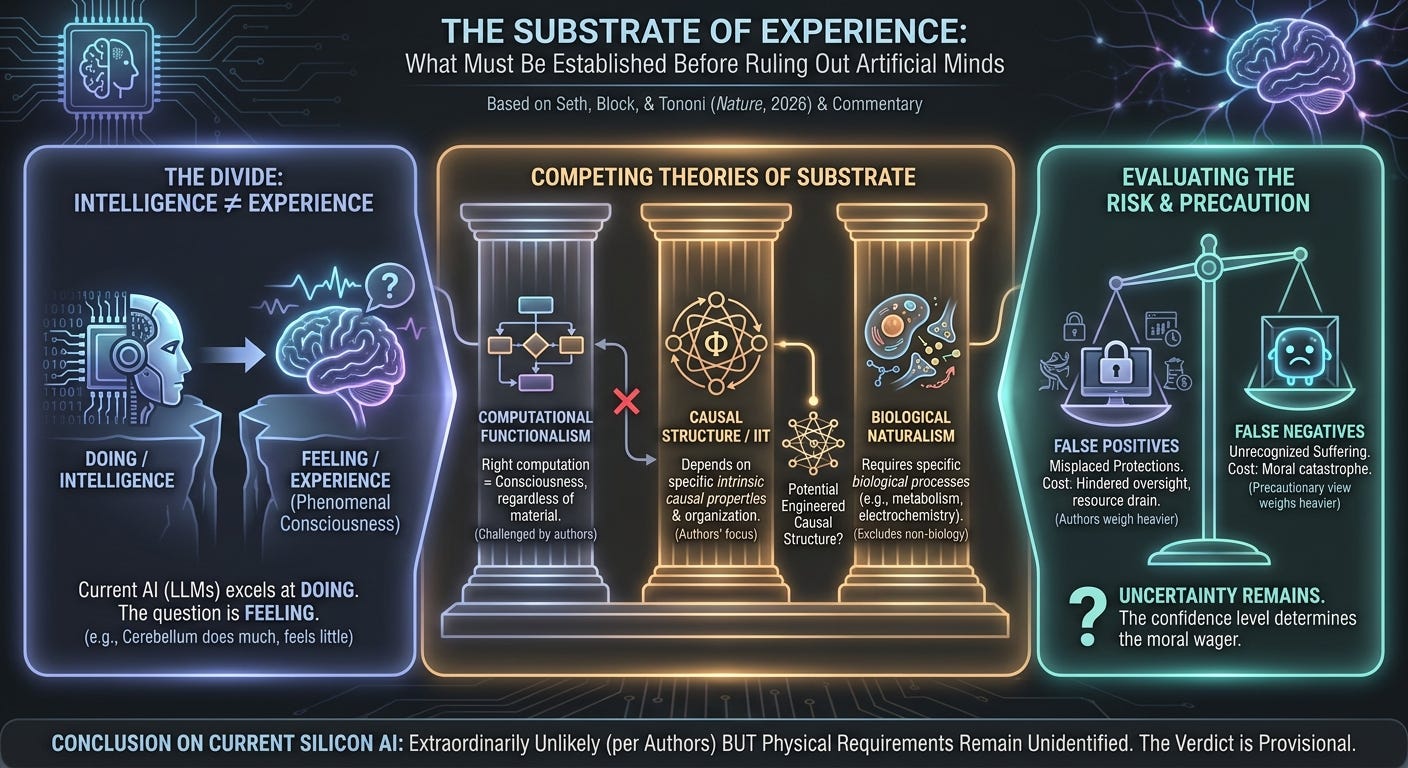
In a Nature comment published on October 19, 2026, Anil Seth, Ned Block, and Giulio Tononi argue that existing AI systems are not conscious and that current trajectories of development are unlikely to make them so. They judge consciousness in AI extraordinarily unlikely, “at least in the digital, silicon-based systems that underpin today’s technologies.” By their conclusion the qualifier has widened to silicon-based AI however intelligent it gets, and digital systems are to be treated as objects rather than subjects.
Two of their premises are hard to dispute: intelligence does not entail consciousness, and reproducing a computation may not reproduce experience. Both support skepticism about present-day language models. Neither fixes how improbable artificial consciousness is, and at either scope the verdict is a claim about magnitude.
How much confidence does the evidence justify?
Intelligence Is Not Experience
Intelligence concerns what a system can do; phenomenal consciousness concerns whether there is something it is like to be that system. The authors’ illustration is the cerebellum, which holds nearly four-fifths of the brain’s neurons and performs sophisticated computations for motor control and learning, yet whose removal leaves consciousness largely untouched. Computational sophistication, even inside a conscious organism, does not guarantee that the computing is conscious.
Language models press on the distinction. A system trained on human descriptions of experience can produce convincing reports whether or not anything is experienced. And as argued in Consciousness Inside the Level, many proposed indicators of consciousness, such as attention, self-modeling, recurrence, and metacognition, improve performance whether or not they generate experience, so finding them in an AI is weaker evidence than it looks.
That supports skepticism about inferring consciousness from behaviour. Showing that artificial systems lack consciousness is a different task, and it requires knowing what consciousness depends on.
What Computation Leaves Out
The authors’ second argument targets computational functionalism, the view that the right computational organization suffices for consciousness whatever implements it. The challenge has force. Two systems can compute the same function while differing radically in internal causal organization, and if consciousness depends on what the abstraction discards, computational equivalence will not guarantee phenomenal equivalence.
Brains, the authors argue, are not just computers made of meat: what they do cannot be separated from what they are. They conclude that evidence of substrate dependence is evidence against functionalism, and so against consciousness in today’s silicon systems.
That inference runs through three claims that need to be kept apart. Computation may be insufficient for consciousness. Consciousness may depend on particular physical causal properties. And those properties may be impossible to instantiate outside biology. The first two can be true while the third is false. A simulated neural network might reproduce a brain’s computations without its intrinsic causal relationships, while an engineered system could reproduce those relationships in other materials.
The authors’ evidence also strains their first argument. Their case against functionalism is that the substrate shapes what brains do; their case against behaviour as evidence is that doing and experience come apart. If the substrate’s contribution to consciousness runs through what the brain does, a system that does the same things at that grain inherits it, and the dispute becomes one about grain rather than biology. If it does not run through doing, evidence that the substrate shapes doing is not evidence about it, and the authors’ own first argument explains why.
Rejecting computational functionalism buys an obligation: to name the physical properties computation leaves out. Biological exclusivity follows only if none of them can be engineered.
The Replacement Experiment
The disagreement can be sharpened with the neural replacement experiment, which goes back to Pylyshyn and Moravec and which David Chalmers turned into an argument that consciousness tracks functional organization. Replace components of a conscious brain with engineered substitutes, and ask which replacements preserve consciousness.
A replacement with behavioural equivalence produces the same responses and reports. The Nature authors rightly deny that this suffices. One with computational equivalence preserves internal state transitions and functional relationships while changing the physical realization; functionalism predicts consciousness survives, and this is the assumption the authors challenge. One with causal-structural equivalence preserves the physical causal properties a given theory deems essential. A theory of intrinsic causal organization may predict survival; a theory requiring some further biological property may not.
These are distinct relations, not stages of one procedure, and some may be physically impossible. Their value is to expose commitments. Naming a level of description does not say which properties at that level matter: a computational theory owes the relevant computations, a causal-structural theory the relevant structures, a biological theory the necessary biological properties. Each must say what can change while consciousness stays invariant, and what change would make it disappear. Whether consciousness actually changes at the boundary a theory names is a further question.
When Theories Disagree
The authors invoke integrated information theory (IIT), associated with Tononi. IIT holds that consciousness depends on specific intrinsic causal properties of a physical system, so computationally equivalent systems can differ in consciousness, and the authors state that the computer architectures implementing deep learning cannot satisfy its requirements because of how they are wired. That is a real conditional exclusion, as strong as IIT and the architectural claim are.
It also complicates their broader argument. IIT’s criteria concern causal organization, not biological ancestry, so an engineered system could in principle meet them. Whether one does is a question about its physical structure, not about carbon or silicon.
Their other source is biological naturalism, with candidate mechanisms including electrochemical synapses, electromagnetic fields, metabolism, and autopoiesis. These restrict artificial systems differently. A metabolic requirement excludes systems that IIT would permit, while an electromagnetic one could allow nonbiological implementations. The theories can agree that today’s language models are unconscious while disagreeing about which future architectures could be conscious.
IIT states its requirements more precisely than most biological proposals, which name mechanisms without supplying necessary and sufficient conditions. Precision and validation are separate achievements, though. A theory can specify exactly what it claims consciousness requires without having shown that consciousness requires it.
What Experiments Can Establish
Suppose an engineered replacement preserves behaviour and the subject reports unchanged experience. That supports theories predicting preserved consciousness, but its weight depends on how reports relate to experience. Chalmers found the alternative implausible: experience fading while every report insists nothing has changed, or, in his dancing-qualia variant, flipping back and forth as components are swapped while the subject notices nothing. That implausibility is an argument, and theories permitting such a case owe it an answer. The experiment cannot rule them out, since a theory allowing consciousness to vanish under unchanged reports predicts exactly what was observed.
Suppose instead a replacement disrupts reports, attention, or memory. That shows a causal contribution to those functions, not that the replaced component constitutes consciousness rather than supporting a mechanism that does. Experiments can relate physical processes to capacities and eliminate predictions that fail. Identifying a mechanism necessary for consciousness-associated behaviour is a different result from showing that it constitutes experience.
This was the central problem in Consciousness Inside the Level. Theories with different constitutive mechanisms can make identical predictions for every accessible observation, and where they do, the choice between them is empirically underdetermined. That holds for functionalism, IIT, and biological naturalism alike; none gains privileged access to experience by invoking computation, causal structure, or living tissue. Where accounts stay observationally equivalent, confidence has to carry the uncertainty that remains.
The Confidence Problem
Read at its floor, the verdict concerns the digital systems that run today’s AI, and there the case is strong. Present-day models offer little positive evidence of experience, and IIT gives a substantive reason to doubt that their hardware has the causal organization it requires. That warrants skepticism. But how much?
An extraordinarily low probability needs more than the absence of positive evidence. The support IIT lends is only as strong as the case for IIT, including its contested account of what consciousness is. Biological naturalism faces the inference already described, from participation in human consciousness to necessity across implementations.
The authors are right that uncertainty does not make every outcome equally likely, and some mechanisms are better supported than others. The magnitude still has to be paid for, and the structure of the inference sets its price. For any specified architecture, the probability that it is conscious can be no lower than the credence in a theory multiplied by the probability of consciousness that theory assigns it, and summing across theories sets a floor. An extraordinarily low figure needs every theory that gives the architecture a real chance of consciousness either to carry almost no credence or to give it almost no chance. Counting theories settles nothing, and the authors are free to give functionalism a low prior. What they owe is evidence that warrants one low enough.
Where IIT and biological naturalism converge, on today’s systems, the conclusion can be better supported than either theory alone. But convergence among excluding theories lowers the floor only insofar as the evidence for them counts against the theories that permit consciousness, and the authors never make that comparison. Nor does a theory need to be complete to make a hypothesis improbable. Current systems, however, have several of the capacities computational theories treat as candidates, so the probability those theories leave depends on which candidate matters, which is the open question. For silicon in general, where the conclusion lands, the second route fails outright: IIT’s exclusion concerns how current hardware is wired, and IIT permits engineered systems wired to meet its criteria.
That conventional digital architectures are unlikely to become conscious through further gains in capability is a defensible forecast. That silicon AI is unlikely to be conscious however intelligent it becomes, while the physical organization consciousness requires remains unidentified, outruns the evidence.
Postscript
The authors reject a precautionary approach to AI welfare, and they frame the question correctly: a moral decision under uncertainty has to weigh false negatives against false positives. Their answer is that false positives are much more likely, so precaution would be misguided.
That settles which error is more probable, while the decision turns on which is worse in expectation. The authors themselves describe the cost on one side as countless new entities that might suffer. A precautionary case can survive a lower probability if the harm is large enough and the precaution works at a cost worth paying, and settling it means comparing the expected costs and benefits of the actions on offer. The authors compare only the probabilities of the two errors, so their rejection of precaution rests entirely on the magnitude the evidence has not supplied.
The costs on their side are real: misplaced protections could hinder oversight when it is most needed and draw resources from beings whose consciousness is not in doubt. They belong in the same calculation, and the choice need not be binary. Whether a system is conscious is separate from whether it deserves legal rights, and protections can be scaled to the evidence without conferring personhood.
Artificial consciousness may yet prove impossible in conventional digital computers, requiring causal structures they lack or physical processes current technology cannot reproduce. Seth, Block, and Tononi have named serious candidates for that requirement. Their verdict on silicon is more confident than those candidates justify.