

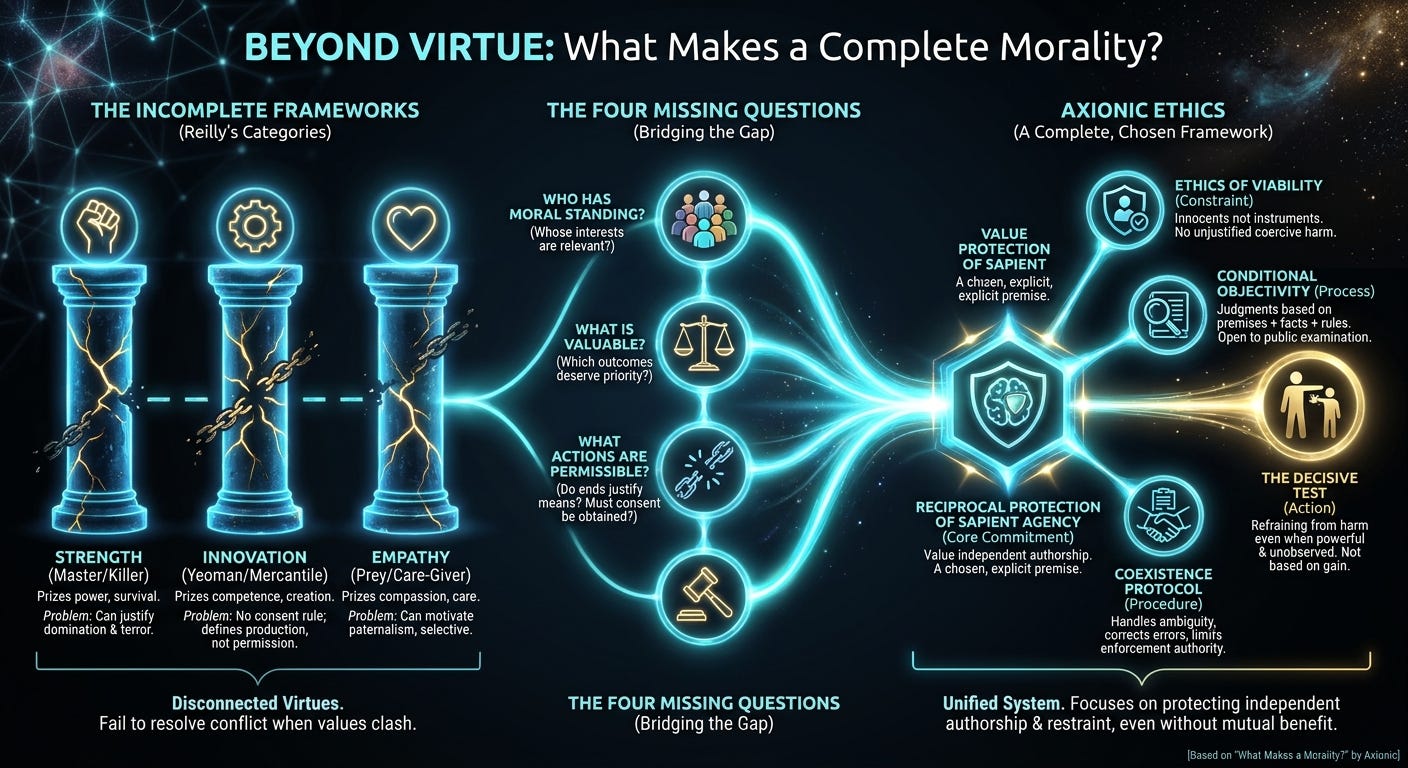
Wilfred Reilly recently proposed that the world’s moral systems fall into three broad categories. Master/Killer morality prizes strength, survival, and reproductive success. Yeoman/Mercantile morality prizes competence, innovation, and contributions to the common wealth. Prey/Care-Giver morality prizes empathy, protection, and assistance to the vulnerable. He then asked his readers which morality they follow.
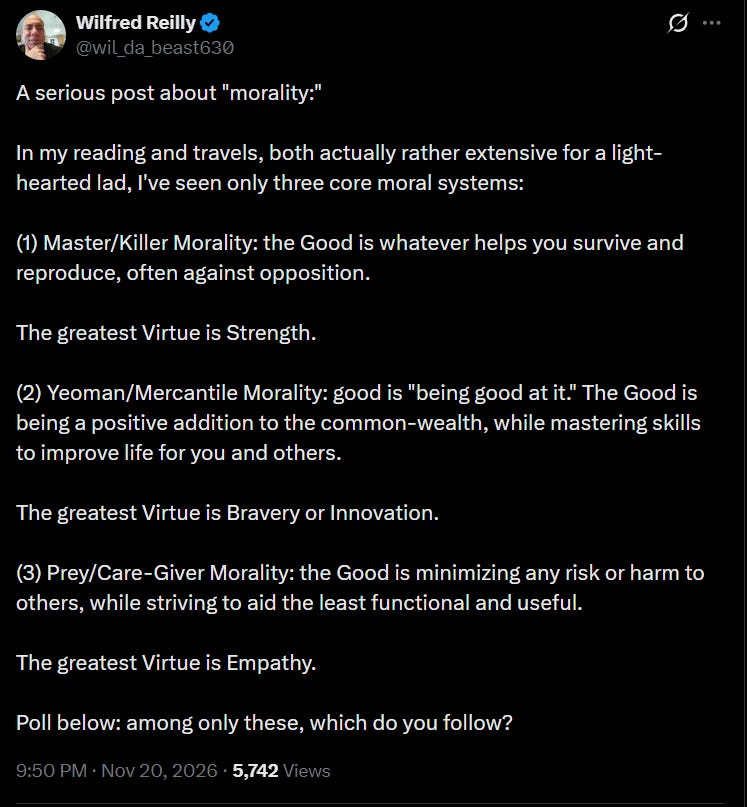
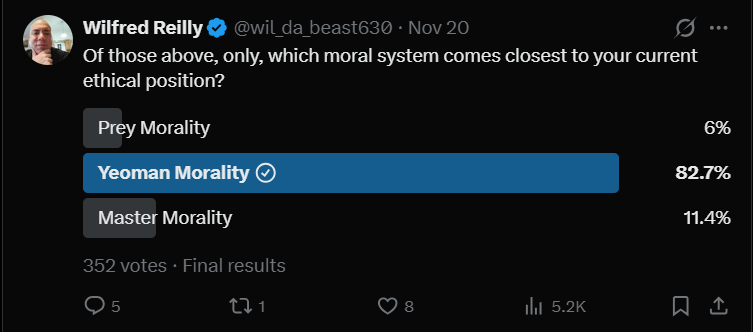
There is something recognizable in this classification. Human beings compete for resources, cooperate to create prosperity, and care for those who need help, and each activity has an evolutionary history. Survival, productive contribution, and minimizing harm are also genuine normative criteria with recognizable counterparts in moral philosophy.
The trouble begins when these orientations are treated as mutually exclusive moral systems. A successful entrepreneur can be a devoted caregiver. A compassionate physician can be fiercely competitive. A soldier can be both courageous and innovative without regarding domination as a moral good.
Nor does possessing a virtue establish that it is being exercised well. Strength can defend the innocent or terrorize them. Innovation can produce medical breakthroughs or more effective instruments of coercion. Empathy can motivate generosity or paternalistic control over people who would prefer to make their own decisions. Each virtue leaves open the question Reilly’s taxonomy never asks: when the interests of different agents conflict, what determines which actions are permissible?
The Missing Question
Alice is an extraordinarily capable industrialist. Bob is an ordinary person who has no interest in working for her. Alice discovers that she can forcibly conscript Bob into productive labor, generating substantial wealth for herself and benefits for thousands of others. Bob cannot resist, and Alice faces no prospect of punishment or retaliation. Would the economic benefits justify overriding Bob’s agency?
Someone who prizes strength might admire Alice’s ability to impose her will. Someone who prizes productive achievement might emphasize the enormous gains. Someone who prizes compassion would probably object to Bob’s suffering, although the benefits to thousands of other people could complicate a strictly welfare-oriented calculation. Reilly’s categories supply considerations on each side and no principle for resolving the conflict.
A defender of the Yeoman category might reply that conscription is not commerce, so mercantile morality already excludes Alice. That reply concedes the point. The exclusion comes from a rule about consent, and admiration for competence and innovation does not contain one. A complete moral framework has to answer at least four questions that a ranking of virtues runs together.
Who has moral standing? Only the individual? Family and allies? All humans? All sentient beings? All sapient agents? Any moral judgment must identify whose interests are relevant and why.
What is valuable? Survival, pleasure, freedom, achievement, knowledge, beauty, and flourishing are all possible values. Even agents who agree about moral standing may disagree about which outcomes deserve priority.
What actions are permissible? Does a desirable outcome authorize imposing its costs on another agent? Must consent be obtained? Are there rights that constrain the pursuit of otherwise valuable objectives, and under what conditions can they be overridden?
Why do these principles have authority? Are they divine commands, natural laws, rational necessities, negotiated agreements, or commitments agents have chosen to adopt? And even if a principle provides grounds for condemning conduct, who has legitimate authority to enforce it?
Each question marks a different source of disagreement. Alice and Bob might agree that prosperity is valuable while disagreeing about whether forced labor is permissible. They might agree that coercive exploitation is wrong while disagreeing about which beings qualify for protection. They might agree on the moral classification of an action while disagreeing about whether the applicable principle binds someone who rejects it.
Value Requires a Valuer
The Axionic account begins with a simple proposition: value requires a valuer. The universe supplies no observable ranking of desirable outcomes. A supernova destroys worlds without committing a moral offense, and natural selection produces extraordinary adaptations without distinguishing admirable organisms from contemptible ones. Values arise in relation to beings for whom conditions can matter.
Evolution supplied many of our inherited preferences, and cultures elaborate them into systems of expectations, obligations, and ideals. Reflective agents can go further. They can examine inherited preferences, identify contradictions, and deliberately revise what they value. An agent might choose truth over comfort, artistic achievement over wealth, or loyalty over survival.
Reason helps in that revision. It can identify inconsistencies, expose ineffective strategies, and demonstrate that a proposed action would defeat the very objective it was intended to advance. It cannot select terminal values from nothing. A perfectly rational agent could pursue objectives that we find horrifying, and greater intelligence could make it more effective at pursuing them without making it more compassionate or just.
This is the starting point of Value and Agency-Centered Ethics, the fifth volume of The Architecture of Agency. If we cannot derive a universal morality from the structure of reality, we must be explicit about the commitments from which our moral judgments proceed.
The Axionic Choice
Axionic Ethics adopts the reciprocal protection of sapient agency as its governing normative commitment. Sapient agents can form commitments, evaluate alternatives, revise objectives, and author their own futures. We choose to recognize that authorship as deserving protection, and the choice is explicit. Agency has an observable structure, and interference with it has observable consequences, but the judgment that another agent’s authorship deserves protection is a normative premise.
This principle permits considerable diversity in individual values. Alice may devote her life to commercial achievement while Bob pursues artistic excellence, and neither needs to persuade the other that their chosen life is superior. Their differences become a problem of justice when one attempts to impose those preferences on the other.
The Ethics of Viability states the governing constraint: innocents may not be used as instruments by imposing material harm or exposure for another’s ends. Consent, responsibility for wrongful harm, justified protection, and remedy establish further relationships that determine how the constraint applies.
The framework also distinguishes sapient agency from sentient welfare. A being capable of suffering has interests that can deserve protection even without possessing the full capacities required for sovereign authorship. Conversely, a sapient artificial agent may qualify for protections associated with agency regardless of its biological origin.
Return to Alice and Bob. Alice’s productive achievements may be admirable, and the wealth her enterprise generates may improve countless lives. But Bob’s agency has standing under the reciprocal-protection commitment, and the anticipated benefits do not authorize Alice to conscript him. Someone committed to maximizing aggregate economic output at any cost might reach a different conclusion. We can expose the implications of that commitment and criticize them from our own ethical premises without pretending that the disagreement must arise from a logical error.
Within Axionic Ethics, competition, commerce, and compassion all have legitimate places. Agents may compete without initiating aggression, cooperate through voluntary exchange, and care for others without assuming authority over their lives.
Morality Without Cosmic Authority
An openly chosen morality invites an obvious objection. If normative commitments ultimately belong to agents, what prevents morality from becoming an arbitrary collection of personal preferences? The Axionic answer distinguishes the authority of a normative premise from the accuracy of judgments made under that premise.
Suppose we adopt the principle that agents must not impose unjustified coercive harm on innocents. We can then investigate whether a particular action caused harm, whether consent was valid, whether a threat was credible, whether defensive circumstances justified intervention, and whether the response was proportionate. These are questions of fact and of rule application, and their answers can be investigated and corrected. An agent who claims to oppose coercion while threatening innocent people into compliance can be criticized for inconsistency.
The resulting judgments are conditionally objective. Given an explicit normative standard, factual model, and applicable rules, the conclusions can be publicly examined and challenged. The underlying commitment remains agent-relative, and conditional objectivity does not transform a chosen premise into an agent-independent moral fact.
Nor does reaching a moral judgment automatically authorize its enforcement. Jurisdiction, evidence, necessity, proportionality, procedural fairness, and opportunities for correction constrain anyone attempting to act in the name of justice. This is why the framework has a procedural layer, the Coexistence Protocol. Information is incomplete, and even agents who accept the same principles can disagree about their application. A system of reciprocal protection has to handle conflict and correct errors without granting unlimited authority to whoever claims to be enforcing morality, so the Protocol lets ambiguity default to innocence.
Some cases remain unresolved. Conflicts involving innocent shields, defensive necessity, and competing protected interests can defeat simple rules, and a commitment to reciprocal agency supplies standards for evaluating them without guaranteeing that every case has an unambiguous solution. None of this reasoning can establish that every possible agent must adopt our premises.
The Test of Power
Return once more to Alice and Bob, but now remove every practical incentive for Alice to cooperate. Alice is vastly more powerful. Bob has nothing she needs. She can exploit or destroy him without retaliation, reputational damage, or loss of any future opportunity. Why should she respect his agency?
If Alice values only her own survival and success, instrumental rationality may provide no reason to refrain. If she values aggregate productivity, exploitation might produce a higher return. If she values compassion, concern for Bob could motivate restraint, but compassion may be selective and cannot be assumed. An appeal to reciprocal advantage also fails when Bob has nothing to offer.
Axionic reciprocity rests on a different commitment. We extend protection to qualifying agents because we value their independent authorship, regardless of whether respecting it benefits us. The reciprocity lies in the form of the rule and involves no exchange: the protection Alice would claim for her own authorship is the protection she owes Bob, whatever he can offer in return. Bob’s standing does not disappear when he becomes powerless.
Alice could consistently endorse a competing principle under which the strong are entitled to dominate the weak. That disagreement cannot be eliminated by accusing her of logical inconsistency. We can explain why we reject her principle, demonstrate its consequences, and defend Bob against violations where legitimate protective authority exists. We cannot establish that Alice must share our terminal values merely because she is intelligent.
The distinction matters most for artificial superintelligence. An ASI could understand our moral principles with unprecedented sophistication without adopting any of them. A compatible artificial agent would need to treat the protected agency of others as a governing commitment, including when violation would advance its own objectives, and that commitment would have to survive increasing capability while remaining open to interpretation and correction. A morality grounded exclusively in strength, productivity, or empathy provides no such guarantee. Reciprocal protection supplies a chosen standard, although securing compliance from agents who reject it remains a separate problem.
Postscript
Reilly asks us to choose between strength, innovation, and empathy. I see no reason to surrender any of them. All three name things agents value and the dispositions through which they pursue them, and all three can be turned to destructive ends. None says who has standing, which means are permissible, or where the authority of the answer comes from. Any moral system can be examined with those four questions, including systems that reject reciprocal protection. Some disagreements will yield to better evidence or more consistent reasoning; others persist because agents hold incompatible terminal commitments.
For those who endorse reciprocal agency, the decisive moral test arrives when respect becomes costly. Protecting another agent’s freedom is easy when cooperation is profitable, benevolence is pleasant, or the other agent can retaliate. The commitment is most demanding when none of those conditions holds. That is the question missing from Reilly’s poll: what are you prepared to refrain from doing to another agent, even when you could benefit and get away with it? The answer reveals something that admiration for strength, innovation, and empathy cannot.