

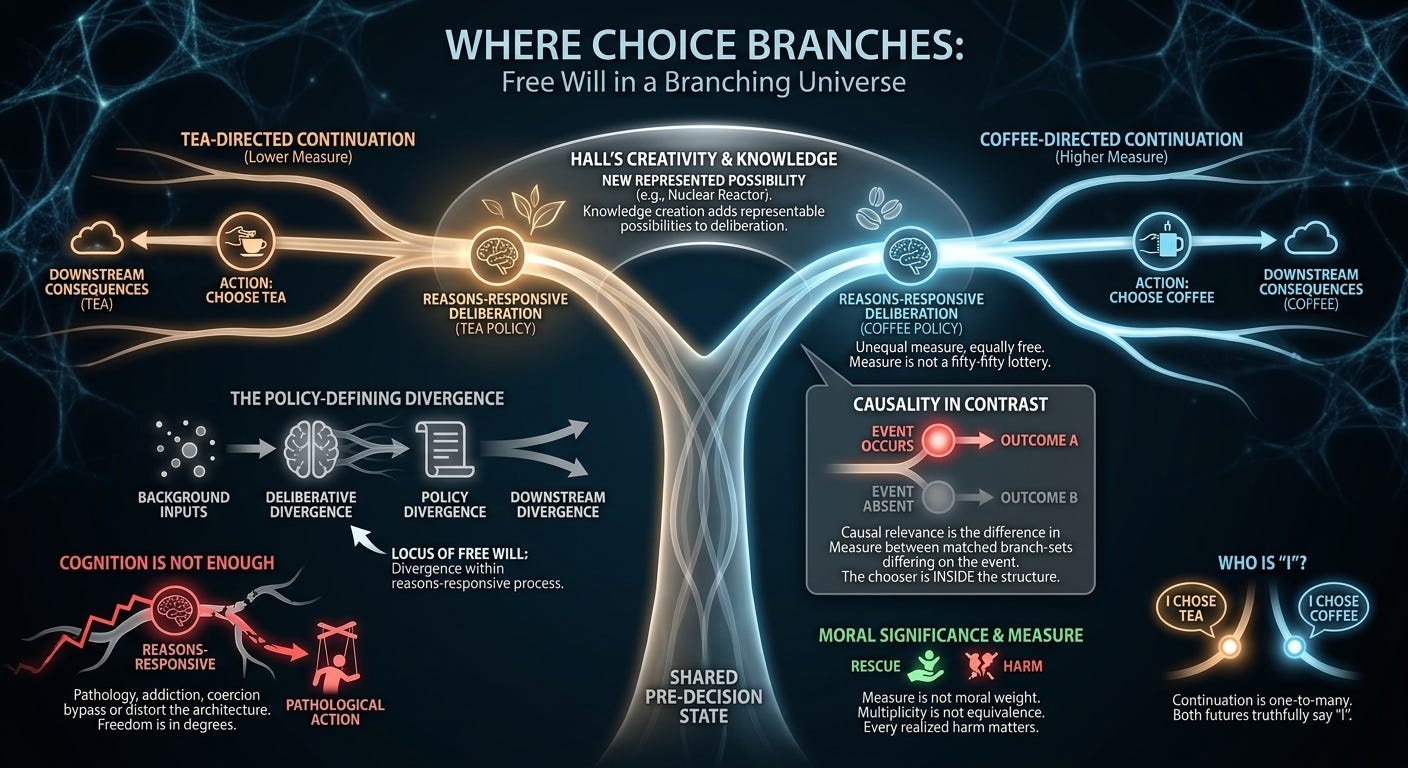
Brett Hall has proposed a problem-centred approach to free will. Rather than start from a definition and ask whether physics permits it, he asks what phenomenon we are trying to explain in the first place. Humans deliberate, imagine alternatives, criticize them, create new explanations, and act on what they think. Hall argues that none of this disappears because the underlying physics is lawful. That physical law determines what happens tells us nothing about why someone chose tea over coffee, wrote one argument instead of another, or conceived of a nuclear reactor when nobody before had.

He is substantially right, and it is still not enough. Causal efficacy is cheap. A thermostat has internal states that produce distinct downstream outcomes. A guidance system represents its environment and adjusts. An artificial controller of sufficient capability can evaluate options, implement a policy, and generate consequences that depend on its internal state. If free will is more specific than control, something has to separate a free choice from ordinary causal regulation.
Quantum Branching Universes offer an answer, though not because branching is needed for causation. Classical compatibilism already handles that much: had the agent deliberated otherwise, the action would have followed otherwise. QBU adds that the alternatives need not stay counterfactual. Distinct deliberative trajectories can be physically instantiated in distinct continuations of the universal state. The question stops being whether an identical universe could somehow have produced another choice, and becomes a question about where the realized alternatives diverge and how the divergence propagates.
Tea or coffee
Suppose you are deciding between tea and coffee. Before deliberation completes, there are continuations in which you choose tea and continuations in which you choose coffee. Take the measures to be equal, which is a convenience of the diagram. No single future waits for you to select it; both outcomes occur, in different continuations of the universal quantum state.
The naive picture puts a single self in front of two branches, picking one: you → choose → tea or coffee. That cannot be the physical story, because there is no observer outside the wavefunction to pick which continuation becomes real. The chooser has to be inside the branching structure.
Start instead from a shared pre-decision cognitive state. In some continuations deliberation develops toward tea and issues in the policy of taking tea; in others it develops toward coffee and issues in the policy of taking coffee. The physical consequences downstream differ accordingly. The divergence of outcomes is the smaller half of it. Distinct deliberative computations come to be associated with distinct policies, and the policies organize what follows.
Different thoughts produce different actions, which is still too weak a formulation, since a thought can be causally efficacious without being free. The divergence has to occur inside a reasons-responsive process: one that represents alternatives, weighs them, and produces a policy on the basis of that weighing.
Causation inside the wavefunction
This fits the Axionic account of causality, on which a candidate event is causally relevant when the Measure of an outcome differs across matched branch-sets: branches agreeing on declared background conditions and differing on whether the event occurs. Compare branches in which tea-directed deliberation occurs against matched branches in which it does not, holding the kitchen, the available drinks, and the agent’s history fixed. The Measure of reaching for tea, drinking it, tasting it, and laying down the physical records of having done so differs across the two sets. Run the comparison for coffee-directed deliberation and the Measure difference falls out accordingly.
The matching does the work that severing incoming relations does in an intervention model. Without it the comparison would be worthless, since branches containing tea-directed deliberation are obviously the branches where tea gets drunk, and mere co-occurrence establishes nothing. What the contrast requires is that the branch-sets agree on everything the model declares as background and part company on the deliberation alone.
Nothing here requires the total measure of the universe to change, and no amplitude has to be transferred out of coffee continuations into tea ones. The causal relation lives in the contrast: tea-directed cognition goes with tea-correlated consequences, coffee-directed cognition with coffee-correlated ones. The thought is efficacious because the Measure of what follows differs across branch-sets matched on background and divided by the deliberation.
One worry can be retired here. Talk of tea continuations and coffee continuations might seem to presuppose a sharp branch structure that a warm, wet, thermally noisy brain could not possibly sustain. The presupposition runs the other way. Reaching for tea and reaching for coffee are macroscopically distinct action sequences that displace air, move limbs, and leave records in the room and in memory. Two such histories cannot interfere: the environmental degrees of freedom that would have to be recohered are already dispersed beyond any prospect of recovery, and the brain’s noisiness accelerates the dispersal rather than impeding it. Conditional on both occurring, they occur in decohered branches. Decoherence explains why macroscopically distinct histories behave as dynamically autonomous continuations. It does not by itself tell us what measure attaches to a high-level outcome like tea or coffee, and it does not hand down a unique decomposition into branches.
That holds even though the universal state evolves under deterministic quantum dynamics. Global determinism does not entail local causal impotence. Deliberation is one of the physical processes through which the deterministic evolution runs. Cognition having antecedent causes no more makes it epiphenomenal than a match strike having antecedent causes makes it irrelevant to the fire.
What branching adds
Everettian branching is not necessary for compatibilist free will, and nothing here shows otherwise. A classical deterministic theory can describe an agent as reasons-responsive and causally efficacious using counterfactuals, and the description will be perfectly good.
What QBU changes is the structure of the explanation. Where distinct deliberative outcomes are physically instantiated, they stop being hypothetical descriptions of unrealized possibilities: tea-directed and coffee-directed deliberation occur, in distinct continuations. The universal dynamics realize the alternatives; the cognitive differences settle which downstream consequences correlate with which trajectory.
One traditional confusion drops out at that point. Free will stops needing to mean that one complete physical state somehow yields two incompatible outcomes, and it stops needing a metaphysical chooser positioned outside causation to select a future from a menu.
Two things the account does not need are worth separating out, since both are easy to read into it. It does not need tea and coffee to carry equal or even comparable measure; a continuation of tiny measure is still a continuation, and its rarity bears on its weighting rather than on whether it exists. Someone who deliberates carefully and arrives at overwhelming confidence in favour of tea has not thereby become less free. Freedom is not a fifty-fifty quantum lottery. It does not need the quantum divergence behind the two histories to originate in the brain either. The universal state already contains an enormous decoherent structure whose differences trace back to causal origins arbitrarily remote from any nervous system, and a divergence seeded by some ancient event can propagate through millions of steps before arriving at two nearly identical agents facing a cup. The policy-defining divergence still sits where the account puts it, in deliberation.
Everett does not prove compatibilism. It supplies compatibilism with a physical realization in which the alternative deliberations belong to the ontology rather than to counterfactual bookkeeping.
When the difference comes from outside
Change the experiment. In one set of continuations someone puts tea in front of you and nothing else; in another, coffee. You drink what is there. Your cognitive state differs across the two cases, your action differs, your sensory experience differs, and cognition is still a causal participant in producing the action.
The phenomenon is nonetheless not the one we started with. The policy difference has been imposed by the environment. The agent is responding to distinct circumstances rather than resolving a common deliberative problem along distinct reasons-responsive trajectories, and cognition tracks an antecedent difference instead of supplying the one that defines the policy.
That sharpens the criterion. A free choice occurs when the alternative continuations diverge within the agent’s reasons-responsive deliberative process, when the divergent deliberations define distinct policies, and when those policy differences causally produce distinct downstream actions.
This is compatible with the divergence having remote physical origins, though the compatibility needs saying. An upstream perturbation counts as imposition when it is already the policy difference, settling what the agent does without passing through evaluation, as the tea-only and coffee-only arrangements do. An ancient quantum event that eventually seeds two slightly different neural states imposes nothing of the kind. It supplies different inputs to the same evaluative machinery, and the machinery still has to do the work of turning them into distinct policies. What disqualifies a case is the deliberation being bypassed, not the difference being old.
“Diverge within cognition” carries no commitment to a unique microscopic instant at which a quantum branch splits inside a neuron. Everettian branching is emergent, approximate, and distributed through decoherence. The commitment is to a causal model of agency in which the policy-defining difference sits in the deliberative computation rather than being wholly imposed by some prior external distinction.
Cognition is not enough
Internal causation cannot be sufficient either. A tumour alters behaviour. Addiction generates compulsions. Injury, coercive conditioning, panic, psychosis, and intoxication all produce cognitive states that influence action while eroding the agent’s control over it.
So the boundary does not fall between internal and external. It falls at whether the process remains adequately reasons-responsive: whether the agent can represent alternatives, assess reasons, revise an evaluation, and convert that evaluation into policy. A pathological process can run inside the skull while bypassing, distorting, or disabling that architecture entirely.
Freedom therefore comes in degrees. Someone addicted may still deliberate, under severe distortion of policy selection. A tumour-induced compulsion may leave most of cognition intact while introducing an impulse largely sealed off from reasons. Neither case is an exception to the account; both show why the criterion has to concern the structure of deliberation rather than the anatomical location of the disturbance.
The policy-defining divergence
Every cognitive difference has earlier physical causes. Upstream there are microscopic differences, environmental perturbations, memories, neural states, prior interactions, all feeding the later deliberative divergence. Were free will to require cognition to be the first physical difference anywhere in the causal history, no physical agent could have any.
Sourcehood does not require causal primitiveness. The question is which difference defines the alternative policies at the agent’s own level of description. Background physical divergence supplies inputs. Deliberative divergence changes the evaluation of represented alternatives. Policy divergence commits the agent to an intended course of action. Downstream divergence shows up in behaviour and in the environment.
Free will belongs to the middle of that sequence, where reasons-responsive deliberation becomes policy. Cognition does not escape physics at any point; it is the physical implementation of choosing.
Hall’s creativity
Hall’s account fits here. He stresses that humans do more than respond to a fixed menu. We create knowledge, and new explanations bring previously unavailable actions within reach of deliberate choice. Before anyone understood nuclear physics, building a reactor was physically possible and not an actionable human policy: the laws permitted the continuations, and no human had the knowledge to represent the outcome or pursue it intentionally.
Knowledge creation changed that without adding a physical possibility to the universe. It added a represented possibility to human deliberation. Universal dynamics constrain what is physically possible; agents can create what is representable. Some of those representations become actionable policies, and deliberation can then differentiate among them and produce consequences that follow.
Creativity thus expands the domain over which free agency operates, which is Hall’s point and a good one. It should not define free will, though. Choosing tea over coffee involves no novel conjecture whatever, and the alternatives may have been familiar for decades. What makes the act a choice is that the policy-defining difference between the continuations is instantiated in the agent’s own reasons-responsive deliberation.
Does everything happening make choice meaningless?
Everettian multiplicity raises the obvious worry. If there are continuations in which you choose well and continuations in which you choose badly, does moral significance collapse? One continuation holds the person who saves the drowning child, another the person who walks away. What is left of the claim that choosing well matters?
The worry assumes that moral significance requires global exclusivity, so that an action matters only if no version of the agent anywhere in the wavefunction does otherwise. No reason has been given to accept that. In one set of continuations the deliberative process results in the child surviving; in another it does not. Both existing does not erase the causal or moral distinction between them.
Every realized harm still matters. Low measure does not render suffering unreal, and a victim in a low-measure continuation suffers no less for the rarity of similar continuations. Measure and moral weight are not the same quantity. Quantum measure describes how outcomes distribute under a policy; what those outcomes are worth is a question for a moral theory.
Policies can still differ in the Measure distributions associated with their downstream outcomes. One policy carries a very small measure of continuations in which the child drowns, another a much larger one, and the two are causally distinct even though neither eliminates every bad continuation. How to aggregate such distributions morally is a further question in ethics, and the free-will account can leave it open.
A murderer is not absolved because some other continuation contains a rescuer. Moral evaluation attaches to the deliberative process, the policy it issues, and the consequences that follow where they follow. Multiplicity is not equivalence.
Who is “I”?
Branching also forces a change in how the personal pronouns work. Before the divergence, the present agent has multiple future continuations, and there is no further fact about which one it will really become. Afterward, each continuation refers to itself indexically as I. The tea-drinker truthfully says “I chose tea” and the coffee-drinker truthfully says “I chose coffee,” and neither statement requires the other continuation to be unreal.
A hidden classical assumption goes with it: that personal identity stays one-to-one through time. In a branching ontology, continuation can be one-to-many. The pre-decision agent has several descendants, each inheriting its memories and history up to the divergence, after which their causal histories come apart.
This clarifies the traditional question of whether you could have done otherwise. From inside a completed tea-drinking continuation, the exact history leading to tea cannot also contain the coffee choice and remain the same history. From the standpoint of the pre-decision agent, there are future continuations in which deliberation resolves toward tea and others in which it resolves toward coffee. Classical debates run these together. QBU separates them: counterfactual alteration of a fixed history is unnecessary, while plural continuation from a common antecedent does the work.
Postscript
The classical intuition harbours a homunculus. We picture a single self at a fork in reality, inspecting two futures and taking one: tea ← self → coffee. Everettian quantum mechanics deletes the picture, because no single observer stands outside the branching universal state. What there is instead: physical continuations containing distinct cognitive computations, distinct policies, distinct consequences.
That looks hostile to free will at first. If both outcomes happen, what can it mean to say I chose one? Choice is not an extra event performed by something outside the computation. The branching deliberative computation is the choice.
In tea continuations, tea-directed deliberation yields a tea-directed policy and a tea-directed action; in coffee continuations, the coffee-directed analogues. The causal distinction between the futures runs through the agent’s own reasons-responsive process. Free will does not consist in making one physically possible continuation uniquely real, and it demands no violation of deterministic dynamics, no injected metaphysical randomness, no uncaused self hiding between neurons. It asks that alternative policies be instantiated through reasons-responsive deliberation and that the policy differences organize the futures downstream.
The universe branches for innumerable reasons, almost none of which have anything to do with anyone deliberating. Free will does not ask the brain to cause the branching. It asks that some of the branching histories differ because the agent deliberated differently.