

Popper’s improvement
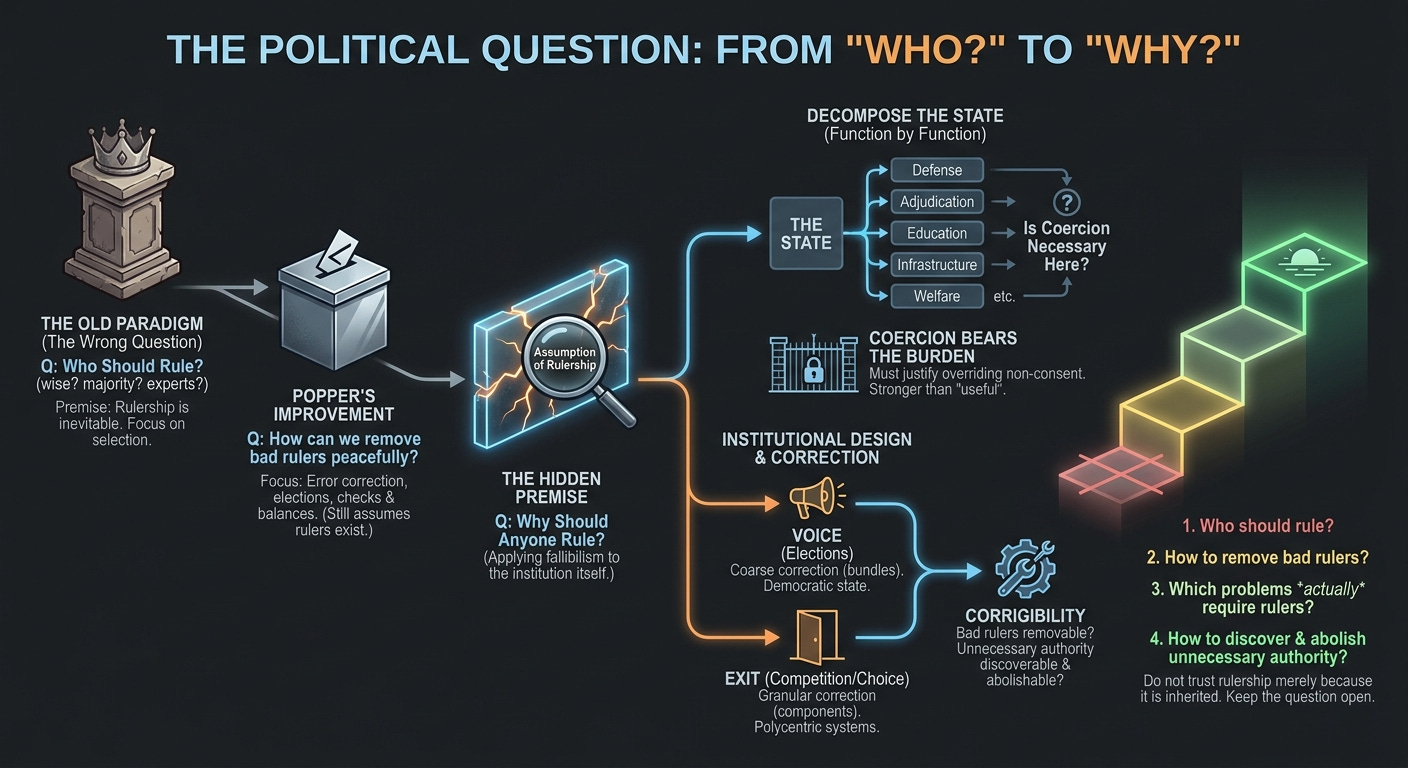
Karl Popper made one of the most important moves in modern political philosophy by changing the question. The traditional question was: Who should rule? The wise? The virtuous? The majority? The experts? The workers? The people?
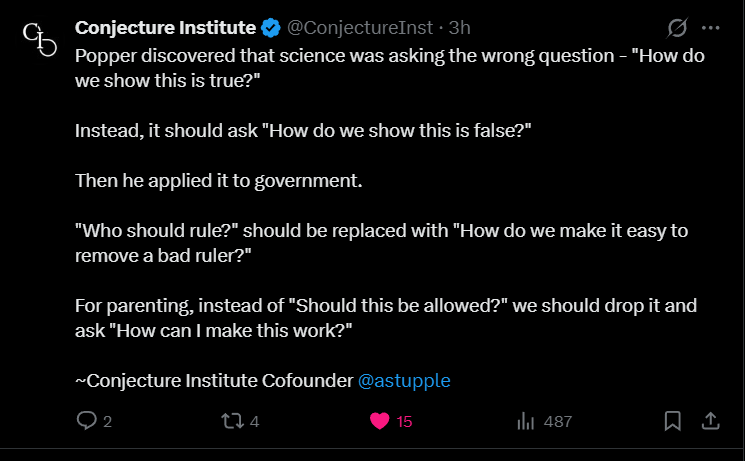
Popper thought this was badly framed. No procedure can reliably identify rulers who will remain wise, competent, benevolent, or incorruptible, so political institutions should not depend on finding the right people. The more useful question is: How can we organize political institutions so that bad rulers can be removed without bloodshed?
This is a major improvement. It replaces faith in selection with error correction, assumes that political mistakes will happen, and asks how institutions can make those mistakes corrigible. Elections, opposition parties, constitutional constraints, divided powers, an independent judiciary, a free press, and peaceful transfers of power become mechanisms for discovering and correcting political failure.
But Popper’s reformulation leaves one premise untouched: why should anyone rule?
The hidden premise
“Who should rule?” assumes that rulership is necessary and asks only who should exercise it. “How can we remove bad rulers?” is better, but it preserves the same assumption. There will be rulers; the problem is merely how to constrain and replace them.
That is an odd stopping point for a philosophy built around exposing assumptions to criticism.
In science, a theory does not become exempt from challenge because it occupies the centre of the framework. We ask what evidence would count against it. Political institutions deserve the same treatment. If a particular exercise of coercive authority is claimed to be necessary, we should ask what would show that it is unnecessary. If monopoly provision is claimed to be necessary, we should ask whether competing arrangements can perform the same function. If compulsory participation is claimed to be necessary, we should ask whether voluntary coordination can solve the problem instead.
The political question should therefore begin not with the ruler but with the problem the ruler is supposedly necessary to solve.
Apply Popper to Popper
Popper’s political insight was that institutions should be designed on the assumption that rulers can be wrong. Taken seriously, the next question follows: can the institution of rulership itself be wrong?
Not wrong in every conceivable case. Not historically useless. Wrong as the presumed solution to some particular class of problems.
A conventional political debate asks what the government should do about X. A more critical inquiry asks why X requires government action at all. The precise version asks: what property of X requires coercive monopoly provision rather than voluntary, competitive, decentralized, or polycentric coordination?
Those questions may still produce an answer involving government. Some problems may genuinely require coercive collective action. But that conclusion should be reached rather than embedded in the question. The existence of a hard problem does not establish the necessity of a ruler.
Decompose the state
“The state is necessary” is too large a proposition to evaluate usefully. States perform many different functions: adjudication, policing, defense, infrastructure, certification, redistribution, monetary administration, education, welfare provision, environmental regulation, and thousands of others. Each function makes a separate institutional claim.
For each one we can ask: What problem is being solved? Why does solving it require coercion? Why does it require monopoly provision? Could competing institutions perform the function? Could participation be voluntary? What evidence would count against the claim that state provision is necessary?
This decomposition blocks a common move in political argument, in which a plausible case for one state function is allowed to bleed into unrelated ones. Perhaps national defense requires centralized coercive coordination. Even if true, it does not follow that schooling does. Perhaps criminal adjudication cannot be entirely privatized. Even if true, it does not establish a government monopoly over currency.
Institutional necessity has to be defended function by function. Two of those defenses have been attempted elsewhere: national defense and criminal justice, the two functions most often treated as settling the question for all the rest.
Coercion bears the burden
There is an asymmetry between voluntary and coercive arrangements. If two people voluntarily transact, cooperate, associate, or create an institution, they do not need to establish that everyone else benefits from it. They need the consent of the participants. A coercive institution makes a stronger claim: it asserts authority over people who may reject its objectives, methods, costs, or judgments, and that creates an additional burden of justification.
The question should therefore not be why government shouldn’t do something, a formulation that treats coercion as the default and demands a case for restraint. The question is: why is coercion necessary here?
Usefulness is not enough. A policy may be beneficial. A public agency may perform valuable work. A government program may produce outcomes many people strongly prefer. None of those facts by itself establishes a right to compel unwilling participants. The justification required is stronger: the objective must warrant coercion, and coercion must be necessary or sufficiently difficult to avoid.
Public goods, externalities, coordination failures, and free-rider problems are not objections to this framework. They are possible answers to its question. If a problem cannot be solved adequately through voluntary or polycentric arrangements, and if the consequences of non-coordination are sufficiently serious, coercive collective action becomes a candidate remedy. It still has to outperform the available alternatives, justify the claims it overrides, and remain proportionate to the problem. None of that can be inferred merely from the fact that governments traditionally address it.
Power is not coercion
Political argument often obscures this issue by expanding the word coercion until it includes any large asymmetry in bargaining power.
Private actors can possess wealth, monopoly power, bargaining leverage, or control over resources on which others depend. Those facts may produce bad outcomes, make competition desirable, or create high switching costs and severe dependency. But they do not by themselves constitute coercion. An employer who says “accept these terms or I will not employ you” is exercising bargaining power. A monopolist who says “pay this price or I will not sell to you” is exercising market power. A platform that says “follow these rules or do not use our service” is exercising contractual authority over its own service. None of those actions is coercive merely because the other party has poor alternatives.
Severe dependence does not erase the distinction. A person may face terrible alternatives because another party controls something valuable, even something essential, and that can create exploitation, domination, or morally objectionable bargaining conditions. But coercion is a different relation: one party compels another through force, threat, seizure, confinement, or another violation of a protected boundary. Fraud can likewise invalidate a voluntary agreement, but through deception rather than compulsion.
If control over the resource was itself acquired coercively, the analysis changes at that point. If it was not, scarcity and dependence do not transform refusal to transact into coercion. This is why examples involving a private owner controlling an essential resource do not settle the issue merely by making the bargaining situation extreme. If the owner seized a resource to which others had a legitimate claim, the coercion lies in that seizure. If the owner legitimately created or acquired the resource, refusing to provide it on someone else’s preferred terms is not equivalent to threatening that person’s life.
Political theories of domination may condemn such private power on other grounds. That is a coherent normative position, but it is a different claim, and it should not be smuggled into the definition of coercion.
A sharper objection runs the other way. Property rights are not self-enforcing. Someone excludes trespassers, and exclusion is backed by force, so the arrangement is not noncoercive at all: it merely distributes the coercion differently. That objection has force against any account treating property as a peaceful baseline from which state action departs.
But it does not collapse the distinction. Force used to repel an invasion of a protected boundary and force used to cross one are different relations, and any legal order that distinguishes self-defense from assault relies on the difference. What the objection does establish is that boundaries have to be justified rather than assumed: which claims count as protected, how they were acquired, and what defense of them is proportionate are questions this framework has to answer rather than inherit. That justification cannot come merely from existing law or title. It requires an independent account of which agency boundaries deserve protection, and where those boundaries are drawn wrongly, enforcing them is aggression regardless of what the deed says.
Private actors can of course behave coercively. Kidnappers, extortionists, violent cartels, criminal protection rackets, and private organizations that confine people or seize their property do exactly that. When they do, the relevant distinction is not public versus private power. It is coercion versus voluntary interaction.
The distinction also matters for rulership. A business owner who decides the terms on which others may use his property is not thereby ruling them in the political sense. Property and contract necessarily create decision rights, and calling every asymmetric decision right rulership dissolves the concept. Historical feudalism does not show otherwise. Feudal lords did not merely own land; they often exercised legal jurisdiction, taxation powers, military authority, compulsory labor claims, and restrictions on movement. Those are political powers. Feudalism shows that property can be bundled with coercive jurisdiction, not that property becomes rulership by becoming extensive.
Institutions that cannot fail
Popper’s epistemology exposes another political weakness: institutions can become insulated from falsification.
When a program succeeds, its success demonstrates that the program works. When it fails, the failure demonstrates that it needs more funding. When people evade it, the evasion demonstrates the need for stronger enforcement. When alternatives appear, the alternatives may be prohibited. When outcomes remain poor, administrators can argue that conditions would have been worse without intervention. The institutional claim becomes progressively insulated from adverse evidence, since every outcome is reinterpreted as a reason to preserve or expand the institution.
This does not describe every government program. It describes a structural danger of monopoly institutions: they can suppress the feedback that would eliminate a failing competitor.
Competitive and decentralized arrangements have an epistemic advantage precisely because they do not have to be infallible. Different arrangements can be tried simultaneously. People can compare outcomes. Failed organizations can lose participants and resources. Successful practices can be copied. Bad decisions need not be reversed by convincing an entire polity.
Exit is an error-correction mechanism.
Voice and exit
Popper rightly emphasized the peaceful removal of rulers, and the ability to replace a government without civil war is an extraordinary institutional achievement. But elections are a coarse correction mechanism. Voters choose among bundles of candidates, parties, policies, institutions, and coalitions. They usually cannot retain one public service while rejecting another, choose among competing providers, or withdraw selectively from a failed policy.
Elections provide voice over the bundle. Exit permits selection among components. Where exit is possible, institutional correction can occur without first assembling a political majority: a dissatisfied customer does not need to win an election to replace a badly run restaurant, and the feedback is faster, more local, and more granular.
But exit is only useful when it is real. A nominal option to leave may do little work if exercising it means abandoning one’s home, livelihood, social network, legal protections, or access to essential infrastructure. High switching costs can make an institution poorly corrigible even when participation remains formally voluntary.
Poor corrigibility is a problem even when it is noncoercive. Nothing in this framework implies that every voluntary arrangement is good, just, or beyond institutional criticism. It means only that we should identify the defect correctly rather than relabel it as coercion.
Coercion, power, and corrigibility are distinct variables. A private monopoly may have enormous market power and poor corrigibility while remaining noncoercive. A democratic state may be substantially corrigible while remaining coercive. These properties should not be collapsed into one another.
Democracy makes rulers more corrigible than autocracy does, while competitive, polycentric, and low-exit-cost institutions can sometimes make correction more granular still.
The question before the question
Popper was right to reject the search for the ideal ruler. Human beings are fallible, and institutions built around presumed wisdom eventually encounter stupidity, corruption, ignorance, or malice. The ability to remove bad rulers matters.
But the same fallibilism should be applied one level earlier. Before asking who should exercise authority, ask why the authority exists. Before designing mechanisms to replace its administrators, ask which of its functions require monopoly administration. Before deciding how government should solve a problem, ask what prevents people from solving it without government.
Sometimes there will be good answers. Sometimes there will not. The important constraint is that the question remain open.
The progression should continue:
Who should rule?
Better:
How can we remove bad rulers?
Better still:
Which problems actually require rulers?
And finally:
How should institutions be designed so that unnecessary authority can be discovered, challenged, bypassed, and abolished?
Popper taught us not to trust rulers merely because we had chosen them. We should not trust rulership merely because we inherited it.