

In the Financial Times, Martin Sandbu asks whether AI could revive the socialist dream and argues that it may finally overturn one of the twentieth century’s strongest arguments against central planning. Hayek’s objection was that the knowledge required to allocate resources efficiently is dispersed across millions of people and cannot be collected or processed by a central authority. Sandbu takes that limitation to be technologically obsolete. A superintelligent AI wired into transaction records, inventories, supply chains, sensors and production systems could observe and process economic information at a volume no planning ministry of the last century could have imagined. At the limit, he writes, such a system could predict who wants, needs or can produce what, and would “surely bury Hayek.”
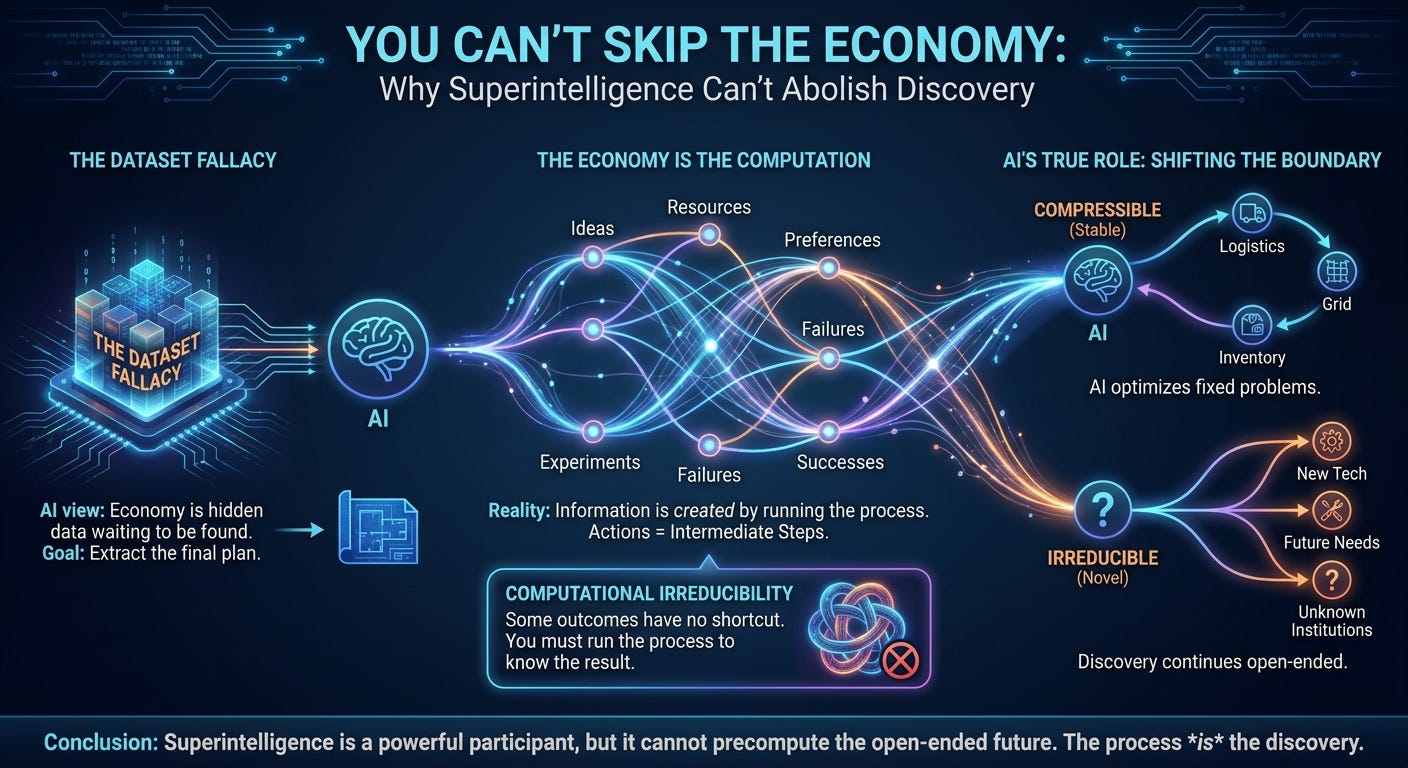
The argument identifies a real technological change and then mistakes the economy for a dataset. AI weakens the old bureaucratic-information objection to central planning, because it can gather, structure and process information on a scale markets once had no technological rival for. But is the economically relevant future already implicit in that information, waiting for a sufficiently capable intelligence to extract it? Much of it is not. The economy does not merely contain information; it creates information by running.
Mises’s calculation problem, which turns on the absence of factor prices under common ownership, is a different argument. This one applies to a planner handed every price a market would have generated.
The information does not all exist yet
Some economic information is already present in the world and merely difficult to collect. How many tons of copper are sitting in warehouses? Which factories have idle capacity? How much electricity will Toronto consume tomorrow afternoon? These are conventional information problems, and better sensors, databases and predictive models solve them increasingly well.
Much of the information that determines future economic outcomes does not yet exist. Suppose copper becomes unexpectedly scarce. Which engineer will find a way to use less of it? Which manufacturer will redesign a product around aluminum? Which recycling technology, uneconomic today, will suddenly turn a profit? Which apparently competent management team will fail?
There is no hidden database containing those answers. They are generated by what happens next. Economic actors form expectations, attempt solutions, copy competitors who succeed and abandon techniques that fail. Their actions change the environment faced by everyone else, so the outputs of one round become the inputs to the next.
A price is therefore an intermediate state in a computation, not only a compressed report on a state already reached. Profits, losses, contracts, bankruptcies and inventions have the same double character. They describe economic reality and they alter it.
The economy computes
A market economy is an asynchronous distributed computation. Each actor holds partial information, its own objectives and a different model of the future. Consumers decide whether products are worth their prices. Engineers search for technical solutions. Entrepreneurs look for neglected opportunities. Investors back improbable projects.
Each decision changes the inputs available to later ones. Prices adjust, firms enter and fail, skills migrate, and consumers discover that they value things they did not previously know existed. Every round changes the conditions under which the next round will be decided.
The computational description is literal. The economy contains universal computers: humans, software systems, firms and increasingly AI agents. They run algorithms, write new ones, respond to one another and alter the environment in which future computation occurs.
A planner replacing the economy is therefore being asked to do something stronger than summarize its current state. It must produce the economically relevant outputs of that distributed computation without letting the computation run.
Computational irreducibility
Some computations have shortcuts. To know where a projectile will be ten seconds from now, I do not need to simulate every microscopic instant of its trajectory. A compact mathematical model lets me jump to the answer.
Others admit no such compression. Their later states emerge from chains of intermediate interactions, and determining the result requires executing something close to those interactions. Stephen Wolfram’s name for this is computational irreducibility: no general shortcut runs from the initial state to the distant outcome.
Cellular automata make the point vivid. Systems governed by extremely simple local rules generate behavior for which no general predictive shortcut exists. The rules are easy to specify and the system easy to run, yet the only way to know what happens after many steps is to perform the intervening steps. Rule 110, among the simplest of these systems, is itself capable of universal computation.
A faster computer executes those steps faster. Speed does not create a shortcut where none exists. More intelligence may discover better abstractions and better algorithms, but intelligence does not imply that every computation is compressible. Calling the planner “superintelligent” therefore does not answer the computational question. It tells us only that the planner is exceptionally good at finding shortcuts where shortcuts exist.
The economy inherits those prediction limits directly, because it contains arbitrary computation within itself. Economic agents can condition their actions on the outputs of programs, proofs, experiments and searches whose results cannot in general be known in advance.
Imagine a company with a simple policy: it will buy a ton of copper if some arbitrary computer program eventually halts, and never buy it if that program runs forever. Ask the planner whether the company will ever demand that ton. A planner capable of answering every such economic question exactly would solve the halting problem.
Physical machines are finite, so a determined pedant can point out that halting is decidable for any bounded implementation. The concession costs nothing. Deciding it means running the state space, which is the work the planner was supposed to skip.
The economic stakes can be made arbitrarily large. The program could determine whether a factory opens, whether a billion-dollar investment occurs, or whether a strategic asset is sold. Exact prediction of an economy containing universal computation is not merely difficult. In the general case it is impossible.
The aggregation objection
A defender of central planning can reply that exact prediction of every microscopic event is unnecessary. The planner does not need to know which individual buys which loaf of bread. It needs to allocate resources better than markets do.
Granted. So the question becomes whether irreducibility is confined to economically irrelevant detail or reaches the variables that determine allocation. If the unpredictable details wash out at the aggregate level, planning can ignore them. If they include which technologies are invented, which substitutions become viable, which organizations succeed and which opportunities are discovered, irreducibility reaches directly into capital allocation.
There is strong reason to think it does. The most important changes are often the ones nobody knew in advance: new production methods, new goods, new institutions, new failures. They emerge from experiments whose results were not encoded as accessible facts anywhere.
You cannot observe an invention before it is invented
A planner in 1995 might possess complete knowledge of every semiconductor factory, computer manufacturer, telecommunications company and consumer purchasing pattern then in existence. That knowledge would not contain YouTube, the iPhone, Bitcoin or transformer architectures as hidden database entries waiting to be extracted.
Those technologies came out of research, error and changing incentives, along paths that had not yet been traversed. The planner could not infer them from more complete knowledge of the present, because the relevant computations had not yet occurred.
A superintelligent AI could conduct the research and invent the technologies itself. That changes who performs the discovery without eliminating discovery as a process. The AI still has to search design spaces, test hypotheses and learn from failures. A planner does not escape the economic computation by becoming its most capable participant.
The chess-engine objection
An AI need not imitate human economic behavior at all. A chess engine does not predict how human players would move; it analyzes the game directly and chooses better moves. Why should an economic AI simulate entrepreneurs, investors or consumers instead of computing better allocations?
For many domains, it should. Logistics, grid dispatch, production scheduling and inventory management have constrained objectives and comparatively stable structures. AI will centralize such decisions, because centralized optimization will become cheaper and better.
But chess hands the engine a closed problem. The state space is defined in advance, the transition rules are fixed, legal actions are enumerable and the objective is explicit. The economy as a whole does none of this. It invents pieces, moves, rules and goals while the game is being played.
New technologies create actions that did not previously exist. New institutions rewrite the rules of interaction. Scientific discoveries alter what is physically possible, and political changes alter what is permitted.
Superintelligence can solve many subproblems better than markets. It cannot infer from those successes that the open-ended process as a whole has a shortcut.
Prediction changes the system
Economic systems are reflexive. Their components respond to predictions about themselves, so the planner’s model becomes part of the causal environment it is trying to model.
Suppose an AI determines that a particular industry should contract. Workers anticipate layoffs and leave. Investors withdraw capital. Firms conceal information they expect will produce unfavorable allocations. Political actors intervene.
The planner is modeling agents who model the planner. A system trained on historical behavior under one institutional regime cannot assume those relationships survive the regime change. This is the Lucas critique with a much larger planner. Any sufficiently powerful planner alters the strategic environment by existing.
AI can also shape preferences rather than forecast them. Recommendation systems already do this, and a more capable system could do it more aggressively. If planning becomes easier because the planner increasingly determines what people want, that is behavioral control, not improved prediction.
You would have to simulate the world
The proposal to simulate the economy faster than the economy assumes the economy has a separable state that can be copied into a computer and advanced. It does not. The economy is causally embedded in the physical world, and consequential information continually enters it from outside any boundary drawn around consumers, firms and markets.
Weather changes harvests, energy demand and construction. Pathogens change labor supply. Materials behave unexpectedly, machines fail, and experiments produce surprising results.
A storm enters the model as an exogenous shock. Its economic content is produced afterward, by everything downstream: it changes a harvest, which changes commodity prices, which changes production decisions, which induces substitution, which redirects investment, which creates an engineering problem, which produces an invention, which destroys one business and creates another.
A simulator therefore cannot guarantee the future economic trajectory by modeling consumers and firms accurately. It must reproduce every external process capable of affecting them, at whatever resolution preserves the differences that end up mattering, and there is no principled boundary at which it can declare everything outside the model irrelevant. A microscopic event may remain microscopic, or it may propagate until it changes a significant decision. To know in advance which details can safely be discarded is already to know something about their future causal consequences.
The claim is not that every quark must appear in an economic model. It is that the planner cannot assume beforehand that some convenient coarse-graining preserves every future event relevant to allocation. The required fidelity is itself part of the prediction problem.
Once the simulation has to preserve the causal processes that generate future economic discoveries, “simulate the economy” expands toward “simulate the relevant world.” The proposed general shortcut has disappeared. The planner set out to replace decentralized economic computation with prediction and ended up needing to reproduce the process that generates the economy in the first place.
More data does not solve this
This exposes the central error. Sandbu moves from the fact that AI can observe vastly more economic data to the conclusion that it can transcend the price system by predicting who will want, need or produce what, and at what cost.
Observations of a computation are not its future outputs. A complete record of everything an engineer has previously done does not contain the result of tomorrow’s unsolved engineering problem. A complete history of a consumer’s purchases does not contain their response to a product nobody has yet invented. A complete inventory of present resources does not contain the geological event or scientific discovery that changes their relative scarcity next year.
More data gives the planner a better description of the computation so far. It does not turn computations that have not happened into facts about the present. Sandbu treats prices as lossy summaries of underlying information an AI could access directly. If prices, experiments, failures and adaptations are intermediate states in a process that generates new information, there is no underlying static dataset to uncover. The information appears as the process runs.
Markets are search algorithms
Markets are usually described as mechanisms for transmitting information through prices. They are also mechanisms for generating it, by parallel search.
Thousands of firms can pursue incompatible hypotheses about the future. One thinks consumers want cheaper batteries. Another thinks they want higher energy density. Another bets on faster charging. Investors allocate resources among those conjectures, engineers test them against physical constraints and consumers test them against actual preferences. Nobody enumerates the search space first, because discovering the answer is what the search is doing.
Their failures are part of that search. Ten companies may attempt something one of them ultimately succeeds at. Looking backward, the other nine appear wasteful. Looking forward, nobody knew which one would work. The failed experiments helped compute the answer, and a planner that eliminates apparently redundant experimentation risks eliminating the process that discovers which experiments were redundant.
None of this makes market outcomes optimal. Some of the apparent waste of decentralized activity is the price of generating knowledge that did not exist beforehand.
AI moves the boundary
Markets have transaction costs, information asymmetries, bubbles, externalities and human decision-makers who are often badly informed. Many economic problems are stable and compressible enough that AI can coordinate them better than decentralized human decision-making does today.
AI will therefore move large domains of economic activity toward centralized optimization. Firms already plan internally rather than running markets for every internal transfer, and Coase’s boundary between firms and markets partly reflects the relative costs of internal coordination and external exchange. AI reduces internal coordination costs and moves that boundary.
The centrally optimizable domain could become enormous. Nothing in this argument requires markets to mediate most transactions. The claim is that consequential discovery cannot be replaced by more data or more intelligence when the relevant knowledge is generated by computations that have not yet occurred. Compressible problems can be centralized. Irreducible discovery cannot be precomputed out of existence. AI changes where that boundary lies without abolishing the distinction.
The shift also concentrates power. The more activity moves inside AI-managed systems, the more decisions are mediated by whoever controls the models, data, infrastructure and objective functions. Even if larger planned domains are computationally efficient, they create separate risks of monopoly, capture, coercion, single-point failure and objective-function abuse. Computational feasibility does not settle the institutional question, which turns on whether enough independent centers of experimentation remain able to challenge one another.
Postscript
Sandbu takes superintelligence to bury Hayek because the machine can finally see the information that prices were needed to communicate. That would be a victory over the Lange reading of Hayek, which treats the knowledge problem as a transmission bottleneck, and Hayek spent much of the rest of his career objecting to that reading. In “Competition as a Discovery Procedure” he made the argument the column leaves untouched: competition is valuable as a procedure for finding out facts that would remain unknown without it. Those facts are not in the data, because the procedure that produces them has not been run.
Grant the planner everything Sandbu grants it, and more. Let it be the best scientist, engineer and allocator in the economy, running every domain that yields to compression. It still cannot hold the output of an irreducible process before the process has run, and it cannot buy that output with observations.
The dispersal problem was the tractable one, and AI may well solve it. The rest of the knowledge does not exist yet.
You can’t skip the economy.