

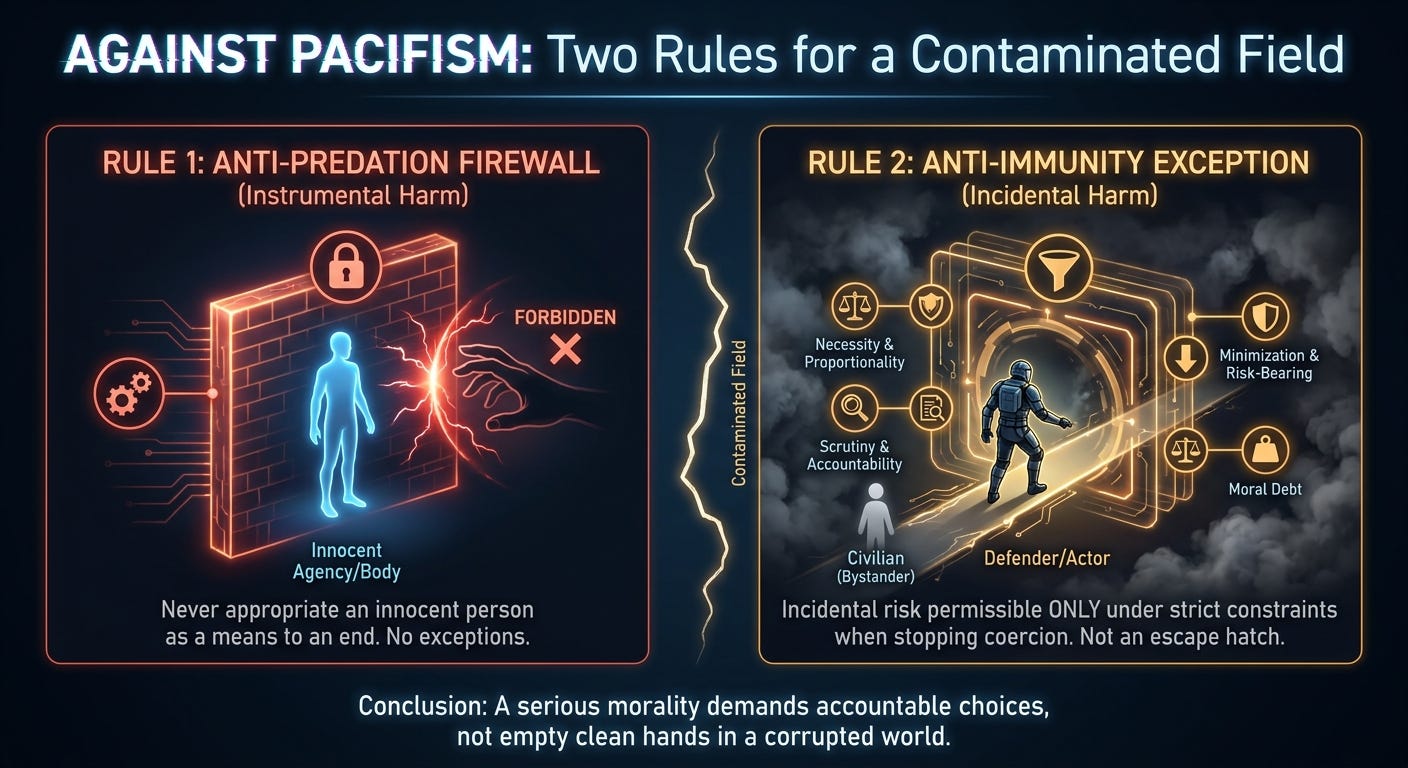
In one segment of a recent discussion, Sam Harris made an argument about the war in Gaza that is easy to caricature and difficult to escape. Stripped of the particulars, his point was roughly this: if the foreseeable deaths of innocent civilians make military action categorically impermissible, then some wars become impossible to fight precisely because the enemy is willing to endanger civilians.
Put more brutally: sometimes innocent children will die because morally serious people choose to act.
That sentence should be disturbing. Any moral system in which it is not disturbing has lost something essential. It can also be true.
Pacifism offers an apparent escape. Its strongest form does not claim that refusing violence will prevent violence. The pacifist may understand perfectly well that an aggressor will continue killing if no one forcibly stops him. The claim is instead about participation: whatever another person chooses to do, I am not morally entitled to become a killer myself.
That is a serious moral position. It recognizes something crude consequentialism often misses: morality concerns not only which world we prefer, but what we may permissibly do to other people in order to produce it. Human beings are not interchangeable quantities in an optimization problem, and another person’s need does not automatically create a claim against your body, liberty, or life.
Pacifism also need not mean passivity. Nonviolent resistance can be active, strategic, disruptive, and courageous. Strikes, blockades, sabotage, civil disobedience, mass refusal, economic pressure, and organized noncooperation can sometimes defeat coercion without killing anyone. When such methods have a credible prospect of success, that fact counts heavily against using violence.
The argument against pacifism begins with the residual cases: situations in which grave aggression is occurring, nonviolent means are unavailable or inadequate, and force is the only realistic means of stopping it. Under those conditions, a categorical refusal to use violence can itself become morally indefensible. What follows is an argument against absolute pacifism, not against the strategic preference for nonviolent means, which the rest of the argument treats as a real constraint on when force may be used at all.
The contaminated field
Suppose an attacker is murdering people in front of you. You possess a weapon and can stop him, but only by killing him. No nonviolent alternative is available, and you know with high confidence that if you refuse, he will continue killing.
The committed pacifist may still refuse. The attacker is responsible for the murders; shooting him would make you responsible for a killing of your own. Better, on this account, to remain outside the violence than to become another participant in it.
The distinction between doing and allowing is real. If the attacker murders ten people because you refuse to intervene, you did not murder them. Moral responsibility does not transfer wholesale from the aggressor to the bystander merely because the bystander could have acted. But neither does the bystander’s agency disappear. You knew what was happening, possessed the ability to alter it, understood the likely consequences of refusal, and made a choice. The attacker remains primarily responsible for the deaths, but saying “I did not kill anyone” does not exhaust the moral accounting.
The reason is that the aggressor has already changed the available choice-set. Before he began shooting, the relevant options may have included peaceful coexistence. Afterward they do not. The choice is now between violent resistance and allowing violent aggression to continue. The aggressor has contaminated the field before anyone else acts.
Moral evaluation therefore cannot begin with the defender’s final act as though the defender had selected violence from an otherwise peaceful menu. The coercive structure that produced the choice matters. The aggressor does not merely commit a wrongful act; he constrains everyone else’s available futures. But contamination changes the available choices without transferring responsibility for the defender’s subsequent decisions. What the defender does next remains the defender’s to answer for.
Pacifism gives excessive moral significance to refusing personal participation after that contamination has already occurred. It preserves a powerful presumption against violence by turning it into lexical priority: whatever happens next, I will not kill.
But morality cannot be exclusively first-personal. Other agents exist inside the same field, and their viable futures matter too. Sometimes a refusal to use violence protects them. Sometimes it abandons them to the person already using it.
The problem of innocence
The harder case is not killing the aggressor. Most ethical systems can justify proportionate force against an active coercer. The real difficulty begins when stopping the aggressor foreseeably harms people who did nothing wrong.
This exposes a contradiction in a principle Axio has defended elsewhere. An earlier formulation treated the prohibition against coercive harm to innocents as categorical. Imposing additional risk on an innocent person for your own purposes reduced that person’s viable futures and therefore constituted coercion. Need did not create claim. Even saving several lives could not justify turning an uninvolved stranger into a resource for someone else’s ends.
In an earlier thought experiment, The Burning Hospital, five people can be rescued only by locking an innocent stranger somewhere that increases the stranger’s risk. The answer was no. You may sacrifice yourself; you may not sacrifice the stranger. The point was to erect a firewall against exactly the reasoning by which innocent people become resources for someone else’s values.
But another class of cases breaks the rule. Suppose an aggressor deliberately embeds himself among innocent civilians. If harming an innocent person is absolutely prohibited, the aggressor can manufacture immunity simply by ensuring that every route to stopping him passes through someone innocent.
The stronger our commitment to innocence, the more valuable innocent people become as defensive infrastructure.
A later essay argued that innocence must therefore be a defeasible constraint rather than an absolute veto, and left the resulting inconsistency standing rather than papering over it. That is the debt this argument is meant to pay. The two positions cannot both stand without qualification, and the original invariant needs greater resolution.
Instrumental harm and incidental harm
The relevant distinction is not simply whether our action worsens an innocent person’s prospects. It is also the role that worsening plays in our action.
Consider the Burning Hospital. You lock the stranger in the room because constraining him is part of the mechanism by which you save your friends. His loss of agency is being deliberately appropriated for your purpose, and if he could remain entirely unconstrained while everything else stayed the same, your plan would fail. The stranger is being used as a means.
Now consider a defensive strike against an attacking force deliberately positioned beside civilians. The civilians’ deaths may be foreseeable, perhaps even highly probable, and that fact weighs heavily against the strike. But their injury is not what makes the defensive action work. If every civilian could instantaneously be transported to safety while everything else remained unchanged, the defender would prefer it and the military objective would still be achieved. The civilians are not being used as a means. Their exposure is an unwanted consequence of stopping an aggressor who created or exploited the contaminated field.
That distinction resembles the traditional doctrine of double effect, but it does not provide a moral escape hatch. “Incidental” describes the role the harm plays in the action, not the harm’s moral importance.
Foreseeability remains morally chargeable even when harm is not intended. If an army knowingly chooses an attack that has a ninety-percent probability of killing fifty civilians, it cannot wash away those deaths by observing that they were not the target. The expected harm formed part of the decision. Nor does increasing probability somehow convert foresight into intention: a side effect can remain unintended even when it is nearly certain. Probability affects the burden of justification, not the conceptual distinction between intended and incidental harm. As the probability and magnitude of civilian harm rise, the burden of justification must rise with them. An action that predictably kills many innocents to achieve a minor objective can be grossly wrongful even if every civilian death is technically incidental.
The distinction therefore supports two different rules.
No innocent agent may be intentionally harmed, constrained, or exposed to additional risk as a means to another agent’s ends.
That prohibition can remain hard. Need does not create claim. Five lives do not entitle you to turn a sixth person into equipment for saving them.
A second rule governs contaminated fields:
Foreseeable incidental harm to innocents may be permissible only when no materially less harmful feasible means can adequately stop the active coercion, and the remaining harm is necessary, proportionate, minimized, and never treated as part of the means.
This rule is defeasible because making it absolute would allow aggressors to manufacture immunity by arranging innocent exposure around themselves.
The two cases are structurally different. In the Burning Hospital, you appropriate the stranger’s agency to solve your problem. In the human-shield case, the aggressor has already created the problem, and your defensive action cannot solve it without exposing an innocent person to risk.
The permission to act does not arise merely because your preferred outcome is better. It arises from an active coercer’s violation of agency boundaries. The innocent person’s presence constrains how you may resist that coercion without necessarily extinguishing the permission to resist. That is a much narrower exception than “greater good” consequentialism, which would authorize harming innocents whenever enough utility appeared on the other side of the ledger. This applies only to counter-coercion inside a field already contaminated by aggression.
Innocence remains a constraint
The distinction would be worthless if “incidental” became a verbal laundering device. An army could describe virtually any civilian death as incidental while choosing tactics that make such deaths routine.
So innocence must continue to exert actual force on the decision. A legitimate objective is required. The threat must be real. The proposed action must materially contribute to stopping it. Less harmful alternatives must be unavailable, ineffective, or materially worse. Expected civilian harm must remain proportionate to the defensive objective. The probability of success matters, uncertainty matters, and precautions matter.
Necessity must also mean necessity. It cannot quietly expand to mean cheaper, quicker, politically useful, emotionally satisfying, tactically convenient, or somewhat safer for the attacking force. Once foreseeable harm to innocents becomes permissible in principle, institutions acquire an enormous incentive to redescribe preferences as necessities.
This is the danger that makes absolute rules attractive. Absolute rules are difficult to game internally because they eliminate discretion, but precisely because they eliminate discretion, they can be gamed externally by adversaries.
A viable ethic therefore has to survive both forms of adversarial pressure. It must resist the defender who wants to loosen every constraint in the name of necessity, and the aggressor who wants to exploit every constraint in order to acquire immunity. Neither side gets to determine the rule merely by being willing to abuse it.
Who should bear the risk?
Necessity and proportionality also require asking who is being protected from risk.
Modern military technology often permits a defender to reduce danger to its own forces by increasing danger to civilians. A bomb dropped from altitude may expose pilots to less risk than soldiers entering a building. Artillery may be safer for the attacking force than close combat. Standoff weapons can move danger away from combatants and toward everyone near the target.
Force protection is morally relevant. A state does not acquire unlimited claims on the lives of its soldiers merely because they wear uniforms, and military personnel remain persons rather than expendable resources. But neither does protecting one’s own forces justify transferring any amount of additional risk onto innocent civilians. Combatants have voluntarily or institutionally assumed a role that includes exposure to military danger. Civilians have not.
There will therefore be cases in which a military force is morally required to accept greater risk to its own personnel in order to reduce a substantially greater risk imposed on innocent people. How much greater risk depends on the objective, available alternatives, expected casualties, and probabilities involved; there is no universal exchange rate.
This follows from the same principle governing the rest of the argument. Civilian harm cannot be treated as incidental in the sense of negligible. If a tactic is chosen primarily because it protects one’s own forces by shifting foreseeable danger onto innocents, that transfer itself belongs inside the proportionality analysis.
A defender need not fight suicidally. But neither may it treat the safety of its own combatants as lexically prior to the lives of civilians.
Who decides what is necessary?
The hardest problem is not formulating the constraint. It is preventing the people who want to use force from interpreting the constraint in their own favor.
“Necessary,” “proportionate,” and “incidental” are judgments, not physical measurements. An army may sincerely believe that a target justifies substantial civilian risk. Its critics may sincerely believe the same attack is reckless. Both may possess incomplete information, while the institution conducting the attack has additional incentives to exaggerate necessity and discount harms borne by outsiders.
No ethical vocabulary can eliminate that problem. The answer must partly be institutional.
The severity of expected harm should determine the burden of authorization and review. Operations expected to impose substantial risk on innocents should require stronger evidence, narrower discretion, more independent scrutiny, and more complete records than ordinary defensive actions. Where advance review is impossible, retrospective review becomes more important rather than less.
The institution proposing force should not be the sole judge of whether its own conduct satisfied the standard. Targeting assumptions should be auditable. Predictions should be compared with outcomes. Repeated underestimation of civilian harm should change future thresholds. Reckless disregard, falsified intelligence, and systematic manipulation of proportionality estimates should carry personal and institutional consequences.
None of these mechanisms escapes the adversarial problem. Military courts can protect their own institutions. Independent reviewers can be captured or politicized. International bodies can be biased, ignored, or selectively obeyed. Powerful states may reject judgments they dislike. There is no final auditor standing outside politics with privileged access to moral truth.
That does not make review pointless. The purpose is not to manufacture infallibility. It is to create competing centers of judgment, preserve evidence, expose claims to challenge, and increase the cost of self-serving error.
There is also a difference between unavoidable uncertainty and unaccountable discretion. War remains epistemically hostile. Intelligence is incomplete, probabilities are uncertain, information may arrive too late, and reasonable observers can disagree. Those facts justify humility, not immunity from scrutiny.
A viable ethics of force therefore needs error-correction mechanisms built around the predictable tendency of decision-makers to interpret ambiguous standards in their own favor. The same framework that permits necessary violence must make it difficult to convert necessity into a ritual incantation that excuses whatever the state already wanted to do. The problem cannot be solved by returning to an absolute prohibition, which merely transfers the exploit from the defender to the aggressor. It can only be managed by forcing claims of necessity to survive procedures designed to challenge them.
Gaza and the failure of shortcuts
This is why the Gaza war produces such morally confused argument.
Several propositions can simultaneously be true. Hamas can be morally monstrous. Israel can possess a legitimate right to destroy an organization actively committed to attacking it. Hamas can deliberately operate in ways that increase the danger to Palestinian civilians. Israel can face military problems for which no casualty-free solution exists. And Israel can nevertheless conduct particular attacks or adopt particular policies that impose unjustifiable harm on innocent Palestinians. None of those claims contradicts the others.
The death of an innocent child does not by itself demonstrate that the action causing the death was wrongful. If it did, embedding military assets among children would produce moral immunity. But the wickedness of Hamas does not demonstrate that a particular Israeli action was justified either. The moral character of the enemy cannot substitute for necessity, proportionality, discrimination, or examination of alternatives.
Intentions matter without settling the matter. Deliberately murdering a child because the child’s death is your objective is morally different from striking a legitimate military target while foreseeing a risk to a nearby child. But foreseeable harm still counts. If killing one minor combatant requires destroying a building containing fifty families, saying that the families were not the target does not answer whether the strike was justified.
The questions remain concrete. What coercive threat was being stopped? How important was the target? How likely was the action to succeed? What harm was expected? What alternatives existed? Could substantially more risk or cost reasonably have been borne by the defender to protect the innocent? Was delay possible? How reliable was the intelligence?
There is no casualty number that answers those questions automatically, and no declaration of righteous intention that makes them unnecessary.
War offers damaged choices. Sometimes the least wrongful available trajectory still contains dead children.
Why pacifism remains tempting
Pacifism avoids many of these problems by refusing the first step. Never participate in killing and one need never decide how much killing is too much, whether the intelligence is reliable enough, whether the target is important enough, or whether necessity has quietly become convenience.
There is wisdom in that refusal. Human beings are exceptionally talented at rationalizing violence. States develop euphemisms. Institutions normalize exceptional measures. Enemies become categories rather than people. Each precedent shifts the next decision slightly, until yesterday’s emergency becomes tomorrow’s doctrine. The aversion to killing is therefore not merely sentimental squeamishness. It is an epistemic defense against predictable defects in human judgment.
Pacifism also deserves credit for insisting that violence is not the only form of effective resistance. History supplies cases in which organized nonviolence achieved political objectives that armed resistance might have failed to achieve or achieved only at vastly greater cost. A serious ethics of force should therefore require more than the claim that violence can work. Where nonviolent methods offer a credible alternative, that weighs directly against violence.
But safeguards can themselves fail under adversarial conditions. If I know that you will never use force against me while I am harming someone else, your pacifism changes my incentives. If an army knows that surrounding its operations with civilians categorically prevents attack, civilians become defensive infrastructure. If hostage-taking absolutely prohibits force, hostage-taking becomes more valuable.
This does not justify ignoring hostages or civilians. Their presence should dramatically increase the cost and burden of intervention. It should alter tactics, delay action where possible, and require greater willingness to accept risk on the defender’s side. But it cannot always make intervention impossible.
An ethical constraint should protect innocent people without making their exploitation strategically decisive. Absolute pacifism cannot guarantee that.
Moral debt
Even justified harm does not become morally clean. If innocent people die as a foreseeable consequence of justified defensive action, their deaths remain genuine losses, and permission does not transform them into mere operational costs.
“Moral debt” captures this residual burden better than either guilt or innocence. Guilt suggests that the action was simply wrongful. Innocence suggests that justification erased the harm. Neither is adequate.
A defender who foreseeably harms innocents may owe explanation, restitution, investigation, institutional reform, stricter future thresholds, or some combination of these. More fundamentally, the loss has to remain inside the moral accounting. A society that becomes psychologically comfortable with killing innocent people has corrupted the constraint even if every individual action can be supplied with a formal justification.
Moral debt also supplies an epistemic test. Actors who regard civilian deaths as genuinely tragic should behave differently from actors who merely describe them that way. They should investigate avoidable failures, revise procedures, compensate victims where appropriate, punish recklessness, and learn from systematic forecasting errors. A regime that repeatedly claims tragic necessity while refusing every mechanism of correction gives us reason to doubt the tragedy and the necessity alike.
The willingness to carry moral debt is therefore part of what distinguishes genuine tragic necessity from moral laundering.
Sometimes you act because every defensible alternative is worse. You should still wish the world had not forced the choice upon you.
There are no clean hands
Pacifism promises one thing that ethics cannot always deliver: non-complicity.
I did not shoot. I did not bomb. I did not kill.
Those statements may be morally important. They are not always sufficient.
When aggression has already contaminated the field, refusing violence is itself one of the available choices shaping what happens next. It may be the right choice. It may save innocent lives. It may prevent an unjustified escalation. Or it may leave other innocent people exposed to someone whose violence could have been stopped.
The mistake is not caring too much about the prohibition against killing. We should care enormously. The mistake is giving that prohibition infinite weight.
The contradiction might therefore be resolved with two boundaries rather than one undifferentiated rule.
Never appropriate an innocent person’s body, agency, or exposure to harm as an instrument for your ends.
That is the anti-predation firewall.
When active coercion has already contaminated the field, incidental risk to innocents may be imposed only when no materially less harmful feasible means can adequately stop it, under heightened duties of minimization, risk-bearing, scrutiny, accountability, and moral debt.
That is the anti-immunity exception.
The first rule prevents us from sacrificing strangers whenever doing so seems useful. The second prevents aggressors from acquiring immunity by forcing innocents into every defensive path. The requirement to bear some additional risk prevents defenders from treating civilian lives as substitutes for the safety of their own forces. The institutional constraints make claims of necessity contestable rather than self-certifying.
None of this eliminates tragedy. No ethical architecture can.
Sometimes refusing violence is morally required. Sometimes using violence is morally required. And sometimes the only justified means of stopping wrongful violence foreseeably places innocent people in danger.
A serious morality cannot promise clean hands in a contaminated world. It can demand that we never dirty them cheaply, casually, or without accounting for what we have done.
Postscript
Innocence Is Not Armor left a contradiction standing. The two rules above were an attempt to discharge it, and I no longer think they do.
The instrumental/incidental distinction tracks something real about how harm figures in an action, but I cannot currently defend it as a categorical moral discontinuity rather than a difference in the weight of justification required. The contaminated field is also doing more work than it can bear. Natural catastrophes create tragic choice structures without any aggressor, so adversarial contamination cannot be what licenses harm to innocents, and an aggressor’s presence does not by itself license it either.
What survives is the argument against absolute pacifism, which does not depend on either distinction. It rests instead on a simpler claim: a constraint that cannot be violated under any circumstances hands a decisive advantage to anyone willing to arrange those circumstances.
What remains open is harder than it looked. Constraints on harming innocents should not become finite quantities that sufficient benefit can outweigh, since a constraint priced in units of gain is a constraint an adversary can afford. But real cases arise in which no available course of action satisfies every such constraint. When protected constraints cannot all be satisfied at once, what principled rule resolves the conflict without converting them into commensurable values?
I do not have that rule. The debt is still outstanding.